

What You'll Learn
- What happens when you invest $10,000 in VOO vs VFIAX vs 5 individual stocks
- How a 0.01% fee difference compounds over 10 years
- The key difference: an index fund is a strategy, not a product type
- ETF vs mutual fund: trading, minimums, fees, and tax efficiency
- When each investment vehicle makes the most sense
A Real Example: $10,000 Three Ways
$10,000 in VOO (ETF): $9,970 goes to work after $30 in fees. Same index in an active mutual fund: $9,850 after $150 in fees. Over 30 years, that fee gap costs you tens of thousands.
You have $10,000 to invest. Here are three paths — each teaches something different about how investment vehicles work.
Path 1 — Buy VOO (S&P 500 ETF). VOO is Vanguard's S&P 500 ETF with a 0.03% expense ratio. You buy shares on the exchange just like a stock. On $10,000, you pay $3 per year in fees. You can buy or sell any time the market is open. No minimum investment beyond the price of one share (or a fractional share).
Path 2 — Buy VFIAX (S&P 500 Mutual Fund). VFIAX is Vanguard's S&P 500 mutual fund with a 0.04% expense ratio. It tracks the same index as VOO. On $10,000, you pay $4 per year in fees. You can only buy or sell at the end-of-day price. Minimum investment: $3,000.
Path 3 — Pick 5 individual stocks. You select Apple, Microsoft, Amazon, JPMorgan, and Johnson & Johnson. No expense ratio — but you carry concentration risk (only 5 companies instead of 500) and need to research and manage each position yourself.
All three paths give you exposure to large U.S. companies. But the mechanics, costs, and risks are different. Over 10 years, assuming 8% average annual returns (illustrative only — past performance does not guarantee future results), here's what fees alone cost you.
Key Insight
An index fund is a strategy (track an index passively), not a product type. VOO is an index fund structured as an ETF. VFIAX is an index fund structured as a mutual fund. Same strategy, different wrapper.
| Feature | VOO (S&P 500 ETF) | VFIAX (S&P 500 Mutual Fund) | 5 Individual Stocks |
|---|---|---|---|
| Expense ratio | 0.03% | 0.04% | 0% (no fund fee) |
| Annual fee on $10,000 | $3 | $4 | $0 |
| 10-year fee cost (est.) | ~$43 | ~$57 | $0 |
| Diversification | 500 companies | 500 companies | 5 companies |
| Minimum investment | Price of 1 share (~$480) | $3,000 | Varies by stock |
| Trading | Anytime during market hours | End of day only | Anytime during market hours |
| Tax efficiency | Generally more tax-efficient | May distribute capital gains | You control when to sell |
What Is an ETF?
An exchange-traded fund (ETF) is a pooled investment that holds a collection of assets — stocks, bonds, or commodities — and trades on a stock exchange just like an individual stock. When you buy one share of an ETF, you own a small piece of everything in that fund.
ETFs were introduced in 1993 with the launch of the SPDR S&P 500 ETF (ticker: SPY). Since then, over 3,000 ETFs have been created covering virtually every corner of the financial markets, with global ETF assets exceeding $10 trillion.
Most ETFs are passively managed — they track a specific index (like the S&P 500) rather than trying to outperform it. A fund manager's job is simply to hold the same securities in the same proportions as the index. This passive approach keeps fees low — some broad market ETFs charge just 0.03% per year.
ETFs trade throughout the day at market prices, just like individual stocks. This is one of their key differences from mutual funds, which only trade once per day. ETF prices fluctuate in real time based on supply and demand and the value of the underlying assets.
ETF vs. Mutual Fund vs. Index Fund: The Full Comparison
These three terms cause more confusion than almost anything else in investing. Here's the clarity you need.
A mutual fund is a pooled investment where you buy shares directly from the fund company (not on an exchange). Shares are priced once per day after the market closes.
Many mutual funds are actively managed — a portfolio manager picks stocks trying to outperform a benchmark. Active management typically costs more (0.50-1.00%+ in fees).
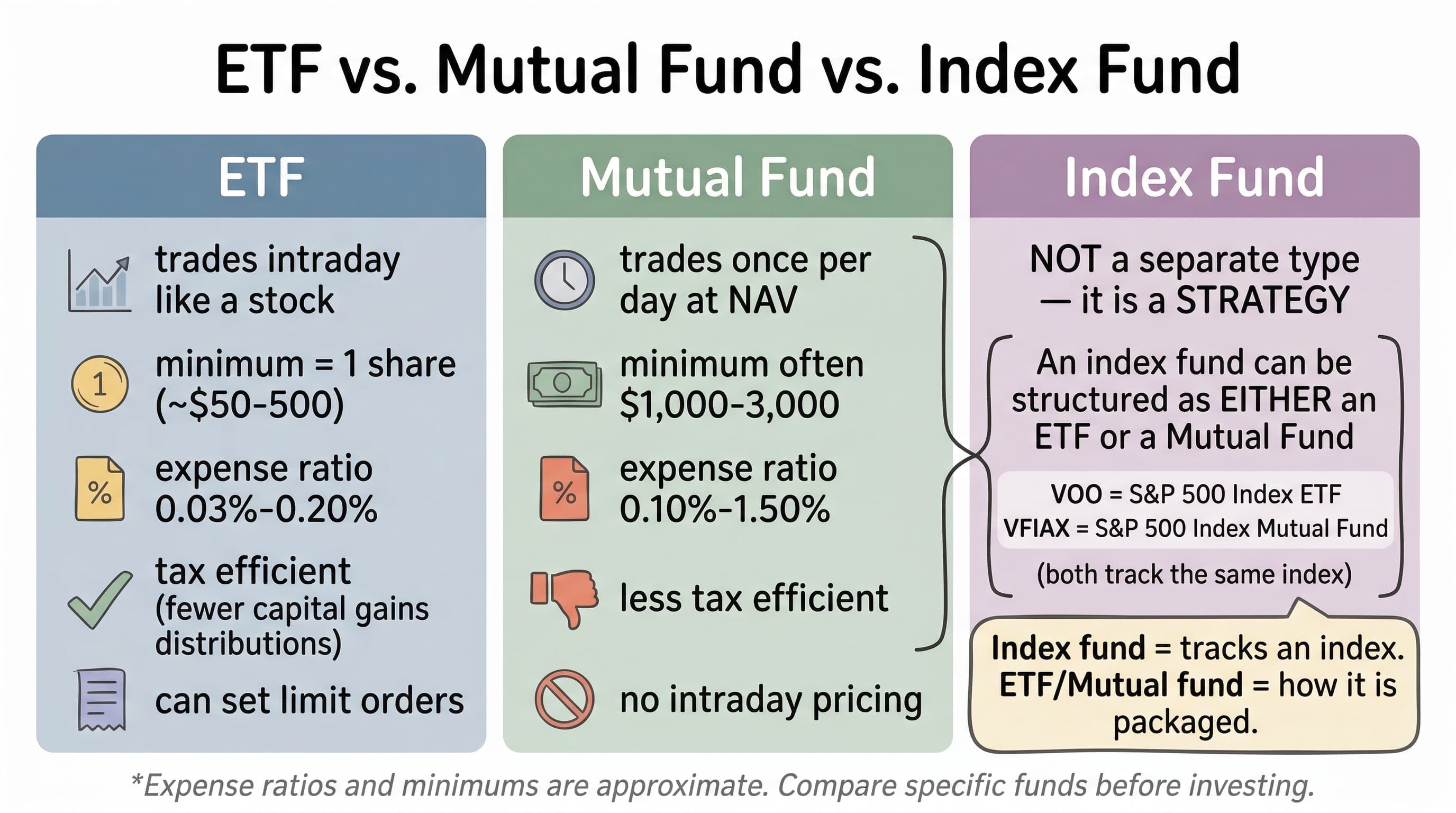
An index fund is a strategy, not a product category. It means "track a market index passively." An index fund can be structured as either an ETF or a mutual fund. VOO (ETF) and VFIAX (mutual fund) both track the S&P 500 — they're both index funds, just in different wrappers.
An ETF is a structure — it defines how you buy and sell the fund (on an exchange, throughout the day, at market prices). Most ETFs are index funds, but actively managed ETFs also exist.
The visual below shows how these three concepts relate to each other, followed by the full comparison table.
| Feature | ETF | Mutual Fund | Index Fund (Strategy) |
|---|---|---|---|
| What it is | A fund that trades on an exchange | A fund you buy from the fund company | A strategy: track an index passively |
| Trading | Throughout the day at market prices | Once per day after market close | Depends on structure (ETF or mutual fund) |
| Minimum investment | Price of one share (or fractional) | Often $1,000–$3,000 | Varies by structure |
| Typical expense ratio | 0.03%–0.20% (passive); higher for active | 0.50%–1.00%+ (active); 0.04%+ (passive) | 0.03%–0.10% regardless of structure |
| Tax efficiency | Generally more tax-efficient | May distribute capital gains annually | Depends on structure |
| Management | Mostly passive, some active | Often actively managed | Always passive by definition |
| Fractional shares | Available at most brokerages | Built-in (invest any dollar amount) | Depends on structure |
Types of ETFs
The ETF universe extends far beyond simple stock index funds. Here are the main categories.
Stock (Equity) ETFs are the most popular. They hold baskets of stocks and may track broad indexes (S&P 500, total stock market), specific market caps (large-cap, small-cap), or investment styles (growth, value).
Bond (Fixed Income) ETFs hold government, corporate, or municipal bonds. They provide bond market exposure without the complexity of buying individual bonds.
Sector ETFs focus on specific industries — technology, healthcare, energy, financials. They allow targeted exposure to parts of the economy you want to emphasize.
International ETFs provide access to markets outside the U.S. — developed markets (Europe, Japan), emerging markets (China, India, Brazil), or specific regions.
Commodity ETFs track prices of gold, silver, oil, or agricultural products.
Thematic ETFs focus on trends like clean energy, artificial intelligence, or cybersecurity. These are narrower and more concentrated than broad market ETFs.
3,000+
ETFs Available
In U.S. markets
$10T+
Global ETF Assets
As of 2025
0.03%
Lowest Expense Ratio
Broad market ETFs
1993
First U.S. ETF
SPY launched
| ETF Type | What It Holds | Example Use |
|---|---|---|
| Stock (Equity) | Baskets of stocks (broad or targeted) | Core portfolio holding |
| Bond (Fixed Income) | Government, corporate, or municipal bonds | Income and stability |
| Sector/Industry | Stocks within a specific sector | Targeted sector exposure |
| International | Stocks or bonds from non-domestic markets | Geographic diversification |
| Commodity | Physical commodities or futures contracts | Inflation hedge or commodity exposure |
| Thematic | Stocks related to a specific trend | Exposure to emerging themes |
ETF Costs and Why They Matter
The primary cost of owning an ETF is its expense ratio — an annual fee expressed as a percentage of your investment. It's deducted automatically from the fund's assets.
Broad market index ETFs from major providers often charge below 0.10%, with some as low as 0.03%. Specialty, thematic, or actively managed ETFs can charge 0.50% to 1.00% or more.
A 0.03% expense ratio on $10,000 costs you $3 per year. A 0.50% ratio costs $50. That $47 difference might seem small, but over 30 years with compounding, it can grow to thousands of dollars. Fees are the one variable you can control completely — and they matter most over long time horizons.
Beyond the expense ratio, watch for the bid-ask spread (the difference between buy and sell prices — tighter for popular ETFs, wider for niche ones) and tracking error (how closely the ETF matches its index). Most major ETFs have minimal tracking error and tight spreads.
Advantages and Disadvantages of ETFs
ETFs have become the default investment vehicle for many investors, but they're not perfect for every situation.
Advantages:
Diversification — A single ETF can hold hundreds or thousands of securities. Buying VOO gives you exposure to 500 companies in one purchase. For more on this concept, see the diversification guide.
Low costs — Many broad market ETFs charge under 0.10%, making them among the most cost-effective investments available.
Tax efficiency — The creation/redemption mechanism minimizes capital gains distributions compared to mutual funds. This matters most in taxable accounts.
Transparency — Most ETFs publish holdings daily, so you know exactly what you own.
Disadvantages:
Temptation to overtrade — Because ETFs trade all day, some investors buy and sell too frequently, incurring unnecessary costs.
Not all ETFs are diversified — A thematic "AI ETF" might hold just 30 stocks in one industry. The diversification benefit depends on what the ETF actually holds.
Niche products carry hidden risks — Leveraged, inverse, and complex derivative-based ETFs can behave very differently than expected over longer holding periods.
No guaranteed returns — Like all market investments, ETFs can lose value. Diversification reduces but does not eliminate risk.
| Advantages | Disadvantages |
|---|---|
| Broad diversification in one purchase | Bid-ask spreads on less liquid funds |
| Low expense ratios (as low as 0.03%) | May encourage overtrading |
| Daily transparency of holdings | Tracking error can occur |
| Tax-efficient structure | Niche products can be complex |
| Intraday trading flexibility | No guaranteed returns |
Key Considerations
ETFs, mutual funds, and index funds are not competitors — they overlap. Choosing between them depends on your situation.
Expense ratios compound over decades. A 0.03% expense ratio vs. 0.50% doesn't sound like much, but over 30 years on a $100,000 investment, the difference can be tens of thousands of dollars. Low-cost broad market ETFs are among the most cost-efficient investments available.
An index fund is a strategy, not a product. When someone says "just buy an index fund," they mean track a broad market index passively. You can do this through an ETF (like VOO) or a mutual fund (like VFIAX). Same strategy, different mechanics.
ETFs have an edge in taxable accounts. Their creation/redemption mechanism minimizes capital gains distributions. In tax-advantaged accounts (IRA, 401k), this advantage disappears, and mutual funds work just as well.
Not all ETFs are diversified. Sector ETFs, thematic ETFs, and leveraged ETFs can be highly concentrated. An "AI ETF" might hold just 30 stocks, all in one industry. Check what's actually inside before assuming diversification.
Related Guides
Continue Your Learning
Related Terms
Key Takeaways
An index fund is a strategy, not a product
An index fund simply tracks a market index. It can be structured as either an ETF or a mutual fund. The strategy is passive investing — the wrapper determines how you buy and sell it.
Tiny fee differences compound into real money
VOO (0.03% expense ratio) vs. VFIAX (0.04%) seems trivial, but over 10 years on $10,000, even small differences compound. Over 30 years, the gap grows to thousands of dollars.
ETFs trade like stocks; mutual funds trade once daily
ETFs can be bought and sold throughout the trading day at market prices. Mutual funds are priced once per day after the market closes. This affects flexibility but also the temptation to overtrade.
Tax efficiency gives ETFs an edge in taxable accounts
ETFs' creation/redemption mechanism minimizes capital gains distributions, making them generally more tax-efficient than mutual funds in taxable brokerage accounts.
Frequently Asked Questions
An ETF trades on a stock exchange throughout the day at market prices, like a stock. A mutual fund is bought and sold directly from the fund company at the end-of-day price. ETFs generally have lower expense ratios, are more tax-efficient, and have no minimum investment beyond one share. Mutual funds can accept any dollar amount and are simpler for automatic investing.
An index fund is a strategy — it means tracking a market index passively. An ETF is a structure — it defines how you trade the fund. Most ETFs are index funds, but an index fund can also be structured as a mutual fund. VOO (ETF) and VFIAX (mutual fund) both track the S&P 500 and are both index funds.
ETFs are widely considered accessible for newer investors because they offer broad diversification at low cost. A single broad market ETF like VOO gives you exposure to 500 companies in one purchase. However, all investments carry risk, and it's important to understand what an ETF holds before investing.
Many ETFs do pay dividends. If the underlying stocks in the ETF pay dividends, the ETF collects them and distributes them to shareholders, typically quarterly. Bond ETFs distribute interest income similarly. The amount depends on the holdings within the fund.
An expense ratio is the annual percentage fee charged by a fund. A 0.03% expense ratio means you pay $3 per year per $10,000 invested. It matters because fees compound over time — a 0.50% ratio costs over 15 times more than 0.03% and directly reduces your long-term returns.
Yes. ETFs are subject to market risk. A stock ETF will decline if the underlying stock market declines. A bond ETF can lose value if interest rates rise. Diversification within an ETF reduces the impact of any single holding's poor performance but does not eliminate the possibility of losses.
Sources & References
- U.S. Securities and Exchange Commission — Exchange-Traded Funds (ETFs)
- https://www.investor.gov/introduction-investing/investing-basics/investment-products/mutual-funds-and-exchange-traded-4
- FINRA — Exchange-Traded Funds
- https://www.finra.org/investors/investing
- Investment Company Institute — 2025 ETF Fact Book