

What You'll Learn
- What happens when you buy 10 shares of Apple at $185
- Three possible outcomes: price goes up, stays flat, or drops
- What stock ownership actually means — your claim on $383 billion in revenue
- How stocks compare to bonds and savings accounts
- Two ways stocks can generate returns: price appreciation and dividends
A Real Example: Buying 10 Shares of Apple
Let's start with a concrete example so you can see exactly how stocks work.
You decide to buy 10 shares of Apple (ticker: AAPL) at $185 per share. That's $1,850 out of your bank account and into your brokerage account. You now own 10 shares of a company with roughly $383 billion in annual revenue, over 160,000 employees, and products used by more than a billion people worldwide.
One year passes. Here are three possible scenarios — and each one teaches something different about how stocks work.
Scenario A — Apple rises to $220. Your 10 shares are now worth $2,200. That's a $350 gain, or roughly 19% on your original $1,850. This is called capital appreciation — the stock price went up.
Scenario B — Apple stays flat at $185. Your shares are still worth $1,850. But Apple paid dividends during the year — about $1.00 per share, totaling $10. You didn't lose money, and you earned a small income stream just for holding the stock.
Scenario C — Apple drops to $150. Your 10 shares are now worth $1,500. That's a $350 loss, or roughly -19%. This is the risk side of stocks — prices can go down, and you can lose money.
All three scenarios are realistic in any given year. The stock market does not promise returns. Understanding these outcomes before you invest is what separates informed investors from those who panic at the first dip.
Key Concept
Every stock purchase has three possible outcomes: the price goes up (gain), stays flat (possible dividend income), or goes down (loss). Understanding all three before investing is the first step.
| Scenario | Apple Share Price (1 Year Later) | Value of 10 Shares | Gain/Loss | Return |
|---|---|---|---|---|
| A — Price rises | $220 | $2,200 | +$350 | +19% |
| B — Price flat + dividends | $185 | $1,850 + $10 dividends | +$10 | +0.5% |
| C — Price drops | $150 | $1,500 | -$350 | -19% |
What Stock Ownership Actually Means
When you buy a stock, you are not just buying a ticker symbol on a screen. You are buying real ownership in a real company.
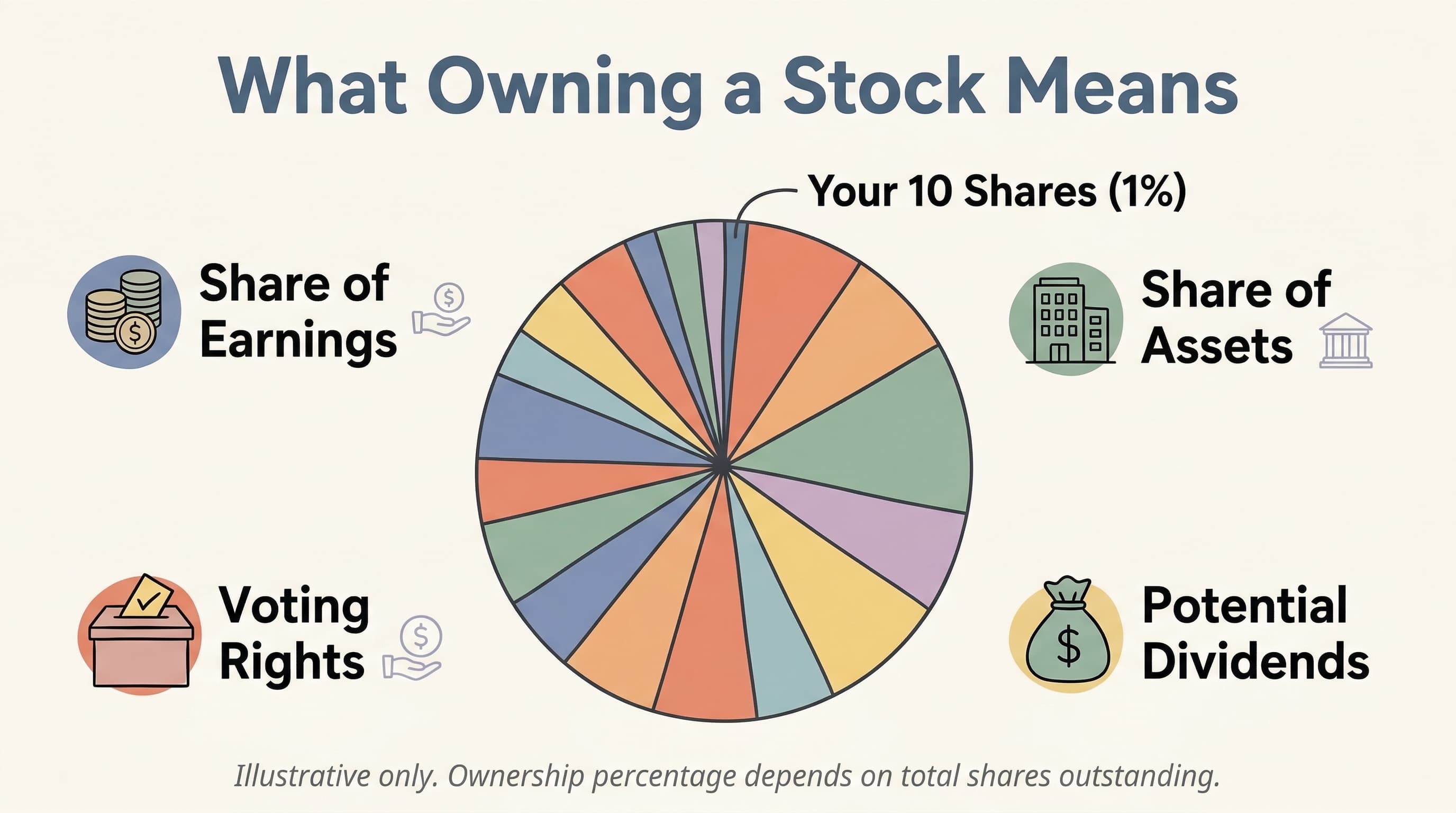
A stock — also called a share or equity — represents a unit of ownership. If Apple has roughly 15.2 billion shares outstanding and you own 10 of them, your ownership percentage is tiny — but it is real. You have a proportional claim on Apple's assets, earnings, and voting rights.
Here's what that means in practice. Apple generates over $383 billion in annual revenue.
It holds over $160 billion in cash and investments. It owns intellectual property behind the iPhone, Mac, iPad, and services ecosystem.
As a shareholder, you have a proportional claim on all of it. You also get to vote on major corporate decisions — like electing board members — at the annual shareholder meeting.
The infographic below illustrates what stock ownership represents — from your proportional claim on earnings and assets to voting rights and potential dividends.
How Stocks Work: From IPO to Your Account
Companies issue stock to raise money. Instead of borrowing from a bank, a company sells ownership stakes to the public through an initial public offering (IPO). The money raised helps the company grow, fund research, expand operations, or pay down debt.
After the IPO, shares trade on the secondary market — exchanges like the New York Stock Exchange (NYSE) or Nasdaq — where investors buy and sell among themselves. The company doesn't receive money from these trades; it's investors trading ownership back and forth.
Stock prices change throughout the trading day based on supply and demand. If more people want to buy a stock than sell it, the price rises.
If more want to sell, the price falls. These price movements are driven by company earnings, economic conditions, industry trends, and investor sentiment.
You can learn more in How Stock Prices Move.
When you place an order through your brokerage account, it's routed to an exchange or market maker that matches buyers with sellers. Trades typically settle within one business day (T+1). The entire process — from clicking "buy" to owning shares — usually takes less than a second for liquid stocks like Apple or Microsoft.
For a structured introduction, see the What Is a Stock? lesson.
Stocks vs. Bonds vs. Savings Accounts
To understand what makes stocks unique, it helps to compare them against the two most common alternatives: bonds and savings accounts.
Stocks give you ownership. You participate in a company's upside — but also its downside. Returns are not guaranteed, and prices can be volatile in the short term. Historically, the broad U.S. stock market has returned roughly 7-10% annually over long periods (adjusted for inflation), though individual years vary wildly. Past performance does not guarantee future results.
Bonds are loans. When you buy a bond, you're lending money to a company or government. In return, you receive regular interest payments and your principal back at maturity. Bonds are generally less volatile than stocks but have historically produced lower average returns.
Savings accounts are the safest option — your money is FDIC-insured up to $250,000, and you earn a guaranteed interest rate. But that rate is often below inflation, meaning your purchasing power may actually decrease over time.
The table below shows how $10,000 would have performed across these three options over different time horizons, based on historical averages. These are illustrative approximations, not guarantees.
| Feature | Stocks | Bonds | Savings Account |
|---|---|---|---|
| What you own | Ownership in a company | A loan to a company or government | Cash deposit at a bank |
| Historical avg. annual return | ~7-10% (inflation-adjusted) | ~2-5% (inflation-adjusted) | ~0.5-4% (varies by era) |
| Risk level | Higher — prices can drop significantly | Moderate — interest rate and credit risk | Very low — FDIC insured |
| Volatility | High — daily swings are normal | Low to moderate | None |
| Liquidity | High — sell in seconds during market hours | Varies — some trade easily, others don't | Instant |
| Income | Dividends (not guaranteed) | Regular interest payments | Interest (guaranteed rate) |
Types of Stocks
Not all stocks are the same. Here are the most common categories you'll encounter.
Common stock is what most people mean when they say "stock." Common shareholders have voting rights and may receive dividends, though dividends aren't guaranteed. Preferred stock doesn't carry voting rights but gives holders priority for dividend payments and a higher claim on assets if the company is liquidated.
Stocks are also grouped by company size, measured by market capitalization. Large-cap stocks (over $10 billion) include established companies like Apple and Microsoft. Mid-cap stocks ($2-10 billion) are often growing companies. Small-cap stocks (under $2 billion) tend to be younger businesses with higher growth potential but also higher risk.
Another classification is by investment style. Growth stocks are companies expected to grow revenue and earnings faster than average — many tech companies fall here. Value stocks appear inexpensive relative to their fundamentals. Income stocks pay consistent dividends and are favored by investors seeking cash flow.
Finally, stocks are grouped by sector — technology, healthcare, financials, energy, consumer goods, and others. Sector classification helps investors understand how different parts of the economy may affect their holdings.
| Stock Type | Key Characteristic | Example |
|---|---|---|
| Large-Cap | Market cap over $10 billion; typically well-established | Apple, Microsoft |
| Mid-Cap | Market cap $2–10 billion; often in growth phase | Etsy, Zillow |
| Small-Cap | Market cap under $2 billion; higher growth potential, higher risk | Regional banks, startups |
| Growth | Reinvests earnings to grow faster than average | Tesla, Amazon (early years) |
| Value | Trades below perceived intrinsic value | Berkshire Hathaway |
| Income | Pays regular dividends | Coca-Cola, Procter & Gamble |
Risks of Owning Stocks
Stocks carry inherent risks that every investor should understand. Unlike savings accounts or government bonds, stocks do not guarantee returns, and it is possible to lose some or all of the money invested.
Market risk is the risk that the overall stock market declines. Even fundamentally strong companies can see their stock prices fall during a bear market or recession. In 2008, the S&P 500 fell roughly 37%. In early 2020, it dropped over 30% in about a month.
Company-specific risk is the risk that an individual company underperforms. A company might lose market share, face a lawsuit, or miss earnings expectations. When Enron collapsed in 2001, shareholders lost nearly everything.
Volatility risk means prices can swing dramatically. A stock might drop 5% on a single piece of news and recover the next week — or not recover at all. Understanding risk is essential before investing.
Inflation risk is the possibility that your returns don't keep pace with inflation, eroding your purchasing power over time.
Diversification — spreading investments across many stocks, sectors, and asset classes — is one commonly discussed approach to managing these risks. ETFs and index funds are tools some investors use to diversify efficiently.
Risk Reminder
Stocks do not guarantee returns. It is possible to lose some or all of the money invested. Past performance does not guarantee future results. Diversification may help manage risk but does not eliminate it.
Key Considerations
Stocks are the foundation of most investment portfolios, but they come with tradeoffs worth understanding.
You own a real piece of the company. When you buy Apple stock, you have a proportional claim on $383 billion in revenue, hundreds of billions in assets, and profits from over a billion devices worldwide. This is not an abstraction — it's legal ownership.
Individual stocks vs. funds is a real choice. Picking individual stocks requires research and carries concentration risk. Index funds and ETFs provide instant diversification. Most financial research suggests diversified funds outperform individual stock-picking for the majority of investors over time.
Short-term volatility is normal. Stocks can drop 10-20% in any given year and still deliver strong long-term returns. Investors who sell during downturns typically lock in losses that patient investors recover from.
Starting small is a valid approach. Fractional shares allow investing with as little as $1. The barrier to entry is lower than most people assume — the hardest part is usually the psychological commitment to begin.
Continue Your Learning
Now that you understand what a stock is and how stocks work, you have a strong foundation for exploring the rest of the financial markets.
To understand where stocks are bought and sold, read What Is the Stock Market?. To learn about pooled investments that hold hundreds of stocks at once, explore What Is an ETF?.
If you want to understand how investors measure whether a stock is expensive or inexpensive, What Is a P/E Ratio? breaks down the most commonly used valuation metric. For how some stocks pay regular cash to shareholders, read What Is a Dividend?.
For the most widely followed benchmark in the stock market, see What Is the S&P 500?. For a structured, lesson-by-lesson learning path, the Foundations course covers everything from stock basics to building a portfolio.
Remember: investing carries risk, and past performance does not guarantee future results. Education is the first step in understanding how markets work.
Related Guides
Continue Your Learning
Related Terms
Key Takeaways
Ownership is real and proportional
When you buy stock, you own a real piece of the company — including a proportional claim on its assets, earnings, and voting rights. Apple's $383 billion in revenue? You have a slice.
Three outcomes exist for every stock
Your stock can go up (capital appreciation), stay flat (but you may still earn dividends), or go down (a loss). Understanding all three scenarios before investing is essential.
Stocks outperform over decades, not days
Historically, the broad stock market has delivered higher long-term returns than bonds or savings accounts — but with significantly more short-term volatility.
You do not need thousands of dollars
Fractional shares let you invest with as little as $1. The barrier to stock ownership is lower than most people assume.
Frequently Asked Questions
When you buy a stock, you purchase ownership in a real company. For example, buying 10 shares of Apple at $185 costs $1,850. You then own a tiny fraction of Apple's assets, earnings, and voting rights. Your shares may increase in value (capital appreciation), pay you dividends (cash income), or decrease in value (a loss). All three outcomes are possible in any given year.
Many modern brokerages offer fractional shares, which means you can invest with as little as $1. You do not need to buy a full share. This has made stock investing accessible to people with small amounts of capital.
Stocks give you ownership in a company — you share in its profits and losses. Bonds are loans — you lend money to a company or government and receive interest payments. Stocks have historically produced higher long-term returns but with more volatility. Bonds are generally less risky but offer lower average returns. Past performance does not guarantee future results.
With individual stocks, yes — if a company goes bankrupt, its stock can become worthless. However, with diversified funds like index ETFs that hold hundreds of stocks, a total loss is extremely unlikely because it would require every company in the fund to fail simultaneously. Diversification reduces but does not eliminate risk.
Common stock gives shareholders voting rights and the possibility of dividends. Preferred stock typically does not include voting rights but offers priority in receiving dividends and a higher claim on assets if the company is liquidated. Most individual investors hold common stock.
No. Many companies — especially younger, high-growth firms like Tesla or Amazon in its early years — reinvest all profits back into the business instead of paying dividends. More established companies like Coca-Cola and Johnson & Johnson tend to pay regular dividends. Whether a company pays dividends depends on its financial policy and cash flow.
Sources & References
- U.S. Securities and Exchange Commission — Stocks
- https://www.investor.gov/introduction-investing/investing-basics/investment-products/stocks
- NYSE — How Listings Work
- https://www.nyse.com/listings
- FINRA — Understanding Stocks