
Market Analysis
Stock Market Today, Oct 15: Hot CPI, Chip Rout
Read Article
Market Analysis
AI-powered insights into global financial markets
 StockCram Editorial4 min read
Markets open lower as Iran tensions spike oil prices past $100 and Treasury yields hover near 19-year highs, squeezing consumers and raising recession fears.
Educational purposes only. This content does not constitute investment advice. Read our disclaimer
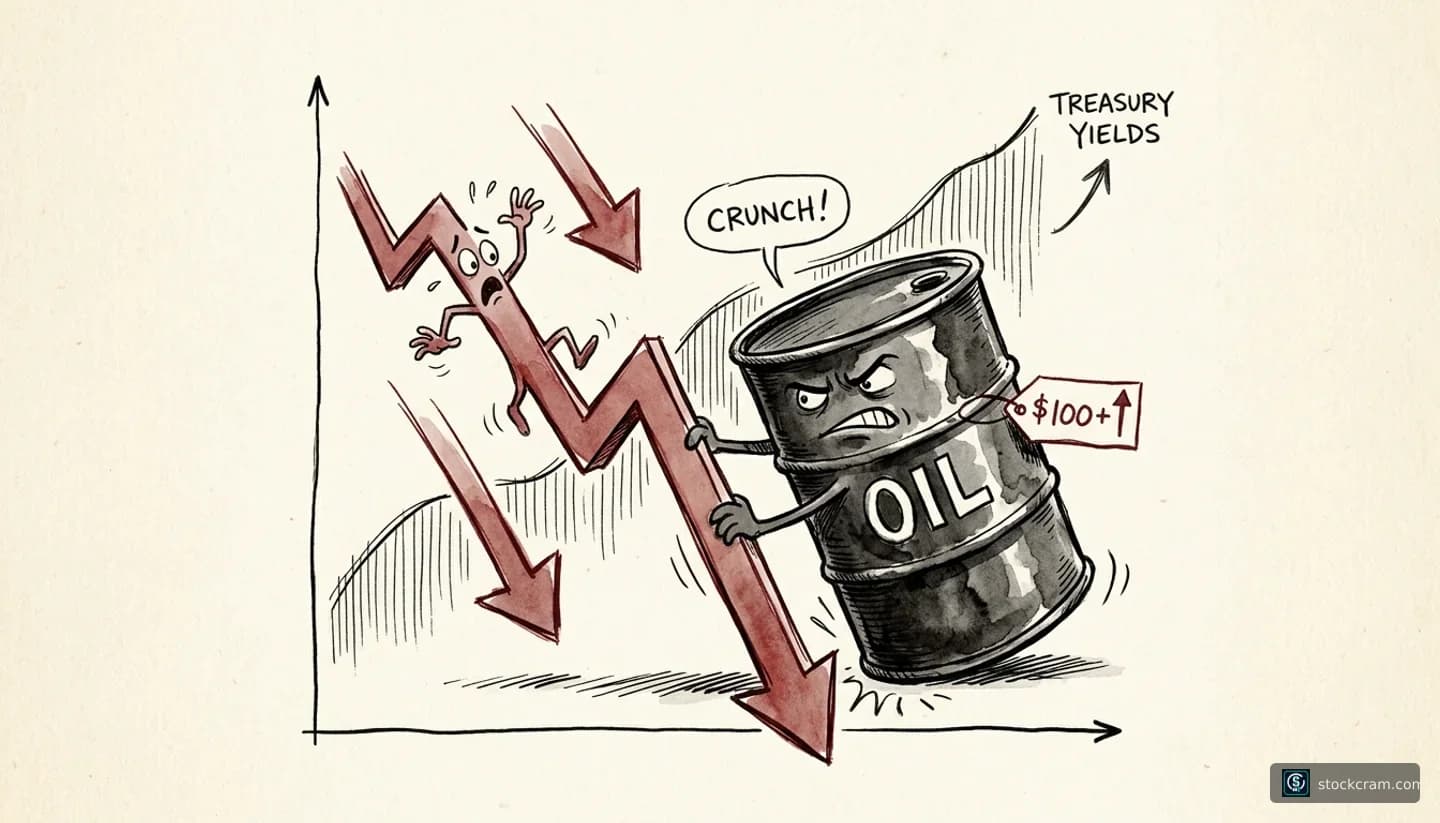
StockCram is not a broker-dealer, investment adviser, or financial institution. All content is for educational and informational purposes only and should not be construed as personalized investment advice. Consult a qualified financial professional before making investment decisions. Past performance does not guarantee future results.President Trump rejected Iran's latest proposal to reopen the Strait of Hormuz over the weekend, sparking fresh attacks on oil tankers and pushing crude prices above $100 for the first time in weeks. Brent crude jumped to $105.86 while WTI climbed to $93.20 as markets priced in prolonged supply disruptions from the Persian Gulf. The Strait of Hormuz closure continues to dominate energy markets.
The Strait of Hormuz handles 20% of global oil trade, and renewed conflict threatens to keep energy prices elevated—fueling inflation fears just as the Fed begins raising rates. Higher oil prices squeeze consumer spending power and could force the Fed to hike more aggressively than markets expect. This oil shock comes at the worst possible time for an economy already battling elevated borrowing costs.
Equities
Futures down 0.5%, energy stocks outperform
Rates
2-year yield climbs to 4.90%, 10-year near 5.2%
FX
Dollar strengthens on safe-haven demand, up 0.3%
Commodities
Brent crude up 1.1% to $105, gold rallies
The 10-year Treasury yield briefly topped 5.2% last week—its highest level since 2007—before pulling back to 5.18% on Friday. Markets now price in a 66% chance the Fed hikes again in October, with traders expecting three more quarter-point increases over the next year. Mortgage rates have climbed above 7.4%, the highest in over two years, intensifying the housing market lock-in effect.
Borrowing costs at these levels hit consumers hard: mortgages, car loans, and credit cards all get more expensive. The yield spike reflects fears that inflation won't cool without much tighter Fed policy, which raises recession risks. If yields stay elevated, housing and consumer spending could stall, creating the conditions for a hard landing rather than the soft landing many investors hope for.
Equities
Growth stocks under pressure, financials benefit
Rates
10-year at 5.18%, 30-year mortgage above 7.4%
FX
Yield surge pressures emerging market currencies
Commodities
Higher rates weigh on gold, support dollar
The University of Michigan's consumer sentiment index plunged to 48.1 in September—down 15% since January and near historic lows. Americans expect 4.6% inflation over the next year, the highest since June, as gas prices and borrowing costs squeeze household budgets. Only 8% of consumers expect their wages to outpace inflation, signaling widespread pessimism about purchasing power.
Consumer spending drives 70% of the US economy, and sentiment this weak signals trouble ahead. When households feel poorer and expect higher prices, they cut back on purchases—slowing economic growth. The sharp rise in inflation expectations could become self-fulfilling if businesses raise prices in response, creating a dangerous feedback loop that makes the Fed's job even harder.
Equities
Consumer stocks face headwinds
Rates
Inflation expectations jump to 4.6%
FX
Weak sentiment pressures risk currencies
Commodities
Reflects demand destruction fears
Microsoft announced plans to merge its consumer and workplace Copilot AI assistants into a single product aimed at corporate customers. The move, revealed at a Seattle event last week, signals the company is ceding the consumer chatbot market to OpenAI and Meta to focus on higher-margin enterprise AI. Microsoft stock gained 3.7% on Friday as investors applauded the strategic clarity.
The shift shows Big Tech is pivoting from flashy consumer AI tools to profitable business applications. Microsoft's enterprise focus could drive stronger revenue growth—the company's cloud business hit $100 billion in fiscal 2026, up 19%. Investors see this as a smart bet on workplace productivity over a crowded consumer market, especially as questions about AI valuations and returns continue to swirl.
Equities
Tech sector consolidation, Microsoft up 3.7% Friday
Rates
No direct rate implications
FX
Limited cross-border impact
Commodities
Neutral
S&P 500 futures rose 0.5% early Monday while Nasdaq futures gained 0.4%, recovering from overnight losses as traders look past geopolitical tensions. The S&P 500 fell 0.41% last Friday to 7,711 but managed a 0.6% weekly gain. This week brings a packed economic calendar: PCE inflation data Wednesday, ADP jobs Thursday, and the September jobs report Friday—all critical inputs for Fed policy.
Markets face a critical test as key inflation and jobs data could determine whether the Fed hikes once or twice more this year. Strong employment with sticky inflation would justify more rate hikes, pressuring stocks. But any signs of labor market cooling could ease Fed pressure and support equities—making this week's data releases pivotal for the rest of 2026.
Equities
S&P futures up 0.5%, Nasdaq up 0.4%
Rates
Futures imply modest Fed tightening
FX
Risk appetite tentatively returns
Commodities
Mixed signals on demand outlook
The last time the 10-year Treasury yield topped 5% was in 2007, just before the housing market collapsed and triggered the Global Financial Crisis. Back then, elevated borrowing costs combined with overextended consumers to create a perfect storm.
Markets initially shrugged off the warning signs, but within months the economy tipped into recession as high rates crushed housing and consumer spending. The S&P 500 eventually fell 57% from its 2007 peak. Today's setup is different—banks are healthier and housing isn't in a bubble—but the combination of high rates, weak sentiment, and geopolitical shocks is eerily familiar. Understanding why stocks sometimes rise despite high rates helps explain why markets haven't collapsed yet, but history suggests caution is warranted.
The biggest wild card is Middle East geopolitics—a sudden ceasefire could crash oil prices and change the inflation picture overnight, while escalation could send crude to $120. We also don't know if consumers will actually cut spending or just complain about prices. And the Fed's next move depends on data we haven't seen yet.