
Market Analysis
Stock Market Today, Oct 15: Hot CPI, Chip Rout
Read Article
Market Analysis
AI-powered insights into global financial markets
 StockCram Editorial4 min read
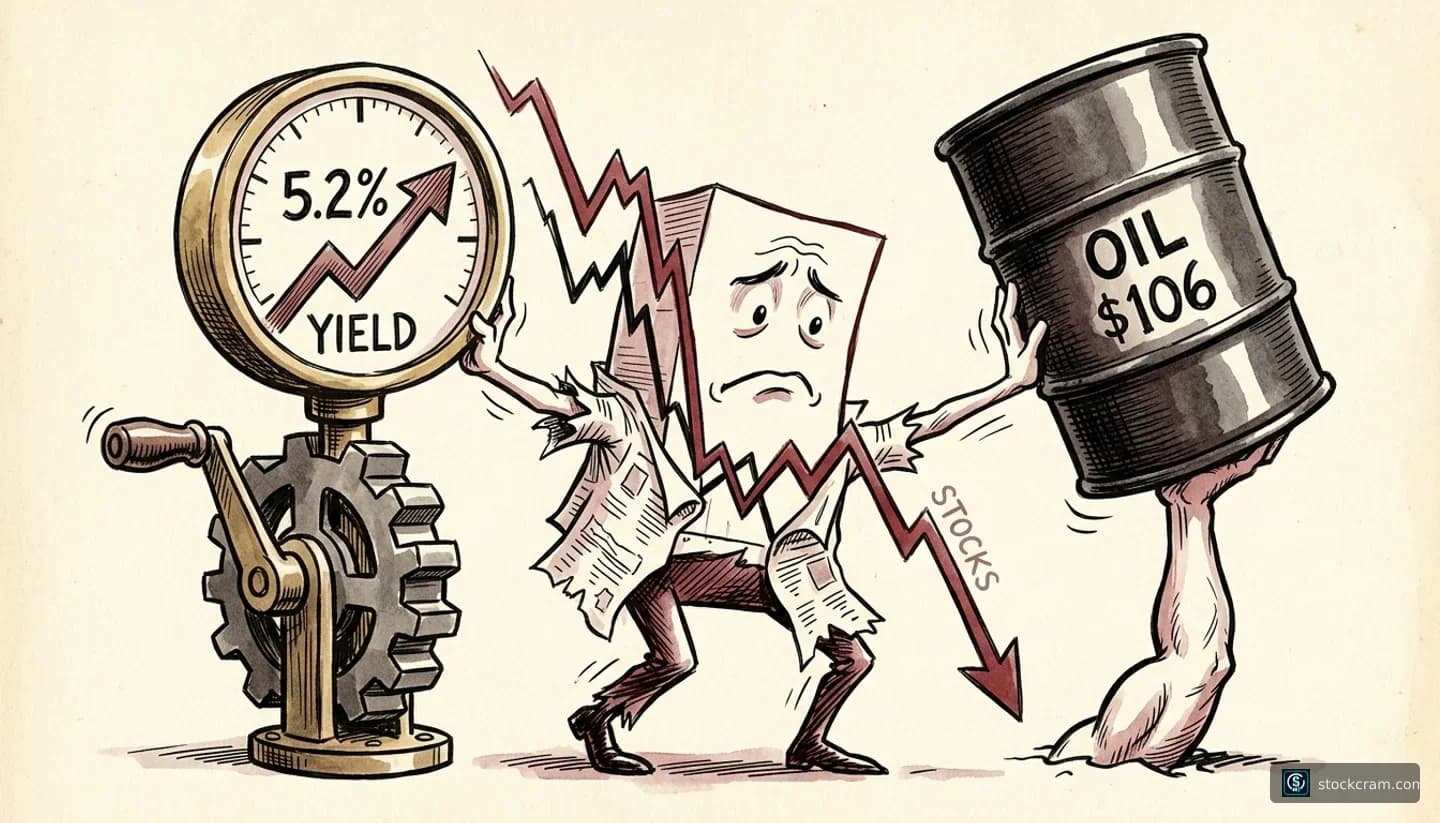
Treasury yields hit 19-year highs while oil tops $106 as Middle East tensions and Fed hawkishness squeeze markets from both sides, pressuring stocks and raising recession fears.
Educational purposes only. This content does not constitute investment advice. Read our disclaimer
StockCram is not a broker-dealer, investment adviser, or financial institution. All content is for educational and informational purposes only and should not be construed as personalized investment advice. Consult a qualified financial professional before making investment decisions. Past performance does not guarantee future results.The 30-year Treasury yield climbed to its highest level since 2004, while the benchmark 10-year yield rose eight basis points to 5.20% on Thursday. The 10-year Treasury closed near 5.11% Wednesday, its highest level since July 2007. A Treasury buyback operation failed to meet investor expectations, souring sentiment. The bond rout has persisted for days, with yields climbing as inflation concerns mount and Fed rate-hike odds increase.
Rising borrowing costs threaten to slow economic growth and weigh heavily on stock valuations, especially for high-growth tech companies. Stocks fell as Treasury yields stayed near 19-year highs and another Fed official advocated another rate hike. Higher yields make bonds more attractive relative to equities and increase the discount rate used to value future corporate earnings, explaining why high rates pressure stock prices.
Equities
Dow down 0.31%, S&P 500 nearly flat, growth stocks pressured
Rates
10-year yield at 5.20%, 30-year at highest since 2004
FX
Dollar strengthening on higher yields
Commodities
Bond selloff compounds oil-driven inflation fears
Oil prices rebounded strongly, with Brent crude jumping 2.18% to $105.33 a barrel amid ongoing U.S.-Iran tensions, as indirect talks between Washington and Tehran at the UN General Assembly yielded little progress. Earlier Thursday, Brent crude surged about 5% to a session high of $108.23 after Iran-allied Houthi militants in Yemen fired a barrage of missiles at Saudi Arabia. The Strait of Hormuz remains largely restricted, choking off Gulf oil exports and creating the kind of supply disruption that typically triggers an oil shock.
Elevated oil prices fueled inflation concerns, driving long-term Treasury yields to multi-decade highs and raising the prospect of further Federal Reserve rate hikes. Brent has gained more than 17% in September while U.S. crude is up more than 10%, threatening to reignite consumer price pressures and complicating the Fed's inflation fight. Energy costs flow directly into transportation, manufacturing, and consumer budgets, making this a critical factor in how geopolitical tensions affect markets.
Equities
Energy stocks gain, consumer and transport sectors suffer
Rates
Fueling inflation expectations, pushing yields higher
FX
Pressure on oil-importing currencies
Commodities
Brent crude up over 17% in September, WTI up over 10%
Amazon began blocking the Muse AI agent from Meta on Sunday night, Sept. 20, 2026, while shares of Amazon and Alphabet fell 2% and 3.8%, respectively, after both companies blocked Muse from their shopping platforms. Since Meta unveiled Muse two weeks ago, the app has amassed more than 2.5 million downloads and reached the top spot in Apple's App Store. Shopify said it would open every store on its platform to the same agent, creating a split in how retailers approach AI-powered shopping.
This conflict reveals the high stakes in controlling the customer relationship as AI agents reshape e-commerce. U.S. retail revenue from AI-mediated search and purchase automation could reach up to $1 trillion by 2030, according to McKinsey estimates. Amazon's advertising business generated over $68 billion last year and depends on shoppers browsing its pages. The outcome will determine whether tech giants maintain their walled gardens or open them to third-party AI agents, a battle that echoes broader questions about AI investment sustainability.
Equities
Meta up 11% Monday, Amazon and Alphabet down 2-4% Wednesday
Rates
No immediate effect
FX
Minimal direct impact
Commodities
No impact
President Donald Trump and Chinese Leader Xi Jinping met at the White House for a high-stakes summit about trade, artificial intelligence and the Iran war on Thursday. Treasury Secretary Scott Bessent said the countries agreed to extend their temporary trade truce, which lowered U.S. tariffs and suspended Beijing's controls on exports of rare earths and critical minerals, from mid-November to Jan. 10. China analysts broadly predict the leaders' personal relationship and policy goals will lead to a cautious summit that yields few major deliverables.
The two-month extension buys time but leaves fundamental trade tensions unresolved heading into 2027. The two countries are likely to talk more about the race to develop AI, as they are in fierce competition but mindful of growing dangers, with the U.S. proposing a new notification mechanism with China to alert each other of any AI incident serious enough to threaten national security. The meeting offers temporary stability for supply chains and multinational corporations but does little to address the deeper strategic rivalry between the world's two largest economies.
Equities
Modest positive for multinationals, tech sector watching AI talks
Rates
No direct impact
FX
Limited relief for yuan and trade-sensitive currencies
Commodities
Rare earth mineral agreement extended temporarily
The 2007-2008 period saw a similar combination of rising oil prices (peaking at $147 in July 2008) and surging Treasury yields as the Fed fought inflation before the financial crisis. In mid-2007, the 10-year yield also traded above 5% while oil climbed steadily.
Markets initially dismissed the dual pressures, but the combination eventually triggered a severe recession. The Fed was forced to reverse course dramatically, cutting rates from 5.25% to near zero within 18 months. Energy stocks outperformed briefly before collapsing with the broader market. Today's scenario differs because the inflation is geopolitically driven rather than demand-driven, but the bond-oil squeeze creates similar stress on corporate margins and consumer spending.
The direction of U.S.-Iran negotiations remains highly uncertain and could swing oil prices by 10-15% in either direction within days. Fed officials have given mixed signals on the next rate move, and the bond market's reaction to continued oil strength is unpredictable. The Trump-Xi trade truce extension is only temporary, leaving January as a new deadline for escalation.