
Market Analysis
Stock Market Today, Oct 15: Hot CPI, Chip Rout
Read Article
Market Analysis
AI-powered insights into global financial markets
 StockCram Editorial4 min read
Treasury yields surge to 19-year highs as strong economic data and rising oil prices fuel Fed rate hike expectations, sending stocks lower and the dollar higher.
Educational purposes only. This content does not constitute investment advice. Read our disclaimer
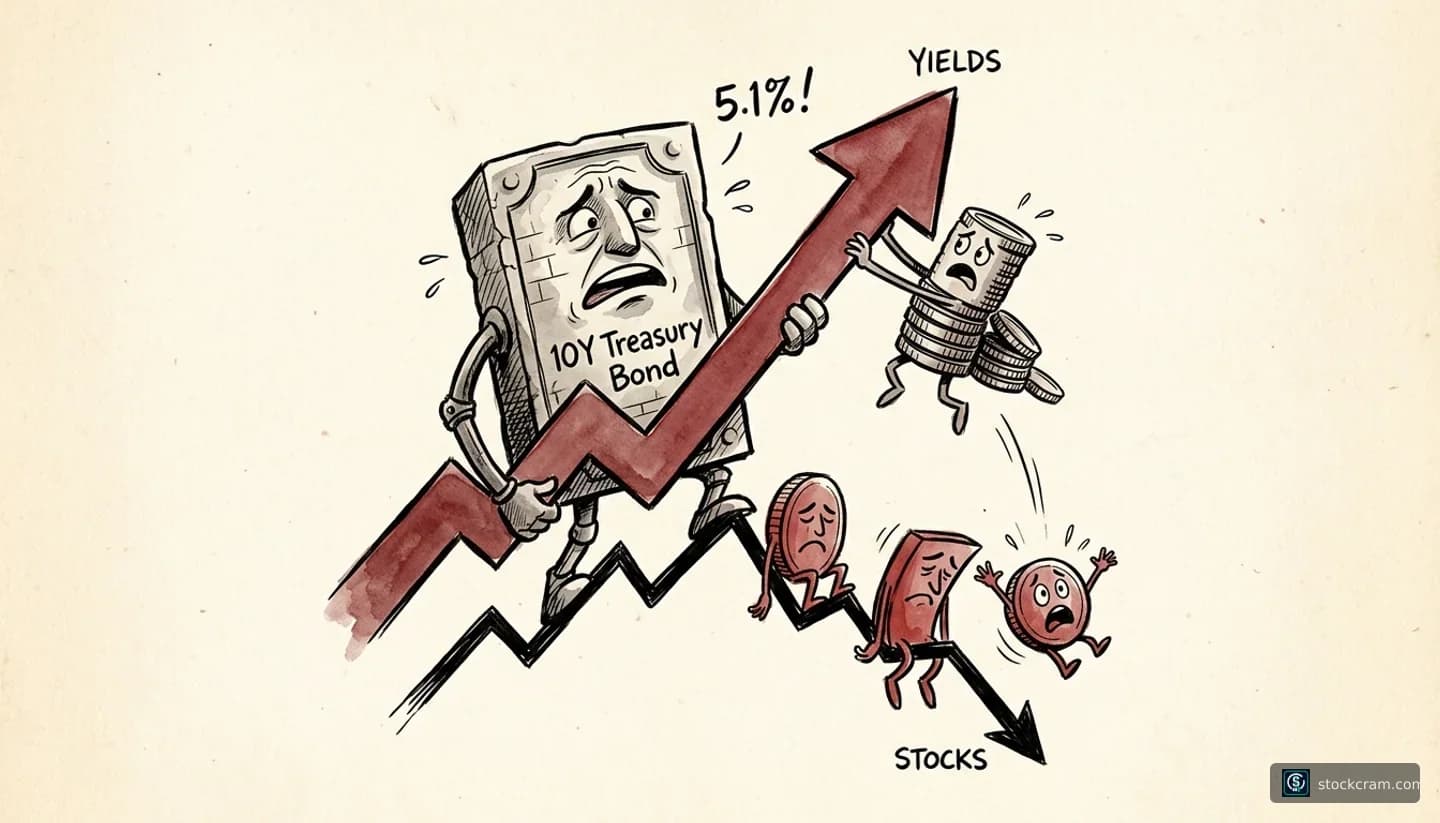
StockCram is not a broker-dealer, investment adviser, or financial institution. All content is for educational and informational purposes only and should not be construed as personalized investment advice. Consult a qualified financial professional before making investment decisions. Past performance does not guarantee future results.The 10-year Treasury yield jumped 17 basis points to 5.12% on Wednesday, reaching levels not seen since July 2007. The spike came after manufacturing PMI data showed business activity expanding at the fastest pace since July 2021, hitting 57.0 versus expectations of 53.6. Input costs surged at the steepest rate in four years, driven by rising energy prices. A weak 5-year Treasury auction added fuel to the selloff, with the auction tailing 3.1 basis points above recent averages.
This is the biggest one-day move for the 10-year yield in nearly 18 months and signals that markets are pricing in a longer, more aggressive Fed hiking cycle than previously expected. Higher yields make mortgages, auto loans, and business borrowing more expensive—directly hitting consumer spending and corporate profits. The combination of strong growth and rising inflation pressure means the Fed may have no choice but to keep raising rates through year-end.
Equities
Major decline—S&P 500 down 0.75%, Nasdaq drops 1.13%
Rates
Sharp surge—10-year yield up 17 basis points to 5.12%
FX
Dollar strengthens moderately on higher rate expectations
Commodities
Oil rises 2% as Middle East tensions persist
Major U.S. stock indexes fell sharply on Wednesday, with the S&P 500 dropping 0.75% to 7,706, the Nasdaq sliding 1.13% to 26,936, and the Dow losing 352 points to close at 51,512. The tech-heavy Nasdaq pulled back from its recent all-time high as investors rotated out of rate-sensitive growth stocks. Utilities and consumer discretionary sectors led declines, each shedding more than 1%. Fed Governor Michael Barr added to the selloff with comments that further policy adjustments are likely needed to bring inflation down to target.
Markets are repricing risk after last week's Fed rate hike—the first in over three years. Investors who expected a one-and-done move are now facing the reality of a sustained tightening cycle. The shift from rate cuts to rate hikes in just six months shows how quickly inflation dynamics can change, especially with oil prices above $90 per barrel and geopolitical tensions keeping energy markets tight.
Equities
Broad-based decline—utilities and consumer discretionary lead losses
Rates
Yield curve steepens as long-end sells off
FX
Dollar index gains on hawkish Fed expectations
Commodities
Gold weakens on rising real yields
The S&P Global Flash Manufacturing PMI jumped to 57.0 in September, well above the forecast of 53.6 and the prior reading of 53.9. This marks the fastest expansion in business activity since July 2021, with both manufacturing and services sectors showing improvement. Employment rose at the fastest pace since 2022. However, the report also showed input costs spiking at a four-year high, driven by surging fuel and transport costs as oil prices remain elevated.
This is a classic case of good news being bad news for markets. While strong economic growth is normally positive, it removes any urgency for the Fed to pause rate hikes and raises the risk of a harder landing down the road. The combination of robust activity and accelerating cost pressures gives the Fed cover to keep tightening, even as borrowing costs reach levels that historically slow growth.
Equities
Mixed—strong economy offset by inflation concerns
Rates
Pushes yields higher across the curve
FX
Bullish for USD as economic strength supports rate hikes
Commodities
Industrial metals gain on demand optimism
WTI crude oil rose 2.4% to $92.71 per barrel on Wednesday, up more than 42% from a year ago. Brent crude traded near $100 per barrel. Prices have climbed more than 9% over the past month as ongoing tensions between the U.S. and Iran keep the Strait of Hormuz—a critical oil shipping channel—at risk. Iran's president told the UN General Assembly that Tehran will not let the U.S. use the waterway to impose aggression, dimming hopes for a near-term diplomatic breakthrough. President Trump is set to meet Chinese President Xi Jinping this week to discuss trade and energy security.
Oil is the single biggest driver of inflation right now, and prices above $90 per barrel put upward pressure on everything from gasoline to airline tickets to plastics. The Fed hiked rates last week largely because of energy-driven inflation, and sustained high oil prices could force another rate increase in December. For consumers, this is a double hit—higher gas prices and higher interest rates on mortgages and credit cards.
Equities
Energy stocks outperform; airlines and transport lag
Rates
Adds to inflation premium in long-term bonds
FX
Supports commodity currencies, pressures oil importers
Commodities
Crude up 2.4% on supply concerns
The last time the 10-year Treasury yield traded above 5% was in July 2007, just months before the financial crisis. Back then, the Fed had raised rates to combat housing-driven inflation, only to reverse course dramatically when the economy collapsed.
Markets initially ignored rising yields in 2007, continuing to push stocks higher until credit markets froze. This time, investors are more cautious—the memory of how quickly conditions can deteriorate is keeping risk appetite in check, even as economic data remains strong.
The biggest wildcard is how quickly oil prices respond to diplomatic efforts between the U.S. and Iran. A breakthrough could send crude down 10-15% in days, easing inflation pressure and changing the Fed's calculus. Conversely, any escalation in the Strait of Hormuz could push oil well above $100 and force the Fed into a more aggressive stance. Corporate earnings season ahead will also show whether companies can pass rising costs to consumers without destroying demand.