
Market Analysis
Stock Market Today, Oct 15: Hot CPI, Chip Rout
Read Article
Market Analysis
AI-powered insights into global financial markets
 StockCram Editorial4 min read
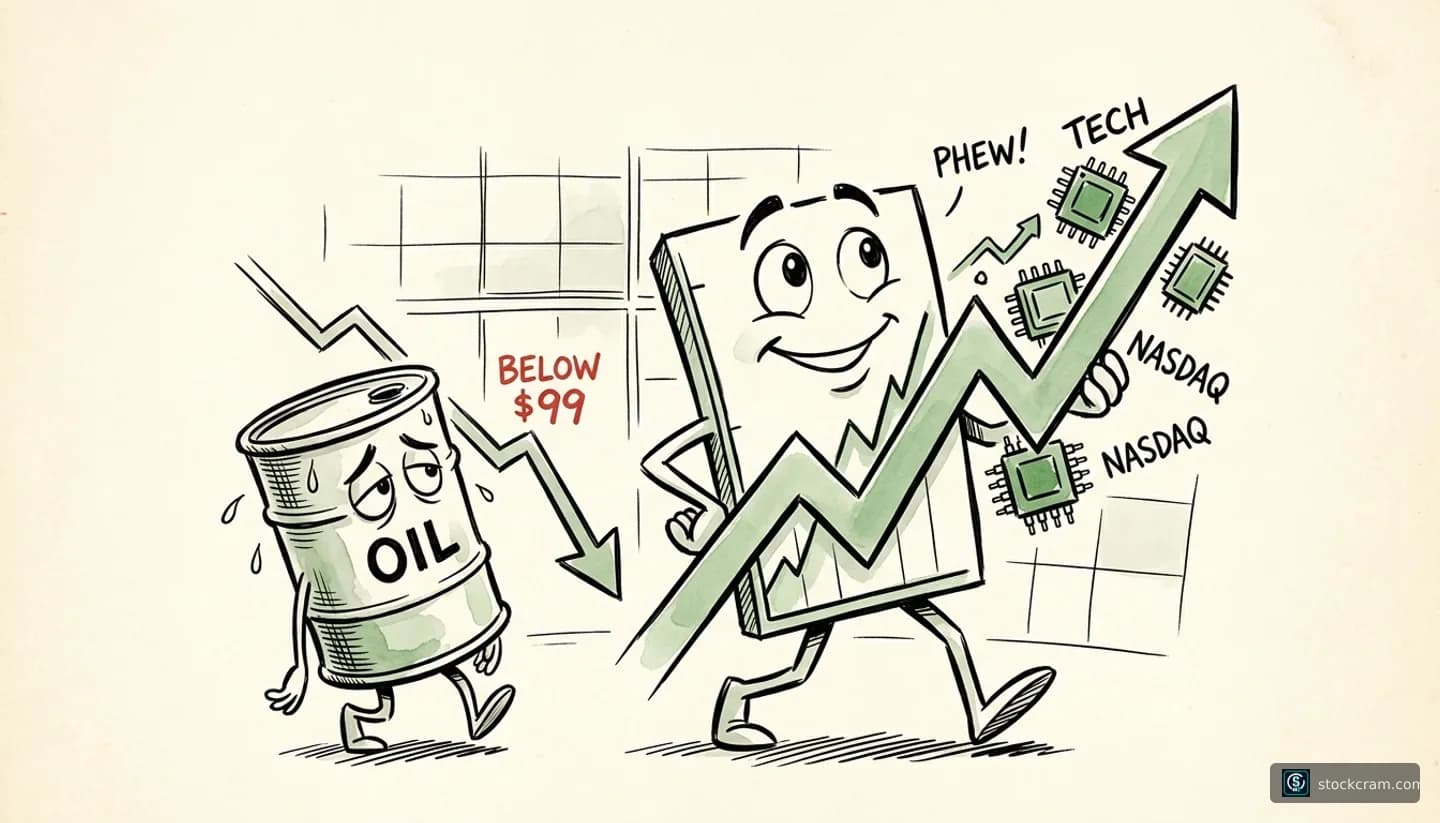
US-Iran diplomatic progress sent oil down 10% in five sessions, easing inflation fears and fueling a tech-led rally as semiconductors hit six-day highs.
Educational purposes only. This content does not constitute investment advice. Read our disclaimer
StockCram is not a broker-dealer, investment adviser, or financial institution. All content is for educational and informational purposes only and should not be construed as personalized investment advice. Consult a qualified financial professional before making investment decisions. Past performance does not guarantee future results.President Trump announced US officials held a three-hour meeting with Iranian envoys at the UN, calling it productive despite earlier threats. Oil prices tumbled more than 10% over five sessions as traders priced out war risk. Brent crude settled around $99 per barrel on Tuesday, with further declines Wednesday morning pushing it toward $98.55. Saudi Arabia also moved to restart a key pipeline, adding to supply optimism and reinforcing the shift away from geopolitical risk premium pricing.
Lower oil prices ease inflation pressure just one week after the Fed's first rate hike since 2023, giving the central bank breathing room. Energy stocks sold off sharply while consumers and travel-related sectors benefit from cheaper fuel. The diplomatic breakthrough could reshape the geopolitical risk premium that's dominated markets since spring, potentially signaling a sustained period of lower energy costs that supports both corporate margins and household budgets.
Equities
Major indexes mixed to higher; energy down 3-4%, tech up 0.5-0.8%
Rates
Treasury yields edge lower on easing inflation concerns
FX
Dollar moderately weaker as risk appetite improves
Commodities
Crude oil down 4-5% to 12-day lows; Brent near $99, WTI below $90
The Nasdaq Composite closed at a record on Tuesday, driven by a sixth consecutive day of gains for semiconductor stocks including Nvidia and Micron. The tech-heavy Nasdaq 100 rose 0.8% and also hit its first record since June. AMD shares surged 8% to approach the $1 trillion market cap milestone, fueled by pricing power in cloud computing. Asian markets followed suit Wednesday with chip stocks in Japan and South Korea climbing before profit-taking set in, demonstrating the global reach of the AI infrastructure buildout.
The semiconductor rally signals investors are regaining confidence in the AI trade after summer volatility. With the Fed's September hike now behind the market and oil prices falling, growth stocks are reclaiming leadership from defensive sectors. The shift back to tech suggests traders believe the economy can handle modestly higher rates without derailing the AI boom, validating the thesis that AI infrastructure spending remains resilient even as monetary policy tightens.
Equities
Nasdaq Composite up 0.5% to all-time high; semis lead with 0.8% gain
Rates
Yields stable as growth optimism balances Fed hawkishness
FX
Yen weakens modestly; dollar steady against majors
Commodities
Gold flat; industrial metals mixed on China demand concerns
Meta shares jumped 11% on Tuesday after its new Muse AI personal assistant racked up over 2.5 million downloads in 13 days since its September 8 launch, topping app store charts ahead of ChatGPT. The free AI agent, which automates web tasks and comes with optional $20 and $100 monthly subscription tiers, recorded 730,000 downloads in its first five days alone. Chip suppliers rallied on expectations of higher AI infrastructure demand, with the ripple effect extending across the entire semiconductor supply chain.
Muse's breakout success validates Meta's heavy AI infrastructure spending and opens new revenue streams beyond advertising. The app's rapid adoption suggests mainstream consumers are ready to embrace AI agents for everyday tasks, moving beyond early-adopter enthusiasm. Investors see potential for Meta to monetize its 3 billion user base through AI subscriptions, a model that could rival OpenAI and Microsoft while demonstrating that AI applications can drive both user engagement and direct revenue simultaneously.
Equities
Meta up 11%; chip suppliers AMD +8%, Intel +12%, Arm +17%
Rates
No significant rate impact
FX
Minimal direct impact; dollar steady
Commodities
No direct commodity impact
Viking Therapeutics shares rocketed 31% on Tuesday after its VK2735 obesity drug showed patients maintained up to 90% of their weight loss when switching from weekly injections to less frequent dosing. Participants lost 16-19% of body weight over 21 weeks, with an exploratory group hitting 22% weight loss at 33 weeks. The dual GLP-1/GIP agonist demonstrated strong tolerability with mostly mild side effects, addressing one of the key patient adherence challenges in the obesity treatment market.
The maintenance dosing data addresses a key challenge in the $100 billion obesity drug market: keeping weight off with fewer injections improves patient adherence and quality of life. Viking's results position VK2735 as a potential competitor to Eli Lilly's Zepbound and Novo Nordisk's Wegovy, with oral formulation trials expected to start in Q4 2026. Less frequent dosing could become a major selling point if the drug reaches market, potentially capturing share from existing therapies and expanding the total addressable market by appealing to patients who avoid frequent injections.
Equities
Viking up 31%; broader obesity sector flat
Rates
No rate impact
FX
No FX impact
Commodities
No commodity impact
In early 2020, oil prices collapsed from $60 to negative territory as COVID lockdowns crushed demand. The S&P 500 initially fell 34% but then rallied 68% over the next year as tech stocks led a V-shaped recovery.
Markets shifted from energy and cyclicals into growth and technology, a rotation that persisted for 18 months as lower input costs boosted corporate margins. The Fed kept rates near zero throughout the recovery, fueling a historic tech bull run that saw the Nasdaq outperform the S&P 500 by more than 40 percentage points, demonstrating how falling energy costs combined with accommodative monetary policy can create sustained tailwinds for growth equities.
US-Iran diplomacy remains fragile and could reverse quickly, sending oil back above $110 and reigniting the geopolitical risk premium. China economic data continues to disappoint, raising questions about global growth and semiconductor demand sustainability. The Fed's dot plot suggests one more hike this year, but markets are split on whether falling oil changes that calculus, creating potential for a hawkish surprise that could pressure equity valuations.