

How Does the Fed Set Interest Rates?
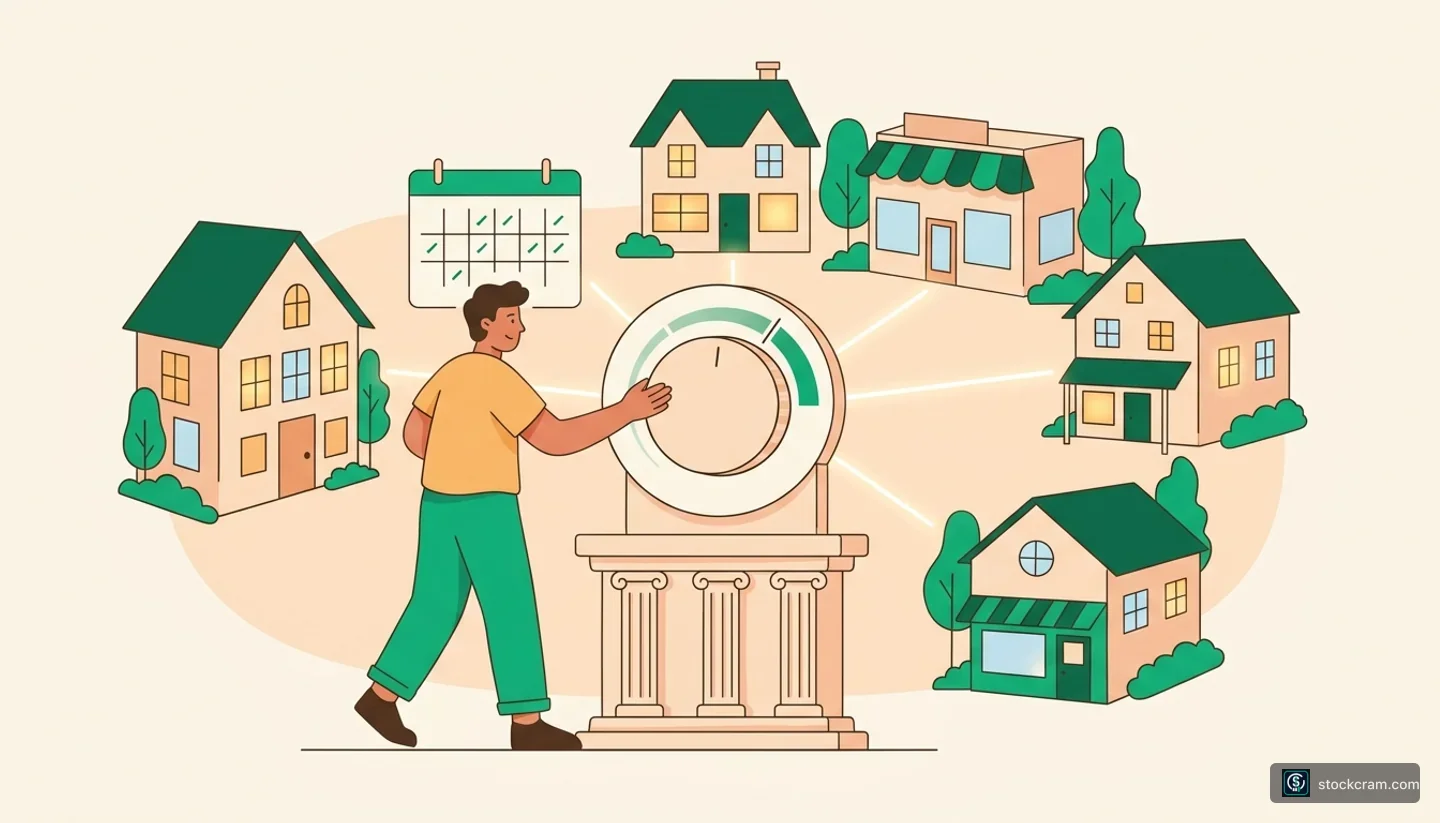
This part surprises people. The Fed doesn't reach in and set every interest rate in the economy. It sets one rate, then lets that rate ripple outward. A committee picks a target for that single rate and uses its tools to keep the real-world rate inside the target. Everything else — bond yields, savings rates, the cost of short-term borrowing — tends to follow. Picture one dial the others follow:
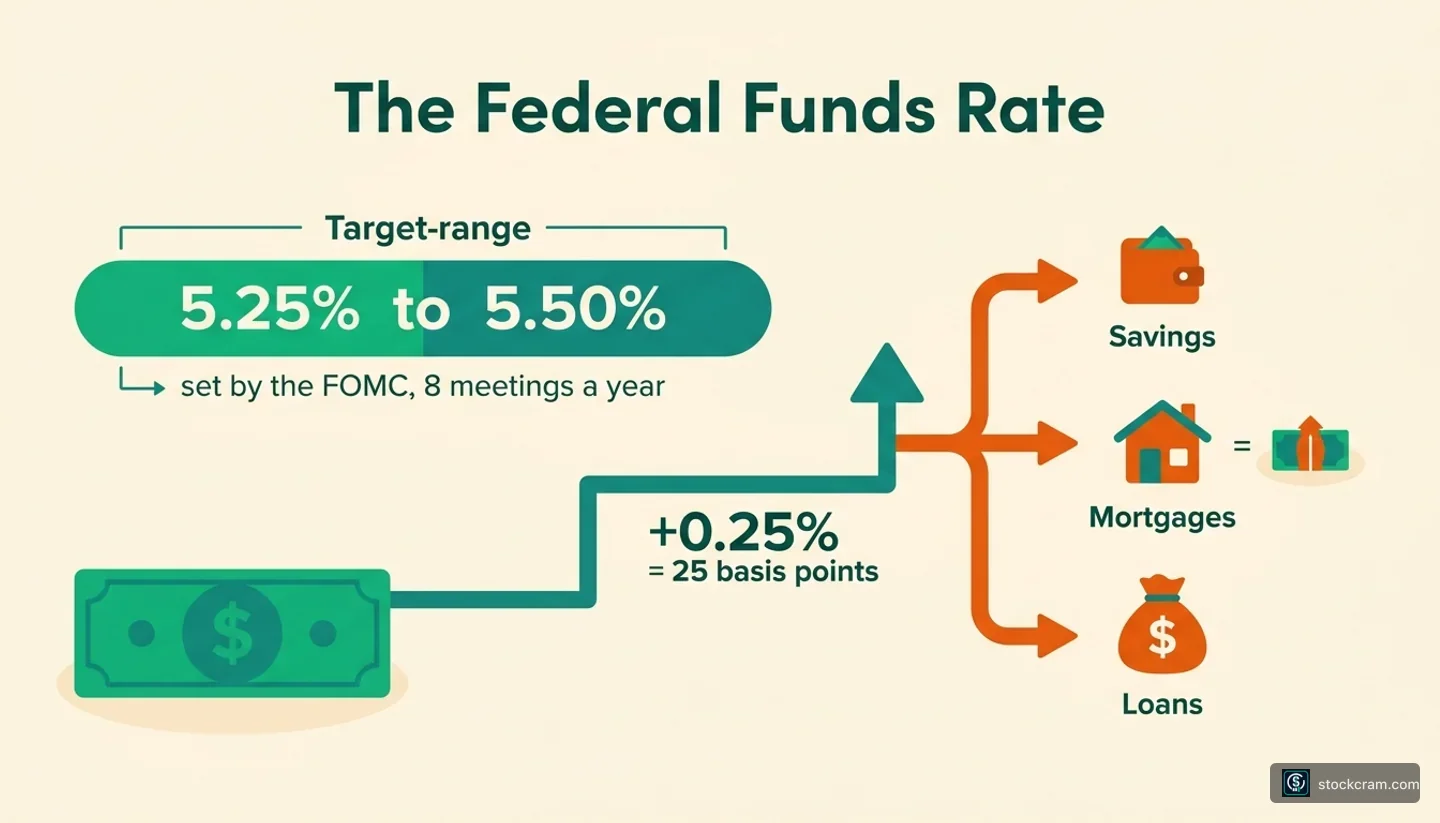
So the whole system traces back to that single dial. Here's who turns it, and which rate it is.
The One-Sentence Version
The FOMC meets eight times a year and sets a target range for the federal funds rate — the overnight rate banks charge each other. That one rate becomes the anchor the rest of the economy follows.
Who Decides: The FOMC
The group that actually makes the call is the FOMC — the Federal Open Market Committee. It's the Fed's rate-setting committee, made up of the Board of Governors plus a rotating set of regional Reserve Bank presidents. The FOMC meets roughly eight times a year on a published schedule. At each meeting it reviews the economy and decides whether to raise its rate target, lower it, or leave it unchanged.
Each scheduled meeting ends with a vote and a written statement explaining the decision. Markets read that statement word by word, because it signals how the committee is thinking about inflation and the broader economy. The decision itself is one number; the explanation around it is what investors pick apart.
The One Rate It Targets: The Federal Funds Rate
The rate the FOMC targets is the federal funds rate — the interest rate banks charge each other to borrow reserves overnight. Banks are required to hold reserves, and at the end of a day some have a little extra while others come up short. The ones with extra lend to the ones short, just until tomorrow, and the rate on that overnight loan is the federal funds rate.
Why a Bank-to-Bank Rate Matters to You
The federal funds rate is the anchor for short-term borrowing across the economy. When this overnight rate moves, other short-term rates — like what banks charge each other for slightly longer loans, and the rates feeding into savings accounts and credit lines — tend to move with it. It's the first domino, even though you never borrow at it directly.
Notice the FOMC doesn't dictate this rate by decree. It sets a target range and then steers the actual market rate into that range. The vote is about where the target should be; the Fed's monetary policy tools do the work of keeping the real rate inside it.
Basis Points and the Target Range
Rate changes are measured in basis points. One basis point equals 0.01%, so 25 basis points = 0.25% and 100 basis points = 1.00%. Saying 'basis points' avoids confusion: 'the Fed raised rates 1%' is ambiguous, but 'the Fed raised rates 25 basis points' is exact.
The FOMC also doesn't pick a single number — it sets a range, usually 25 basis points wide, like 5.00%–5.25%. The range gives the Fed a little room to steer the actual overnight rate without it having to land on one precise figure every day.
| Basis points | Percentage | How it's usually described |
|---|---|---|
| 25 bps | 0.25% | A 'quarter-point' move — the most common step |
| 50 bps | 0.50% | A 'half-point' move |
| 75 bps | 0.75% | A 'three-quarter-point' move |
| 100 bps | 1.00% | A 'full-point' move |
Basis points translated into plain percentages. Illustrative only.
A Worked Example
Here's a stylized example to make it concrete. Suppose the FOMC's target range going into a meeting is 5.00%–5.25%. The committee meets, reviews the data, votes, and decides to raise the target by 25 basis points.
Follow One Rate Decision (Stylized)
Before the meeting, the target range is 5.00%–5.25%.
The FOMC votes to raise it by 25 basis points (0.25%).
After the meeting, the new target range is 5.25%–5.50%. The Fed then uses its policy tools to keep the actual overnight rate inside that higher range. These figures are illustrative, not a current or projected rate.
That's the mechanic. Shift the range by some number of basis points, publish a statement, and let the new anchor work its way through short-term borrowing. A 25-basis-point move sounds tiny, but because so many other rates reference this one, even a small change can ripple widely.
How a Rate Decision Is Made
The committee gathers
The FOMC meets on its published schedule, roughly eight times a year, in a two-day session.
It reviews the economy
Members weigh data on inflation, employment, and growth against the Fed's goals.
It votes on the target
The committee votes to raise, lower, or hold the target range for the federal funds rate, in basis-point steps.
It releases a statement
A written statement explains the decision and the committee's view of conditions. Markets parse it closely.
The Fed steers the rate
Using its policy tools, the Fed keeps the actual overnight rate inside the new target range. We keep the plumbing light here — it's a later topic.
| Question | Short answer |
|---|---|
| Who sets the rate? | The FOMC, the Fed's rate-setting committee, by vote. |
| How often? | On a published schedule, roughly eight times a year. |
| Which rate? | A target range for the federal funds rate — the overnight bank-to-bank rate. |
| Measured how? | In basis points, where 1 bp = 0.01% and 25 bps = 0.25%. |
How the Fed sets rates, at a glance.
Educational use only
Educational content only. StockCram isn't a broker or adviser, and we have no affiliation with any institution we name.