
Market Analysis
Stock Market Today, Oct 15: Hot CPI, Chip Rout
Read Article
Market Analysis
AI-powered insights into global financial markets
 StockCram Editorial4 min read
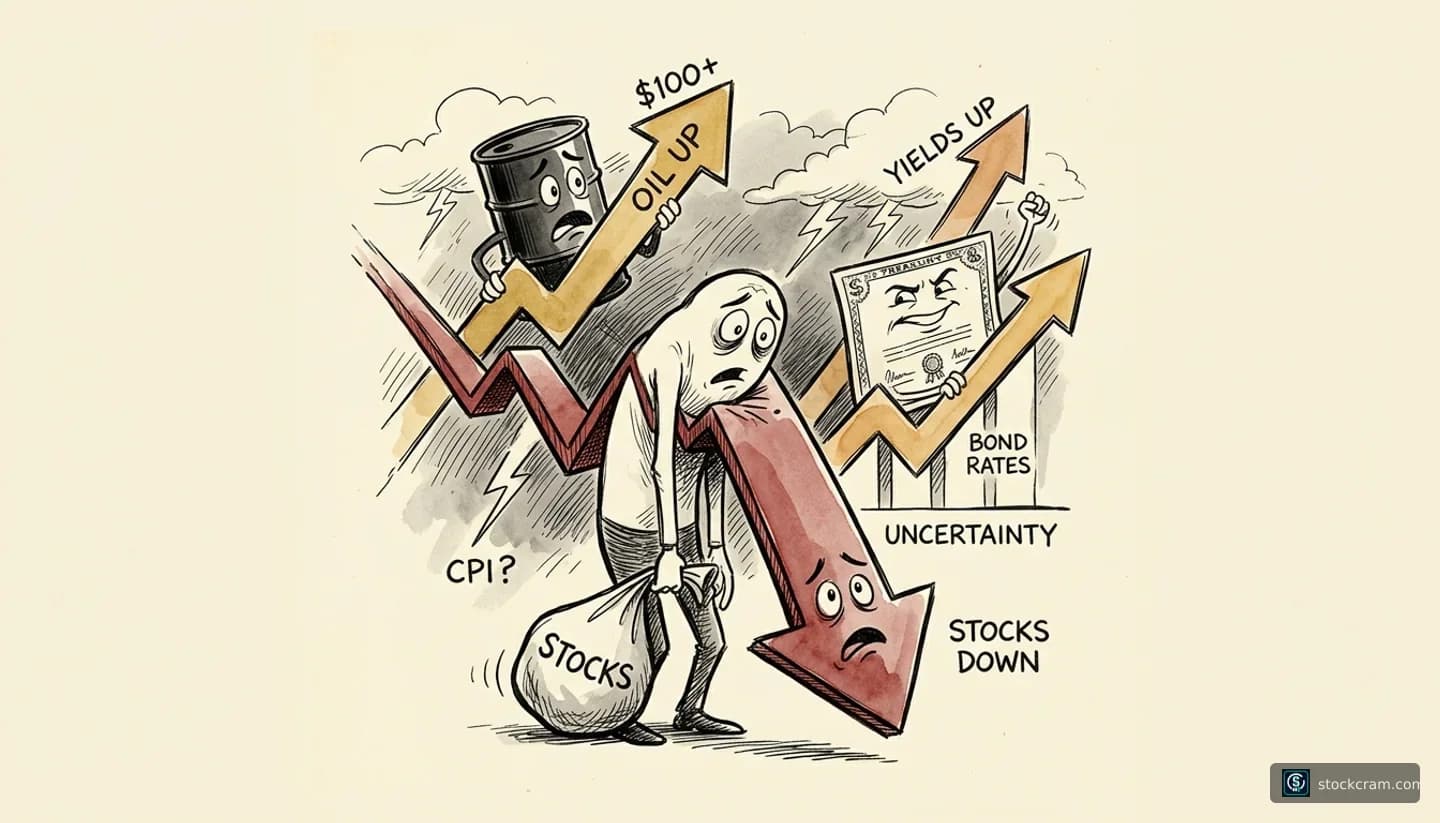
Oil surges past $100 on Middle East conflict, Treasury yields hit multi-year highs despite buybacks, and stocks slide for a third day as inflation fears collide with Fed rate uncertainty.
Educational purposes only. This content does not constitute investment advice. Read our disclaimer
StockCram is not a broker-dealer, investment adviser, or financial institution. All content is for educational and informational purposes only and should not be construed as personalized investment advice. Consult a qualified financial professional before making investment decisions. Past performance does not guarantee future results.Oil prices surged past $100 per barrel for the first time since July after the U.S. military destroyed five Iranian oil tankers and Iran retaliated by attacking American vessels in the Gulf. Houthi militants also targeted Saudi Arabia's Jazan refinery. The escalation has raised fears of prolonged disruptions to global oil supplies, particularly through the Strait of Hormuz, which handles roughly 20% of the world's oil.
Higher energy costs feed directly into inflation expectations, complicating the Federal Reserve's rate decisions. With oil up more than 60% this year, consumers face rising gas and diesel prices—diesel hit a record $5.90 per gallon—which could dampen spending and slow economic growth even as inflation remains sticky. This oil price surge during war follows a familiar pattern, though the magnitude is testing historical norms.
Equities
Dow fell 405 points (-0.77%), S&P 500 down 0.48%, marking third consecutive decline
Rates
10-year Treasury yield hit 4.857%, highest since November 2023
FX
Dollar strengthened moderately as safe-haven flows offset inflation concerns
Commodities
Brent crude surged above $101/barrel, WTI topped $94; energy stocks up 1.3%
The Treasury Department announced it will buy back up to $6 billion in longer-dated government debt—triple the normal $2 billion—in an effort to improve liquidity in the bond market. Secretary Scott Bessent had signaled the increase in August, citing poor liquidity in the 10-to-30-year sector. Despite the intervention, Treasury yields jumped after the announcement, with the 10-year hitting its highest level since late 2023.
The move shows Washington is worried about dysfunction in the bond market, but the fact that yields rose anyway suggests the problem is bigger than liquidity. With federal debt up 8.2% this year and persistent inflation fears, investors are demanding higher compensation to hold long-term Treasuries—a headwind for stocks and housing. The August bond buyback surprise had initially moved gold, but this expanded program failed to calm rate markets.
Equities
Negative—rising yields pressured stocks, especially growth and tech names
Rates
10-year yield rose to 4.857% despite buyback; 2-year hit highest since January 2025
FX
Limited direct impact; dollar remained firm on rate expectations
Commodities
Minimal impact beyond general risk-off sentiment
Investors are on edge ahead of Friday's August CPI report (releasing September 11 at 8:30 a.m. ET), which could determine whether the Federal Reserve raises rates at its September 15-16 meeting. Markets are pricing in a 58% probability of a hike after last week's stronger-than-expected jobs report showed 162,000 payrolls added versus 53,000 expected. Fed Governor Christopher Waller said he'd support holding rates steady barring surprises in the inflation data.
The Fed is caught between rising oil prices that threaten to reignite inflation and signs of economic resilience that reduce the urgency to cut rates. A hot CPI print could trigger a rate hike just as energy costs squeeze consumers, raising recession risks. The shift from expected cuts to potential hikes has caught many investors off guard. Markets have historically struggled in September, and this year is no exception.
Equities
Defensive rotation underway; 68% of stocks declining Wednesday
Rates
Fed funds futures now price 58% chance of September rate hike, up from 50%
FX
Dollar strengthened in anticipation of potential Fed tightening
Commodities
Gold and other inflation hedges under pressure from rising real rates
U.S. stocks fell for the third consecutive session, with the Dow dropping 405 points to 52,380. RBC Capital Markets warned that the risk of a 5-10% pullback has grown, citing seasonal headwinds—the S&P 500 has fallen in September in five of the past 10 years—and upcoming midterm elections. Nearly 70% of stocks were declining by midday Wednesday. Apple shares fell 1.75% despite unveiling a new foldable iPhone under CEO John Ternus.
Breadth is deteriorating even as major indexes hold near highs, suggesting institutional investors are turning cautious. The combination of rising yields, expensive valuations, and geopolitical uncertainty creates a fragile setup heading into the Fed meeting. Historically, when September weakness coincides with midterm election years, volatility tends to persist into October.
Equities
S&P 500 down 0.48% to 7,636; Nasdaq fell 0.64%; Russell 2000 lagged
Rates
Volatility in rates markets increased as investors repositioned
FX
Yen strengthened 2% Thursday on intervention speculation; dollar mixed
Commodities
Copper surged on infrastructure hopes; industrial metals mixed
In 2011-2012, oil spiked above $110 on Middle East tensions (Arab Spring, Iran sanctions) while the Fed debated tightening. The S&P 500 experienced two corrections of 10%+ within 12 months.
Markets stabilized only after oil prices retreated and the Fed signaled patience. The lesson: when energy shocks coincide with rate uncertainty, volatility persists until one variable resolves.
The CPI report could swing either way, and the Fed's reaction function is unclear given conflicting signals from the labor market and energy prices. Geopolitical risks are highly unpredictable, and any ceasefire or escalation could rapidly shift oil prices and market sentiment.