
Market Analysis
Stock Market Today, Oct 15: Hot CPI, Chip Rout
Read Article
Market Analysis
AI-powered insights into global financial markets
 StockCram Editorial12 min read
Markets snapped a four-day losing streak as oil prices retreated and inflation data came in close to expectations.
Week of Monday, September 7, 2026 - Friday, September 11, 2026
-0.8%
7,656.98
-0.7%
26,333.04
-1.6%
52,573.29
-2.4%
2,903.94
15.84
-11.21%
4.92%%
+6.15%
$$99.99
+8.0%
$$4,315
-1.79%
99.07
+0.26%
The U.S.-Israel war on Iran intensified throughout the week, with the United States striking five Iranian oil tankers on September 8, provoking counterattacks on Jordan's al-Azraq airbase, while Iran launched ballistic missiles toward a U.S. aircraft carrier near the Strait of Hormuz and targeted vessels traveling through what it called an 'unauthorized route.' Brent crude fell to $104.42 per barrel on Friday, down 2.98% from the previous day, while WTI crude dropped to $99.99, down 2.43%, though both benchmarks remained approximately 9% higher for the week.
After surging above $108 earlier in the week, oil finally retreated on Friday, with Brent crude falling roughly 2.8% to $104.61 per barrel and WTI dropping about 2.4% to $100.05, though oil still gained more than 8% for the week, raising concerns about inflationary pressures feeding into consumer prices.
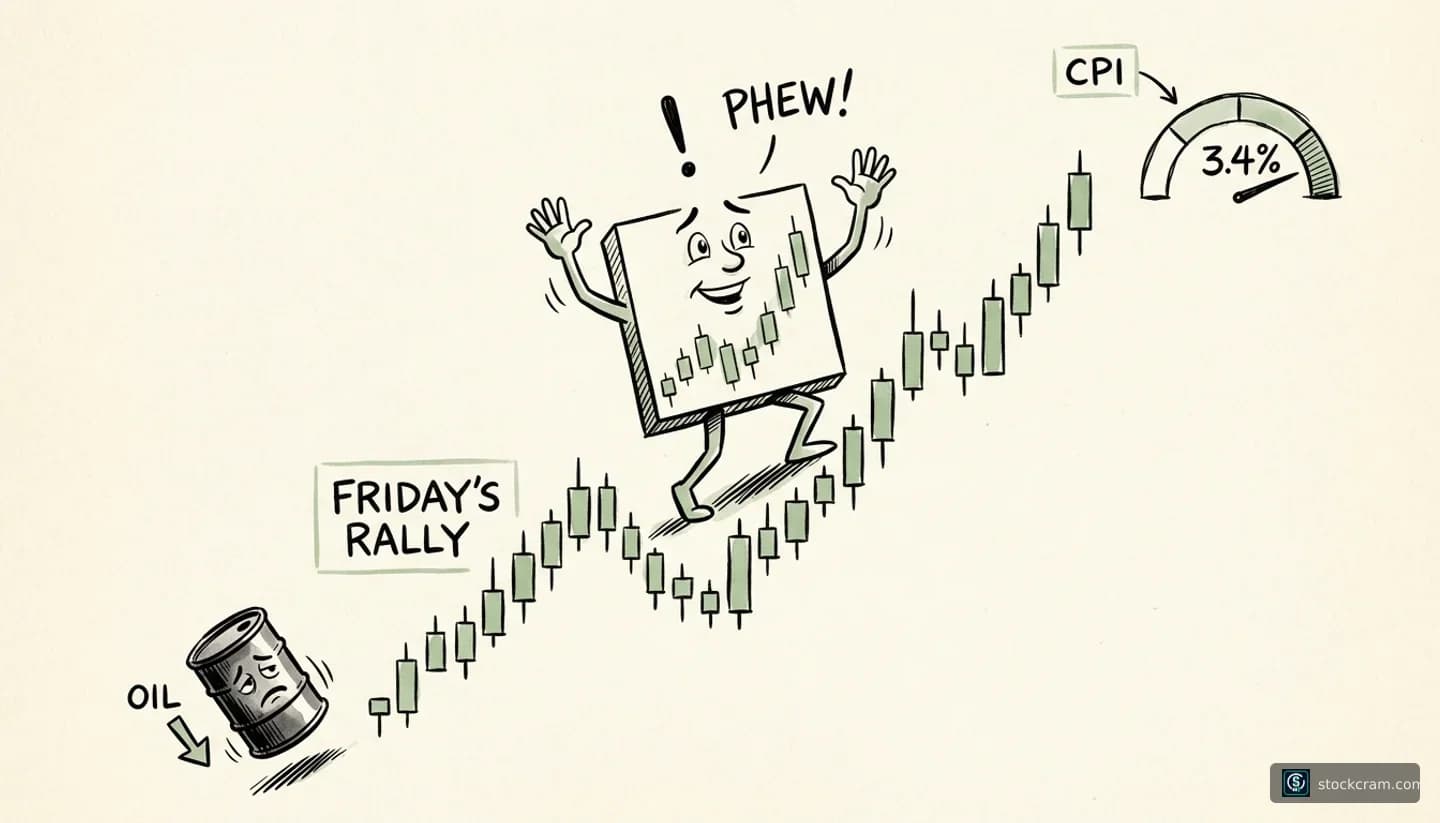
The consumer price index rose a seasonally adjusted 0.4% in August, putting the 12-month increase at 3.4%, both in line with expectations, while core CPI advanced 0.3%, above the 0.2% consensus, leaving consumer prices significantly higher than the Fed's 2% target and making a rate hike next week all but assured. Core prices increased 0.3% for the month, slightly hotter than the 0.2% economists expected, though on an annual basis core inflation actually eased to 2.4% from 2.5%.
After Friday's CPI report, financial markets increased the probability of a 25-basis-point rate hike next week to roughly 85%-90%, a remarkable shift from around 50% one week ago and roughly 70% the day before, as the market now considers a hike increasingly likely.
Qualcomm shares rose 3% on Tuesday after the company announced a data center infrastructure partnership with Amazon Web Services, issuing warrants to Amazon to acquire 25 million shares at $161.26 apiece for a total investment of $4 billion, with shares vesting tied to the purchase of up to $60 billion worth of Qualcomm's server chips and other technology. Server hardware owned Friday's close, with Hewlett Packard Enterprise adding 12.2% and Dell rising 11.5%, while ON Semiconductor and Super Micro also finished up more than 7%.
Chipmakers gained on Friday, with AMD up 2.5% and Intel up 2.6%, while Dell surged 11.9% to an all-time high on RBC Outperform initiation, reflecting broader optimism about AI infrastructure spending despite the challenging market environment.
On September 8, the United States struck five Iranian oil tankers, provoking a counterattack on Jordan's al-Azraq airbase, just three days after the U.S. had hit three Iranian tankers in an escalating series of strikes centered on the Strait of Hormuz. The 2026 Strait of Hormuz crisis, which began on February 28, 2026, has disrupted a waterway through which about 25% of the world's seaborne oil trade and 20% of liquefied natural gas passed, with the number of tankers trafficking the strait dropping near zero soon after the start of the conflict.
Brent crude slipped below $105 a barrel on Friday but remained almost 9% higher for the week as investors weighed diplomatic efforts to ease tensions around the Strait of Hormuz against continued fighting, with Gulf Cooperation Council diplomats expected to meet their Iranian counterpart on Monday to discuss a possible temporary arrangement for managing shipping through the strait.
Top diplomats from the six-member Gulf Cooperation Council are expected to meet their Iranian counterpart on Monday to discuss a possible temporary arrangement for managing shipping through the Strait of Hormuz, while the International Energy Agency sharply lowered its outlook for global oil demand, forecasting a 2.5 million-barrel-a-day contraction in 2026, which could weaken further if the conflict persists.
The U.S. national average diesel price has climbed above $6, reaching record nominal levels, which matters because diesel powers trucks, farm equipment, construction machinery, and delivery vehicles, potentially feeding inflation throughout the economy.
Qualcomm said it's working with Amazon across 'multiple generations of customized silicon' to help build out AWS' AI infrastructure, specifically focused on inference, with the shares vesting in tranches tied to the execution of certain commercial arrangements and the purchase of up to $60 billion worth of Qualcomm's server chips and other technology. Qualcomm signing a major AI chip deal with Amazon helps Qualcomm continue diversifying beyond smartphones and gives Amazon the option to buy up to $60 billion in AI data center chips.
Qualcomm shares rose 3% on Tuesday after the company announced the data center infrastructure partnership with Amazon Web Services, a major win as the chipmaker tries to take on Nvidia in the artificial intelligence market.
The Amazon partnership gives Qualcomm a long-term customer relationship with one of the world's largest cloud providers, while management pointed to an unnamed second hyperscaler engagement as further evidence that Qualcomm's data center ambitions extend well beyond a single customer, with analysts tracking QCOM stock forecasting earnings to expand from $10.52 per share in fiscal 2025 to $20.84 per share in fiscal 2030.
The move stands out against a rough year, as Qualcomm shares had slipped about 1% in 2026 before Tuesday, with an August rebound only partly offsetting losses tied to weaker smartphone demand.
The week's biggest S&P 500 loser was Cooper Companies (COO), down about 22.98%, as the medical-device company suffered a major selloff after reporting weaker-than-expected quarterly revenue and reducing its full-year outlook. In its Sept. 9 report, Cooper's fiscal 2026 fourth-quarter revenue forecast fell below Wall Street's estimate, while the company said that lower inventory at U.S. contact-lens distributors would keep hurting its 2026 numbers for the vision side of the business.
CooperCompanies stock fell to USD 54.89 on September 10, 2026, after Needham cut its target to USD 73 from USD 86, while Q3 EPS was USD 1.15 and revenue missed at USD 1.07 billion.
CooperCompanies reported third-quarter adjusted EPS of USD 1.15 for the period ended July 31, 2026, ahead of the USD 1.12 consensus by USD 0.03, while free cash flow rose 66 percent to USD 273 million.
Needham cut its target to USD 73 from USD 86 while keeping a buy rating, JPMorgan lowered its target to USD 58 from USD 71 and kept a neutral rating, and Robert W. Baird also cut CooperCompanies from strong-buy to hold.
Nine of eleven S&P sectors finished higher on Friday, led by technology (XLK), Industrials (XLI) and Communications (XLC) all up over 1%, driven by strength in AI infrastructure stocks following positive earnings reactions and the Qualcomm-Amazon deal.
Eight of the 11 S&P sectors are higher so far in 2026, with energy leading, up 43% year-to-date, while Energy leads all sectors with a return of +46.11% as oil prices surged on Middle East conflict and supply disruptions.
Industrials (XLI) finished Friday up over 1%, benefiting from increased capital spending in key growth areas like electricity capacity and AI-related infrastructure buildout.
Healthcare fell 0.91% on September 10, pressured by significant declines in medical device companies like CooperCompanies, which posted one of the week's worst performances after cutting guidance.
Consumer Discretionary is the weakest sector year-to-date at -5.47%, pressured by concerns about consumer spending amid rising energy costs and potential interest rate hikes.
Basic Materials fell 2.81% on September 10, the worst-performing sector that day, as concerns about global demand and higher energy input costs weighed on commodity-related stocks.
Dell surged 11.9% to an all-time high on Friday following RBC Outperform initiation, reflecting optimism about the company's AI server business and strong positioning in the data center infrastructure market.
Server hardware owned Friday's close with Hewlett Packard Enterprise adding 12.2%, benefiting from enthusiasm around AI infrastructure spending and strong positioning in the enterprise hardware market.
Lumentum Holdings emerged as the week's top S&P 500 performer with a gain of approximately 9%, benefiting from optimism around optical networking components used in AI data centers.
Qualcomm shares rose 3% on Tuesday after the company announced a data center infrastructure partnership with Amazon Web Services, issuing warrants to Amazon to acquire 25 million shares at $161.26 apiece for a total investment of $4 billion.
Cooper Companies was the week's biggest S&P 500 loser, down about 22.98%, as the medical-device company suffered a major selloff after reporting weaker-than-expected quarterly revenue and reducing its full-year outlook.
Midwestern pizza chain and c-store chain Casey's General Store is down 10% after reporting analyst-beating earnings but offering conservative guidance amid concerns about consumer spending.
Oracle Corp. increased the scale of its planned job cuts by an additional $700 million while the company grapples with a cash crunch tied to development of large-scale data centers for artificial intelligence work.
Biggest losers on Friday were UnitedHealth (-2.47%), Amgen (-1.34%) and Merck (-0.47%), with healthcare stocks facing pressure despite the broader market rally.
Expected: Headline: +0.4% monthly expected; Core: +0.2% monthly expected
Core prices increased 0.3% for the month, slightly hotter than the 0.2% economists expected, though headline inflation landed exactly where economists expected; after Friday's CPI report, financial markets increased the probability of a 25-basis-point rate hike next week to roughly 85%-90%.
Expected: Above 47.8
Michigan Sentiment missed estimates at 47.8, and 1-Year Inflation Expectations were higher than forecast at 4.6%, adding to concerns about consumer confidence and inflation expectations ahead of the Fed meeting.
Expected: Lower reading
The data followed a slightly hotter producer price index (PPI) on Thursday that sunk markets, as US producer inflation accelerated in August with the Iran war driving up wholesale energy prices.
The Dow suffered its worst week since March, posting a 1.6% decline as the combination of surging oil prices, rising Treasury yields, and geopolitical tensions created a challenging environment reminiscent of previous energy-driven market selloffs. The Russell 2000 fell about 2.4% for the week, though despite the declines, the major indexes remained solidly positive for 2026, with the S&P 500 up approximately 11.9% for the year through Friday.
Historically, periods of escalating Middle East conflict have driven oil price spikes that feed into broader inflation, often prompting central banks to tighten monetary policy even as economic growth slows. Sometimes markets don't need good news—they just need the news to be less bad than feared, which explains Friday's rally despite inflation data that confirmed the likelihood of a Fed rate hike. The current environment mirrors past episodes where interest rates rose in response to supply-driven inflation shocks, creating headwinds for stocks until either geopolitical tensions ease or the economy adjusts to higher energy costs.
Ongoing since February 28, 2026; escalated September 5-8, 2026
The 2026 Iran war is a conflict centered on Iran that was initiated by the United States and Israel on February 28, 2026, with the Strait of Hormuz crisis disrupting a waterway through which about 25% of the world's seaborne oil trade and 20% of liquefied natural gas passed. On September 8, the United States struck five Iranian oil tankers, provoking a counterattack on Jordan's al-Azraq airbase, just three days after the U.S. had hit three Iranian tankers.
Market Relevance
Brent crude fell to $104.42 per barrel on Friday, down 2.98% from the previous day, while WTI crude dropped to $99.99, down 2.43%, though oil still gained more than 8% for the week, raising inflationary concerns across global markets.
Renewed advances by Iran-backed Houthi militants towards the Bab al-Mandeb Strait have raised fresh concerns over supply disruptions, while a Houthi advance along Yemen's Red Sea coast could help push gas prices up even more as the Iran-backed group also launches attacks on Saudi Arabia's oil facilities.
Disclaimer: This weekly recap is for educational purposes only and does not constitute investment advice. Past performance is not indicative of future results. Always consult with a qualified financial advisor before making investment decisions.