
Market Analysis
Stock Market Today, Oct 15: Hot CPI, Chip Rout
Read Article
Market Analysis
AI-powered insights into global financial markets
 StockCram Editorial4 min read
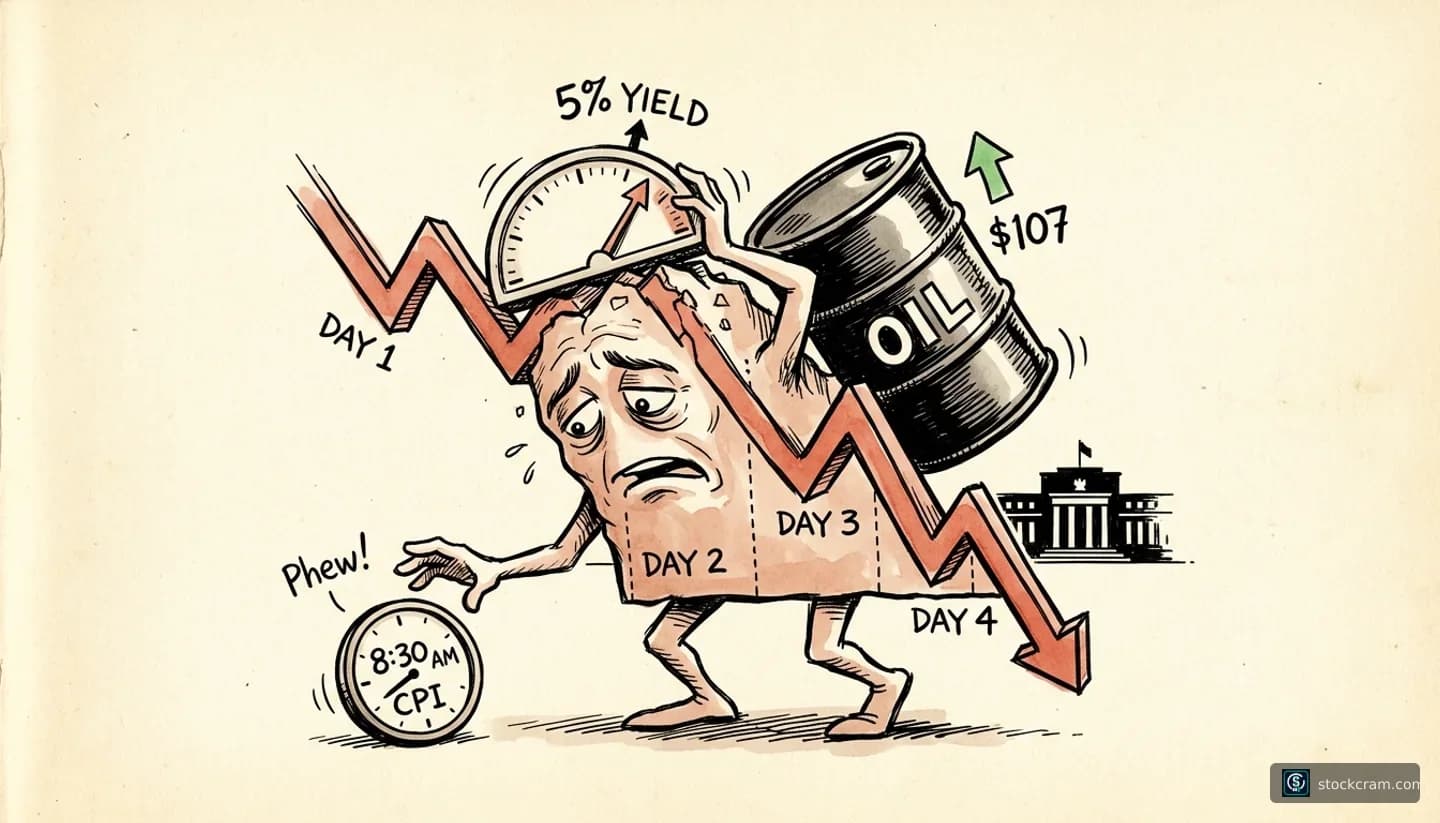
Oil tops $107, Treasury yields near 5%, and August CPI drops at 8:30 AM—markets brace for a pivotal Friday that could determine the Fed's next move.
Educational purposes only. This content does not constitute investment advice. Read our disclaimer
StockCram is not a broker-dealer, investment adviser, or financial institution. All content is for educational and informational purposes only and should not be construed as personalized investment advice. Consult a qualified financial professional before making investment decisions. Past performance does not guarantee future results.The Bureau of Labor Statistics releases August inflation data this morning—the final major economic report before the Fed's September 16 meeting. Economists expect headline CPI to rise 3.4% year-over-year, matching July's pace, with core inflation edging down to 2.4% from 2.5%. Markets are on edge because recent data—strong August jobs numbers, rising producer prices, and surging oil—have pushed rate-hike odds above 60%, making this the most consequential CPI release in months.
A hotter-than-expected reading could tip the Fed toward its first rate hike since July, sending Treasury yields above 5% and potentially triggering a deeper equity selloff. Conversely, a cooler print could ease pressure, allowing stocks to recover and pushing rate-hike odds back below 50%. With the S&P 500 down 2% this week and the Nasdaq off 1.6%, today's 8:30 AM number will likely dictate whether September ends in relief or renewed selling.
Equities
S&P 500 futures up 0.2% pre-market after four consecutive down days; expect sharp volatility at 8:30 AM release
Rates
10-year Treasury yield sits at 4.95%, inches from the psychologically critical 5% level; 2-year already at highest since January 2025
FX
Dollar strength hinges on inflation surprise; hot print could push DXY higher as rate-hike odds climb
Commodities
Gold pressured by rising real yields; oil holding stubbornly above $100 regardless of CPI outcome
Brent crude oil climbed above $107 per barrel Thursday after fresh strikes between the U.S. and Iran over the weekend, with reports of attacks on Saudi Aramco facilities adding to supply fears. The price has surged from roughly $72 in early July as the seven-month conflict continues to disrupt flows through the Strait of Hormuz. Goldman Sachs analysts warn that sustained disruptions could push oil to $120, with worst-case scenarios reaching $150 if major infrastructure is damaged.
Higher energy costs are reigniting inflation just as the Fed debates its next move, creating a toxic mix for equities. Wholesale inflation jumped 5.4% year-over-year in August, driven largely by a 4.2% energy surge. Companies face squeezed margins, consumers face higher gas prices (now $4.15/gallon nationally), and the Fed faces a dilemma: hike rates to fight inflation or hold steady to avoid choking growth. For investors, sustained triple-digit oil means earnings headwinds and continued pressure on rate-sensitive growth stocks.
Equities
Energy sector +1.3% this week while broader market falls; tech and consumer discretionary hit hardest by margin compression fears
Rates
Rising oil feeds inflation expectations, lifting long-end yields; 30-year Treasury at 5.31%
FX
Petrodollar flows support USD; emerging market currencies under pressure from rising energy import costs
Commodities
Brent crude briefly topped $108 Thursday, highest since May; WTI above $102; diesel at all-time highs
Major U.S. stock indexes fell for a fourth consecutive session Thursday, with the S&P 500 losing another 0.6% to close at 7,591.70. The selloff was driven by surging Treasury yields—the 10-year yield hit 4.95%, just shy of the psychologically important 5% mark—and oil prices that remain stubbornly above $100. The Dow shed 316 points, while the Nasdaq dropped 0.7% as tech stocks bore the brunt of rising borrowing costs. Week-to-date, the Dow is down 2.5%, the S&P 500 off 1.6%, and the Nasdaq sliding 1.6%.
The bond market is sending a clear signal: investors are pricing in higher inflation and a more aggressive Fed. When 10-year yields approach 5%, the risk-free return on government bonds becomes increasingly attractive compared to stocks, especially richly valued tech names. The S&P 500 remains up 11% for the year, but momentum has stalled as the combination of oil shocks, inflation fears, and potential rate hikes creates a difficult September. Historically a weak month for stocks, September 2026 is living up to its reputation with investors rotating out of equities and into bonds.
Equities
S&P 500 closed at 7,591.70 (-0.6%); Dow at 52,064.10 (-0.6%); Nasdaq at 26,081.72 (-0.7%); Russell 2000 hardest hit
Rates
10-year yield jumped to 4.95%, approaching key psychological 5% level; 2-year at highest since January 2025
FX
Dollar index at one-week high as yields attract capital flows
Commodities
Flight to quality limited; gold pressured by rising real yields
Market-based measures now show a greater than 60% probability that the Federal Reserve will raise interest rates by a quarter-point at its September 16 meeting, up sharply from below 50% just two weeks ago. The shift followed Fed Chair Kevin Warsh's Jackson Hole speech warning about sticky inflation, Thursday's hotter-than-expected producer price report, and the August jobs report that showed 162,000 new positions—triple expectations. CME FedWatch pricing puts the odds at 63%, while prediction markets like Kalshi and Polymarket show similar probabilities.
A rate hike would mark a reversal from the Fed's July decision to hold steady and signal that policymakers are more worried about inflation than growth. The current fed funds rate sits at 3.5-3.75%, and a hike would push borrowing costs higher for everything from mortgages to corporate debt. For markets, the key question is whether this is a one-and-done hike or the start of a new tightening cycle. History shows the S&P 500 has risen in six of the last seven Fed hiking cycles, but those periods also featured higher volatility and sector rotation away from high-growth stocks toward value and defensive names.
Equities
Growth stocks underperforming as discount rates rise; value and energy outperforming
Rates
Fed funds futures pricing 63% chance of 25bp hike to 3.75-4% range next week
FX
Higher rate expectations support dollar against euro and yen
Commodities
Stronger dollar typically headwind for commodities, but oil defying gravity on supply concerns
In September 2018, oil prices spiked above $85 on geopolitical tensions while the Fed was in a hiking cycle, pushing the 10-year Treasury yield above 3.2%.
The S&P 500 fell 7% in October 2018 and another 9% in December as the combination of rising rates and energy costs squeezed corporate margins, though the market recovered in early 2019 after the Fed paused.
CPI could surprise in either direction given volatile energy prices. Iran conflict trajectory remains unpredictable—peace talks or escalation would dramatically shift oil outlook. Fed voting patterns unclear with several members on the fence between hike and hold.