
Market Analysis
Stock Market Today, Oct 15: Hot CPI, Chip Rout
Read Article
Market Analysis
AI-powered insights into global financial markets
 StockCram Editorial4 min read
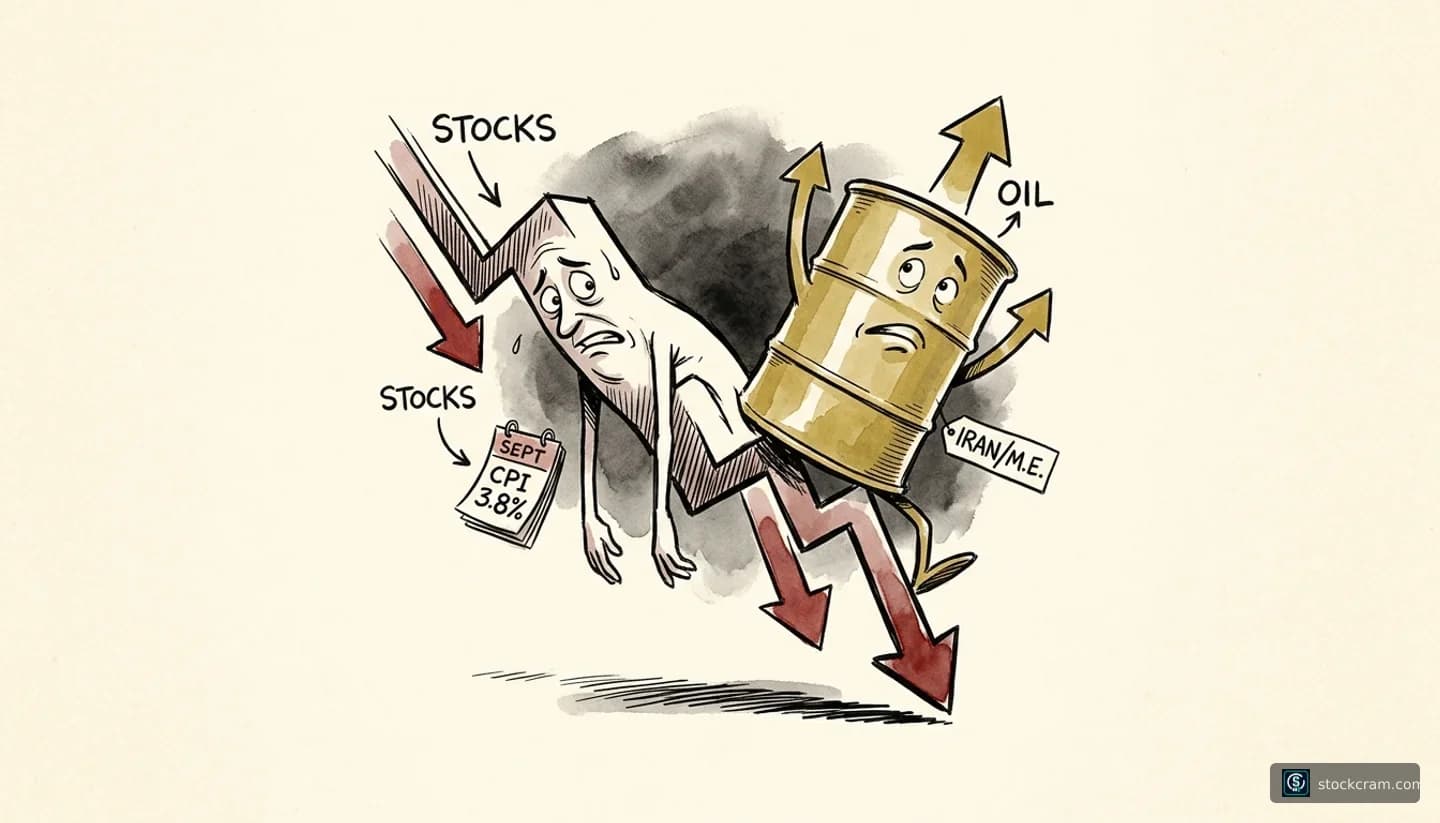
Oil surges on US-Iran strikes while biotech tumbles on drug trial failure. Markets brace for Friday's CPI report that could trigger Fed rate hike at September meeting.
Educational purposes only. This content does not constitute investment advice. Read our disclaimer
StockCram is not a broker-dealer, investment adviser, or financial institution. All content is for educational and informational purposes only and should not be construed as personalized investment advice. Consult a qualified financial professional before making investment decisions. Past performance does not guarantee future results.The United States and Iran traded strikes on oil tankers and warships over the weekend, escalating the conflict that began in February. Iran vowed to target Middle East energy infrastructure in response to further US attacks. Brent crude rose to $97.31 per barrel on Monday, the highest since late July, while WTI climbed above $92. Commercial tankers are now being deliberately used as economic weapons, disrupting global supply chains.
Higher oil prices threaten to reignite inflation just as the Fed debates whether to hike rates at its September 15-16 meeting. The conflict has already forced nations to burn through stockpiles to avoid deficits. If tensions near the Strait of Hormuz—which handles 20% of global oil flows—escalate further, analysts warn crude could top $100 per barrel and derail the Fed's progress on bringing inflation back to its 2% target.
Equities
Energy stocks rallied; broader indices fell 0.6-1.2%
Rates
Treasury yields climbed as oil-driven inflation fears grew
FX
Dollar strengthened modestly on safe-haven demand
Commodities
Brent crude hit $97, WTI reached $93—both up 8-10% last week
US stocks fell Tuesday as investors positioned ahead of Friday's August CPI report, due at 8:30 AM ET on September 11. The Dow shed 628 points, marking back-to-back losses following Monday's Labor Day holiday. Treasury yields surged, with the 10-year note hitting 4.82%—a level not seen since late 2023. Markets are now pricing in a higher chance of a Fed rate hike than a cut this year, a dramatic reversal from earlier in 2026.
Friday's inflation data will be the Fed's last major input before its September 15-16 policy meeting. Strong August payrolls data already raised expectations for tighter policy, and if CPI comes in hot—especially with energy prices climbing—the Fed could hike rates for the first time since pausing in July. That would pressure corporate margins, mortgage rates, and consumer spending heading into the final quarter of 2026.
Equities
Dow fell 628 points (-1.2%), S&P 500 dropped 0.6%, Nasdaq lost 0.3%
Rates
10-year Treasury yield hit 4.82%, highest since November 2023
FX
Dollar firm as rate hike expectations build
Commodities
Gold held near record highs on geopolitical uncertainty
Amgen shares plunged 10% on Tuesday after rival Novartis announced on September 4 that its experimental cholesterol drug pelacarsen failed to reduce heart attacks or strokes in a pivotal Phase III trial, despite successfully lowering lipoprotein(a) levels. The news rattled confidence in the entire Lp(a)-lowering drug class, including Amgen's own candidate olpasiran, which is in late-stage testing. BMO Capital downgraded Amgen to Market Perform, citing limited near-term upside and mounting loss-of-exclusivity headwinds on legacy products.
Amgen is the fourth-largest stock in the Dow Jones Industrial Average, so its 10% drop weighed heavily on the index Tuesday. The trial failure raises doubts about whether lowering Lp(a)—a lipid linked to heart disease—actually translates to better patient outcomes, threatening billions in expected revenue for multiple drugmakers. Amgen's cholesterol franchise, including fast-growing Repatha, remains a key growth driver, but the setback could delay or derail its longer-term pipeline bets.
Equities
Healthcare sector pressured; Dow component Amgen fell 10%, Eli Lilly dropped 2%
Rates
No direct impact
FX
No direct impact
Commodities
No direct impact
August nonfarm payrolls grew by 162,000, crushing expectations for 53,000 and marking a sharp acceleration from prior months. The unemployment rate held steady at 4.1%. Combined with upward revisions to June and July data, the report suggests the labor market remains resilient despite elevated interest rates. Fed Chair Kevin Warsh and dissenting committee members have grown increasingly vocal about the need to raise rates to contain price pressures, especially with oil prices surging.
At the start of 2026, markets were pricing in multiple rate cuts. Now, traders see a rate hike as more likely than a cut before year-end. The Fed's divided 9-3 vote in July—with three members pushing for a hike—signals that strong economic data and rising energy costs could tip the balance toward tightening at the September meeting. That would mark a major policy shift and challenge the equity rally that has powered stocks to near-record levels this year.
Equities
Rate-sensitive sectors underperformed; small caps lagged
Rates
Fed funds futures now price in a hike as more likely than a cut in 2026
FX
Dollar gained on hawkish Fed expectations
Commodities
Stronger dollar pressured non-energy commodities
The 2019 US-Iran tensions following the Soleimani strike sent Brent crude from $66 to $71 in days, but prices retreated within weeks as supply disruptions proved limited.
The S&P 500 dipped 1.2% initially but recovered within two weeks. This time, however, the conflict has already lasted seven months and cut global supply significantly, suggesting a more sustained impact on energy markets and inflation.
The magnitude and duration of the US-Iran conflict remain unpredictable, and Friday's CPI print could swing Fed policy expectations dramatically. Biotech sector volatility may also spread if additional Lp(a) trial data disappoints.