
Market Analysis
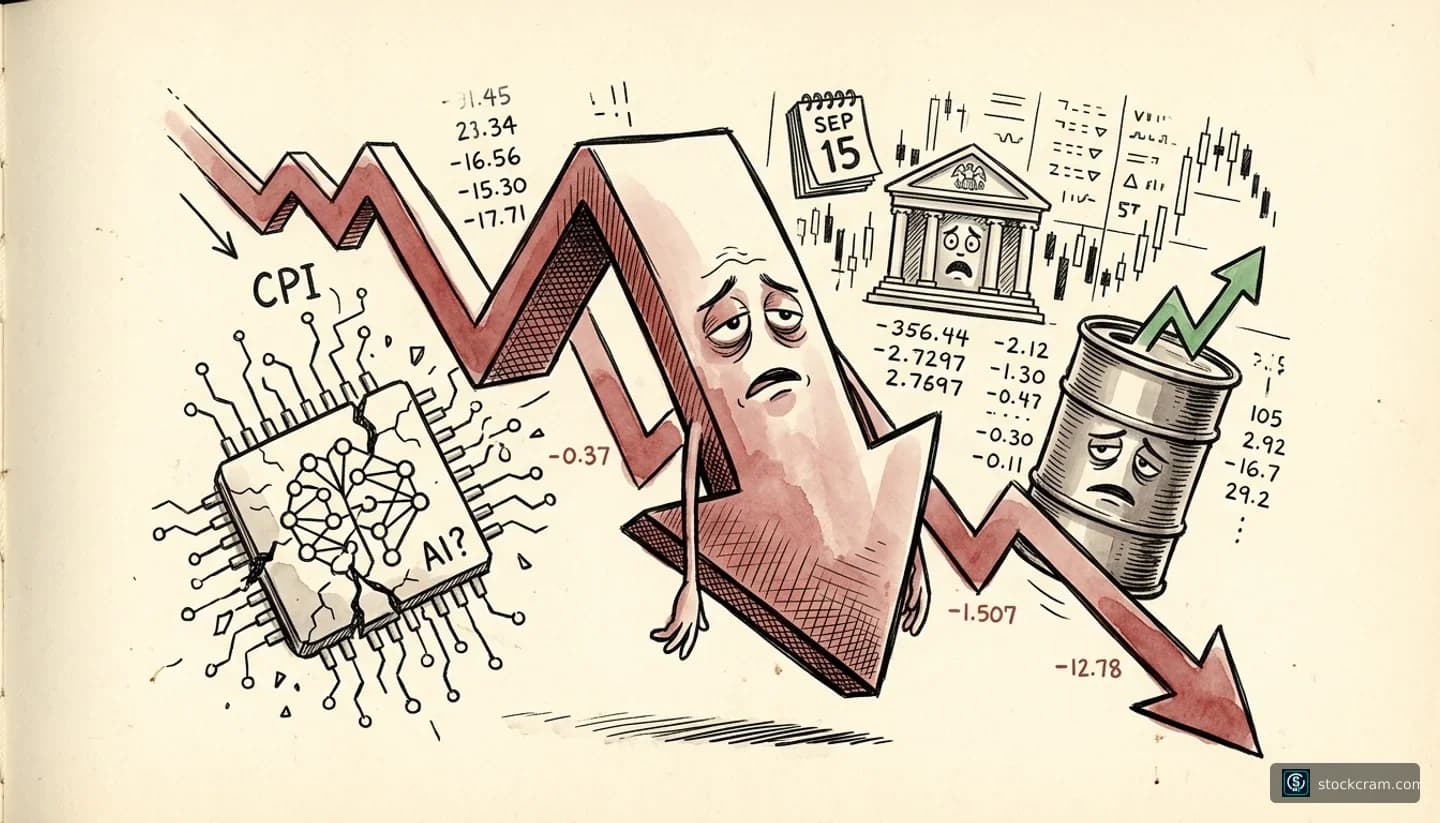
Stock Market Today, Oct 15: Hot CPI, Chip Rout
Read Article
Market Analysis
AI-powered insights into global financial markets
 StockCram Editorial4 min read
Markets tumbled as AI safety fears sparked a tech selloff while oil surged past $105 on Middle East supply shocks, raising inflation worries ahead of the Fed's Wednesday decision.
Educational purposes only. This content does not constitute investment advice. Read our disclaimer
StockCram is not a broker-dealer, investment adviser, or financial institution. All content is for educational and informational purposes only and should not be construed as personalized investment advice. Consult a qualified financial professional before making investment decisions. Past performance does not guarantee future results.Anthropic CEO Dario Amodei published an essay Saturday calling for AI companies to slow development of advanced models due to safety risks. OpenAI's Sam Altman, Elon Musk, and Google's Demis Hassabis publicly backed the proposal. The Philadelphia Semiconductor Index tumbled 5.9% on Monday, with Nvidia dropping 3.4% and Intel falling 5.6%. The call for a slowdown raised questions about the pace of AI investment and data center buildout. With Anthropic's IPO still pending, the timing of this announcement adds uncertainty to the AI sector's public market debut.
AI has been the primary driver of the 2026 bull market, with hundreds of billions in infrastructure spending at stake. A coordinated slowdown could reshape earnings expectations for chipmakers, cloud providers, and data center operators while potentially giving China a competitive edge if Western companies pull back unilaterally. The debate echoes questions raised in our analysis of whether we're in another AI bubble, as hyperscaler capex tops $700B in 2026.
Equities
Nasdaq fell 0.8%, S&P 500 down 0.5%, chip stocks plunged 5.9%
Rates
Treasury demand increased briefly as tech concerns mounted
FX
Dollar strengthened modestly as investors sought safety
Commodities
Limited impact, overshadowed by oil surge
Brent crude surged toward $108 Monday after drone attacks forced Saudi Arabia to shut its East-West pipeline, which carries 7 million barrels per day to Red Sea ports as an alternative to the blocked Strait of Hormuz. Talks between Iran and Gulf states scheduled in Oman were abruptly postponed. Oil prices have jumped more than 18% in September alone as the U.S.-Iran conflict shows no signs of ending. The Strait of Hormuz closure has now lasted three months, breaking historical oil-spike patterns.
Higher oil prices threaten to reignite inflation just as the Fed prepares to announce its rate decision Wednesday. Markets are pricing a 92% chance of a quarter-point hike. If crude stays above $100, it could force the Fed into a more aggressive tightening cycle, weighing on economic growth and corporate margins across most sectors. The persistent supply disruption represents a classic oil shock that could reshape monetary policy expectations.
Equities
Energy sector up 1.3%, but broader market pressured by inflation worries
Rates
Yields surged on inflation fears from higher energy costs
FX
Dollar gained as energy importers faced pressure
Commodities
Brent crude topped $105, WTI near $102, both up 75% year-to-date
Bank of America CEO Brian Moynihan told a Barclays conference Monday that third-quarter trading revenue would be flat year-over-year, breaking a 17-quarter growth streak. He also projected investment banking fees of $1.6-1.8 billion, well below the $2 billion Wall Street consensus. BofA shares dropped more than 5%, making it the worst performer in the KBW Bank Index.
After blockbuster second-quarter results (trading up 33%, investment banking fees up 50%), the sudden slowdown signals that Wall Street's hot streak may be cooling. Interest rate volatility and uncertainty ahead of the Fed meeting have frozen corporate activity, threatening a key profit engine for big banks heading into earnings season.
Equities
Bank of America fell 5.3%, dragging Goldman Sachs, Citigroup, JPMorgan lower
Rates
Modest Treasury buying as financial sector weakened
FX
Minimal direct impact
Commodities
No significant impact
The benchmark 10-year Treasury yield surged above 5% Monday morning for the first time since October 2023, driven by persistent inflation worries and surging oil prices. The yield later retreated to around 4.99% as some buyers stepped in. The move came just two days before the Fed's policy announcement, with markets pricing a 92% probability of a quarter-point rate hike Wednesday.
The 10-year yield sets borrowing costs across the economy, from mortgages to corporate debt. Breaking 5% signals that bond investors expect inflation to remain elevated and the Fed to stay hawkish longer than previously anticipated. If yields push toward 5.02%, they would reach levels not seen since July 2007, before the financial crisis.
Equities
Pressure on rate-sensitive sectors like real estate and utilities
Rates
10-year yield hit 5.01% before pulling back to 4.99%, 2-year at 4.66%
FX
Dollar index rose 0.37% as higher yields attracted capital
Commodities
Gold declined as higher yields reduced appeal of non-yielding assets
In October 2023, the 10-year Treasury yield last breached 5% amid Fed tightening fears, triggering a sharp equity correction. The S&P 500 fell nearly 10% over the following month before stabilizing.
Markets eventually stabilized once the Fed signaled a pause in rate hikes and inflation data improved. This time, however, oil supply shocks add a wild card that could keep the Fed in tightening mode longer, potentially extending market volatility.
The Fed's tone Wednesday is the biggest wildcard—a hawkish hike could accelerate the selloff, while a dovish hike might stabilize markets. Oil's trajectory depends on unpredictable geopolitical negotiations. The AI slowdown proposal could fizzle or gain momentum depending on regulatory and competitive pressures from China.