
Market Analysis
Stock Market Today, Oct 15: Hot CPI, Chip Rout
Read Article
Market Analysis
AI-powered insights into global financial markets
 StockCram Editorial3 min read
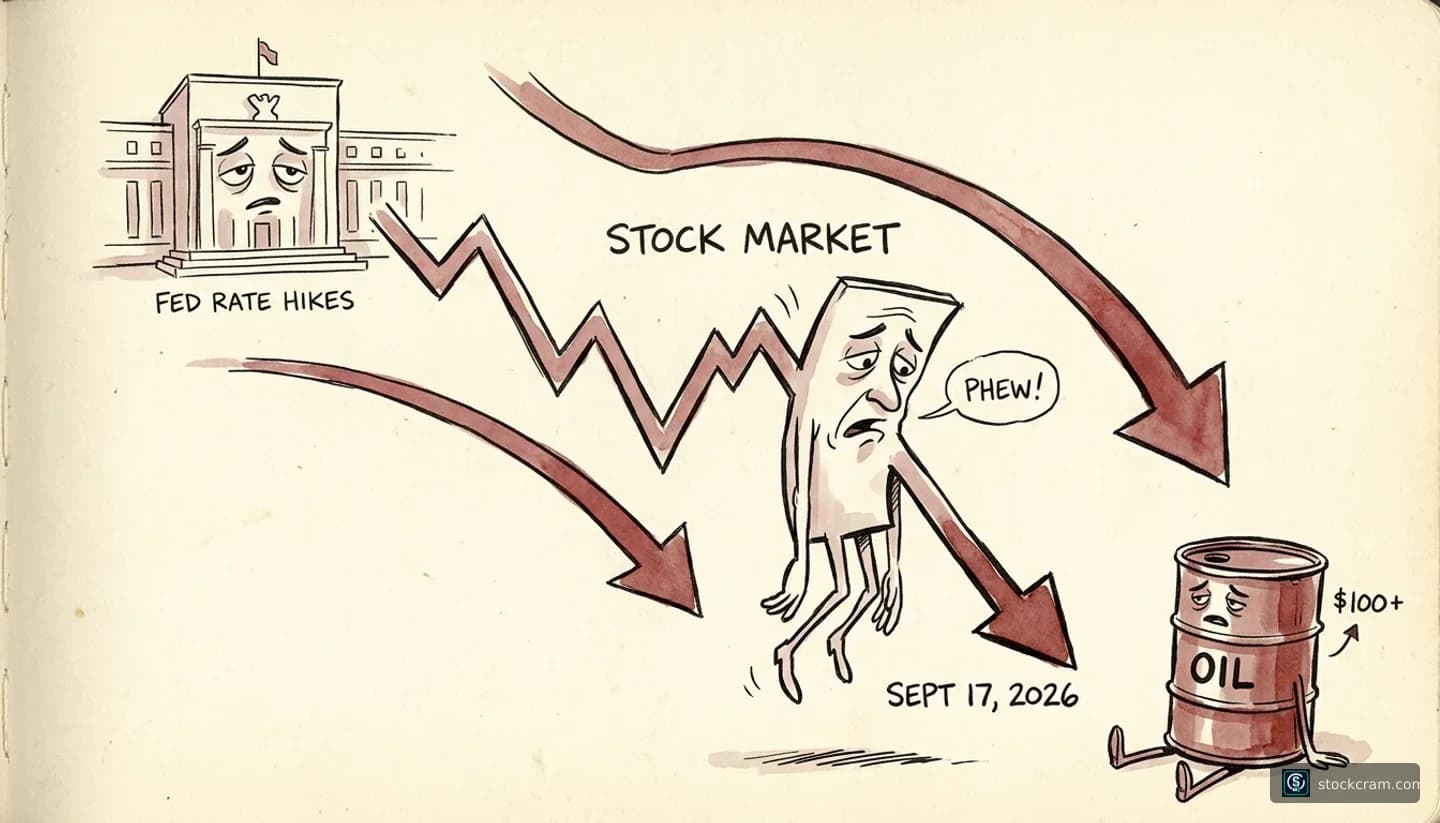
The Fed hiked rates for the first time in three years as oil topped $100 after a Saudi pipeline shutdown. Amazon locked in $8B of backup power for its AI data centers.
Educational purposes only. This content does not constitute investment advice. Read our disclaimer
StockCram is not a broker-dealer, investment adviser, or financial institution. All content is for educational and informational purposes only and should not be construed as personalized investment advice. Consult a qualified financial professional before making investment decisions. Past performance does not guarantee future results.The Federal Reserve raised its benchmark interest rate by 25 basis points to 3.75-4%, marking its first hike since July 2023. The unanimous 12-0 vote came after Chair Kevin Warsh signaled at Jackson Hole that inflation remains too high. Updated projections show 16 of 18 officials expect at least one more hike this year, with four seeing two additional increases possible.
This reverses the Fed's three-year pause and confirms that rising oil prices and stubborn inflation have forced policymakers back into tightening mode. Markets now face higher borrowing costs just as energy prices spike, squeezing corporate margins and consumer spending power heading into year-end. Understanding why the Fed shifted from expected cuts to hikes helps explain the disconnect between headline inflation numbers and the Fed's hawkish stance.
Equities
S&P 500 fell 0.4%, Dow dropped 631 points on Wednesday
Rates
10-year Treasury yield climbed to 5.01%, 2-year hit 4.72%
FX
Dollar strengthened moderately as rate differentials widened
Commodities
Pressure on gold and other non-yielding assets
Saudi Arabia shut down its 1,200-kilometer East-West pipeline on September 10-11 after drone strikes from Iraq damaged pumping stations. The pipeline moves 4-5 million barrels per day to the Red Sea, serving as Saudi Arabia's main bypass route since the Strait of Hormuz has been disrupted by the U.S.-Iran conflict. Oil prices surged above $100 per barrel for the first time in months.
With Hormuz largely closed and now the Saudi bypass route offline, roughly 5% of global oil supply is suddenly off the market. This supply shock is hitting just as the Fed hikes rates to combat inflation—creating a dangerous feedback loop where higher energy costs force more rate hikes, which in turn slow economic growth. This pattern differs from earlier oil spikes during the Hormuz closure, when alternative routes remained open.
Equities
Energy stocks rallied 1-2%, while airlines and transport fell sharply
Rates
Inflation expectations rose, pushing yields higher globally
FX
Emerging market currencies weakened on energy import costs
Commodities
WTI crude at $102, Brent near $108—up 60% year-over-year
Generac Holdings announced a long-term supply agreement with Amazon to provide up to $8 billion worth of backup generators for data centers, with $2.4 billion in initial deliveries scheduled for 2027-2028. Amazon received warrants to buy up to 1.69 million Generac shares at $200.93 each, potentially worth $340 million. Generac shares jumped over 40% in extended trading Wednesday.
This deal highlights how tech giants are scrambling to secure reliable power infrastructure as AI-driven data center expansion collides with an increasingly strained electrical grid. Amazon is essentially betting on Generac's future by taking equity stakes tied to delivery milestones—a model that could reshape how hyperscalers lock in critical suppliers. The massive capital expenditure on AI infrastructure continues despite questions about whether we're in another AI bubble.
Equities
Generac surged 33-45% after-hours; data center infrastructure stocks rallied
Rates
No significant impact
FX
Minimal direct impact
Commodities
Potential long-term support for natural gas and diesel demand
U.S. equity markets opened lower Thursday as investors absorbed Wednesday's Fed decision and the implications of oil above $100. The S&P 500 gained 0.59% by midday Thursday after falling 0.4% Wednesday, while the Dow had dropped 1.18% in the prior session. Credit-sensitive sectors like banks and rate-sensitive tech stocks led declines, with Bank of America down 2.7% and Microsoft falling 1.4%.
The market is caught between two forces: a Fed tightening into a slowing economy and an energy shock that could reignite inflation. Investors are repricing risk across asset classes, with volatility rising and defensive positioning increasing. The big question is whether the Fed will pause if oil-driven inflation persists but economic data weakens.
Equities
Banks fell 2-3%, tech down 0.6-1.4% as growth stocks repriced
Rates
VIX rose 2.97%, signaling increased volatility expectations
FX
Dollar Index strengthened as Fed diverged from peers
Commodities
Gold fell 1.87% as real yields climbed
In 2022-2023, the Fed raised rates 11 consecutive times (from 0.25% to 5.5%) to combat post-pandemic inflation, while oil spiked above $120 following Russia's invasion of Ukraine.
Markets eventually stabilized once the Fed paused and oil retreated, but the tightening cycle triggered a regional banking crisis in March 2023 and pushed the economy to the brink of recession. This time, the Fed is starting from a higher baseline (3.5%) with oil already elevated, raising risks of a policy mistake.
The duration of the Saudi pipeline shutdown remains unclear, and geopolitical risks in the Middle East could escalate further. We also don't know if the Fed will follow through on its hawkish projections if economic data softens, or if the administration will intervene with strategic reserve releases to cap oil prices before the November elections.