
Market Analysis
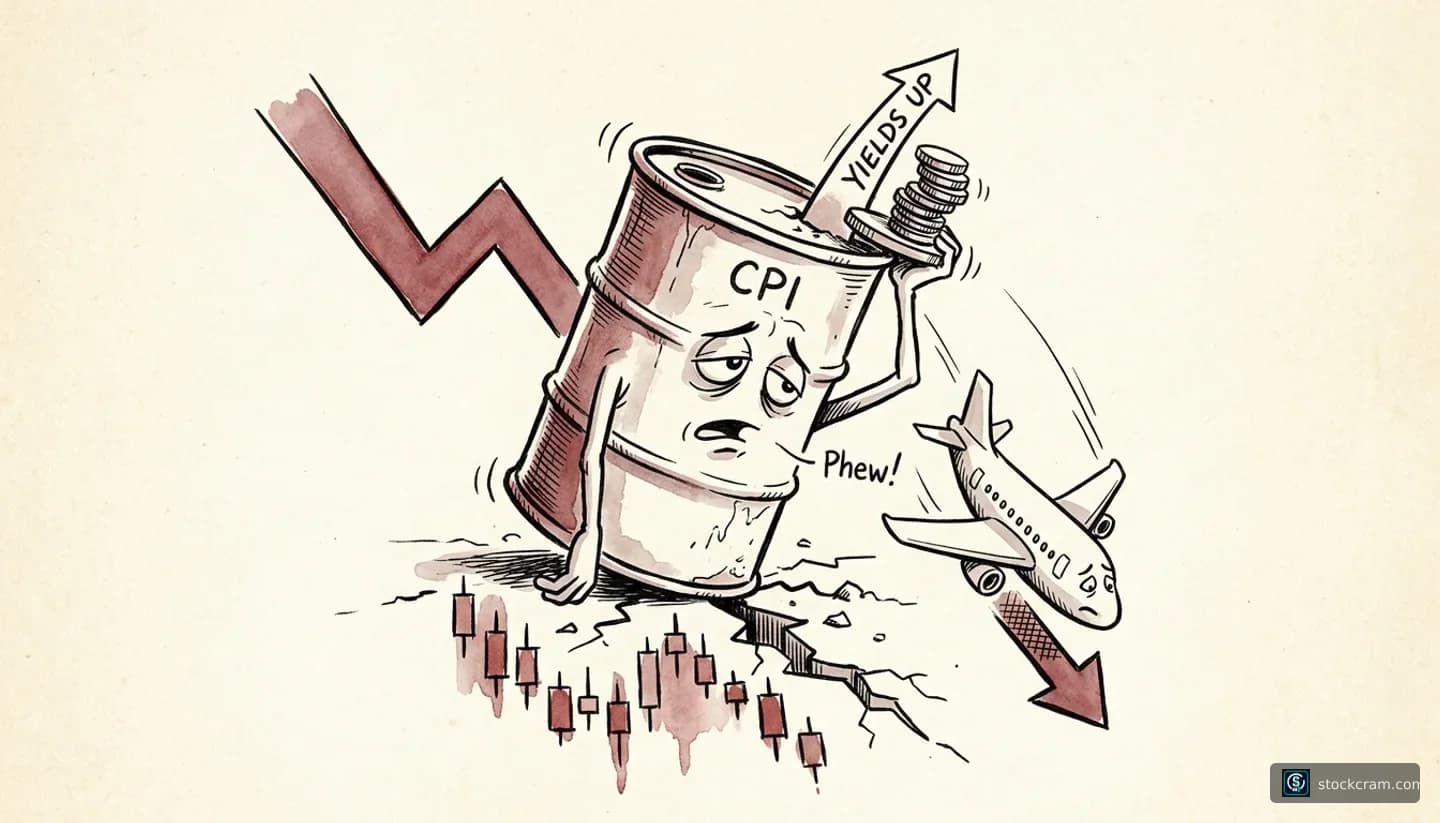
Stock Market Today, Oct 15: Hot CPI, Chip Rout
Read Article
Market Analysis
AI-powered insights into global financial markets
 StockCram Editorial3 min read
Treasury yields hit 19-year highs as Iran tensions fuel oil fears. Boeing crashes 7% on FAA delays while Nvidia announces record $150B buyback.
Educational purposes only. This content does not constitute investment advice. Read our disclaimer
StockCram is not a broker-dealer, investment adviser, or financial institution. All content is for educational and informational purposes only and should not be construed as personalized investment advice. Consult a qualified financial professional before making investment decisions. Past performance does not guarantee future results.Bond yields surged across the curve Monday as President Trump rejected Iran's latest peace proposal, keeping oil prices elevated and raising the specter of persistent inflation. The 10-year Treasury yield touched 5.24%, its highest level since 2007, while the 30-year climbed to 5.56%, a level not seen since 2004. Markets are now pricing in a 70% chance the Fed will hike rates again in October.
Rising borrowing costs threaten to choke off economic growth and squeeze corporate profits. Higher yields make stocks less attractive and mortgage rates more painful for homebuyers. If oil stays high and the Fed keeps tightening, the risk of a policy mistake—tipping the economy into recession—grows significantly.
Equities
S&P 500 down 0.8%, Nasdaq fell 0.9% as growth stocks sold off on rate pressure
Rates
10-year Treasury yield climbed to 5.24%, 30-year to 5.56%—both multi-decade peaks
FX
Dollar strengthened as safe-haven demand and rate hike bets converged
Commodities
Oil hovered near $98/barrel on Strait of Hormuz uncertainty
The Federal Aviation Administration announced it won't certify Boeing's 737 Max 10—the last variant of its best-selling jet family—until it assesses a newly discovered software issue affecting landing procedures. Boeing had expected approval within weeks. Shares tumbled nearly 7%, their worst day in recent memory, as investors worry about delivery delays and lost market share to Airbus.
The Max 10 is critical to Boeing's recovery after years of safety crises and production setbacks. Every month of delay pushes airlines toward Airbus and erodes Boeing's cash flow. This setback intensifies scrutiny on the company's quality control and raises questions about when—or if—Boeing can regain its footing in the narrowbody market.
Equities
Boeing dragged the Dow down 347 points; aerospace sector under pressure
Rates
No direct impact
FX
Minimal direct impact, but industrial weakness weighed on sentiment
Commodities
No direct impact
Federal Reserve Governor Lisa Cook told a tech conference in Oakland that AI-driven infrastructure spending—data centers, chips, and power—is fueling broad inflation, with utility costs up 5% over the past year. She warned that productivity gains from AI won't arrive in time to offset near-term price pressures, and she backed the Fed's recent rate hike, saying the labor market can handle tighter policy.
This is a clear signal the Fed sees inflation risks broadening beyond just energy. If AI investment—a pillar of the current bull market—is now being flagged as inflationary, the central bank may keep raising rates even as tech investors hope for a pause. That sets up a potential clash between Fed policy and market expectations.
Equities
Tech and growth stocks under pressure; utilities rose on AI power demand
Rates
Reinforced expectations for further rate hikes
FX
Hawkish Fed rhetoric supported the dollar
Commodities
Oil and electricity costs cited as inflation drivers
Nvidia unveiled a $150 billion increase to its share repurchase program—the largest single buyback authorization in US history—bringing its total authorization to $235 billion. CEO Jensen Huang said the company's massive cash flow from the AI boom gives it room to invest in new technologies and return capital to shareholders. The stock rose 1.7% Monday, bucking the broader tech decline.
Buybacks signal management confidence, and Nvidia's move suggests leadership sees the stock as cheap at a trailing P/E of around 30—its lowest valuation in four years. With analysts expecting earnings to nearly double this fiscal year, the buyback could provide a floor for the stock. But it also raises questions about whether Nvidia has exhausted its best growth opportunities.
Equities
Nvidia rose 1.7%, providing rare bright spot in tech selloff
Rates
No direct impact
FX
No direct impact
Commodities
No direct impact
The last time 10-year Treasury yields topped 5% was in mid-2007, just months before the financial crisis. Back then, the Fed was also tightening into a slowing economy, and credit markets eventually seized up.
Stocks peaked in October 2007 and then plunged 57% over the next 17 months. The lesson: when yields spike this fast, something usually breaks—either in markets, the economy, or both.
The biggest unknown is whether US-Iran tensions escalate or ease—oil could swing 20% either way. We also don't know if the Fed will tolerate 5%+ yields or intervene. Finally, AI's true inflation impact is uncharted territory; Cook's warning could be early or overstated.