
Market Analysis
Stock Market Today, Nov 9: Jobs Report Lifts Hike Odds
Read Article
Market Analysis
AI-powered insights into global financial markets
 StockCram Editorial4 min read
Tech giants surge as weak jobs data lifts rate-hold hopes, while a $23 billion industrial AI deal reshapes the software landscape.
Educational purposes only. This content does not constitute investment advice. Read our disclaimer
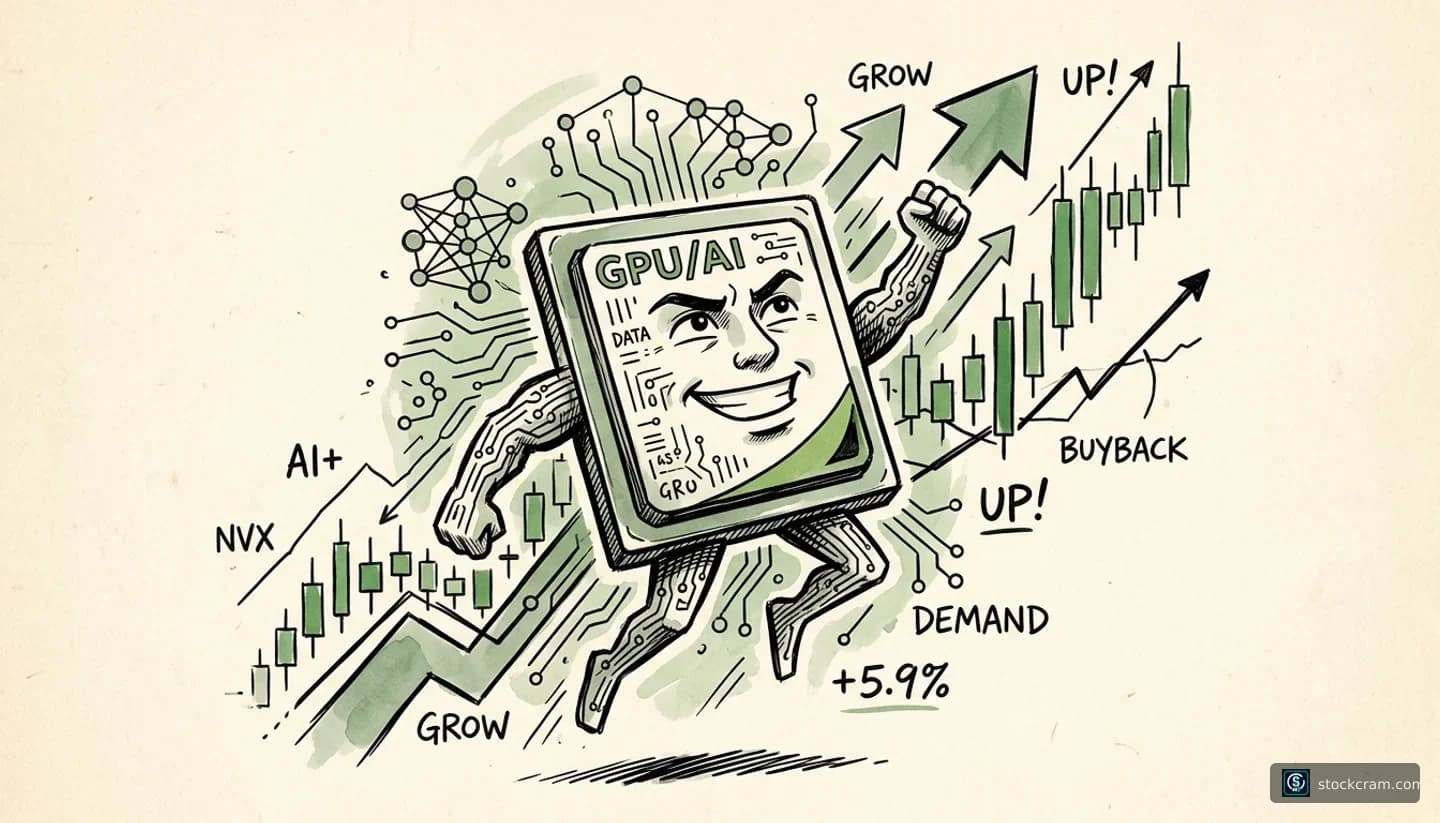
StockCram is not a broker-dealer, investment adviser, or financial institution. All content is for educational and informational purposes only and should not be construed as personalized investment advice. Consult a qualified financial professional before making investment decisions. Past performance does not guarantee future results.Nvidia hit a fresh all-time high and is approaching $6 trillion in market value after announcing the largest stock buyback in corporate history alongside robust revenue guidance. The chipmaker's valuation sits near multi-year lows on a price-to-earnings basis even as growth remains strong, attracting investors rotating back into AI stocks. Semiconductor stocks rallied broadly, pushing the Nasdaq Composite to a new record close above 27,400.
Nvidia's breakout signals renewed confidence in the AI infrastructure buildout despite high interest rates and economic uncertainty. The combination of strong earnings visibility and a massive buyback program is drawing capital back into mega-cap tech at a critical moment when market breadth has been deteriorating for weeks.
Equities
Nasdaq hits record on AI momentum; tech-heavy indices outperform
Rates
Treasury yields hold near 5.3% despite equity gains
FX
Dollar strengthens moderately on tech strength
Commodities
Gold slips as risk appetite improves
French energy giant Schneider Electric agreed to buy Boston-based industrial software firm PTC in an all-cash deal at $205 per share, representing a 42% premium. The $22.6 billion equity transaction—Schneider's largest ever—aims to create a leading industrial software and AI platform by combining PTC's product design tools with Schneider's energy management systems. The deal is expected to close in Q3 2027 after shareholder and regulatory approvals.
This mega-deal underscores how established industrial players are racing to embed AI across physical operations, from manufacturing to energy systems. The steep premium paid for PTC reflects the strategic value of software that bridges digital and physical worlds, and could trigger more consolidation in the industrial tech sector as companies seek scale in AI-powered automation.
Equities
PTC surges 33% on deal premium; industrial software sector gains
Rates
Minimal impact on rates
FX
Euro weakens slightly on large cross-border acquisition
Commodities
No direct impact
The 10-year Treasury yield surged to 5.35% on Monday—the highest level since April 2002—before pulling back after Friday's shockingly weak September jobs report showed just 29,000 payrolls added versus 84,000 expected. The yield volatility reflected competing forces: persistent inflation concerns, massive government borrowing needs, and Middle East tensions pushing rates higher, while the weak labor data reduced expectations for further Fed tightening. Markets now price an 82% chance the Fed holds rates steady at its October meeting.
The 10-year yield breaking above 5.3% marks a psychological threshold that pressures equity valuations and raises borrowing costs across the economy. However, the sharp jobs miss gives the Fed cover to pause rate hikes, creating an unusual market dynamic where growth stocks rally even as the risk-free rate remains exceptionally high. This tension between elevated yields and softening economic data will define the path forward for both stocks and bonds.
Equities
Rate-sensitive sectors pressured early, then rally on Fed pause hopes
Rates
10-year yield peaks at 5.35%, highest since 2002, before settling near 5.28%
FX
Dollar volatile; initially strong on yields, then softens
Commodities
Gold gains on lower rate-hike expectations
Crude prices declined for a second straight session as data showed Middle East oil exports recovering toward pre-conflict levels, and G7 nations pledged to release 100 million barrels from emergency reserves. WTI settled near $89 per barrel while Brent fell to $100, down from last week's peaks. Saudi Arabia unexpectedly cut its November pricing for Asian buyers by $3 per barrel—the steepest discount since June 2020—signaling intensifying competition for market share. However, downside remains limited by tanker attacks in the Strait of Hormuz and reports that the U.S. deployed a third aircraft carrier to the region.
The pullback in oil prices offers relief on inflation pressures and could boost consumer spending power heading into the holiday season. But the fragile recovery in crude flows—combined with ongoing military tensions and constrained refinery capacity—means energy markets remain vulnerable to sudden supply shocks. Lower oil also reduces the urgency for aggressive Fed tightening, supporting risk assets in the near term.
Equities
Energy sector underperforms; consumer discretionary benefits
Rates
Lower oil eases inflation fears, supporting bonds
FX
Oil-linked currencies weaken moderately
Commodities
WTI falls to $89; Brent drops to $100 from recent highs above $103
In October 2007, the 10-year Treasury yield last traded consistently above 5% before the Global Financial Crisis, while oil prices were climbing toward their 2008 peak of $147 per barrel amid Middle East tensions
Elevated yields eventually contributed to the housing market collapse and credit crisis, while high oil prices crushed consumer spending. Today's setup differs—the economy remains resilient and unemployment is low—but the combination of 5%+ yields and geopolitical energy risks creates similar headwinds for growth-sensitive assets
The path of oil prices remains highly uncertain given Middle East military escalation risks. Fed policy direction is clouded by conflicting signals—weak jobs data versus sticky inflation and elevated yields. Market breadth continues to deteriorate even as mega-cap tech rallies, raising questions about the sustainability of index gains.