
Market Analysis
Why Did Stocks Fall Nov 6? AI Selloff, Jobs
Read Article
Market Analysis
AI-powered insights into global financial markets
 StockCram Editorial4 min read
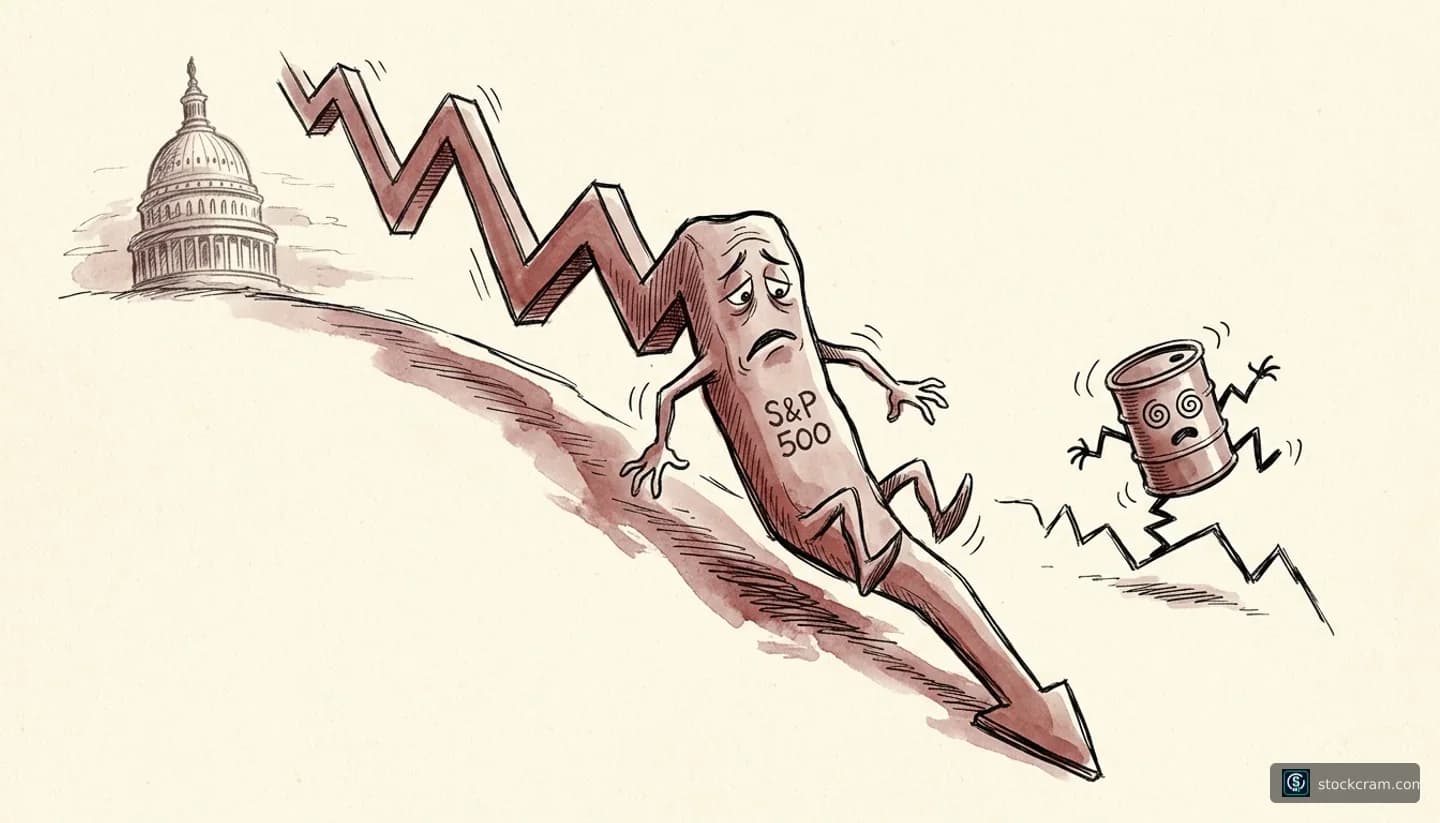
Stocks ended Election Day with small, mixed moves, then S&P 500 futures fell about 1.25% overnight as Democrats won key midterm races.
Educational purposes only. This content does not constitute investment advice. Read our disclaimer
StockCram is not a broker-dealer, investment adviser, or financial institution. All content is for educational and informational purposes only and should not be construed as personalized investment advice. Consult a qualified financial professional before making investment decisions. Past performance does not guarantee future results.US stock futures dropped on election night after Democrats posted strong early results in the midterm elections. S&P 500 futures fell about 1.25% and Dow futures fell 408 points, or 0.79%, as investors weighed what a shift in congressional control could mean for taxes, spending and regulation. The drop followed a mixed Tuesday session: the S&P 500 rose 0.36% to about 7,569, the Nasdaq gained 0.83% to 25,372.01, and the Dow slipped 0.38% to 51,786.72.
Markets dislike surprises, and a split or Democratic Congress could change tax and spending plans. Futures moves overnight can shrink or grow by the open, so Wednesday's opening prices will show how much investors cared. History offers some context: the S&P 500 has risen in the 12 months after every midterm since 1950, per JPMorgan Asset Management analysis. New to the term? Look up 'futures' in our stock market glossary.
Equities
Overnight S&P 500 futures fell about 1.25% and Dow futures fell 408 points (0.79%) as results came in.
Rates
10-year Treasury yield ended Tuesday near 4.96%; no election-night yield move is confirmed.
FX
No clear move reported; the dollar ended Tuesday firmer against the yen and the Australian dollar.
Commodities
Brent closed Tuesday at $103.60; oil has been a campaign issue.
Brent crude, the global oil benchmark, fell more than $6 to $100.80 on Tuesday morning before recovering, and it closed down 1.12% at $103.60 a barrel. Reports of a US-approved draft deal with Iran drove the drop, and officials then denied a breakthrough. US WTI crude closed down 0.38% at $96.09, its second straight daily decline.
Oil prices feed into gasoline, shipping and food costs, which keep inflation higher. Headlines about the Iran conflict can move prices within minutes, so the daily level can hide wide swings. For more background, see our look at how the US-Iran conflict has affected stocks.
Equities
Energy shares lagged on Monday; the broad market ignored the oil whipsaw on Tuesday and chip stocks led gains.
Rates
Treasury yields moved higher as oil swung and jobs data came in strong.
FX
Oil swings fed into currency moves; the Australian dollar fell about 0.5% after the RBA's split rate hike.
Commodities
Brent fell 1.12% to $103.60 a barrel and WTI fell 0.38% to $96.09, after Brent dropped from $107.24 to $100.80 intraday.
The US government's September JOLTS report showed job openings rose 333,000 to 7.523 million, above the 7.164 million economists expected and the prior reading of 7.19 million (revised). Quits jumped 321,000, the most since May 2023, though restaurants and hotels drove most of that rise. Treasuries fell after the report, pushing the 10-year yield to near 4.96%.
A strong job market gives the Federal Reserve less reason to ease up. The Fed held rates at 3.75%-4.00% in October after raising them in September, and some forecasters expect another hike in December. Learn what a yield is and why it moves.
Equities
Little direct effect; the S&P 500 still closed up 0.36%.
Rates
The 10-year Treasury yield rose to near 4.96%.
FX
The dollar ended firmer against the yen and the Australian dollar.
Commodities
No direct effect reported.
Advanced Micro Devices (AMD) reported third-quarter revenue of $13.38 billion, up 45% from a year earlier, against the $13.06 billion Wall Street expected. Adjusted earnings were $2.09 a share versus the $1.94 expected, and data center sales hit a record $8.5 billion. AMD forecast fourth-quarter revenue of about $17 billion, and its shares jumped in after-hours trading after closing at $483.90.
Chip stocks had slid in recent sessions, and the Nasdaq-100 was still about 10% below its recent high on Tuesday. AMD's results gave a fresh look at demand for AI hardware, which has driven much of the market. Learn more with our guide on what a stock is.
Equities
AMD rose 3.65% to $483.90 in regular trading, then 5% to 9% after hours; Nasdaq rose 0.83%.
Rates
No notable effect.
FX
No notable effect.
Commodities
No notable effect.
The Reserve Bank of Australia raised its cash rate to 4.85% on November 3, as markets expected. Six board members voted for the hike and three voted against it, and the bank raised its inflation forecasts. The Australian dollar fell against the US dollar after the split vote.
Central banks abroad are still raising rates as energy costs keep inflation high. That is the same pressure facing the US Federal Reserve.
Equities
No direct US effect reported.
Rates
Australia's cash rate rose to 4.85%.
FX
The Australian dollar slipped about 0.5% against the US dollar.
Commodities
No direct effect reported.
Past US midterm elections, which often bring short-term nerves over who controls Congress.
The S&P 500 has risen in the 12 months following every midterm election since 1950, according to JPMorgan Asset Management analysis. Past results do not guarantee future ones. For a longer view of market swings, see how the market recovered after Black Monday 1987.
Final midterm results for the House and Senate were still coming in overnight, and Wednesday's market reaction is not yet known. Oil prices are swinging on conflicting Iran headlines. Sources disagree on some details, such as the exact size of AMD's after-hours gain.