
Market Analysis
Stock Market Today, Oct 13: Chip Selloff
Read Article
AI-powered insights into global financial markets
 StockCram Editorial10 min read
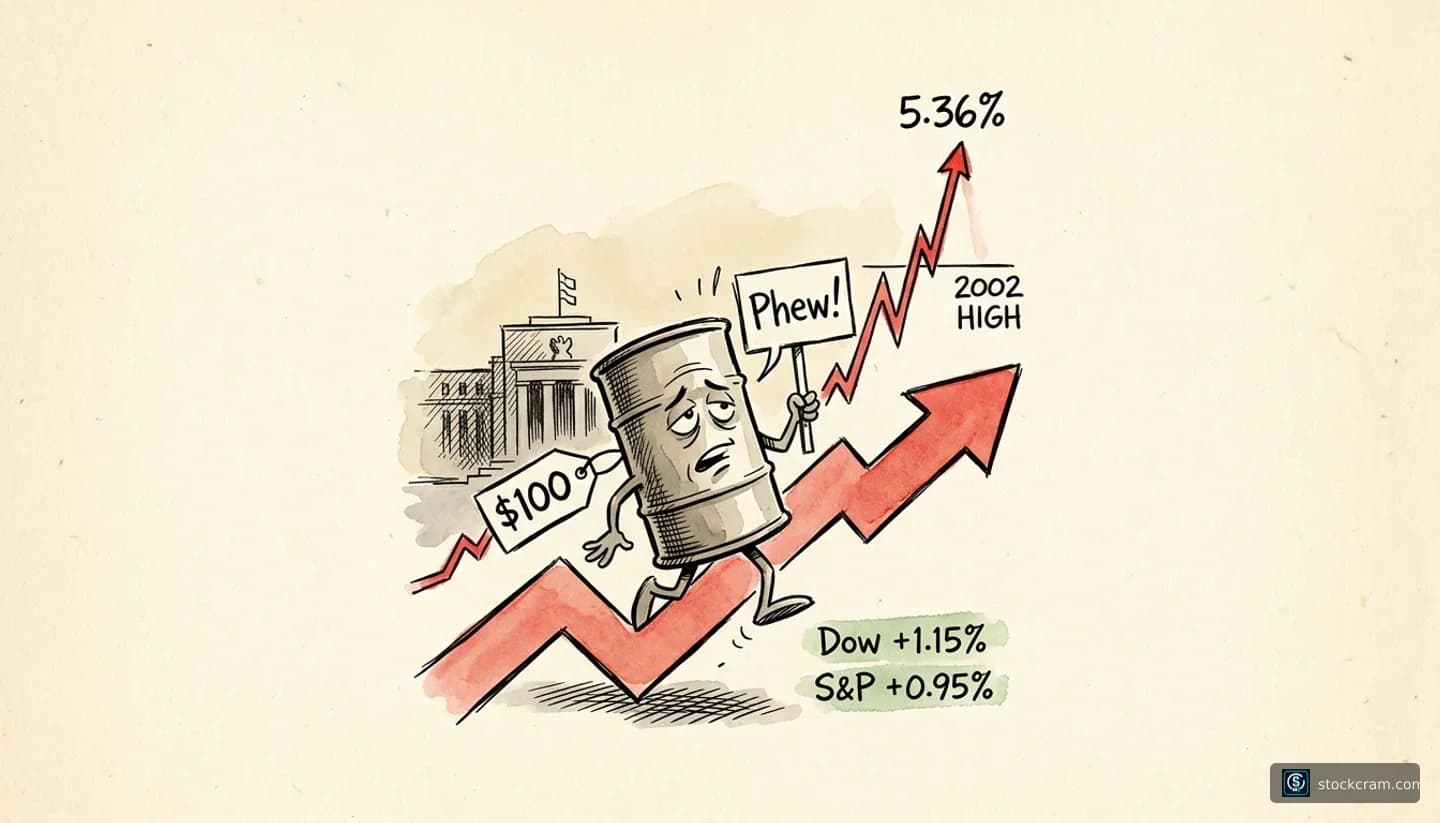
Stocks finished higher despite Treasury yields hitting 20-year peaks and geopolitical tensions driving oil near $100.
Week of Monday, October 5, 2026 - Friday, October 9, 2026
+0.95%
7,811.51
+0.19%
27,366.17
+1.15%
51,655.01
+0.52%
2,808.57
14.84
-3.70%
5.24%%
+0.08%
$$90.35
-0.89%
$$4,193.87
+1.47%
102.32
+0.23%
The 10-year Treasury yield climbed to 5.36% on Wednesday, its highest level since April 2002, before settling at 5.24% by Friday. The surge reflected market expectations for persistent inflation and potential Federal Reserve rate hikes, with Fed minutes released Wednesday showing most policymakers believe another increase would be appropriate by year-end. Rising yields pressured growth stocks and raised concerns about financing costs across the economy.
Higher yields created headwinds for technology and other growth-oriented sectors, while also supporting the dollar and weighing on bond prices. The yield spike contributed to Wednesday's broad market decline and kept volatility elevated through the week.
Oil prices whipsawed between $88 and $92 per barrel as Houthi forces escalated attacks on Saudi energy infrastructure, including strikes on Aramco facilities near Riyadh. Saudi-backed Yemeni government forces launched a renewed offensive to retake territory near the Bab al-Mandeb Strait, a critical shipping chokepoint. The fighting intensified concerns about supply disruptions in a market already facing elevated prices due to broader Middle East tensions.
Energy sector stocks fluctuated with oil prices, with the sector finishing the week modestly higher. The geopolitical risk premium supported oil near $91 by Friday, contributing to inflation concerns and complicating the Federal Reserve's policy outlook.
Reports emerged Thursday that OpenAI's annualized revenue stood at approximately $50 billion as of late September, significantly below the $68-70 billion figure previously circulated among investors. The discrepancy stemmed from different accounting methodologies for partner revenue, but the news triggered questions about AI demand sustainability. Chipmakers and cloud providers sold off sharply, with Nvidia down nearly 3%, Oracle falling over 5%, and Intel dropping more than 5% on Thursday.
The tech-heavy Nasdaq fell 1.25% on Thursday in its worst session of the week. While Friday saw a partial rebound, the episode highlighted investor sensitivity to any signs that AI spending might not justify the sector's elevated valuations.
Minutes from the Federal Reserve's September 15-16 meeting, released Wednesday, showed that most policymakers assessed another rate hike would likely be appropriate by year-end. The document revealed some participants took a more hawkish view, emphasizing the need for higher rates to address demand-driven inflation rather than simply offsetting supply shocks. Markets currently price approximately 20% odds of a hike at the late October meeting, with higher probability for December.
Treasury yields surged to two-decade highs on the news, with the 10-year touching 5.36%. Stocks opened lower Wednesday and struggled to recover, with the S&P 500 falling 0.22% and the Dow dropping 0.66%.
Some market participants noted that the economy's resilience in the face of higher rates demonstrates underlying strength, and that clarity on the Fed's path reduces uncertainty even if rates stay elevated longer.
Cautious analysts pointed to the risk that additional rate hikes could tip the economy into recession, particularly as consumers face higher borrowing costs and companies grapple with elevated financing expenses just as earnings season begins.
Delta Air Lines reported third-quarter earnings of $1.72 per share on revenue of $17.59 billion, missing Wall Street estimates of $1.77 per share and $17.65 billion in revenue. The airline slashed its full-year 2026 adjusted earnings outlook to $5.10-$5.60 per share from a prior range of $6.50-$7.50, citing a $6 billion increase in fuel costs. CEO Ed Bastian said demand remains strong despite higher ticket prices, but the company cut its free cash flow forecast to $2.5 billion from $4 billion.
As the first major airline to report third-quarter results, Delta's miss and reduced guidance set a cautious tone for the sector. The report underscored how elevated energy prices are squeezing profit margins across industries.
Optimistic observers noted that Delta maintained profitability despite the fuel shock and that strong demand allows the company to pass through higher costs via fare increases, suggesting pricing power remains intact.
Skeptical analysts highlighted the magnitude of the profit outlook cut and warned that if fuel prices remain elevated, airlines may struggle to maintain margins even with fare increases, particularly if economic weakness eventually dampens travel demand.
Iran-backed Houthi forces claimed strikes on Saudi Aramco facilities south of Riyadh on October 3-4, with flames and smoke visible at the sites. Saudi Arabia reported intercepting additional projectiles throughout the week while launching airstrikes on Houthi-controlled areas in Yemen. The escalation came as Saudi-backed Yemeni government forces launched an offensive to retake positions near the Bab al-Mandeb Strait, through which significant global oil and trade flows pass. The Houthis have declared a naval blockade on Saudi shipping in the Red Sea.
Oil prices spiked above $92 per barrel mid-week on supply disruption fears before settling near $91 by Friday. Energy stocks showed volatility but finished the week modestly higher, while the developments added to broader inflation concerns weighing on markets.
Some energy analysts noted that Saudi Arabia has significant spare production capacity and that global oil inventories remain adequate, suggesting any supply disruptions would likely be temporary and manageable.
Geopolitical risk specialists warned that the Bab al-Mandeb Strait represents a critical chokepoint for global trade, and that sustained conflict in the region could disrupt shipping routes and drive sustained energy price increases, compounding inflation pressures.
The sector led Friday's rally as Treasury yields retreated from Wednesday's peaks, making real estate investment trusts more attractive on a relative yield basis and easing concerns about refinancing costs.
Healthcare stocks advanced on defensive positioning as investors sought stability amid bond market volatility and geopolitical uncertainty, with the sector benefiting from its lower sensitivity to economic cycles.
Despite volatility tied to Middle East tensions, energy stocks finished modestly higher for the week as oil prices remained elevated near $91 per barrel, up more than 55% year-over-year.
The sector faced selling pressure after OpenAI revenue reports sparked concerns about AI demand sustainability, with chipmakers and cloud infrastructure providers leading declines. Rising Treasury yields also weighed on growth-oriented tech valuations.
The sector declined alongside broader technology weakness, as higher discount rates from rising yields pressured valuations for companies with long-duration cash flows.
Concerns about consumer spending power amid elevated inflation and higher borrowing costs weighed on the sector, though losses were limited by resilient demand signals from companies like Delta despite its profit warning.
The commercial real estate data and analytics provider rallied on strong revenue growth expectations and as investors rotated into companies with pricing power and recurring revenue models in a higher-rate environment.
The restaurant chain advanced on strong same-store sales data and evidence that consumers continue spending on dining despite inflation concerns, with the company demonstrating ability to pass through higher costs.
The refiner benefited from elevated crack spreads as oil prices remained high and refining capacity remained tight, with geopolitical tensions supporting the premium for refined products.
The cloud infrastructure provider fell sharply Thursday after OpenAI revenue reports raised questions about the pace of AI infrastructure spending, with investors concerned that demand may not justify the massive capital expenditures across the sector.
The chipmaker declined alongside broader AI-related stocks following concerns about OpenAI's revenue trajectory, though the company maintained its position as a key beneficiary of artificial intelligence infrastructure buildout.
The semiconductor manufacturer extended recent weakness as investors questioned its competitive position in AI chips and as the broader sector faced selling pressure on concerns about the sustainability of AI capital spending.
Expected: 200,000
The lower-than-expected claims figure suggested labor market resilience continues, supporting the Federal Reserve's view that the economy can withstand higher interest rates but also reducing urgency for rate cuts.
Expected: 50.5
Weakening consumer confidence reflected household concerns about persistent inflation and higher borrowing costs, though the impact on actual spending behavior remained unclear as Delta and other companies reported strong demand.
Expected: 3.6% in August
The increase to the highest level since May 2023 signaled that inflation expectations are becoming less anchored, potentially justifying the Fed's hawkish stance and contributing to the week's bond market selloff.
The 10-year Treasury yield's climb to 5.36% marked the highest level since April 2002, a period when the Federal Reserve was in the early stages of an easing cycle following the 2001 recession. Today's context differs significantly—yields are rising due to persistent inflation and potential further Fed tightening rather than economic recovery. The current environment more closely resembles 2006-2007, when yields remained elevated before the financial crisis, though underlying economic conditions differ substantially.
Historical patterns suggest that when Treasury yields reach multi-decade highs, markets often experience increased volatility as investors reassess valuations across asset classes. The 2002 period saw technology stocks still recovering from the dot-com bust, while today's market faces questions about AI valuations. Past episodes of yield spikes have sometimes preceded either recession or a pivot in Fed policy, though each cycle's specific drivers and outcomes vary. Investors historically have benefited from maintaining diversified portfolios during periods of elevated rate uncertainty.
October 3-7, 2026
Houthi forces launched multiple attacks on Saudi Aramco oil facilities near Riyadh throughout the week, with Saudi Arabia responding with airstrikes on Houthi-controlled territory in Yemen. The Iran-backed group declared a naval blockade on Saudi shipping in the Red Sea and threatened the Bab al-Mandeb Strait, a critical chokepoint through which significant global oil and trade flows pass. Saudi-backed Yemeni government forces launched a counter-offensive to retake coastal positions.
Market Relevance
Oil prices fluctuated between $88 and $92 per barrel on supply disruption concerns, adding to inflation pressures that are already keeping the Federal Reserve in hawkish mode. Energy sector volatility reflected uncertainty about the conflict's duration and potential impact on global supply. Observers noted this represents the most significant escalation in the region since earlier 2026 attacks.
The situation remains fluid with active military operations continuing. Further escalation could disrupt shipping through the Bab al-Mandeb Strait and sustain elevated oil prices, while de-escalation could ease energy market tensions.
Disclaimer: This weekly recap is for educational purposes only and does not constitute investment advice. Past performance is not indicative of future results. Always consult with a qualified financial advisor before making investment decisions.