
Market Analysis
Stock Market Today, Oct 15: Hot CPI, Chip Rout
Read Article
Market Analysis
AI-powered insights into global financial markets
 StockCram Editorial14 min read
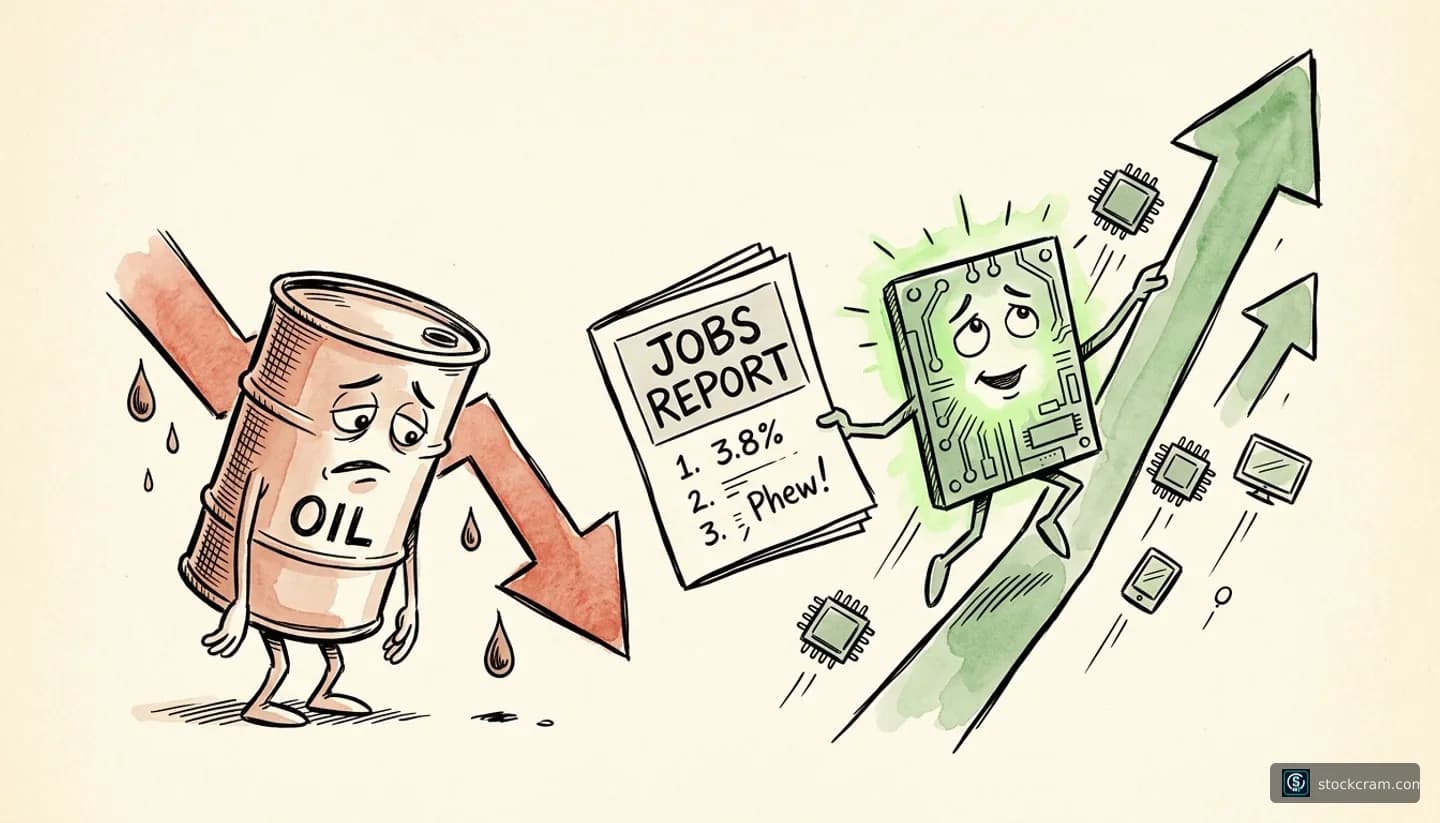
Markets rallied Friday as weak September jobs data eased rate-hike fears, while oil tumbled on G7 reserve releases amid Iran tensions.
Week of Monday, September 28, 2026 - Friday, October 2, 2026
+0.01%
7,722.72
+1.3%
27,190.86
-0.6%
51,176.96
+0.9%
2,806.00
15.31
-6.6%
5.27%%
+0.03%
$$89.41
-1.5%
$$4,172
+0.9%
102.0
+0.8%
The week opened with markets under pressure as President Trump rejected Iranian peace proposals over the weekend, sending oil prices surging toward $110 per barrel and reigniting concerns about inflation pressures. Brent crude climbed above $105 during the week as the U.S.-Iran conflict intensified, with attacks on shipping in the Strait of Hormuz disrupting global energy supplies. By Friday, oil reversed sharply lower—falling over 3%—after G7 nations announced plans to release 100 million barrels from strategic reserves over four months.
Energy sector stocks led gains early in the week, rising 2.0% as oil prices climbed, but the broader market struggled as investors worried that sustained high energy costs would force the Federal Reserve to maintain its hawkish stance despite signs of economic cooling.
The Federal Reserve raised interest rates by 25 basis points to 3.75%-4.00% on September 16—its first hike since 2023—citing elevated inflation driven by oil price pressures. The unanimous decision marked a hawkish shift, with updated projections suggesting another hike could come before year-end. However, Friday's September jobs report showed the economy added just 29,000 jobs versus 84,000 expected, with the unemployment rate ticking up to 4.2% and July's payrolls revised into negative territory. The miss gave markets confidence the Fed would pause at its October meeting.
The 10-year Treasury yield hit 5.29% midweek—a 19-year high—before retreating to 5.27% Friday as bond traders recalibrated rate-hike expectations. The VIX volatility index fell 6.6% Friday to close at 15.31, reflecting reduced near-term uncertainty about Fed policy.
Technology stocks demonstrated resilience throughout the week, with artificial intelligence-related names leading the charge. Nvidia hit an all-time intraday high of $237.88 on Friday after Morgan Stanley reinstated the stock as a top pick in semiconductors. The rally came despite broader market weakness Monday, when the Nasdaq fell 0.9% alongside most sectors. Semiconductor stocks rallied in Friday's premarket session, with chip names gaining 2-4% as traders positioned for a Fed pause.
The Technology sector finished the week down just 0.2%, vastly outperforming most other sectors and highlighting the market's narrow leadership. This concentration in mega-cap tech stocks helped the Nasdaq post gains while the equal-weighted S&P 500 struggled, underscoring investor preference for quality growth names in an uncertain macro environment.
The U.S. economy added just 29,000 jobs in September, far below the 84,000 consensus estimate, while the unemployment rate ticked up to 4.2% from 4.1%. Average hourly earnings rose only 0.1%, pushing the annual wage growth rate down to 3.0%—below the 3.2% forecast. July's payrolls were revised downward to show a loss of 10,000 jobs (previously reported as a 21,000 gain), and August was revised down to 133,000 from 162,000.
Stocks surged on the news, with the S&P 500 gaining 0.7% and the Nasdaq jumping 1.2% to touch an intraday record. Treasury yields fell sharply, with the 10-year dropping from 5.29% to 5.27%, as traders priced in a higher probability the Fed would hold rates steady at its October 30 meeting.
Market participants viewed the weak report as removing pressure on the Federal Reserve to continue aggressive rate hikes, potentially allowing the economy to achieve a soft landing. The data suggested inflation pressures from wage growth were easing even as the labor market remained above pre-pandemic unemployment levels.
Some analysts noted the sharp downward revisions and slowing wage growth indicated the labor market was deteriorating faster than expected, raising concerns that the Fed's September rate hike may have been a policy error. The combination of rising unemployment and elevated inflation from energy costs presented a challenging stagflation-like scenario.
The Federal Aviation Administration announced Monday it would delay certification of Boeing's 737 Max 10—the largest variant of the company's best-selling jet—after the aerospace giant disclosed a software glitch affecting automated flight guidance during certain go-around landing scenarios. FAA Administrator Bryan Bedford said the agency would not approve the aircraft until it determined whether the issue posed a safety risk, with no timeline provided for resolution.
Boeing shares fell 6.9% Monday, dragging the Dow Jones Industrial Average down 347 points. The stock recovered modestly Thursday after the company avoided a strike from its white-collar union, but remained under pressure for the week as investors questioned further delays to a program already years behind schedule.
Observers noted that Boeing successfully negotiated a four-year contract with the Society of Professional Engineering Employees in Aerospace, avoiding labor disruption, and that the company recently won a Navy fighter jet contract. Some analysts viewed the FAA's cautious approach as ultimately beneficial for Boeing's long-term safety reputation.
The certification delay adds to Boeing's challenges in competing with Airbus in the single-aisle market and raises questions about quality control processes. With the Max 10 originally planned for 2020 delivery, the continued setbacks threaten customer relationships and Boeing's ability to fulfill a backlog of orders from airlines including Alaska Airlines.
Group of Seven nations agreed Friday to release up to 100 million barrels of crude oil and diesel from strategic reserves over the next four months, coordinated through the International Energy Agency. The announcement came after President Trump publicly pressured European allies to release diesel stockpiles to combat soaring fuel prices driven by U.S.-Iran conflict disruptions to Strait of Hormuz shipping. The G7 pledged to frontload a substantial diesel release within 20 days and committed not to impose export restrictions on energy products.
WTI crude oil fell 3.6% Friday to close at $89.41, while Brent crude declined similarly. Energy sector stocks, which had led the market earlier in the week with a 2.0% gain, gave back some gains. The announcement helped ease immediate inflation concerns and contributed to the broader market rally alongside the weak jobs data.
Market observers noted the coordinated release could provide meaningful near-term relief to diesel markets, where prices had hit record levels above $6.50 per gallon in the U.S. The commitment against export bans reduced tail risks of further supply disruptions and demonstrated international cooperation on energy security.
Analysts including Goldman Sachs estimated the 100 million barrel release would offset only about half of recent diesel price increases and represented an acceleration of already-pledged volumes rather than new supply. Structural issues including refinery constraints, ongoing Russian export restrictions, and continued Strait of Hormuz disruptions suggested the relief would be limited and temporary.
Nvidia shares surged to an all-time intraday high of $237.88 on Friday after Morgan Stanley reinstated the stock as its top pick in the semiconductor sector following meetings with CEO Jensen Huang. The upgrade came days after the company announced a $150 billion increase to its share buyback program, bringing total authorization to $235 billion. The stock closed up 1.3% at $233.95 for the week, extending its year-to-date gain to over 25%.
The rally in Nvidia helped lift the broader Technology sector and contributed to the Nasdaq's weekly outperformance. Other AI-related chip stocks including Intel, AMD, and Broadcom also posted gains in Friday's session, with semiconductor names rising 2-4% in premarket trading.
Supporters pointed to continued strong demand for AI infrastructure and data center buildouts, with reports emerging that China was considering allowing ByteDance and Alibaba to purchase Nvidia's RTX PRO 5500 chips. The massive buyback authorization signaled management's confidence in the company's valuation and future cash generation.
Skeptics noted the stock's concentration risk in portfolios and questioned whether AI infrastructure spending could sustain current growth rates. Some analysts expressed concern about potential export restrictions and geopolitical risks, particularly regarding sales to Chinese companies, which could limit future revenue growth.
Energy led all sectors for the week as oil prices surged on escalating U.S.-Iran tensions and supply disruptions in the Strait of Hormuz. WTI crude topped $100 per barrel midweek before retreating Friday on the G7 reserve release announcement. The sector benefited from rising crude prices through most of the trading week despite Friday's pullback.
Technology finished nearly flat for the week, vastly outperforming most other sectors. Strength in AI-related semiconductor stocks and mega-cap names like Nvidia offset Monday's weakness when the sector fell alongside rising bond yields. Friday's jobs miss sparked a rally in growth stocks sensitive to interest rate expectations.
Healthcare was the week's worst performer as rising bond yields pressured defensive sectors and rotation into cyclicals early in the week weighed on the group. The sector's traditionally stable earnings profile offered less appeal as investors focused on rate-sensitive growth stocks following Friday's jobs data.
Industrials lagged as Boeing's 6.9% Monday decline on FAA certification delays weighed heavily on the sector. Rising input costs from elevated oil prices and concerns about slowing economic activity following weak jobs data also pressured industrial names, particularly those with significant international exposure.
Nvidia hit an all-time intraday high of $237.88 Friday after Morgan Stanley reinstated the stock as its top semiconductor pick following meetings with CEO Jensen Huang. The rally was supported by the company's announcement earlier in the week of a $150 billion increase to its share buyback program and reports that China might allow domestic companies to purchase Nvidia chips.
Intel shares rallied alongside other semiconductor names as AI chip stocks benefited from cooling rate-hike expectations following Friday's weak jobs report. The stock gained over 2.5% in Friday's premarket session as traders positioned for a Fed pause, with the company's turnaround efforts in advanced chip manufacturing continuing to attract investor interest.
The energy sector led all groups for the week as oil prices surged on U.S.-Iran tensions and Strait of Hormuz supply disruptions. Despite Friday's 3.6% decline in crude following the G7 reserve release announcement, the sector held weekly gains as WTI crude remained elevated above pre-conflict levels near $90 per barrel.
Boeing plunged 6.9% Monday after the FAA announced it would delay certification of the 737 Max 10 due to a software issue affecting automated flight guidance during go-around procedures. The stock recovered modestly Thursday after avoiding a white-collar union strike but remained under pressure for the week as the certification timeline remained uncertain.
Meta shares declined 4.8% Monday as technology stocks sold off alongside rising Treasury yields and concerns about sustained high interest rates. The stock underperformed despite the company's recent product announcements at Meta Connect 2026, as investors rotated away from mega-cap tech into energy and defensive sectors early in the week.
Healthcare was the week's worst-performing sector as rising bond yields pressured defensive stocks and investors rotated toward rate-sensitive growth names following Friday's jobs miss. The sector's stable earnings profile offered less appeal in a market focused on <a href="/learn/terms/federal-reserve">Federal Reserve policy</a> and economic growth concerns.
Expected: 84,000 expected
The significant miss, combined with downward revisions that turned July negative (-10,000), signaled labor market cooling faster than anticipated. Markets interpreted this as reducing pressure on the Fed to hike rates at the October meeting, triggering a rally in rate-sensitive growth stocks and a decline in Treasury yields.
Expected: 4.1% expected
The uptick in unemployment to 4.2% from 4.1% suggested modest labor market slack was emerging. While still historically low, the direction of change gave the Federal Reserve more flexibility to pause its tightening cycle despite elevated inflation from energy costs.
Expected: +3.2% year-over-year expected
Wage growth slowing to 3.0% annually—below expectations and down from prior months—indicated easing pressure on services inflation. However, with headline inflation running at 3.4% due to energy costs, real wages were declining, potentially pressuring consumer spending in coming months.
The week's combination of geopolitical oil shocks and weak employment data echoed patterns from past periods when the Fed faced conflicting signals. The 10-year Treasury yield reaching 5.29%—its highest since 2007—recalled the pre-financial crisis period when the Fed was navigating inflation concerns. Meanwhile, the sharp payroll miss and downward revisions resembled early warning signs from slowdowns in 2001 and 2008, when the labor market deteriorated faster than real-time data initially suggested.
Historical episodes of simultaneous energy price spikes and labor market weakness—such as the 1970s stagflation or the 2008 oil shock—often created difficult policy dilemmas for central banks. The current situation differs in that core inflation excluding energy has been moderating, giving the Fed more flexibility. However, past experience suggests that when geopolitical oil shocks coincide with weakening employment, markets tend to experience extended periods of volatility as investors reassess growth and inflation outlooks.
Ongoing throughout the week, September 28 - October 2, 2026
The week opened with President Trump rejecting Iranian peace proposals over the weekend, leading to renewed military tensions and attacks on shipping in the Strait of Hormuz—a chokepoint for over 20% of global oil trade. Brent crude surged above $105 per barrel as Iran threatened to strike energy infrastructure across the Middle East. By Friday, G7 nations announced a coordinated release of 100 million barrels from strategic reserves to ease supply pressures.
Market Relevance
Energy prices drove market volatility throughout the week, with the 10-year Treasury yield hitting 19-year highs above 5.29% on inflation concerns before retreating Friday. The Energy sector gained 2.0% for the week while broader indexes struggled. Oil's Friday decline of over 3% contributed to the relief rally alongside weak jobs data.
Yes—the underlying U.S.-Iran conflict remains unresolved with no diplomatic breakthrough announced. Markets remain vulnerable to further supply disruptions, attacks on energy infrastructure, or escalation that could push oil prices back above $100 despite the G7 reserve release.
Disclaimer: This weekly recap is for educational purposes only and does not constitute investment advice. Past performance is not indicative of future results. Always consult with a qualified financial advisor before making investment decisions.