
Market Analysis
Why Did Stocks Fall Nov 6? AI Selloff, Jobs
Read Article
Market Analysis
AI-powered insights into global financial markets
 StockCram Editorial3 min read
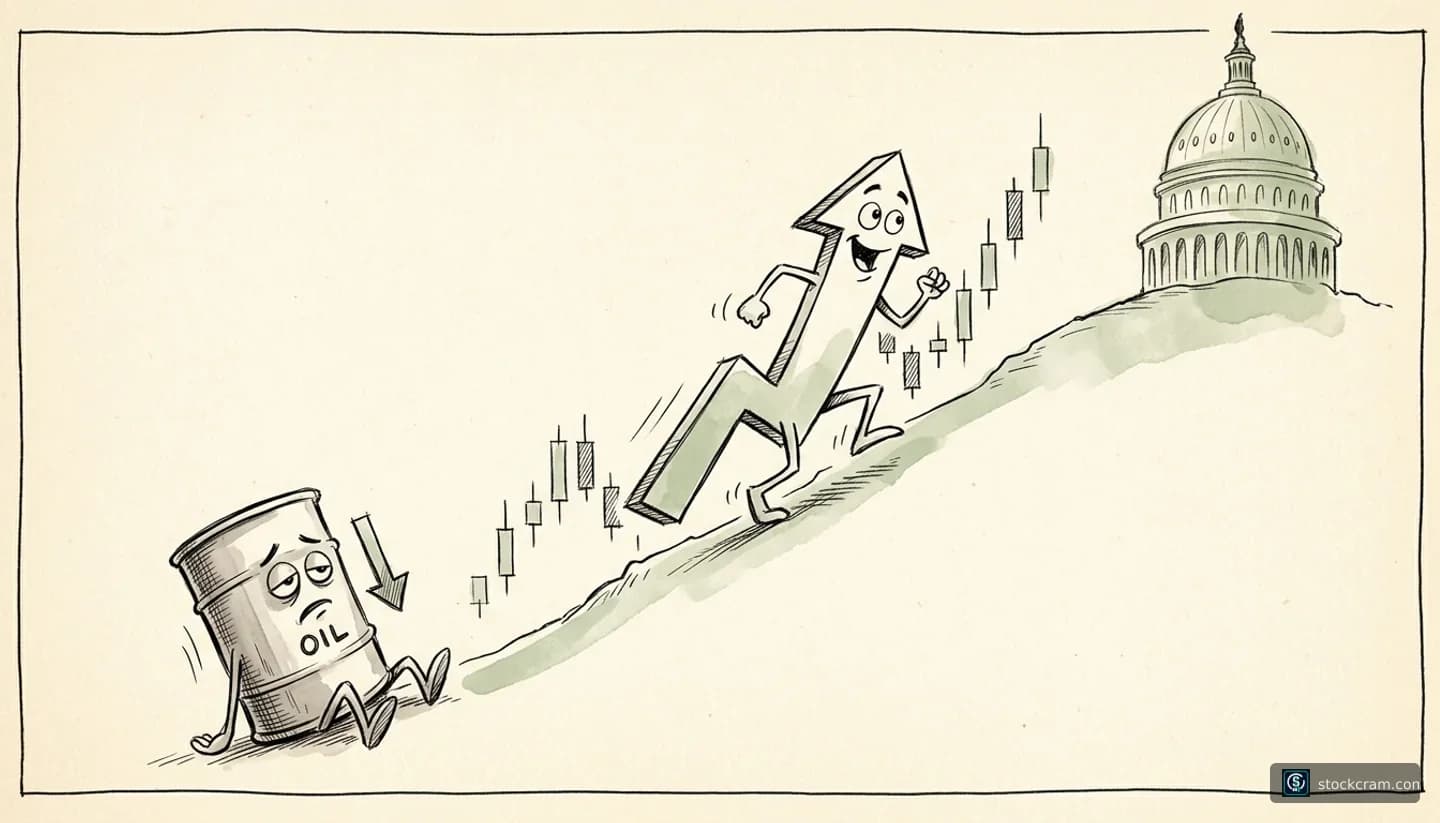
A clear midterm result and a sharp oil drop sent US stocks higher and Treasury yields lower on Wednesday; the Dow gained 3% and Brent fell 8.7%.
Educational purposes only. This content does not constitute investment advice. Read our disclaimer
StockCram is not a broker-dealer, investment adviser, or financial institution. All content is for educational and informational purposes only and should not be construed as personalized investment advice. Consult a qualified financial professional before making investment decisions. Past performance does not guarantee future results.The Dow Jones Industrial Average closed up 1,569.40 points, or 3%, on Wednesday, its best day since April 2025, after Democrats won control of Congress in Tuesday's midterm elections. The S&P 500 rose about 1.6%, its best day in three months, and the Nasdaq Composite gained 1.44%. Hospital owners and dollar-store chains led the rally, and the clear result removed a source of doubt for traders.
Markets often move sharply when a big uncertainty ends. The Dow's gain was its biggest after a midterm election since 1982, according to CFRA Research data cited by CNN. A split government also makes big new laws less likely, which many investors read as a calmer backdrop. New to these terms? See our stock market glossary.
Equities
Dow +3% (1,569.40 points), S&P 500 +1.6% to about 7,701, Nasdaq Composite +1.44%
Rates
10-year Treasury yield fell about 6 basis points to roughly 4.88%-4.90%
FX
Dollar weakened; the euro rose to $1.1273, a one-month high against the dollar
Commodities
Brent crude fell about 8.7% to $94.62 a barrel
Brent crude, the global oil benchmark, settled at $94.62 a barrel on Wednesday, down almost 8.7% and its lowest close since August 31. US crude (WTI) fell 7.2% to $89.17. Prices fell further after Vice President JD Vance blamed Republican midterm losses on the war with Iran. Brent is down about 20% this week.
Oil feeds into gasoline and shipping costs, so a big drop can ease inflation pressure. For the simple mechanics of why oil often falls and stocks rise when war fears fade, read why oil falls and stocks rise when war fears ease. Reuters reported that, if it holds through Friday, this would be the largest weekly oil drop since April 2020.
Equities
Energy and data-center stocks fell; solar and consumer stocks rose
Rates
Lower oil cut inflation fears and helped pull yields down
FX
Dollar fell to a one-month low as lower oil eased inflation worries
Commodities
Brent fell about 8.7% to $94.62, its lowest close since August 31; WTI fell 7.2% to $89.17
The 10-year Treasury yield fell to about 4.88% on Wednesday from 4.95% late Tuesday, as bond prices rose. The 2-year yield, which tracks expectations for Fed interest rates, slipped about 2 basis points to 4.56% in early Asian trading Thursday. Traders expect a divided Congress to limit big government spending, and lower oil eased inflation fears.
Yields had climbed to their highest levels in decades this summer on debt and inflation worries. Lower yields lower borrowing costs for the government, companies and home buyers. Learn how bond yield works in plain English.
Equities
Lower yields supported the broad rally
Rates
10-year yield fell to about 4.88% from 4.95%; 2-year yield near 4.56%
FX
Dollar index hit a monthly low near 101.20
Commodities
Silver rose as the dollar softened
The Institute for Supply Management's October Services PMI came in at 54.5, down from 54.9 in September and just under the 54.8 forecast. A reading above 50 means the sector is growing, and this was the 28th straight month above that line. Separately, ADP reported that private employers added 86,000 jobs in October.
Steady growth gives the Federal Reserve room to keep rates high. That is why the data still matters even on a day dominated by politics.
Equities
Data was a minor factor next to the election
Rates
Firm data kept expectations alive for another Fed rate hike
FX
Little direct effect; dollar still fell on politics and oil
Commodities
Limited direct effect
South Korea's chip-heavy KOSPI index fell 4% on Thursday, and data-center companies and their suppliers across Asia dropped. Investors expect tougher rules under a Democratic Congress. In the US, data-center builders also sank on Wednesday, while solar supply-chain stocks jumped on hopes for more support for renewable energy.
The AI building boom has been a big driver of stock gains, a debate we cover in Are We in Another AI Bubble? Any sign of new rules can move the companies tied to it, even as the broader market rises.
Equities
KOSPI fell 4%; Nasdaq 100 rose 1.3% to about 28,557 despite weak data-center names
Rates
Little reported effect
FX
Little reported effect
Commodities
Limited effect
The stock rally after the 2018 midterm elections, when Democrats took the House.
The S&P 500 rose sharply the day after that vote, the only post-midterm one-day gain larger than Wednesday's since 1982, according to CFRA data cited by CNN. LPL Research finds the S&P 500 has gained an average of 15% in the 12 months after every midterm since 1950, though past results do not predict future returns.
Closing levels differ slightly between sources, so figures are rounded. The Iran war outlook, any policy shift from Washington, and Friday's jobs data could all change the picture. Final closing yields vary by source.