
Market Analysis
Markets This Week: Oil, AI Selloff, Meta, Tesla
Read Article
Market Analysis
AI-powered insights into global financial markets
 StockCram Editorial4 min read
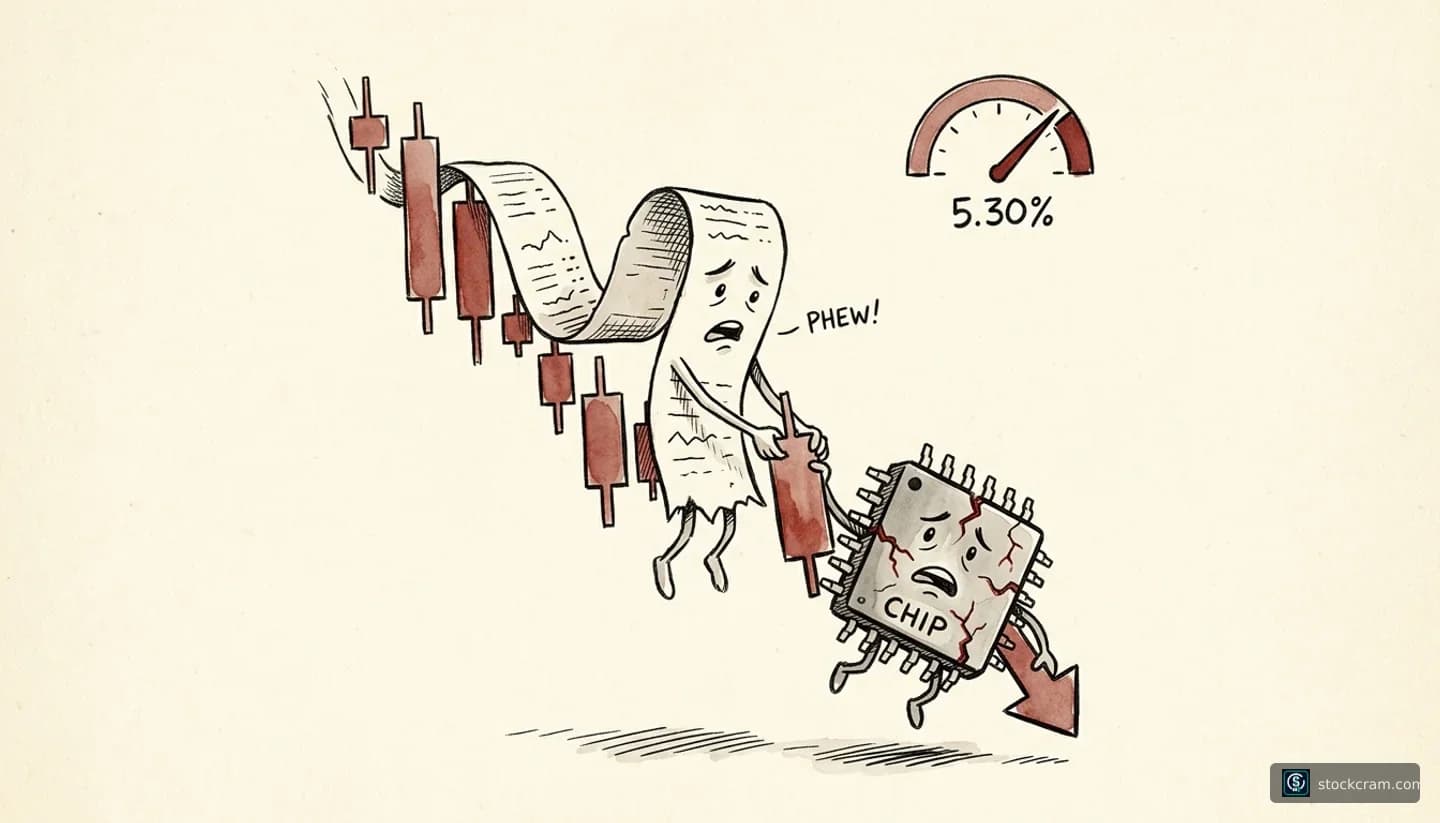
Hotter-than-expected September CPI and a global chip selloff gave Wall Street its worst day since July, while 10-year Treasury yields jumped to 5.30%.
Educational purposes only. This content does not constitute investment advice. Read our disclaimer
StockCram is not a broker-dealer, investment adviser, or financial institution. All content is for educational and informational purposes only and should not be construed as personalized investment advice. Consult a qualified financial professional before making investment decisions. Past performance does not guarantee future results.The Bureau of Labor Statistics said the September Consumer Price Index (CPI) rose 0.6% from August and 3.7% from a year earlier, above the 3.6% yearly rate economists expected and up from 3.4% in August. Core CPI, which leaves out food and energy, rose 0.3% on the month and 2.6% on the year, against forecasts of 0.2% and 2.5%. Gasoline jumped 9.1% in September and made up over half of the monthly increase.
Higher inflation gives the Fed more reason to keep raising rates, and that makes borrowing costlier for companies and households. Traders put the odds of an October hike at 46%, up from about 20% before the report. For background on how the Fed weighs monthly data against annual figures, read why the Fed might raise rates in 2026, or see our explainers on CPI and core inflation.
Equities
S&P 500 fell 1.11% to 7,718.94; Russell 2000 fell 1.93% to 2,729.53
Rates
10-year Treasury yield jumped about 9 basis points to 5.30% right after the report, then pulled back
FX
US dollar rose after the report, then gave back those gains by Thursday as yields eased
Commodities
Gasoline drove the price jump; Brent crude was near $108.70 a barrel Wednesday morning
South Korea's Kospi index closed down 7.57% at 5,554.22 on Thursday after Samsung Electronics and SK Hynix fell roughly 10% each, which triggered a market-wide trading halt. The selloff followed a Wednesday in the US when the Nasdaq Composite lost 1.88% and information technology was the weakest S&P 500 sector at -3.00%. Bloomberg reported MSCI's Asia Pacific index slid 2.7%, its lowest level since July.
Chip and AI stocks have driven much of this year's market gains, so sharp drops there pull whole indexes down. Rising borrowing costs make the huge spending on AI data centers look more expensive, which feeds the debate in are we in another AI bubble?
Equities
Nasdaq Composite fell 1.88% to 26,692.87; tech was the worst S&P 500 sector, down 3.00%; Kospi closed down 7.57% at 5,554.22
Rates
Treasuries rallied on Thursday as investors sought safer assets
FX
Dollar weaker on Thursday as investors moved into bonds
Commodities
No clear direction tied to the chip selloff
CoreWeave, an AI data-center company backed by Nvidia, fell 15.46% on Wednesday as its bond yields climbed. Nebius Group fell 10.08% and Nvidia fell 3.16% in the same session. Investors worried about how companies will pay for costly AI buildouts when Treasury yields are above 5%.
Firms that borrow heavily to expand are the most exposed when interest rates rise. Their stock and bond moves are an early sign of how much stress higher rates are putting on the AI boom.
Equities
CoreWeave fell 15.46%, the weakest Nasdaq 100 stock; Nvidia fell 3.16%
Rates
Higher yields on CoreWeave's bonds signaled investors want more pay to lend to it
FX
No notable move
Commodities
No notable move
The 10-year Treasury yield rose 9 basis points to 5.304% after the CPI report, then fell back as stocks sold off and investors moved into bonds. The 2-year yield, which tracks Fed policy closely, rose to about 4.808% at one point, its highest since September 29. The Fed raised its rate to a 3.75%–4.00% range in September, its first hike since 2023.
Yields set the cost of mortgages, car loans and business debt. When they rise, stocks that promise profits far in the future usually look less valuable. See our guides to bond yield and basis points.
Equities
Higher yields weighed most on small caps and growth stocks
Rates
10-year yield touched 5.30% Wednesday, then eased to about 5.1% by Thursday; 2-year near 4.81%
FX
Dollar gave back its post-CPI gains on Thursday as yields slid
Commodities
Little direct effect
Brent crude traded near $108.70 a barrel on Wednesday morning, up 1.31% from a day earlier and about 74% above its level a year ago. TheStreet linked the hot CPI report to the effects of the months-long Iran war. Gasoline's 9.1% jump in September made up over half of the monthly rise in consumer prices.
Energy prices touch almost every cost in the economy, so they keep inflation high and make the Fed's job harder. For more on how the conflict affects supply, see oil prices during war and the Strait of Hormuz.
Equities
Energy costs add to pressure on consumer and industrial shares; industrials fell 0.96%
Rates
Energy costs feed inflation and support bets on higher rates
FX
No clear effect
Commodities
Brent was about $108.70 a barrel Wednesday morning, up $1.41 from a day earlier and about $46 above a year ago
In 2022, when the Fed was raising rates to fight high inflation, a hotter-than-expected CPI report on September 13, 2022 hit stocks hard.
The S&P 500 fell about 4.3% that day, its worst single day since 2020, as investors expected more rate hikes. Growth and tech stocks fell the most, which is a pattern similar to Wednesday's selloff. Learn more with our guide on what the stock market is.
Reports differ on the exact closing level of the 10-year yield and on the price of oil. The Thursday data on producer prices, retail sales and jobless claims had not been seen when this was written. The chip selloff is moving fast, so figures can change quickly.