Oil Prices During War: The Strait of Hormuz Explained
After three months of Strait of Hormuz closure, the oil-spike-decay rule has stopped working. Here's what's actually happening to prices and energy stocks.
Hyperscaler capex tops $700B in 2026 while smart investors loudly disagree on whether it's a bubble. Here's both sides, in plain English.
Educational purposes only. This content does not constitute investment advice. Read our disclaimer
StockCram is not a broker-dealer, investment adviser, or financial institution. All content is for educational and informational purposes only and should not be construed as personalized investment advice. Consult a qualified financial professional before making investment decisions. Past performance does not guarantee future results.
In May 2026, Nvidia reported a single quarter of revenue larger than the entire annual GDP of half the world's countries. The same week, Michael Burry — the investor made famous by *The Big Short* — declared that the market had "jumped the shark." Both things are true at the same time, which is what makes the AI bubble debate so confusing right now.
The two-sentence version: Bears say AI spending — over $700 billion in 2026 from four companies — has become detached from the cash AI is actually producing. Bulls say that spending is matched by rapidly growing cloud-AI revenue, funded by profitable companies, and just the early innings of a real revolution. The rest of this article is the long version of what each side actually believes, and why.
We'll define what a bubble actually is, walk through the bear and bull cases with named voices and current data, examine the two names everyone is fighting about (Nvidia and Palantir), compare today to the dot-com era, lay out the specific events each side is watching for, surface what both sides quietly agree on, and end with the honest answer. This is the first piece in our Market Explainers series — plain-English breakdowns of confusing market moments.
Before the long version, here's the debate at a glance — feel free to read this and skip ahead, or keep going for the named voices, current 2026 data, and the dot-com comparison.
What bears say: AI spending — over $700 billion in 2026 from four companies — has become detached from the cash AI is actually producing. The roughly $12 billion in consumer AI revenue today doesn't justify the buildout. (Voices: Burry, Grantham, Sequoia's Cahn, Zitron, Dalio, Sorkin's 1929 as historical mirror.)
What bulls say: That spending is matched by rapidly growing cloud-AI revenue (Azure AI at a $37B run-rate, +123% year-over-year; Google Cloud roughly $80B annualized at +63%), funded by profitable companies, and just the early innings of a real revolution. (Voices: Nadella, Pichai, Amodei, Morgan Stanley research.)
What both sides actually agree on:
What separates them: Bears think current AI stock prices don't yet reflect the revenue-catchup risk. Bulls think they already do. That's the entire fight in one sentence.
The surprising thing while researching this piece: bulls and bears were almost always looking at the same numbers — Nvidia's $75 billion quarter, the $700 billion capex figure, the 35% Mag-7 concentration — and reaching opposite conclusions about what those numbers will mean three years from now. The disagreement isn't about facts. It's about the future, which neither side can prove.
The rest of this article walks through each side carefully — what they actually argue, with current 2026 data and specific named voices — so you can decide for yourself whose framing you find more convincing.
Key Takeaway: Bears and bulls cite the same numbers and reach opposite conclusions about what those numbers mean.
If you've been online recently, you've seen the headlines. The New York Review of Books ran a long essay in March 2026 about Andrew Ross Sorkin's book 1929, drawing parallels between the run-up to the Great Crash and today's AI boom. Burry's Substack — yes, Substack; we'll get to that — has been calling the market overheated for months. Bloomberg and Fortune publish a new "AI stock bubble" piece about every other week. The question keeps coming back because the underlying AI stocks keep going up.
There are real numbers behind the chatter. As of early June 2026, the S&P 500 is trading near all-time highs around 7,609. The seven largest U.S. stocks — known as the "Magnificent 7" (Apple, Microsoft, Alphabet, Amazon, Meta, Nvidia, and Tesla) — now make up roughly 35% of the entire S&P 500's market capitalization. That's up from about 12.5% a decade ago.
Then there's the spending. The four largest cloud companies — Microsoft, Alphabet/Google, Amazon, and Meta — collectively guided to roughly $700–725 billion in capital expenditure for 2026, almost all of it on AI infrastructure: data centers, Nvidia GPUs, networking, and the electricity to power them. That's up roughly 77% from 2025, when the same four spent around $410 billion. We have a glossary entry for capex if the term is new.
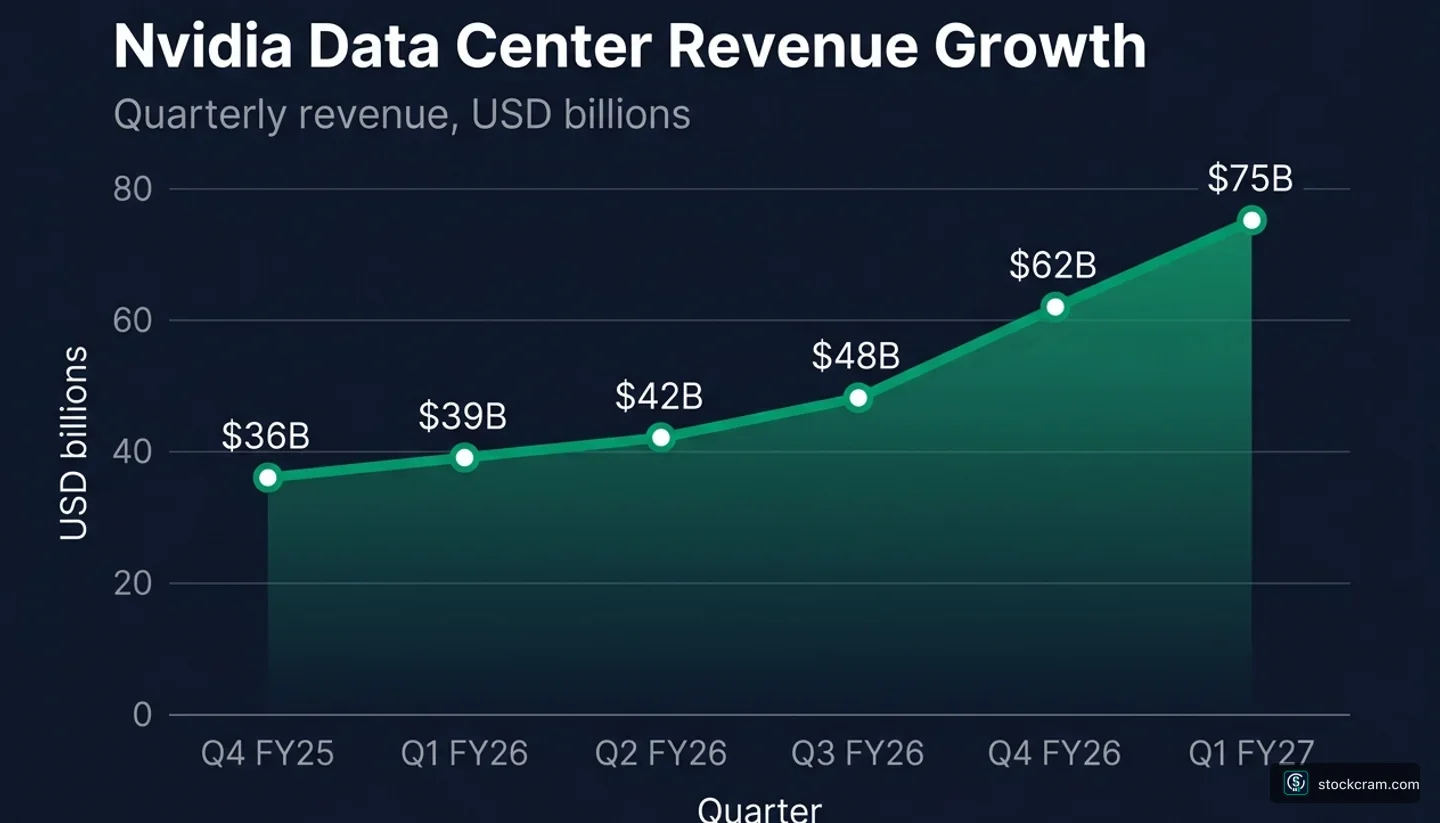
And Nvidia — the company that sells most of the chips inside those data centers — reported on May 20, 2026 that its Q1 FY27 revenue hit $81.6 billion in a single quarter, with $75.2 billion of that coming from its Data Center segment alone, up 92% year-over-year. Our earlier breakdown of Nvidia and Palantir covers how the company got here.
So: an unprecedented chunk of the stock market is concentrated in a handful of names, those names are spending unprecedented amounts on a single technology, and serious investors are publicly arguing about whether the whole picture is brilliant or about to break. That's why the question is everywhere.
Key Takeaway: AI is suddenly the conversation because the numbers got too big to ignore — and smart people genuinely disagree about what those numbers mean.
Before we wade into who's right, it helps to know what we're arguing about. "Bubble" gets thrown around so loosely that most people use it to mean "prices went up a lot." That's not what it means in finance.
A bubble is a specific pattern. It's when asset prices become disconnected from the cash those assets are likely to produce — when prices are sustained mostly by narrative and the expectation that someone else will pay more for the same asset tomorrow, rather than by valuation tied to underlying earnings, revenue, or cash flow. If you'd like to try one on a real company, our P/E ratio calculator is a quick way to compare a stock's price to its earnings.
The economist Hyman Minsky described five stages every bubble tends to move through. In plain English:
Here's the crucial point for the AI debate: by this definition, asking whether AI stocks are overvalued is partly a question about what investors are buying and why, not just about what prices are doing.
The bears and bulls in the next two sections aren't really arguing about whether prices are high. They're arguing about which Minsky stage we're in.
Key Takeaway: A bubble is a kind of price movement, not just a price movement — the question is whether AI prices are driven by future cash flows or by the story about them.
The bear case isn't a single argument; it's a chorus of investors and analysts who've reached similar conclusions from different angles. Here's the strongest version of what they collectively argue, in their own words where possible.
Michael Burry is the most famous bear of the moment. The investor who shorted the 2008 housing market shut down his fund Scion Asset Management in late 2025 and now publishes warnings on his Substack "Cassandra Unchained," which has more than 200,000 subscribers as of mid-2026. His final Scion 13F filing in late 2025 showed large notional short positions on Palantir, Nvidia, Oracle, the SOXX semiconductor ETF, and the QQQ Nasdaq ETF, mostly through long-dated put options expiring in 2027. In May 2026 he declared the market had "jumped the shark" and added a leveraged short via January 2027 SOXX puts. Burry has publicly argued Palantir is significantly overvalued; we won't reproduce specific price targets here because they're his opinion, not StockCram's recommendation.
Jeremy Grantham, co-founder of asset manager GMO and the long-running superbubble watcher, co-wrote a paper in January 2026 titled "Valuing AI: Extreme Bubble, New Golden Era, or Both?" His verdict, paraphrased: mostly the first. The paper cited OpenAI's 2025 numbers — roughly $12 billion in revenue against $8 billion in operating losses — and projected losses scaling to $35 billion by 2027. In an April 2026 ThinkAdvisor interview, Grantham assigned what he described as "slim to none" odds that the AI bubble doesn't burst. That's one analyst's view, and a famous bear's view at that; we cite it as a data point in the debate, not a forecast we endorse.
Sequoia Capital's David Cahn has been writing for over a year about what he calls the AI "revenue gap." His updated 2026 estimate: roughly $600 billion of annual AI revenue would need to materialize to justify the current pace of capex — and the gap is widening, not closing. Sequoia is a Silicon Valley venture firm with deep skin in the AI game, so the fact that they're flagging the AI capex bubble matters.
Ed Zitron, an independent industry analyst whose newsletter Where's Your Ed At has become widely read in finance and tech circles, published "What If We're In An AI Bubble? (Part 2)" on May 22, 2026. His sharp data point: roughly $178.5 billion of U.S. data-center debt is currently financing the buildout, often through private credit. If AI revenue lags, that debt becomes a problem far beyond the tech sector.
Ray Dalio, the founder of Bridgewater Associates, joined the bear chorus publicly on Bloomberg TV on June 3, 2026. He said AI shows bubble signs that "will eventually burst" and that his bubble indicators are at "1929 and 2000 levels" — a direct echo of the Sorkin parallel. Bridgewater pegs Mag-4 2026 capex at around $650 billion (slightly below the $700B+ figure the broader counts produce). Like Burry and Grantham, Dalio isn't predicting timing; he's describing what he sees.
And finally, Andrew Ross Sorkin's book 1929 (Viking, October 2025) has become a touchstone for bears not because Sorkin himself predicts a crash but because the book documents how confidently the smartest people of 1928 dismissed bubble warnings — until they couldn't. Sorkin's recurring observation, paraphrased: at some point in any mania, the math may stop adding up.
The summary of all these voices: bears aren't claiming AI is fake. They're claiming the spending is wildly ahead of the cash AI is currently producing — and history suggests that gap has to close, one way or the other.
Key Takeaway: Bears aren't arguing AI isn't real — they're arguing the spending is wildly ahead of the cash AI is currently producing.
If bears worry about the gap between spend and revenue, bulls answer essentially: the spend is funded by profit, not debt; the revenue is arriving fast and from sources you can verify; and the technology is still in early innings. Here are their voices.
Satya Nadella, CEO of Microsoft, has had to defend his company's roughly $190 billion 2026 capex budget repeatedly. At Morgan Stanley's TMT conference earlier this year, he argued that software-driven improvements in total cost of ownership and server utilization will produce real returns on invested capital — not in some distant future but throughout 2026 and 2027. He also said something that doesn't usually come from CEOs justifying massive spend: Microsoft has been capacity-constrained through 2026. Demand for Azure AI services exceeds supply. The Azure AI run-rate alone is reported at roughly $37 billion, up 123% year-over-year.
Sundar Pichai, CEO of Alphabet, raised Google's 2026 capex guidance on the April 29 Q1 earnings call to between $180 and $190 billion. He told staff that supply constraints — not demand worries — "keep me up at night." Google Cloud, which carries much of Alphabet's AI investing exposure on the revenue side, grew 63% year-over-year to a roughly $80 billion annualized run-rate.
Dario Amodei, CEO of Anthropic (one of the leading AI model labs), said at a Morgan Stanley conference in February 2026 that the scaling laws — the relationship between model size, training compute, and capability — "have not hit a wall." He expects "radical acceleration" in 2026. Anthropic's confidential IPO filing on June 1, 2026 put its current run-rate near $47 billion at a roughly $965 billion valuation — substantially above the $30 billion figure cited earlier in 2026, and an order of magnitude above 2025 levels. (Some bullish industry estimates project Anthropic toward the $80–100 billion range by year-end; the S-1 figure is the authoritative anchor for now.) Crucially, Amodei has also been refreshingly honest about the risk: "If I'm just off by a year in that rate of growth… then you go bankrupt." That's a bull acknowledging the bear case — useful for understanding why even AI insiders take the question seriously.
Morgan Stanley's equity research team has watched its own framing evolve. The earlier line — that bubble fears were "misplaced or premature" — has shifted in 2026 to something more careful: "We don't see this risk as a 2026 story, but vigilance is a 2026 responsibility." Their analysts estimate roughly $3 trillion of total data-center spend across 2025–2028, with about half flowing through private credit markets. They flag data-center debt potentially exceeding $1 trillion by 2028 — which is closer to the bear case than the 2024-era "don't worry about it" framing.
And then there's the profitability argument that bulls cite most often: unlike the dot-com era, today's index leaders are profitable. The Mag-7 generate substantial free cash flow and fund AI capex from earnings rather than debt. This is the strongest single difference between 2000 and 2026, and we'll examine it more closely later. The bull framing of the valuation story: today's prices reflect earnings that exist, not earnings that might.
Bulls also push back on the dot-com comparison with what we'll call the Cisco caveat — Cisco was a real, profitable company at the center of a real internet revolution, and its stock still fell about 85% from the 2000 peak. Bulls' point: yes, that's true. But Cisco's P/E ratio at the peak was in the triple digits. Today's Nvidia, even after the run, isn't priced like that. Different fundamentals can justify different multiples.
The summary of all these voices: bulls aren't claiming capex doesn't matter. They're claiming the cash flows backing it are real, growing fast, and (mostly) funded from profits rather than from a hope and a credit line.

Key Takeaway: Bulls aren't arguing capex doesn't matter — they're arguing the cash flows backing it are real, growing fast, and funded from earnings rather than debt.
If there's one ticker symbol the AI stocks debate revolves around, it's NVDA. Nvidia is the largest single beneficiary of hyperscaler capex — it sells most of the GPUs that go into the data centers — and so the "Nvidia bubble" question is, in many ways, the broader AI stocks question in miniature.
The bull case for Nvidia. The numbers are extraordinary and they're audited. Q1 FY27 (reported May 20, 2026): $81.6 billion in total revenue, $75.2 billion of that from the Data Center segment alone, +92% year-over-year. That single quarter generated more Data Center revenue than the entire company produced in all of fiscal 2024. The company is profitable; gross margins remain north of 70%; cash from operations is enormous. Beyond raw numbers, Nvidia has a software moat in CUDA — the developer ecosystem that makes its chips the default choice for AI training — which competitors haven't been able to crack despite years of trying. Bulls argue that even a "normalized" Nvidia, growing at half its current pace, would justify the current valuation.
The bear case for Nvidia. Three things make bears nervous, and only one of them is the P/E ratio.
First, customer concentration. Roughly half of Nvidia's Data Center revenue comes from a handful of hyperscaler customers — Microsoft, Google, Amazon, Meta, and Oracle. If any one of them slows orders, the revenue line moves immediately. Bears point out that this is exactly the dynamic that hit Cisco in 2000: when the telecom buildout paused, Cisco's revenue collapsed even though the underlying technology kept growing.
Second, circular financing concerns. Nvidia has disclosed substantial investments in OpenAI and Anthropic during recent funding rounds (the precise dollar figures vary by source), and some of that capital flows back to Nvidia as GPU purchases. The arrangement is legal and not unprecedented in tech (Microsoft does something similar with OpenAI), but it makes bears uneasy: the revenue isn't fully "organic" if a chunk of the cash funding the customers comes from the supplier.
Third, the inference shift. Stanley Druckenmiller's recent positioning is instructive — he exited Nvidia in late 2024 (a move he later publicly called a "big mistake") and has rebuilt his AI exposure through Broadcom, Intel, and Arm Holdings. His thesis: the next leg of AI spend will be dominated by inference (running AI models for users) rather than training (building the models). Inference workloads may favor different chips and architectures. If Druckenmiller is right, Nvidia's revenue mix has to evolve — and there's execution risk in that pivot.
The honest take on Nvidia specifically: at $75 billion in a single quarter of Data Center revenue, you cannot reasonably claim Nvidia is a fake business. The bear case requires belief that the growth rate breaks — not that the business does. The bull case requires belief that hyperscaler customers stay patient and that the inference transition doesn't open the door to credible competitors. Both are arguable. Neither is obviously right.
Key Takeaway: Nvidia bears don't argue the business is fake — they argue the growth rate may break. Bulls argue the hyperscaler customers will stay patient long enough.
The other name that comes up constantly in any AI investing conversation is Palantir Technologies (PLTR). If Nvidia is the picks-and-shovels play, Palantir is the software-layer play — the company selling AI-powered analytics and decision-making platforms to governments and large enterprises. And it is, by some measures, the most expensive large-cap stock in the U.S. market.
The bull case for Palantir. Real revenue, growing fast. The company is profitable. Its AIP (Artificial Intelligence Platform) product has been adopted by a substantial and growing roster of large commercial customers in addition to its long-standing government work. U.S. commercial revenue growth has remained robust — in the high double digits year-over-year — for multiple recent quarters, well above the company's pre-AIP baseline. The bulls' argument: Palantir is the rare software company that has actually figured out how to monetize AI at the application layer, while most others are still in pilot programs. If you believe enterprise AI software becomes a category as large as cloud infrastructure, Palantir has positioned itself well.
The bear case for Palantir. Almost entirely about the P/E ratio. Even bulls acknowledge Palantir's valuation is rich. Burry's Substack has been particularly focused on Palantir; his final Scion 13F before winding down showed Palantir as the largest single short position by notional value. We won't reproduce his price target because that's his opinion, not ours, but it's substantially below the current price. The bear case in three words: growth-priced-to-perfection. Bears argue that even if Palantir continues to execute, the current price already reflects several years of flawless growth, leaving no margin for any stumble.
The Nvidia/Palantir comparison. It's useful to see why these two stocks are bucketed together when they're really different bets:
For our broader breakdown of Palantir and Nvidia's recent performance, the existing article has more company-specific detail. The takeaway here: "AI stocks overvalued" doesn't mean the same thing for these two names — and treating them as one trade is a mistake even Burry doesn't make.
Key Takeaway: Palantir bears aren't arguing the business is fake — they're arguing the price requires several years of flawless execution. That's a different bet than Nvidia.
Every AI stock bubble debate ends here, because the dot-com bubble is the only modern bubble most readers have a vivid mental image of. So let's compare them honestly — what's the same, what's different, and what each comparison actually implies.
The similarities are real and not flattering. Like dot-com, today's market is narrative-driven and top-heavy. A single technology story is justifying valuations across a wide swath of stocks. The press is breathless. The IPO market is reopening for AI-adjacent names. Smart people are loudly disagreeing in public. Most importantly: there's an undeniable real underlying revolution. The internet was real in 1999; AI is real in 2026. That part isn't in dispute.
The differences are also real, and they matter:
The table below summarizes the comparison.
The honest caveat that bulls and bears both share: differences from dot-com don't mean immunity. Cisco was profitable in March 2000 and still fell about 85% from its peak — it took 24 years for the stock to recover its dot-com high. A stock can be backed by a real revolution, generate real cash, and still be priced for an outcome that doesn't arrive. Different fundamentals shift the odds; they don't eliminate the possibility.
Key Takeaway: AI 2026 looks more like "expensive but profitable" than "speculative and broke." That's a material difference — but not a guarantee.
Historical data shown; past performance does not indicate future results. Figures rounded.
| Metric | Ai 2026 | Dot Com 2000 |
|---|---|---|
| Index leader P/E (peak) | Nasdaq ~32× | Nasdaq ~175× |
| Top-5 share of S&P 500 | ~30% | ~18% |
| Capex funded by | Primarily earnings; rising private credit | Often debt; many unprofitable cos |
| Revenue at peak | Nvidia alone $75B/qtr Data Center | Largely speculative |
| Index leaders profitable? | All Mag-7 are profitable | Many were not |
| Speculative IPOs | Limited so far — mostly incumbents | Many no-revenue IPOs at $1B+ |
Most bubble articles describe the bear case in vibes. We'll do it in specifics. Here are the actual events bears are watching for — the things that would tell them the AI capex bubble has started to deflate.
1. Hyperscaler capex cuts. This is the single biggest signal. If Microsoft, Google, Amazon, or Meta lowers its capex guidance — not because of a one-time write-down but because the company itself sees lower ROI — bears would treat that as game-on. So far, every hyperscaler guidance revision in 2026 has gone up. Bears watch the quarterly earnings calls of all four carefully for the first downward revision.
A related early-warning signal is downstream chip demand. On June 3, 2026, Broadcom posted a record Q2 ($10.8B AI semiconductor revenue, +48% YoY) but guided Q3 AI revenue to $16B against a $17.2B consensus — a textbook "beat-and-miss" that sent AVGO down roughly 14% and dragged Nvidia, AMD, and Intel in sympathy. One quarter doesn't make a trend, but this is exactly the kind of "expectations have outrun reality" moment bears watch for. The Nvidia July quarter — and any AI-revenue qualitative commentary from the next round of hyperscaler earnings — will be more telling than any single number.
2. Cloud-AI revenue growth slowing materially. Azure AI is at a $37B run-rate growing 123% YoY. Google Cloud is ~$80B annualized at 63% growth. AWS is the largest at ~$150B annualized at 28% growth. Bears watch for deceleration. The thresholds matter: Azure AI dropping below 50% YoY growth, or Google Cloud below 30%, would be a serious signal that enterprise AI demand isn't keeping pace with infrastructure spend.
3. OpenAI or Anthropic stumbling. The two leading independent labs are increasingly central to the AI revenue story. If OpenAI's reported revenue trajectory breaks — particularly if it can't justify another massive funding round — that would undercut the entire framing of "the revenue is coming." Anthropic's $80–100B run-rate target by year-end is a number bears will scrutinize closely against actual reported figures.
4. Data-center financing stress. The Ed Zitron and Morgan Stanley framing both center on private credit funding the data-center buildout. Bears watch for credit spreads on data-center-backed debt widening, defaults at smaller data-center operators, or a reputable institutional investor publicly walking away from the asset class. Any of those would suggest the financing assumptions under the buildout are getting tested.
5. Better, cheaper models. A "DeepSeek moment" 2.0 — a breakthrough that delivers competitive AI capabilities with materially less compute — would directly undercut the case for $700B/yr of GPU spend. Bears watch for any open-source release or architectural advance that suggests scaling laws can be sidestepped. (This is the risk Amodei himself flagged with his "if I'm off by a year" quote.)
6. Power and supply constraints binding. Even bulls acknowledge electricity is the new bottleneck. If new data centers can't get grid hookups, or if power prices spike enough to compress hyperscaler margins, the capex math gets harder. Bears watch utility filings, transmission queue data, and any announcement of capex deferral due to power.
7. Regulatory action. Either antitrust action against any of the Mag-7 (limiting their ability to deploy AI vertically) or AI-safety regulation that significantly constrains deployment timelines could change the ROI picture. Bears watch the EU AI Act enforcement, U.S. state-level AI laws, and any FTC/DOJ activity around big-tech AI integration.
Note what's not on this list: a one-quarter Nvidia revenue miss, a single hedge fund's losses, or any single Tweet from a famous bear. Real validators are structural, not headline-driven.
Key Takeaway: Real bear validators are structural — hyperscaler capex cuts, revenue deceleration, financing stress — not single-quarter headlines.
Symmetric treatment matters. Here are the specific events bulls are watching for — the things that would tell them the AI investing thesis is playing out and the bear case is fading.
1. Enterprise AI adoption accelerating with measurable productivity gains. The bear-side critique that "90% of firms report no productivity impact from AI" (a February 2026 study cited by Grantham) is the most damaging single data point in the bear case. Bulls are watching for that to flip — specifically, large-cap corporate reports starting to attribute concrete revenue or cost savings to AI tools. The first earnings call where a non-tech S&P 500 company says "AI delivered X basis points of margin expansion" would be a major signal.
2. AI agents going mainstream. The leap from chatbots to autonomous AI agents that handle real workflows — booking travel, processing claims, writing code end-to-end — is the bull case's killer-app moment. Bulls are watching for measurable agent-driven workflow adoption inside Fortune 500 companies. If agents become as common in 2026–27 as chatbots became in 2024, that would significantly expand the addressable revenue base.
3. The $700B vs. $12B revenue gap closing. Bulls don't need the gap to close immediately — they need it to start closing measurably. The headline gap is mostly consumer AI revenue. Cloud-AI revenue (Azure AI, Google Cloud's AI services, AWS's AI offerings) is rapidly approaching combined $200+ billion annualized. If that line shows another year of 50%+ growth, the gap narrows fast.
4. Margins improving on AI workloads. A recurring critique of cloud-AI economics is that it's harder to make high gross margins on GPU-heavy workloads than on traditional cloud. If Microsoft and Google start showing that AI is actually accretive to gross margin — not just additive to revenue — that would defuse one of the most credible bear concerns. Watch the cloud segment margin lines on Q1 and Q3 2026 reports.
5. New AI product categories emerging. Beyond chatbots and code completion, bulls are looking for genuine new product categories — vertical AI for healthcare diagnostics, AI-driven scientific discovery, consumer hardware integration. The bull case strengthens dramatically if AI starts producing categories of value that didn't exist before, not just better versions of existing software.
6. Scaling laws continuing to hold. Amodei's framing is that scaling laws have not hit a wall. If the next generation of frontier models (GPT-5 / Claude 4 / Gemini 2.5 successors) shows clear capability jumps proportional to compute increases, the bull case for continued infrastructure spend strengthens. If those models disappoint, the case weakens.
7. Geopolitical AI competition driving more, not less, spend. The U.S.-China AI race has so far been a tailwind for hyperscaler capex. If U.S. policy continues to view AI infrastructure as a strategic priority — and if European and Asian competitors accelerate their own spend — that creates a competitive dynamic that supports the bull case essentially regardless of near-term ROI.
One thing to note: validators on both sides take time to play out. The bear case wouldn't be fully validated by a single bad quarter, and the bull case wouldn't be fully validated by a single strong product launch. The market spends most of its time in the in-between — which is exactly why the debate stays alive.
Key Takeaway: Real bull validators are productivity gains in non-tech companies, margin improvement on AI workloads, and continued scaling-law performance — not just rising stock prices.
Same article in one screenshot. Bookmark this and check back each quarter.
| Signal | Bears Need | Bulls Need |
|---|---|---|
| Headline | Hyperscaler capex guidance cuts | Non-tech S&P 500 cos attribute AI productivity |
| Revenue | Cloud-AI growth slowing (Azure AI <50%, GCP <30%) | Cloud-AI revenue gap closing materially |
| Margins | Compression on AI workloads | AI accretive to gross margin |
| Financing | Private credit stress / data-center debt issues | Continued capex funded from earnings |
| Technology | Cheaper models break compute demand | Scaling laws continue to hold |
Reading the bull and bear research side by side for this article, one observation kept jumping out: both sides cite the same numbers — Nvidia's $75 billion quarter, the $700 billion capex figure, the 35% Mag-7 concentration — and reach opposite conclusions about what those numbers mean. That's the unusual feature of this debate, and it's worth its own section.
If you read Morgan Stanley's 2026 update, Grantham's GMO paper, Burry's Substack, and Nadella's earnings calls in sequence, three areas of quiet agreement become obvious.
1. Concentration risk is real. When seven companies make up ~35% of the S&P 500, the index goes where those seven go. Bulls don't dispute this. They argue the concentration reflects deserved success, but they don't argue it isn't there. Concentration is not the same as overvaluation — but it does mean a diversified index isn't as diversified as it used to be. Our note on market capitalization gives the technical definition.
2. Capex magnitude is unprecedented. Whether you think $700 billion of annual hyperscaler spend is brilliant or reckless, it's genuinely new in scale. The number itself isn't contested. Even Burry and Nadella would agree on the dollar figures — they'd just frame what those figures mean very differently. The AI capex bubble framing, popularized by Sequoia's Cahn, doesn't get pushback on the magnitude — only on the interpretation.
3. ROI timing is uncertain. Bulls expect the AI revenue ramp to validate the spend within a few years. Bears expect a stumble — either a revenue shortfall, a hyperscaler pulling back on capex, or stress in the private credit financing the data centers. Both expect some lag between investment and full return. Amodei's quote — "If I'm just off by a year in that rate of growth… then you go bankrupt" — lives precisely in that overlap. He's saying "I expect to be right, but the margin for error is thinner than it looks."
When you set the agreements next to the disagreements, the actual question gets clearer. It's not "is AI real?" — both sides say yes. It's not "is the spending unprecedented?" — both sides say yes. The real question is: do current stock prices already reflect the risks that both sides see? Bears say no, prices reflect a smooth ramp that may not arrive. Bulls say yes, prices reflect realistic earnings growth from companies actually delivering. That's the whole fight.
Key Takeaway: Bulls and bears are arguing about the consequences of the same facts, not about the facts.
Here's a possibility most AI stocks coverage skips: history suggests both sides may end up being right at the same time, just measuring different things on different time horizons.
The internet was real. The dot-com bubble was also real. Both descriptions of 1995–2002 are true — there's no contradiction between them. Cisco was a profitable, dominant company at the center of an actual technological revolution that permanently reshaped the global economy. And Cisco's stock still fell about 85% from the March 2000 peak, and didn't recover that high until 2024. Investors who said "the internet will change everything" were correct. Investors who said "Cisco at $80 is overpriced" were also correct. They weren't actually in conflict — they were measuring different things.
The pattern shows up earlier. The railroad reshaped 19th-century America in ways that still echo today. The 1840s railroad investment bubble in Britain wiped out enormous amounts of investor capital. Both statements describe the same period. Real revolution; real losses for many of the people who funded it. The market sorts winners and losers within a transformative industry — not just transformative industries themselves.
If this turns out to be the AI scenario, the honest framing is: technology revolution = yes; AI stock returns = maybe. A real revolution can produce real long-term winners and still produce dramatic losses for investors who paid too much, were positioned in the wrong names, or simply got the timing wrong. Even after the dot-com pop, the eventual large internet winners (Amazon, Google, Meta) delivered enormous returns. They just had to be held through the bust by people who didn't already know they'd survive.
In that scenario, both Burry and Nadella could be partly right. Burry could be right that a meaningful repricing event is coming in some AI stocks — particularly those priced for flawless growth. Nadella could be right that AI capex compounds into durable cash flows for the patient long-term investor. The bears would be right about prices; the bulls would be right about the technology. That's not a comforting answer. It's just the historically most common one when a real innovation meets an enthusiastic market.
Key Takeaway: A real revolution can produce real winners and still produce dramatic losses for investors. "Both sides right" is historically more common than "one side right."
Here's the part most articles dodge. After laying out both sides, they pretend to render a verdict. We won't, and the reason is practical, not evasive.
Bubbles are obvious in hindsight. In real time they're contested by very smart people on both sides, and roughly half of them will turn out to have been wrong. In 1999, every panel discussion about "is this a bubble?" had multiple credentialed economists on each side. The bears who turned out to be right were, by 2000, treated as geniuses. They had been called premature, hysterical, or simply mistaken for the four prior years.
Which is the second thing worth knowing: timing is famously hard. John Maynard Keynes — economist, not exactly a paragon of patience — is supposed to have said "the markets can stay irrational longer than you can stay solvent." Even if you correctly identify an AI stock market bubble in 2026, the pop could be tomorrow, in 2027, in 2029, or never. The Nasdaq peaked on March 10, 2000. It didn't return to that peak until 2015. Bubbles deflate in waves, sideways, slowly, or sometimes not at all.
Third: "is it a bubble?" turns out to be a less useful question than people think. A more useful one — and the one we tried to set you up to answer for yourself in the last two sections — is what specifically would have to be true for each side to be right? Watching those specific things (Azure AI run-rate, Google Cloud growth, hyperscaler capex revisions, signs of stress in private credit, productivity attribution from non-tech S&P 500 companies) is more useful than watching the daily Nvidia close.
For a beginner: the most valuable thing isn't picking a side. It's learning to hold uncertainty without panicking. Smart investors disagree because the future is genuinely unknowable, not because one of them is dumb. Your reaction to reading this article — relief, anxiety, conviction in either direction — is itself information about your own risk tolerance and time horizon. That's information worth paying attention to. What you do with it is a separate question, and one this article can't and won't answer for you.
If you'd like to go deeper on how stocks are valued in the first place, the Foundations course is the starting point. If you're newer than that, Start Investing walks through the basics of building toward a long-term portfolio.
Key Takeaway: The most useful skill in a bubble debate isn't picking a side — it's holding uncertainty without panicking.
Four common misreads we hear from beginners. None of these are dumb questions — they're the questions the headlines invite.
"If it's a bubble, I should sell everything." Maybe. But historically, the investors who correctly identified bubbles often called them years too early — and during those years, the market kept going up. The investors who sold the Nasdaq in 1997 because it "looked frothy" missed three more years of gains before they were ultimately right. Acting on a bubble call requires being right about both the bubble and the timing — and the second is much harder than the first.
"If smart people disagree, one of them must be wrong." This is a deep misread of how markets work. Bull and bear can both be looking at the same data and weighting it differently — different assumptions about discount rates, growth durability, technological adoption, geopolitical stability. Disagreement among informed people is the norm for a healthy market, not the exception. A market where everyone agreed would already have priced in that agreement; the price wouldn't move, and there'd be no opportunity at all.
"Crashes are predictable from headlines." By the time "AI bubble" is on the front page of The New York Review of Books, the question is already widely discussed and at least partly priced in. Sometimes the warning has been on the cover for months while prices kept rising — because the warning itself was already in the price. "Cover indicator" is folklore, but the underlying point is real: public consensus is often a lagging signal.
"Bubbles always pop suddenly." Sometimes. Often not. The dot-com Nasdaq peaked on March 10, 2000 and was below that level for fifteen years. It declined in waves — sharp drops, partial recoveries, then more drops. The Japanese stock market peak of 1989 wasn't fully reclaimed until 2024 — three and a half decades. A bubble pop can be a multi-year, sideways, painful slog rather than a single cinematic crash.
For a more current-market read on how confusing things have gotten, the rest of the Market Explainers series takes the same both-sides approach to other questions — why stocks keep rising despite high yields, why the housing market feels frozen, why markets seem numb to war headlines. Coming up over the next few weeks.
Key Takeaway: Most beginner confusion in bubble debates comes from treating uncertainty as ignorance — when it's actually the honest answer.
Quick answers to the questions readers ask most about the AI bubble.
Selected primary sources for the figures and quotes used in this article. We encourage readers to check the originals — financial debates are easier to follow when you read the underlying documents yourself, not just the takes about them.
Earnings & company disclosures
Bear research
Bull research
Historical framing
Market data
Last reviewed: June 2026.
Key Takeaway: Read the underlying documents, not just the takes about them — financial debates are easier to follow when you've seen the primary numbers yourself.
"Bubble" has a specific meaning.
A bubble is prices disconnected from underlying cash flows — not just "stocks went up." Knowing the definition is the first filter for which AI bubble takes to take seriously.
Bears and bulls cite the same facts.
They disagree about consequences, not data: ~$700B/yr hyperscaler capex, ~35% Mag-7 concentration of the S&P 500, and rapidly growing Nvidia revenue are agreed; what those facts mean is contested.
Today is different from dot-com — but not immune.
Profitability and cash-funded capex are real material differences. But Cisco was profitable in 2000 and still fell about 85% from its peak.
Each side has a concrete watchlist.
Bears watch hyperscaler capex cuts, cloud-AI revenue deceleration, and private-credit stress. Bulls watch enterprise productivity attribution, AI margin improvement, and continued scaling-law performance. Which list moves first will likely settle the debate.
Both sides may end up being right.
History suggests technology revolutions often coexist with stock-price corrections. The internet was real; the dot-com bubble was real. "Tech revolution = yes; AI stock returns = maybe" is the historically most common outcome when a real innovation meets an enthusiastic market.
Uncertainty isn't ignorance.
Smart investors disagree because the future is genuinely unknowable, not because one side is wrong. Holding uncertainty without panicking is itself a skill — and the most useful one for navigating debates like this.
After three months of Strait of Hormuz closure, the oil-spike-decay rule has stopped working. Here's what's actually happening to prices and energy stocks.
The S&P 500 fell 8%, then hit a new all-time record — all within 50 days of war. Here's what the data shows and why this conflict breaks the historical pattern.
From WWII to Ukraine — how the stock market has reacted to every major military conflict, what recovered, what didn't, and what 80 years of S&P 500 data actually shows.
A simplified illustration of how bubbles typically progress. Not predictive — descriptive of historical patterns.
Estimated 2026 hyperscaler capex (Microsoft, Google, Amazon, Meta) vs. total estimated consumer AI revenue today. Sources: company earnings calls Apr 2026; OpenAI revenue figure cited in GMO Jan 2026.
Approximate share of total S&P 500 market capitalization. Source: MacroMicro (May 2026).
Nobody can answer this with confidence — and you should be skeptical of anyone who claims to. Bulls (Microsoft's Satya Nadella, Alphabet's Sundar Pichai, Morgan Stanley equity research) argue current AI capex is funded by profitable companies and matched by rapidly growing cloud-AI revenue (Azure AI run-rate $37B, Google Cloud ~$80B annualized). Bears (Michael Burry, Jeremy Grantham, Sequoia's David Cahn) argue the ~$700 billion in 2026 hyperscaler capex is far ahead of the roughly $12 billion in consumer AI revenue today. Both cite real numbers. The disagreement is about how patient markets will be while revenue catches up to spend.
Depends on whose math. In Q1 FY27 (reported May 20, 2026), Nvidia generated $75.2 billion in Data Center revenue in a single quarter — up 92% year-over-year. Bulls argue the cash flow justifies the valuation. Bears note Nvidia's elevated price-to-sales ratio, customer concentration (roughly half of Data Center revenue from a handful of hyperscaler customers), and the inference-vs-training shift that Stanley Druckenmiller is positioning around via Broadcom, Intel, and Arm. Neither side disputes the revenue is real — they disagree about whether the growth rate will hold.
Even bulls acknowledge Palantir's valuation is rich. The business is real — U.S. commercial AIP revenue has grown over 60% year-over-year for several quarters running — but the stock is priced for years of continued flawless growth. Burry's largest single short position before winding down Scion was Palantir; he has publicly argued PLTR is significantly overvalued (we don't reproduce specific price targets here). The bear case for Palantir is almost entirely about the valuation multiple, not the underlying business.
Today's index leaders are profitable. They fund AI capex primarily from earnings rather than debt. They generate measurable, audited revenue (Nvidia alone produced more in one quarter than many dot-com leaders generated in their lifetimes). Valuation multiples are also lower — the Nasdaq's P/E ratio is around 32× today versus roughly 175× at the dot-com peak in March 2000. Different doesn't mean immune: Cisco was profitable in 2000 and its stock still fell about 85% from the peak. See the comparison table in the article above.
"Hyperscaler" is industry shorthand for the four largest cloud-computing operators: Microsoft, Alphabet (Google), Amazon, and Meta. Their combined annual capital expenditure (capex) in 2026 is estimated at $700–725 billion, up from roughly $410 billion in 2025. Most of that money goes to AI infrastructure: data centers, Nvidia GPUs, networking equipment, and the electricity to run all of it. For comparison, $700 billion is roughly 2.2% of U.S. GDP — a single-year capex line item from four companies, equal to the entire annual economy of a country the size of Switzerland.
This is not a question StockCram can answer for you — and you should be skeptical of anyone who answers it confidently. What investors typically do when they feel uncertain is review their position sizing (what percentage of a portfolio is in any single stock or sector), check their time horizon (would they need the money in 1 year, 5 years, 20 years?), and consider whether they would be comfortable holding through a significant drawdown without panic-selling. Tools that help: our P/E ratio calculator to compare prices to earnings; the Foundations course to understand how stocks are valued. The article above explains what bears and bulls each argue. Your emotional reaction to each side is itself useful information about your own risk tolerance.
Burry hasn't published an explicit reversal checklist, but based on his Substack writing and prior letters the bear case typically reverses when (a) the spending companies themselves pull back their own capex — meaning insiders see what bears claim — (b) the revenue catches up to a level that makes current valuations defensible, or (c) markets stress-test the data-center financing stack and find it holds. None of those have happened yet, which is why his thesis hasn't shifted. The first hyperscaler that meaningfully lowers capex guidance will be the moment to watch.