
Why Oil Falls and Stocks Rise When War Fears Ease
When war fears ease, oil often falls while stocks rise. Here's the simple mechanic behind it, taught through the June 2026 Iran ceasefire.
26 min read
Read Article
A war headline turned your portfolio red and your finger is over the sell button. Here is a calm, educational look at panic selling and how to tell a reaction from a plan.

Educational purposes only. This content does not constitute investment advice. Read our disclaimer
StockCram is not a broker-dealer, investment adviser, or financial institution. All content is for educational and informational purposes only and should not be construed as personalized investment advice. Consult a qualified financial professional before making investment decisions. Past performance does not guarantee future results.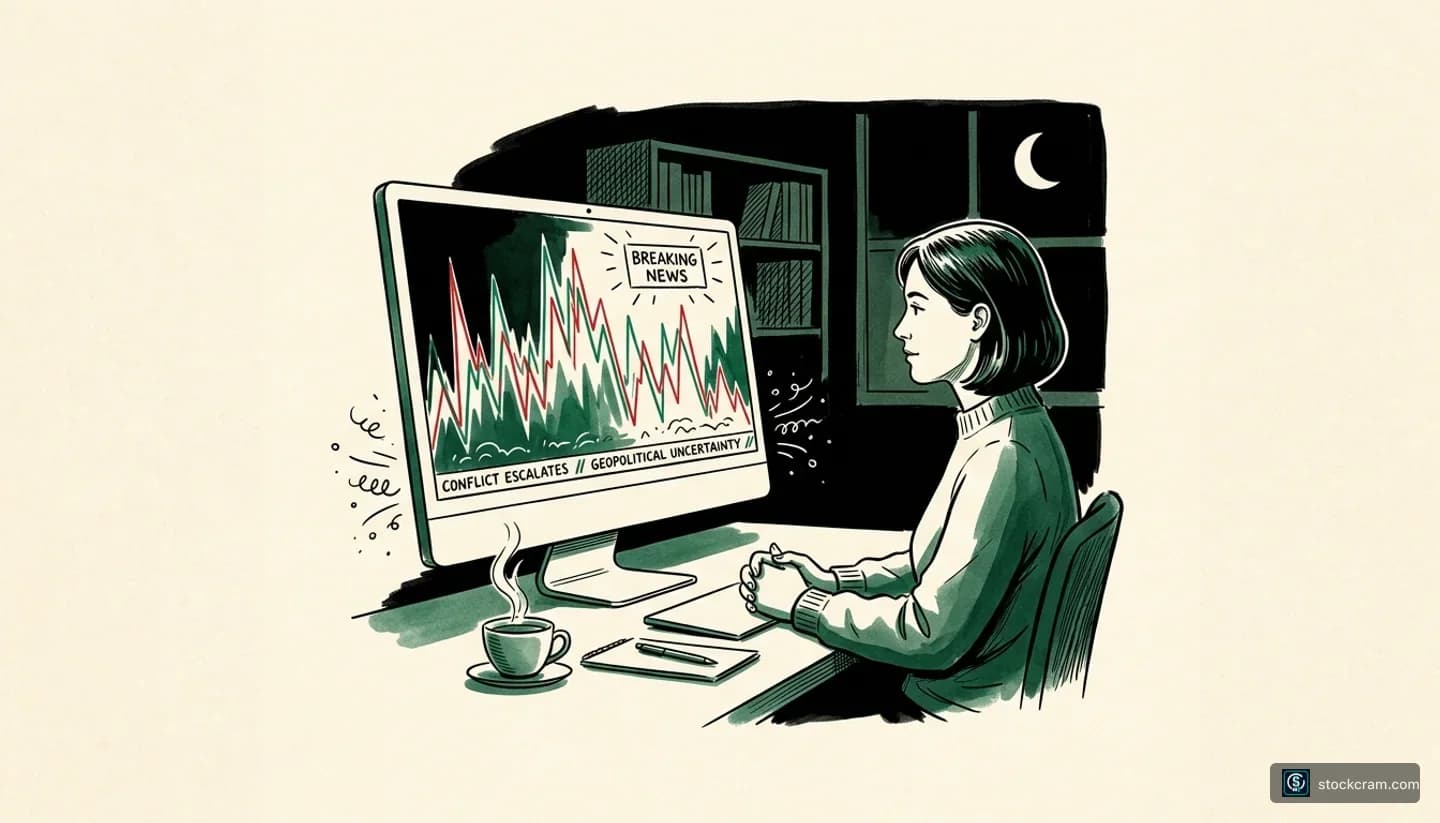
You opened your brokerage app, saw a wall of red, and one question started looping: should I sell stocks during war? Maybe a Strait of Hormuz headline just crossed your feed, maybe a friend already moved everything to cash. Your heart rate is up and your finger is hovering over the sell button. That feeling is real and common. It is also a bad setup for a rushed decision.
This page will not tell you to sell or to hold. It will help you slow down, check whether your plan actually changed, and avoid turning a scary headline into a rushed trade. Along the way it separates a panic reaction from a planned decision and puts a few past war shocks in perspective. Nothing here is a recommendation to buy, sell, or hold, and none of it is a forecast.
It sits alongside our other Market Explainers guides on the mechanics of war and markets, so this page can stay in one lane: your reaction to the headline. You cannot control the war. You can control whether you trade before you have thought it through.
Update (October 8, 2026): Markets reached fresh records in early October even as the Strait of Hormuz remained disrupted. The S&P 500 closed above 7,800 for the first time on October 6, reaching 7,818.93, then pulled back slightly to 7,801.77 by October 7 (CNBC, FRED, Investing.com, Oct 6-7). Oil has remained volatile, with Brent trading in a range around $101-105 per barrel in early October as Iran continues to restrict shipping through the strait and insists on seven conditions before reopening the waterway; multiple tanker attacks were reported October 3-6 (Fortune, Trading Economics, CFR, Al Jazeera, Oct 3-7). The 10-year Treasury yield briefly touched 5.35% on October 7, its highest level since April 2002, before easing to around 5.27%, driven by persistent inflation concerns tied to elevated oil prices (CNBC, FRED, Trading Economics, Oct 7-8). The federal funds rate remains at 3.75-4% following the September 16 hike, with markets pricing potential additional hikes at the October 28 and December meetings as inflation stays above the Fed's 2% target (Federal Reserve, CME FedWatch, Forbes, Sept 29). The headline and the supply worry moved the price again, not your plan.
The short answer is that this is a planning question, not a yes-or-no question, and treating it like one is how people get hurt. Whether selling makes sense for you depends on things this article cannot see: when you need the money, how the rest of your money is arranged, and whether anything about your actual situation changed today. A war headline changes the news. It does not automatically change your financial plan.
So here is the reframe to keep in your head every time a scary headline hits: did the headline change my plan, or did it only change how I feel? Those are different events. A changed plan (you suddenly need cash next month, or your goals genuinely shifted) is a reason to make deliberate adjustments. A changed feeling is a mood, and moods make a poor basis for permanent moves. Volatility is uncomfortable, but discomfort is not new information.
We will not tell you to sell, and we will not tell you to hold. We will help you notice which of those two things actually happened, because that is the part you control.
News snapshot: US-Iran re-escalation, mid-July 2026. Headlines like this drive people to pages like this one. As reported (Reuters and AP, July 13-14, 2026), an interim US-Iran ceasefire collapsed in early July, the US resumed strikes on Iranian military targets, and Iran attacked shipping in the Strait of Hormuz and declared the waterway closed. President Trump ordered a renewed US naval blockade of Iranian ports, reported to take effect July 14, and floated, then walked back, a 20% fee on cargo through the strait. Markets moved the way they often do on a supply scare: U.S. stocks slipped on July 13, 2026, with the S&P 500 down about 0.8%, the Dow down about 0.3%, and the Nasdaq down about 1.6%, while Brent crude jumped nearly 10% to settle near $83 and kept climbing on July 14 (AP, Reuters). Oil peaked at $100.69 on July 23 as the disruption intensified (CNN), then retreated to around $83 by early August as tensions briefly eased (Forbes, Trading Economics, Aug 6-7), before climbing back to around $88 by mid-August as negotiations stalled (Trading Economics, Aug 17). The episode appears here as an example of how war headlines stir portfolio anxiety, not as a forecast. Details are reported and evolving; the article does not predict the conflict. Through late August 2026, the Strait of Hormuz remained heavily restricted but not shut, with Lloyd's List and Kpler data showing 73-112 vessels transiting in mid-to-late August, down sharply from the normal ~130 per day (Lloyd's List, Al Jazeera, CNN, Aug 19-20). Oil climbed back toward $95 by August 20, then fell to around $87-91 by August 25 as Pakistan mediated in Tehran and new US sanctions landed softer than expected (Fortune, Eastern Herald, Trading Economics, Aug 20-25). Markets continued setting records despite the uncertainty, with the S&P 500 reaching an intraday high of 7,814.88 in mid-August (Intellectia, Seeking Alpha, Aug 12-14).
Key Takeaway: We cannot tell you whether to sell. We can help you tell whether the headline changed your plan or only your mood, because that is the part you control.
Wanting to sell during a war scare is not a character flaw. The urge comes from how brains handle fear and money, and understanding the loop is the first step to noticing when you are inside it.
The sequence usually runs like this: A breaking headline lands. Your body reacts before your reasoning does: heart rate up, attention narrowed, a sense that you must do something now. Then a few well-documented biases switch on and push you toward the sell button.
Loss aversion. Loss aversion is the finding that losses hurt roughly twice as much as equal gains feel good. A 10% drop does not register as the mild wobble a 10% gain would; it registers as pain, and the brain wants the pain to stop. Selling promises to stop it immediately. The catch is that the move which relieves the feeling fastest can be very different from the one that fits your plan.
Recency bias. Recency bias is the tendency to weight what just happened far more heavily than the long record. After a red day driven by a war headline, the last few hours feel like the whole story, and it is easy to stretch today's drop into tomorrow's crash. They rarely tell the whole story.
Herd behavior. Herd behavior is the pull to do what everyone around you is doing. When your feed, your group chat, and financial TV all lean one way, staying put feels reckless and joining the stampede feels safe. Fear is socially contagious, and a war headline is about as contagious as news gets.
Stack those three on top of market sentiment turning sour and you get a specific urge: sell, go to cash, or at least refresh the portfolio for the tenth time. That is panic selling, selling driven by emotion and the crowd rather than by any change in your own situation.
Put together, the sequence runs as a loop, each stage feeding the next:
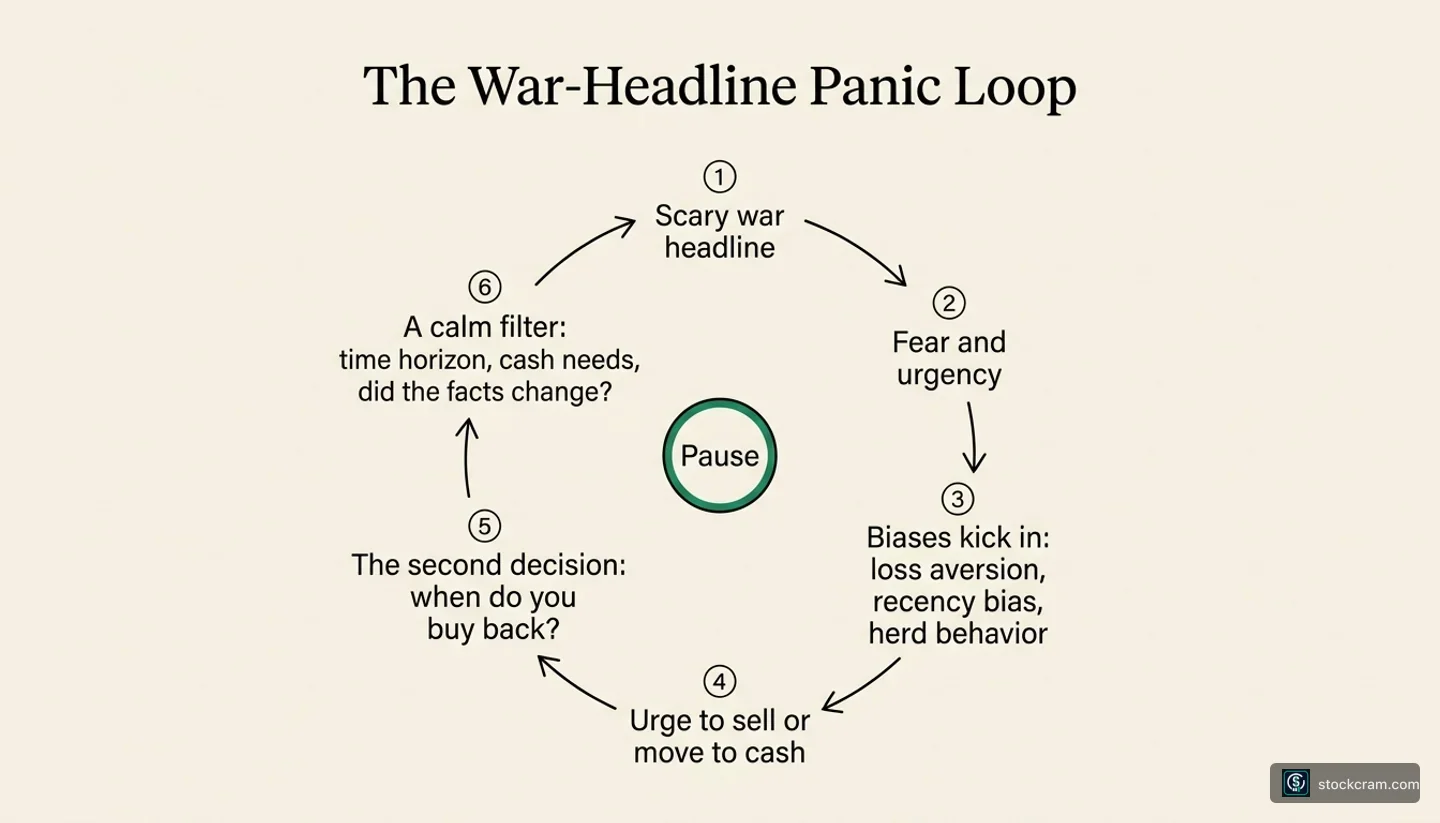
Trace that loop for a moment, and notice what it never includes: a single new fact about the companies you own. None of those three forces is information about your finances. Loss aversion is about how loss feels. Recency bias is about how the timeline feels. Herd behavior is about how other people are acting. A war can genuinely matter to markets, and we are not waving that away. But the loop pushing your finger toward the button is made of feeling and social pressure, not of any fact about when you need your money. Naming the loop is how you buy a beat of space between the headline and the trade.
Key Takeaway: The panic loop is built from loss aversion, recency bias, and herd behavior. Naming it buys you a beat of space between the headline and the trade.
History will not tell you what happens next. What the record can do is loosen the grip of the assumption doing most of the damage right now: that war equals a permanent crash. The real picture is messier, and calmer, than that.
We are keeping this to one compact table on purpose. The full war-by-war account, with recovery times and sector detail, lives in our 80 years of stock-market data across major wars guide. Read the numbers as behavioral evidence, not a forecast.
Historical data shown; figures are approximate and vary by source; Historical data is context, not a forecast.
A few things stand out. In the first three cases (the Cuban Missile Crisis in 1962, the 1990–91 Gulf War, and 9/11 in 2001), the initial drop was real, but the market was higher ninety days later than at the shock. People call this pattern market resilience.
The fourth row keeps this honest. The 1973 Arab Oil Embargo was not a quick dip: stocks fell about 16% and were still down about 13% ninety days later, and the surrounding bear market took years, not months, to recover. The difference is worth understanding. A shock tied to a lasting hit to the real economy, an actual oil supply cut feeding a recession, has behaved very differently from a shock that was mostly a spike of fear. Some war-era selloffs took years to come back. Figures throughout are approximate and vary by source and methodology (Citi/Citigroup).
A recent data point about behavior rather than prices is worth noting. During the early 2026 Iran conflict, Vanguard reported that the S&P 500 fell about 9% from January 27 to March 30, 2026, then reached a record high by April 15, 2026. More telling: over the conflict window Vanguard measured, February 28 to April 8, 2026, only about 14% of Vanguard retail investors traded at all, and among those who did, traders were net buyers of equities by nearly four to one. Most did not trade; the minority who acted mostly leaned the opposite way from the panic narrative. Useful mirror: the crowd you picture rushing for the exits is often smaller and less unanimous than the fear in your chest suggests. StockCram is not affiliated with Vanguard or any brokerage or firm mentioned here.
What history does not show is a rule you can trade on. It does not promise a bounce or a timeline, and every one of these episodes looked genuinely uncertain while it was happening, exactly as today does. The record is perspective, not a crystal ball.
Key Takeaway: Some war shocks were quickly recovered and one (1973) took years; history offers perspective, not a rule you can trade on.
Approximate S&P 500 moves around four geopolitical shocks (Citi/Citigroup market-reaction tables; figures rounded and vary across publications). Historical data is context, not a forecast.
| Event | Initial Drop | Days 30 | Days 90 |
|---|---|---|---|
| Cuban Missile Crisis (1962) | -4% | +8% | +17% |
| Gulf War (1990–91) | -4% | ~flat | +12% |
| 9/11 attacks (2001) | -12% | +0.5% | +4% |
| Arab Oil Embargo (1973) | -16% | -8% | -13% |
Selling feels like one decision but is actually two, and the second is the hard one nobody mentions in the moment.
The first decision is when to get out, and it feels urgent and obvious: the headline is scary, so exit. Decision two is when to get back in, and it determines whether the whole move helped or hurt. The day you sell, you have signed up for a second call: at what point do you return? Most people who panic-sell never plan this part, and that is where the trouble lives.
Getting the round trip right means being correct twice. You would need to get out ahead of a further decline and then back in ahead of the recovery, all while the news is still frightening and every instinct is screaming to stay in cash. Getting the round trip right is market timing, one of the hardest things to do consistently, because the re-entry point never arrives with a bell.
Pictured on a price chart, the trap is easy to see:
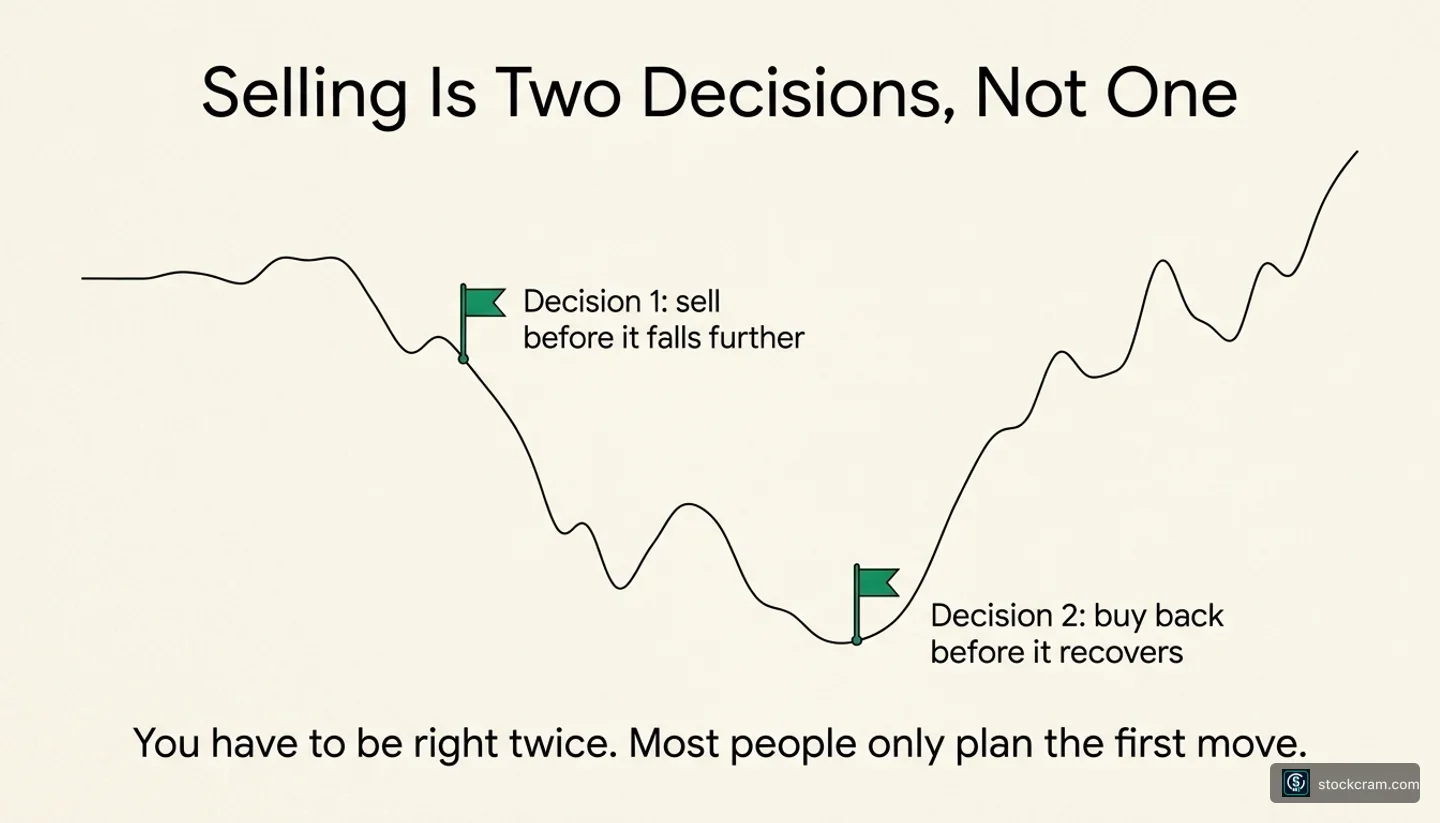
Recoveries after war shocks, when they have happened, have often been fast and front-loaded. Look at the table: some of the biggest moves came in the first weeks off the bottom, while the headlines were still ugly. Waiting in cash for the news to feel safe? It almost never feels safe at the exact moment the market turns. By the time the all-clear feeling arrives, a good chunk of the recovery has usually already happened, and you are deciding whether to buy back higher than you sold. A fear-driven exit can lock in a loss a paper dip never would have.
Selling is not wrong for everyone, but anyone weighing it owes themselves a clear answer to the second question before acting on the first. What is your actual re-entry rule: a price, a date, a feeling? An answer of 'I will just know' deserves a second look, because that phrase is often what recency bias and herd behavior sound like when they pretend to be a plan. The point is to look at both halves of the decision, not just the half fear is shouting about.
Key Takeaway: A sell is really two calls, and the second (when to buy back) is the one panic never plans; getting the round trip right means being correct twice.
To tell a reaction apart from a decision, questions work better than rules. These questions do not decide for you. Each is a mirror for checking whether today's headline touched your plan or only your pulse. Sit with them before you touch anything.
Has my time horizon changed? Time horizon is how long until you actually need this money. A headline does not move that date. If you did not need these dollars for fifteen years yesterday, a war scare has not changed the number of years, even if it changed how the wait feels. A horizon that genuinely shifted for reasons unrelated to the news is a real planning input.
Do I have a near-term cash need I forgot to fund? A tuition bill, down payment, or emergency landing in the next year or two means money you truly need soon arguably should not have been exposed to daily volatility in the first place, war or no war. Noticing that now is useful. The trigger, though, is your calendar, not the headline.
Did anything about why I own this actually change? Ask whether the war altered the specific reason you bought what you own, or only the mood around it. A correction or even a bear market driven by a fear premium is different from a permanent change in what you own. Sometimes something real changed. Often the reason you own it is intact, and only the price and the mood moved.
Am I too concentrated to sleep? A single stock, sector, or bet large enough that this week genuinely threatens your finances or your rest reveals information about how the portfolio was built, not about the war. Concentration is what turns a market wobble into a personal crisis. That is a structural question worth examining calmly, ideally not mid-session.
Is my risk level honestly matched to me? A war scare is a brutally effective stress test. A drawdown that feels unbearable may reveal that the risk you carried was higher than the risk you can live with. Worth learning. The trap is letting the scariest possible moment set your permanent risk level, because fear overshoots in exactly one direction.
Notice the shape of every question. Each asks whether something in your situation changed, not whether the headline is frightening. War headlines are frightening; that does not mean every frightening headline changes your finances. Underneath all five sits one question: did anything practical change? Answer that honestly and you have done the hardest and most valuable part, whichever way you decide.
Key Takeaway: Planning questions all reduce to one: did anything practical change, or is the headline just frightening? That distinction, not a rule, separates panic from a plan.
A whole body of long-term investing thinking exists precisely because headlines like today's are unpredictable. The useful thing is not to follow any of it as an order but to see what problem each idea was built to solve. We are describing them, not prescribing them.
Buy-and-hold stays invested through cycles instead of jumping in and out around events. Buy-and-hold does not claim nothing bad will happen; it bets that reacting to each scare costs more than it saves, for the two-decision reason above. Its design assumption is that frightening headlines keep coming and most will not have mattered in hindsight.
Diversification stops your outcome from depending on any one company, sector, or event, so no single headline, war included, can be decisive. Single-event outcomes are unpredictable, so you arrange things not to need the prediction.
Rebalancing nudges a portfolio back toward its target proportions after prices push it out of shape. Notice what it answers to: a predetermined target on a schedule, not how frightening the news feels today.
Dollar-cost averaging invests a fixed amount on a regular schedule regardless of the market. Dollar-cost averaging takes the timing call, the one fear corrupts most, off the table by letting the schedule decide. Some people also cite mean reversion, the historical tendency of markets to swing back toward long-run averages, though that is an observation about the past, not a guarantee.
The thread is simple: each idea removes a decision emotion is bad at making. They automate away the exact moment you are living through. Whether any fits you depends on your goals and circumstances, which is a question for you and, if you want one, a licensed professional who knows your situation.
Key Takeaway: Long-term frameworks share one design goal: automating away the panic-prone decision you are facing right now. They are concepts to understand, not orders to follow.
If you take nothing else from this piece, take a pause. When a war headline has your finger over the sell button, the most useful move is to insert a short, boring gap between the feeling and the action. The checklist below is built for that gap. The checklist does not tell you to sell or to hold; it helps make sure that whatever you decide is a decision and not a reflex.
Try this one-sentence self-check first. Finish the sentence: 'I am selling because ______.' A blank filled with 'I feel scared' signals a need to pause. 'I need this cash within a year' is a real planning reason. 'Everyone says it gets worse' means pause again and check the facts. The sentence is a mirror, not an instruction.
Notice what the checklist questions share: almost every one points back at your own situation and away from the headline. A trade that still makes sense after you have honestly worked through them is a planned trade, whatever it turns out to be. A trade that only made sense while your heart was racing is the one these prompts are meant to catch. The headline will still be there in an hour, and the button will still be there tomorrow.
Still unsure after all that? That is a reasonable place to be, and a good moment to talk to a licensed financial professional who can look at your actual circumstances rather than a generic page. Uncertainty is not a signal to act fast. Uncertainty usually signals you should slow down.
One thing before you close the tab: save this checklist before the next scary headline.
Key Takeaway: Before any war-headline trade, insert a boring pause and run the checklist; a decision that still holds afterward is a plan, and one that doesn't was a reflex.
You cannot control the war, whether the Strait of Hormuz stays open, what any government does next, or where the market closes on Friday. Spending energy predicting those things spends it on the one part entirely outside your hands.
What you can control sits closer: your reaction. Whether you let a headline convert a temporary feeling into a permanent decision is up to you, and it is where nearly all the avoidable damage in these moments happens. The market did what it did in the table above regardless of how anyone felt; the difference between investors was in what they did next.
So the frame we leave you with is the one we opened with. When the next frightening headline lands, and there will always be a next one, the useful question is not 'will it get worse.' Nobody knows. The useful question is: did this change my plan, or only my feelings? When your plan genuinely changes, adjust it deliberately, ideally with a professional who knows your situation. If only your feelings changed, you have met volatility behaving the way it routinely does, and the calmest move is often to let the feeling pass before deciding anything.
None of this is a recommendation to buy, sell, or hold, and none of it is a forecast. This lesson does not expire when the current headlines fade, which is the point. Wars, elections, crashes, and crises will keep arriving. The reaction is the part you own every time, and learning to read your own reaction is the most durable investing skill there is.
Want a calmer way to follow market headlines? Create a free StockCram account to save guides like this to your dashboard.
Key Takeaway: The war is outside your control; your reaction is not. The controllable risk in front of you is turning a temporary feeling into a permanent decision.
Short answers to the questions people ask most when a war headline has their portfolio in the red.
No one can answer that for you; a flat yes or no would be guessing about your life. Whether selling fits depends on when you need the money, how your portfolio is built, and whether anything in your situation actually changed, none of which a headline touches. The more useful question is whether the war changed your plan or only how you feel. A genuine change in your plan calls for deliberate adjustment, ideally with a licensed professional. When only your feelings changed, that is volatility behaving normally. Educational content only, not advice.
Often there is an initial drop, but what happens to stocks during a war has varied a lot. Around the Cuban Missile Crisis (1962), the Gulf War (1990–91), and 9/11 (2001), the S&P 500 fell at first yet was higher ninety days later. The 1973 Arab Oil Embargo is the counterexample: stocks fell about 16%, were still down about 13% three months on, and the surrounding bear market took years to recover. Shocks that genuinely hurt the real economy behaved very differently from shocks that were mostly fear. Figures are approximate (Citi/Citigroup); past performance does not indicate future results.
Because your brain is running a fear loop, not a spreadsheet. Loss aversion makes a drop hurt more than an equal gain feels good, recency bias makes today's decline feel like the start of a trend, and herd behavior makes selling feel safe when everyone else is doing it. Together they produce the urge that defines panic selling. Recognizing the loop buys you a moment to check whether anything in your plan actually changed.
It depends on what you mean by safe and over what period. Cash does not swing day to day, so it feels safer during a scare, and money you need in the next year or two is a different question from long-term money. Over longer stretches, cash carries its own risk: inflation erodes its purchasing power, and stepping out means facing the re-entry problem of deciding when to return. There is no universally safe choice, only trade-offs that depend on your timeline.
A 401(k) is not a single investment; it is an account holding the funds you chose inside it, often stock funds, bond funds, and target-date funds. Moving it 'to cash' usually means switching those funds into a money-market or stable-value option, which locks in whatever the balance is that day and hands you the re-entry problem: deciding when to switch back, while the news still feels bad. For most people a 401(k) is long-term, retirement-horizon money, a different time horizon from cash you need soon. How it is structured we can explain; the right mix depends on your circumstances and is a good topic for a licensed professional. Not allocation advice.
Anyone who gives you a universal answer is guessing. Which path fits depends on your timeline, your cash needs, how your portfolio is currently built, and whether the reason you own your investments changed, not on the headline itself. The stock market during war has reacted in very different ways to different shocks, so the past offers perspective rather than a rule. Investing during a geopolitical crisis feels different, but the decision structure is the same: the useful step is telling whether today's news changed your plan or only your mood. Educational content only, not a recommendation.
No fixed answer exists. In some past cases recovery came within weeks or months (the market was higher ninety days after the 1962, 1990–91, and 2001 shocks). In others, like the 1973 oil embargo, it took years. When rebounds did come, much of the move often arrived early, which is exactly why timing your exit and re-entry is so hard: the recovery tends to start while the news still feels bad. Figures are approximate; the future stays uncertain.
Panic selling is selling in a rush, driven by fear and crowd pressure rather than by any change in your plan or the reason you owned the investment. It sits at the end of the fear loop: loss aversion and recency bias make a drop feel unbearable, herd behavior makes selling feel safe, and the sell button promises instant relief. The tell is the motivation. A sale prompted by a real change in your situation is planning; a sale prompted mainly by how a headline felt is panic selling.
The behavioral corner of a larger set. If you want the mechanics behind the headlines rather than the psychology of reacting to them, these companions go deeper, each in its own lane:
All four are part of our Market Explainers series. And for a parallel example of the same behavioral pull in a very different setting, are we in another AI bubble? looks at how the crowd's mood shapes reactions to hype rather than to fear.
Key Takeaway: Use the companion guides for the mechanics of war and markets; this piece stays focused on how to read your own reaction.
What changed on this page since it was published, newest first.
Update (October 1, 2026):
Update (September 24, 2026): Diplomatic momentum shifted over the past week as US and Iranian officials held mediated talks on September 22 at the UN General Assembly in New York, with President Trump calling the three-hour session "very productive" and Iran offering to reopen the Strait of Hormuz within seven days if the US eases military pressure and lifts its blockade (Al Jazeera, Bloomberg, Reuters, Sept 22-23). Oil responded to the mixed signals, climbing back above $100 after briefly dipping below $99 earlier in the week; Brent reached $101.61 on September 23 as markets weighed Saudi pipeline restoration efforts against renewed tanker attacks and diplomatic uncertainty (Trading Economics, Sept 23). The S&P 500 fell to around 7,699-7,706 by September 23-24, down from 7,551.81 on September 16, pressured by the 10-year Treasury yield hitting 5.11%, its highest level since July 2007, as strong economic data and persistent inflation concerns drove bond selling (Trading Economics, FRED, Yahoo Finance, Sept 23-24). Markets remain volatile as investors parse conflicting headlines: threats and talks, attacks and offers, all arriving in the same news cycle. Once more, the headline and the diplomatic mood changed the price, not your plan.
Update (September 17, 2026): Oil prices have pulled back over the past week after Saudi Arabia announced plans to restore its East-West pipeline, which was damaged in Houthi drone attacks on September 10. Brent crude fell from around $101-105 on September 10 to approximately $103-104 by September 17 as Riyadh indicated it could restore half the pipeline's capacity within days and is offering additional crude to Asian refiners through ship-to-ship transfers near Oman, bypassing Hormuz transit risks (CNBC, Trading Economics, Fortune, Sept 17). Strait of Hormuz traffic remains heavily restricted, with only 8-12 vessels transiting daily in mid-September compared to the normal ~130 per day (straits.live, Windward, Sept 13-17). The S&P 500 fell to around 7,699-7,706 by September 23-24, down from 7,551.81 on September 16, as the 10-year Treasury yield hit 5.11%, its highest since July 2007, driven by strong economic data and persistent inflation concerns tied to elevated oil prices (Trading Economics, FRED, Yahoo Finance, Sept 23-24). The Federal Reserve raised rates by 25 basis points to 3.75-4% on September 16, its first hike in three years, with Chair Kevin Warsh signaling a hawkish stance on inflation (CNBC, Sept 16). Markets remain volatile as investors weigh supply workarounds against the backdrop of tighter monetary policy and ongoing conflict uncertainty. Once again, the headline and the workaround changed the mood and the price, not your plan.
Update (September 10, 2026): The conflict has intensified further over the past week. Iran-backed Houthi militants attacked several energy facilities in Saudi Arabia, forcing temporary shutdowns, and Iran attempted attacks on US Navy ships, including ballistic missile strikes on an aircraft carrier over the weekend (Trading Economics, Sept 9-10). The US struck three Iranian oil tankers on Saturday in retaliation. Oil surged past $100 on September 9 for the first time since May, with Brent climbing to around $101-105 per barrel by September 10 as the war premium returned in force (Trading Economics, Fortune, Convex, Sept 9-10). Strait of Hormuz traffic remained severely restricted, with Kpler and other tracking services showing only 6-13 vessels per day transiting in early September, far below the normal ~130 per day (Al Jazeera, straits.live, Sept 3-10). Markets pulled back from around 7,668 on September 2 to approximately 7,604-7,636 by September 9-10, posting three consecutive days of losses as oil prices and Treasury yields climbed (Yahoo Finance, TheStreet, Sept 9-10). President Trump stated the conflict would likely continue past the November midterms, signaling limited prospects for near-term relief in gasoline prices (Trading Economics, Sept 10). Once again, the headline changed the mood and the price, not your plan.
Update (September 3, 2026): The conflict re-escalated after a month of relative calm. The US launched fresh strikes on approximately 100 Iranian targets on September 1, the largest American action since late July, hitting IRGC sites around the Strait of Hormuz and, for the first time, two Iranian government tankers (Insurance Journal, Bloomberg, GlobalSecurity, Sept 1-2). Iran retaliated with drones and missiles targeting American bases across the Middle East. Brent crude surged from around $87-91 on August 25 to approximately $95-99 by September 3 as the war premium returned (Trading Economics, Fortune, Forbes, Sept 3). Kpler data shows Strait of Hormuz traffic collapsed again to only 6-11 vessels per day in late August and early September, down sharply from the 73-112 vessels reported in mid-to-late August and far below the normal ~130 per day (Middle East Eye, The Hill, Al Jazeera, Aug-Sept). Markets pulled back from their mid-August intraday peak of 7,814.88 to around 7,668 by September 2, though still up roughly 19% year-to-date (Trading Economics, Investing.com, Sept 2). Once again, the headline changed the mood and the price, not your plan.
Update (August 26, 2026): The conflict picture has shifted again in the past week. Oil fell from around $95 on August 20 to approximately $87-91 by August 25 as diplomatic efforts intensified: Pakistan's army chief visited Tehran carrying a mediation proposal, and new US sanctions on Iran landed softer than markets had feared, with no immediate deadline for countries to wind down trade (Fortune, Eastern Herald, Trading Economics, Aug 20-25). Lloyd's List and Kpler data show the Strait of Hormuz remained heavily restricted but not shut in mid-to-late August, with 73-112 vessels transiting, down sharply from the normal ~130 per day but well above the single-digit lows seen in early summer (Lloyd's List, Al Jazeera, CNN, Aug 19-20). Ships routed through alternative corridors, often with transponders off, and shadow-fleet operators filled gaps left by mainstream carriers. Markets continued setting records beyond the August 12 high noted below, reaching an intraday peak of 7,814.88 in mid-August (Intellectia, Seeking Alpha, Aug 12-14). Oil's recent drop reflects what traders call the war premium unwinding, though the strait remains far from normal and the diplomatic path forward stays uncertain. Once more, the headline changed the mood and the price, not necessarily your plan.
Update (August 17, 2026): The situation has shifted since the early-August update. The 60-day ceasefire between the US and Iran expired today with no deal in place, and negotiations remain stalled (CNBC, Aug 17). The Strait of Hormuz is effectively closed to commercial shipping, with only 1 vessel transiting on August 9 compared to a normal 73 per day (straits.live, Aug 17). Oil has climbed back to around $88 per barrel as of August 17, up from the ~$83 level in early August (Trading Economics). Despite the renewed uncertainty, stock markets continued their recovery: the S&P 500 hit a fresh record of 7,798.99 on August 12 (CNBC), extending gains from the early-August rebound. That lesson stays the same, but the snapshot reflects the current deadlock and market resilience through mid-August.
Update (August 8, 2026): The US-Iran conflict has evolved since this post was published in mid-July. After the ceasefire collapsed in early July, the situation escalated through multiple rounds of strikes and a reimposed US naval blockade. By early August, Iran and Oman were in negotiations over a Strait of Hormuz shipping route, with President Trump stating the strait would reopen "soon" (CNN, Aug 5). As of August 17, those talks remain stalled, the ceasefire has expired, and the strait is effectively closed to commercial shipping (CNBC, straits.live). Oil peaked at $100.69 on July 23, then retreated to around $83 by August 6-7 as tensions eased (CNN, Forbes). Stock markets continued their recovery through mid-August: the S&P 500 hit a fresh record of 7,798.99 on August 12, the Dow crossed 54,000 for the first time on August 4, and the Nasdaq surged nearly 9% from a July 29 low (CNBC, CNN). That lesson below stays the same, but the snapshot has been updated to reflect the current state of the conflict and markets.
This guide draws on reported news and published research, credited here as a transparency and credibility signal.
Key Takeaway: Reporting from AP and Reuters, historical data from Citi/Citigroup, behavior data from Vanguard, and education from FINRA and SEC Investor.gov.
Should you sell stocks during a war? That was never a question a webpage could answer, because it depends on your plan, your timeline, and your life, not the headline. What we can do is separate the two things a scare mixes together: a change in your plan, which is a reason to act deliberately, and a change in your feelings, which is volatility behaving normally. History offers perspective without a rule, selling is really two decisions rather than one, and long-term frameworks exist to automate away the panic-prone choice. The part you can control is your reaction.
Educational content only. StockCram is not a broker-dealer, investment adviser, or financial institution, and nothing here is a recommendation to buy, sell, or hold any security. The July 2026 US-Iran details are reported and evolving, used as an example rather than a forecast; this article does not predict the conflict or the markets. Historical figures are rounded and shown for context: the future stays uncertain. If you are weighing a real decision, consider speaking with a licensed financial professional who knows your circumstances. Last reviewed: October 8, 2026.
Want a calmer way to follow market headlines? Create a free StockCram account to save guides like this to your dashboard. For the mechanics behind the headlines, read how the 2026 US-Iran war hit the stock market, how the Strait of Hormuz drives oil shocks, why oil falls and stocks rise when war fears ease, and the full 80 years of stock-market data across major wars, all part of our Market Explainers series.
This is a planning question, not a yes-or-no
Whether to sell depends on your timeline, your portfolio, and whether your situation changed, none of which a headline decides. The reframe: did anything practical change, or did my body just react?
The urge to sell is a fear loop, not information
Loss aversion, recency bias, and herd behavior push toward the sell button; none of the three is a fact about when you actually need your money.
History gives perspective, not a rule
Markets recovered within months after some war shocks (1962, 1990–91, 2001) but took years after 1973; the future stays uncertain.
Selling is two decisions, and the second is the hard one
You have to be right about when to get out and when to get back in, while recoveries often start before the news feels safe.
The reaction is the part you can control
You cannot control the war or the market, only whether you turn a temporary feeling into a permanent decision. That skill never expires.
When war fears ease, oil often falls while stocks rise. Here's the simple mechanic behind it, taught through the June 2026 Iran ceasefire.
After three months of Strait of Hormuz closure, the oil-spike-decay rule has stopped working. Here's what's actually happening to prices and energy stocks.
The S&P 500 fell 8%, then hit a new all-time record, all within 50 days of war. Here's what the data shows and why this conflict breaks the historical pattern.