
Market Analysis
Stock Market Today, Oct 15: Hot CPI, Chip Rout
Read Article
Market Analysis
AI-powered insights into global financial markets
 StockCram Editorial12 min read
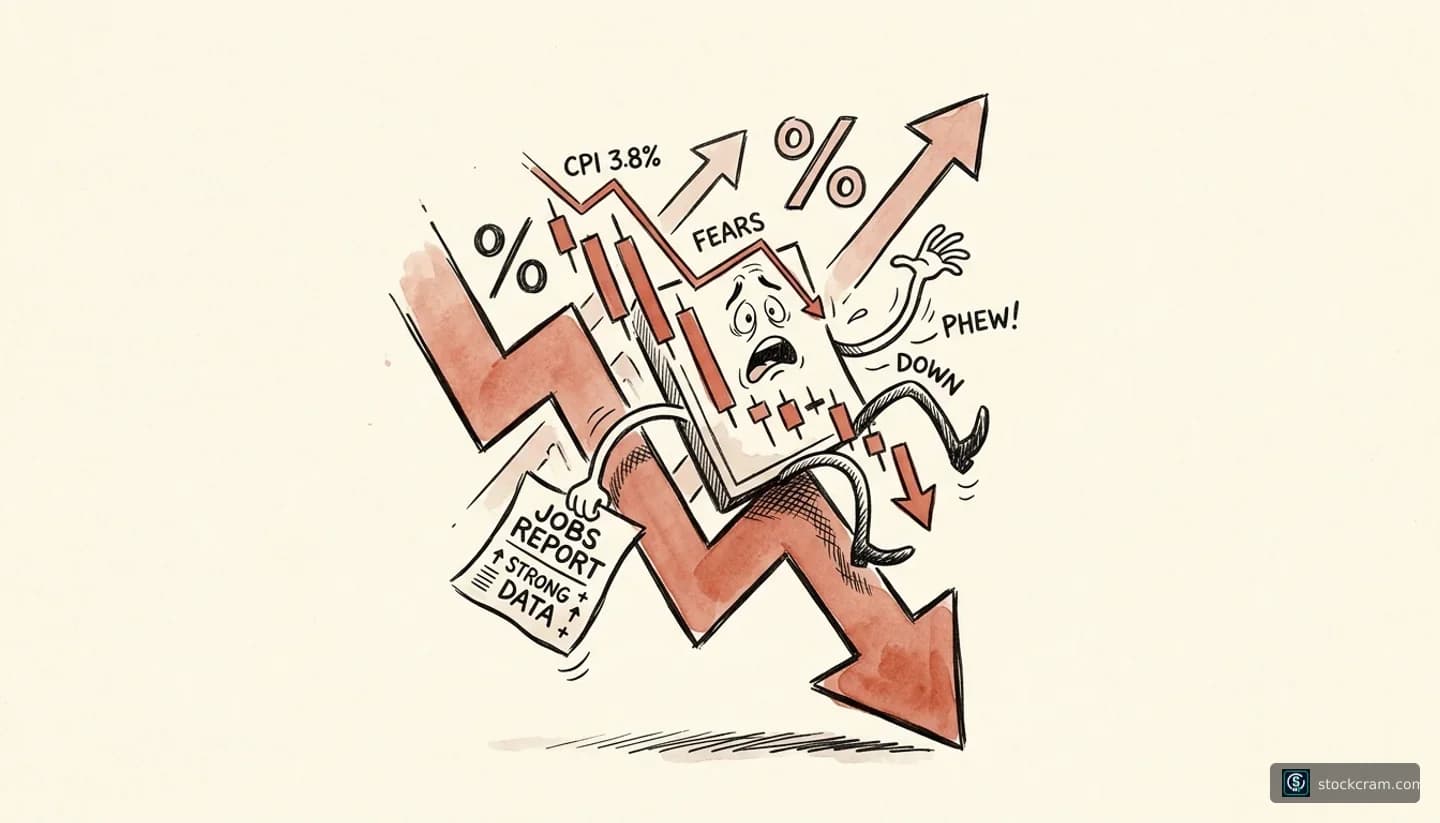
Strong August jobs report triggers rate hike expectations, sending yields higher and stocks lower to end the week.
Week of Monday, August 31, 2026 - Friday, September 4, 2026
+0.1%
7,718.60
+0.4%
26,506.99
-0.3%
53,414.25
+0.3%
2,968.27
14.53
+1.5%
4.77%%
+0.06%
$$90.96
+9.0%
$$4,470.66
-0.1%
99.16
-0.3%
The week began with U.S. military strikes on Iranian rocket launchers at Larak Island in the Strait of Hormuz on August 31, prompting Iranian retaliatory attacks on U.S. bases in Jordan and the UAE. The escalation marked the first major military exchange between the two nations in over a month, raising concerns about oil supply disruptions through the critical shipping corridor.
Energy stocks hit all-time highs as oil prices jumped, with WTI crude gaining approximately 9% for the week to close around $91 per barrel. The State Street Energy Select Sector SPDR ETF reached its highest level since its 1998 inception, while energy companies like Marathon Petroleum and Phillips 66 notched fresh 52-week highs.
Friday's August employment report showed nonfarm payrolls increased by 162,000 jobs, crushing consensus estimates of just 53,000. Additionally, July's previously reported decline of 23,000 jobs was revised upward to show a gain of 21,000, meaning summer employment was 55,000 jobs higher than initially reported. The unemployment rate held steady at 4.1%.
Markets reacted swiftly to the data, with traders boosting odds of a September Fed rate hike to over 58%, up from roughly 50% before the report. The 10-year Treasury yield rose to 4.77%, while the 2-year yield—more sensitive to near-term Fed policy—jumped to 4.37%. Credit-sensitive sectors pulled back as borrowing cost expectations increased.
Technology stocks displayed mixed performance throughout the week, with semiconductor stocks rallying on Friday while mega-cap names faced pressure. Fed Governor Christopher Waller's mid-week comments suggesting openness to holding rates steady if inflation continues to ease briefly supported tech valuations, but Friday's jobs data reversed that sentiment. Tesla's highly anticipated Cybercab robotaxi launch on September 3 failed to impress Wall Street.
Chip stocks bucked the Friday selloff, with Nvidia gaining 0.8%, Micron surging 6.1%, and Intel adding 4.5% amid optimism around AI infrastructure demand. Conversely, Apple fell 2.6%, Alphabet dropped 2.1%, and Tesla plunged 5.9% after analysts called the Cybercab event underwhelming and raised questions about the company's autonomous vehicle timeline.
The week opened with U.S. forces striking Iranian rocket launchers on Larak Island in the Strait of Hormuz on Sunday, August 30, as Iranian forces prepared to disperse sea mines into the waterway. Iran responded overnight into Monday with missile and drone attacks on U.S. military facilities in Jordan and the UAE, marking the first major military escalation between the two nations in over a month.
Oil prices surged on supply disruption fears, with Brent crude rising above $96 per barrel and WTI climbing toward $92. Energy stocks rallied sharply, with the sector posting the strongest weekly performance. Safe-haven assets like gold also saw increased demand, though gold ultimately closed the week down slightly after Friday's jobs data.
Energy sector analysts noted that sustained geopolitical risk premiums could support higher oil prices for an extended period, particularly given the strategic importance of the Strait of Hormuz, through which roughly 20% of global oil supply passes. Some strategists viewed energy stocks as offering value at current levels despite recent gains.
Other market observers pointed out that crude supplies continued reaching markets despite the tensions, with Iraq's August oil exports actually rising. Some analysts cautioned that geopolitical risk premiums can dissipate quickly if conflicts de-escalate, and that elevated oil prices could exacerbate inflation concerns and prompt more aggressive Fed tightening.
Tesla officially launched its Cybercab autonomous robotaxi at an invite-only event in Austin, Texas on September 3. The two-seat vehicle features scissor doors and no steering wheel or pedals, designed exclusively for camera-based autonomous navigation. However, CEO Elon Musk did not attend the event, which was not livestreamed, and the company provided limited details on deployment timelines and regulatory approvals.
Tesla shares initially rallied 7% on Thursday ahead of the event but reversed sharply on Friday, falling 6% to erase the prior day's gains and post the stock's worst single-day performance since late July. The decline came as analysts expressed disappointment with the lack of concrete information.
Supporters of Tesla's autonomous strategy noted that the Cybercab moved from concept to actual passenger service, reducing product risk. Some analysts pointed to recent Nevada regulatory approvals allowing Tesla to deploy up to 5,000 robotaxis in Las Vegas over the next 12 months as evidence of progress, and highlighted that the company's high valuation has long been predicated on autonomous vehicle success.
Skeptical analysts argued that Tesla's robotaxi operations remain small-scale compared to Alphabet's Waymo, which already operates nearly 1,000 vehicles in Texas alone. Critics noted that the event failed to address key questions about safety data, unit economics, regulatory clearance timelines, and how quickly the fleet could scale—leaving significant execution risk unresolved.
Lululemon and Oxford Industries both slashed full-year guidance during the week, with Lululemon cutting its sales outlook to a range of $10.35-10.50 billion from $11.0-11.5 billion previously, citing continued weakness in China where sales fell 4% year-over-year. Oxford Industries lowered its revenue forecast due to softness at Lilly Pulitzer and broader macroeconomic pressures.
Lululemon shares plummeted 17-18% on the news, while Oxford Industries dropped 14%. The consumer discretionary sector lagged for the week, down for the year-to-date period, as investors weighed concerns about spending patterns amid elevated interest rates and persistent inflation.
Some retail analysts suggested the weakness was company-specific rather than indicative of broader consumer health, noting that other retailers have posted solid results. They pointed to still-low unemployment and wage growth as supportive factors for consumer spending, particularly in value-oriented categories.
Cautious observers noted that multiple retailers have now cited macroeconomic headwinds and international weakness, suggesting consumers may be pulling back on discretionary purchases. With interest rates potentially heading higher following the strong jobs report, some analysts warned that credit-sensitive consumer spending could face additional pressure in coming months.
Energy was the week's standout winner, benefiting from geopolitical tensions in the Middle East that drove oil prices sharply higher. The sector hit all-time highs early in the week and remained the year's strongest performer, up over 42% year-to-date, as concerns about Strait of Hormuz shipping disruptions supported crude prices.
Technology finished the week in positive territory despite Friday's selloff, supported by strength in semiconductor stocks. Memory chip makers rallied on optimism around AI infrastructure demand, with analysts noting strong guidance from hyperscale cloud providers and continued investment in data center capacity.
Utilities outperformed as a defensive play, attracting investors seeking stability amid geopolitical uncertainty and rate volatility. The sector was the only one in positive territory on Friday when broader markets fell following the jobs report.
Consumer discretionary stocks faced pressure from disappointing retail earnings and guidance cuts, particularly from Lululemon and Oxford Industries. The sector remained negative for the year-to-date period as investors grew concerned about consumer spending power amid elevated prices and rising borrowing costs.
Communication services lagged as mega-cap tech names including Alphabet fell on Friday following the strong jobs report. The sector faced selling pressure as investors rotated away from high-valuation growth stocks in anticipation of higher interest rates.
Consumer staples underperformed despite their typically defensive characteristics, as the sector failed to attract meaningful safe-haven flows. Some analysts noted that elevated valuations and concerns about margin pressure from higher input costs weighed on the group.
Memory chip maker Micron rallied on Friday despite broader market weakness, benefiting from optimism around AI infrastructure demand and upcoming earnings expectations. Analysts noted strong guidance from Nvidia regarding hyperscaler spending, which could drive significant memory chip demand.
SanDisk posted the week's strongest gain among major chip stocks, rallying on similar AI-driven memory demand themes. The company benefited from analyst commentary suggesting memory chip makers face supply constraints as AI server production accelerates.
Intel gained on Friday as semiconductor stocks rallied broadly, though the company continues facing questions about its foundry business turnaround. The stock remained up 148% year-to-date despite recent volatility, reflecting investor optimism about its AI strategy and government manufacturing incentives.
Lululemon plummeted after cutting its full-year sales guidance for the second time, now expecting revenue to fall 5-7% to $10.35-10.50 billion. The athletic apparel maker cited continued weakness in China, where sales declined 4% year-over-year, disappointing investors who had hoped for a recovery.
Fair Isaac tumbled after the Federal Housing Finance Agency Director announced on social media that Fannie Mae and Freddie Mac would be directed to approve all lenders to use the competing VantageScore credit scoring system, potentially threatening FICO's dominant market position.
<a href="/learn/foundations/what-is-a-stock">Tesla shares</a> fell sharply on Friday, erasing Thursday's 7% rally that preceded the Cybercab launch. Analysts expressed disappointment with the lack of concrete details about deployment timelines, safety data, and regulatory approvals, leaving significant questions about the robotaxi business model unanswered.
Expected: +53,000 jobs expected
The stronger-than-expected jobs report dramatically shifted market expectations for Federal Reserve policy, with traders now pricing in over a 58% chance of a rate hike at the September 15-16 FOMC meeting. The data, combined with upward revisions to prior months, suggested the labor market remains resilient despite previous concerns about softening.
Expected: 4.1% expected
The unchanged unemployment rate indicated labor market stability, supporting the Fed's view that the economy can withstand higher interest rates without triggering significant job losses. This reading reinforced expectations that policymakers have room to maintain their hawkish stance if inflation remains elevated.
Expected: 55.3 expected
The manufacturing activity index came in slightly below expectations but remained in expansion territory above 50, indicating continued factory sector growth. The employment component edged down to 51.2, while the prices index held steady at 71.1, suggesting input cost pressures persist in the manufacturing sector.
The week's divergent performance—with energy surging on geopolitical tensions while rate-sensitive sectors struggled with jobs data—echoed market dynamics from previous Middle East conflict periods. The 2019-2020 U.S.-Iran tensions similarly drove oil price spikes and defensive sector rotation, though that episode occurred in a falling rate environment rather than the current rising rate backdrop.
Historical patterns suggest that geopolitical oil price spikes tend to be temporary unless conflicts escalate into sustained supply disruptions. However, the combination of Middle East tensions and a strengthening labor market presents a particularly challenging environment for the Fed, as higher energy prices could keep inflation elevated even as the central bank considers tightening policy. The 1970s stagflation period demonstrated how energy shocks and tight monetary policy can create difficult market conditions, though today's economy shows different structural characteristics.
August 30-31, 2026
U.S. forces struck Iranian rocket launchers on Larak Island in the Strait of Hormuz on August 30 as Iranian forces prepared to disperse sea mines into the critical shipping waterway. Iran responded overnight with missile and drone attacks targeting U.S. military facilities in Jordan and the United Arab Emirates, marking the first major military exchange between the nations in over a month.
Market Relevance
The escalation sent energy markets sharply higher, with oil prices gaining approximately 9% for the week as investors priced in supply disruption risk. The Strait of Hormuz is a critical chokepoint for global oil flows, with roughly 20% of the world's petroleum passing through the waterway. Energy stocks rallied to all-time highs, while safe-haven assets saw increased demand early in the week.
Yes—the situation remains fluid with President Trump stating the U.S. could still take additional action. Markets will continue monitoring for further escalation or signs of de-escalation, as sustained conflict could drive oil prices significantly higher and complicate the Fed's inflation fight.
Disclaimer: This weekly recap is for educational purposes only and does not constitute investment advice. Past performance is not indicative of future results. Always consult with a qualified financial advisor before making investment decisions.