


The Risk Isn't Losing Money. It's Being Forced to Sell.
A quick qualification first, because the heading is deliberately blunt: this is about the broad, diversified, long-term portfolio the rest of this course builds toward. A single company really can go to zero and stay there, and no amount of patience fixes that. Within a diversified portfolio, though, a falling market is not by itself a disaster. Prices drop and recover; that has happened repeatedly and is a normal feature of owning shares in businesses. What turns a drop into a permanent loss is selling while it's down. The most common reason people sell at the bottom isn't panic. It's need.
The boiler fails. The car needs a transmission. Hours get cut. If the only money available is invested, it gets sold at whatever price the market happens to be offering that week. The market didn't cause the loss. The absence of a cushion did.
What this lesson is actually about
Not whether markets are risky; they are. Whether you're positioned so that a bad year is something you sit through rather than something that forces your hand.
How Long Have Recoveries Taken?
"It recovers eventually" is true and not very useful. The practical question is how long, because that determines how much time you need to be able to give it.
The table below measures every drop the same way: from the peak before the fall to the day the index got back to that peak. That's the honest measure, because the peak is where a person who invested at the worst possible moment actually started.
| Downturn | Peak-to-trough fall | Peak back to peak |
|---|---|---|
| 1973–74 oil shock | About −48% | Roughly 7 years |
| Dot-com bust (2000–02) | About −49% | Roughly 7 years |
| Global financial crisis (2007–09) | About −57% | Roughly 5.5 years |
| COVID crash (2020) | About −34% | About 6 months |
| 2022 bear market | About −25% | About 2 years |
S&P 500 price levels, rounded. Measured peak-to-peak, so recovery times are longer than trough-to-peak figures you may see elsewhere. Past performance does not indicate future results.
Two things stand out. Recoveries are wildly uneven (six months in one case, seven years in another), and the long ones are long enough to matter. Someone who needed their money three years after the dot-com peak was still well underwater.
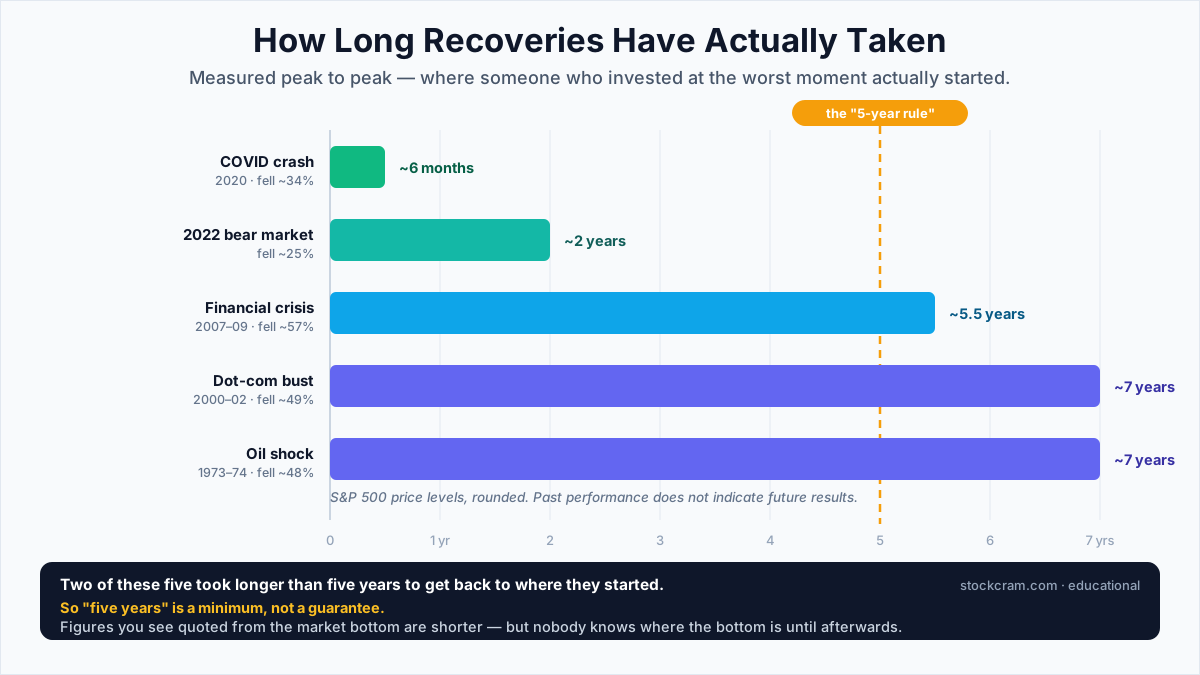
Seen on one axis, the spread is the point: the same event class produced anything from half a year to seven.
The 2022 bear market is worth its own note. It was shallower than the others, but bonds fell alongside stocks rather than cushioning them, which is the combination people planning around "stocks fall, bonds hold" don't expect. Diversification reduces risk; it doesn't switch it off.
Three Things That Make It Survivable
Given recoveries that can run for years, what has to be true for you to sit through one?
Cash you can reach without selling
A cushion in savings means an unexpected bill gets paid from cash rather than from your portfolio. This is what breaks the link between a bad month and a forced sale. The next lesson covers how big it needs to be.
No debt charging more than investing is likely to earn
A balance at a high APR compounds against you at a known, guaranteed rate while your investments compound for you at an uncertain one. Carrying both means running a race against yourself. The debt lesson covers where the line sits.
Time you can genuinely give it
Money needed within a few years shouldn't be exposed to a drop it may not have time to recover from. Money you won't touch for a decade can sit through the table above.
Where the Five-Year Rule Comes From
You'll often see a rule that money needed within five years shouldn't be in the market. It's a rough heuristic rather than a law, and the table above shows why it's rough: two of those five recoveries took longer than five years.
What the rule really encodes is that short horizons and volatility are a bad combination. A three-year goal has no room to absorb a 30% drop. A twenty-year horizon has absorbed every drop in the table and then some. Five years is a reasonable dividing line for thinking, not a guarantee. The honest version is "five years at minimum, and history says be prepared for longer."
Where this rule gets misapplied
The five-year rule is about the money, not the account. Putting a house deposit into a taxable brokerage doesn't make a three-year horizon safe; the account type changes the tax treatment, not the volatility. The last lesson covers where nearer-term money can actually sit.
The One Common Exception
This lesson is broadly sequential (cushion, then debt, then invest), but there's a widely-noted exception worth understanding rather than following blindly.
If an employer offers a matching contribution to a workplace retirement plan, contributing enough to receive it adds money to your account that you would not otherwise get. That is a different proposition from an investment return, because it doesn't depend on markets. But it comes with conditions that are frequently left out: matched money is often subject to vesting, meaning you can forfeit it by leaving before a set period; once contributed it is invested and can fall in value; and it's generally locked until retirement age absent an exception.
Worth being precise about
An employer match is compensation you only receive if you contribute, not a guaranteed or instant return. Formulas vary; a common one is 50% of your contributions up to 6% of pay. Your own contributions are always yours immediately. Vesting applies only to the employer's share. The 401(k) Calculator shows what a given match adds over time. 401(k) Explained covers the mechanics.
If You're Not There Yet
Reading a checklist and failing it is a common outcome, and "wait" is a poor answer if the wait is measured in years. The conditions above are not a gate you pass in order; they're things that can be built in parallel.
A small starter cushion, enough to absorb an ordinary surprise rather than a job loss, removes the most likely reason you'd be forced to sell, and it can be built while also paying down a balance. Someone with a $280 monthly surplus, a card balance, and no savings has a genuine sequencing problem, not a reason to do nothing. What that sequence looks like depends on the rate on the debt, which is the next-but-one lesson.
Sources & Further Reading
- Investor Bulletin: How to Prepare for a Market Downturn, U.S. Securities and Exchange Commission, Office of Investor Education
- NBER Business Cycle Dating, National Bureau of Economic Research, for recession dating referenced in the downturn table
Educational use only
Educational content only. StockCram isn't a broker or adviser, and we have no affiliation with any institution mentioned. Investing involves risk, including possible loss of principal. Nothing here is a recommendation about when to invest.