


The Labels Are Shorthand
"Good debt" usually means borrowing that bought something durable: a home, an education, a business. "Bad debt" means borrowing that funded consumption. It's a useful distinction for thinking about whether the borrowing was worthwhile, and close to useless for deciding anything now.
What matters now is the APR. A mortgage at 12% would be punishing regardless of the asset behind it. A 0% promotional balance is cheap regardless of what it bought. The rate is the number that decides how much the debt costs you every month it exists.
The question worth asking
Not "is this good debt or bad debt?" but "does this rate cost more than investing is likely to earn?" That's a comparison between two numbers, and it has an answer.
What a Credit Card Balance Actually Costs
Most people underestimate this, and the underestimate is not small. Here is the arithmetic in full, so you can check it.
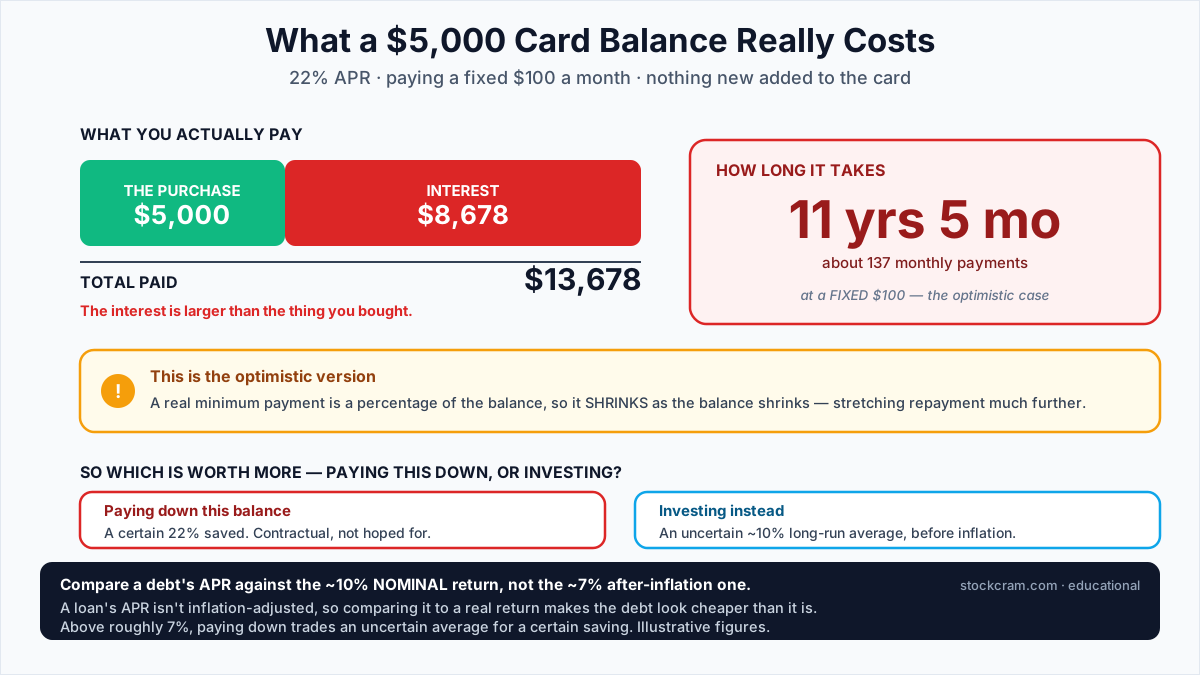
Take a $5,000 balance at a 22% APR, paying a fixed $100 a month and adding nothing new.
| $5,000 at 22% APR, $100/month | Result |
|---|---|
| Time to clear the balance | About 137 months (11 years and 5 months) |
| Total paid | About $13,678 |
| Of which interest | About $8,678 |
| So the $5,000 purchase cost | About $13,700 |
Fixed $100 monthly payment, 22% APR compounded monthly, no further spending on the card. Illustrative.
Compounding works against a balance exactly as it works for a portfolio; the Compound Interest Calculator runs it in either direction. The interest is larger than the original purchase. And this is the *optimistic* version, because it assumes a fixed $100 payment. A real minimum payment is typically calculated as a small percentage of the balance, so it shrinks as the balance shrinks, which stretches the timeline dramatically further.
That is the cost of one balance left to run. With more than one, the next question is which to attack first.
This is what "minimum payment" means
A minimum payment is designed to keep the account current, not to clear it. Paying a fixed amount, even the same amount you'd have paid as the first minimum, clears a balance far faster than paying the shrinking minimum, because more of every payment goes to principal instead of interest.
Where the Line Falls
If the question is "pay this down or invest?", the comparison is between a certain cost and an uncertain return.
A balance at 22% that you pay down produces a guaranteed 22% saving on that money, guaranteed because the interest is contractual. Investing produces an uncertain return. Historically, a broad U.S. stock index has returned roughly 10% a year before inflation, which works out around 7% a year after inflation. Those two figures get mixed up constantly, and the distinction matters here. The Inflation-Adjusted Return Calculator shows the gap between the two for any figure you put in.
Compare like with like
A loan's APR is a nominal number, not adjusted for inflation. So the fair comparison is against the nominal historical return of roughly 10%, not the ~7% real figure. Comparing a 7% APR against a 7% *real* return is a category error that makes the debt look cheaper than it is.
So why isn't the dividing line simply 10%? Because the two numbers aren't the same kind of number. Paying down a balance is a certain saving, locked in the moment you make the payment. The 10% is a long-run average that includes years of losses, and the next decade isn't obliged to repeat it. Certainty is worth something, so the line people use sits below the historical average rather than at it. How far below is a judgement rather than a calculation: Investor.gov, for instance, uses about 8% or above as its rule of thumb for high-interest debt without tax advantages.
| Rate on the debt | How the trade-off is usually described |
|---|---|
| Below ~5% | The case for investing alongside repayment is easier to make. |
| Roughly 5–8% | A genuine gray zone. Taxes, job security, and how the balance feels to carry all matter. |
| Above ~8% | Prioritising payoff becomes progressively more compelling. |
| Credit-card rates | Not a close call. These sit far above the range where the question is interesting. |
A framework, not a formula. The right answer depends on your rate, your tax situation, and your own tolerance for carrying a balance.
Note the word *average*. The ~10% figure is a long-run average containing the downturns from the previous lesson. Paying down a 22% balance beats it comfortably. Paying down a 4% mortgage is a much closer call, and reasonable people land differently.
Where Different Debts Typically Sit
Rates move, and the ones you're offered depend heavily on your credit score. Rather than memorise numbers that go stale, it's more useful to know the ordering, and roughly where these bands cut through it.
| Type of borrowing | Where it usually sits | Where it usually falls |
|---|---|---|
| Credit cards | Low-to-mid 20s | Far above the gray zone |
| Personal loans | Wide range, roughly 7%–36% | Depends entirely on the offer |
| Used car loans | Often low double digits | Usually above the gray zone |
| New car loans | Around 7%, promotional rates lower | Around the gray zone |
| Federal student loans | Undergraduate lower, graduate and PLUS higher | Around or above the gray zone |
| Mortgages | Typically the lowest rate most people carry | Usually below the gray zone |
General ordering, not current quotes. Check your own statements: the rate you actually pay is the only one that matters.
About the mortgage interest deduction
Mortgage interest is often described as tax-deductible, which makes the debt sound cheaper. It only helps if you itemise, and because the standard deduction is large, most filers don't. Treat it as a possible bonus, not a reason a mortgage is cheap. Investment Taxes 101 covers deductions in more depth.
Which Balance First?
With more than one debt, there are two well-known orderings, and they optimise for different things.
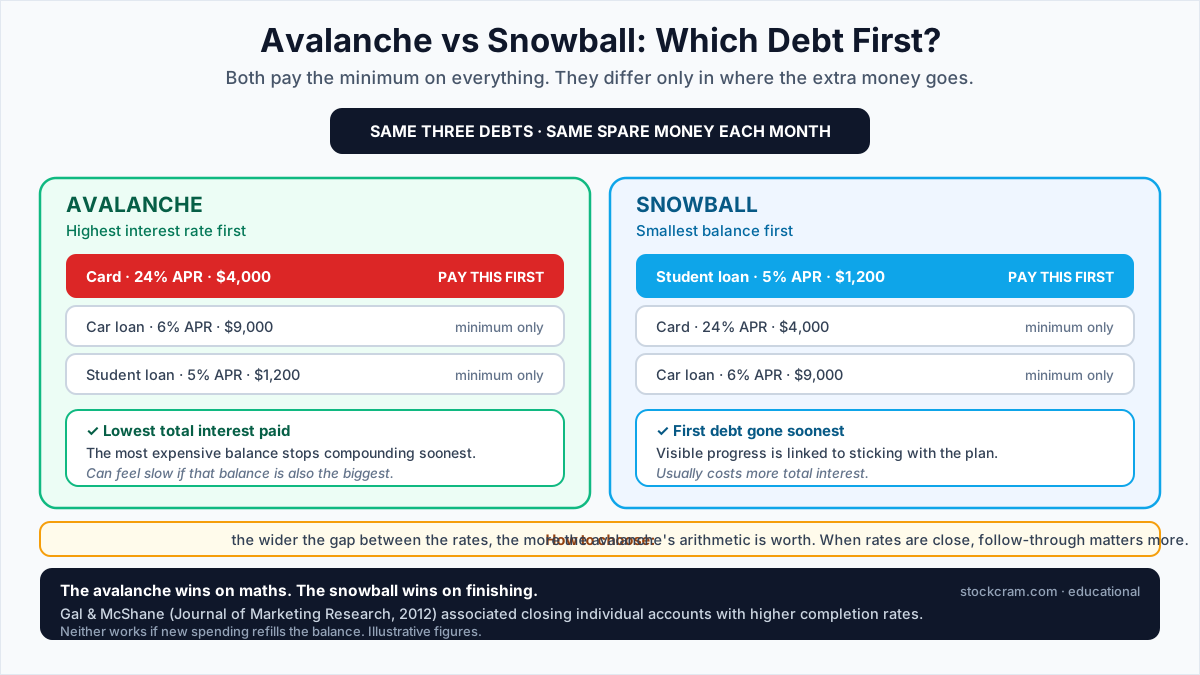
[[debt-avalanche|Avalanche]]: highest rate first
- Pay minimums everywhere, extra to the highest APR
- Mathematically produces the lowest total interest
- The most expensive balance stops compounding soonest
- Can feel slow if that balance is also the largest
[[debt-snowball|Snowball]]: smallest balance first
- Pay minimums everywhere, extra to the smallest balance
- Clears individual debts sooner
- Research links completion to visible progress
- Usually costs more total interest
The avalanche wins on arithmetic, and that isn't in dispute. The snowball's case is behavioural: research by Gal and McShane published in the *Journal of Marketing Research* (2012) found that closing individual accounts was associated with higher rates of completing a repayment programme. A plan followed through beats a better plan abandoned in month four.
Neither ordering is wrong. The gap between your own rates is what decides how much the arithmetic is worth giving up.
If the rates are close together, the difference in total interest is small and follow-through matters more. If one balance is at 24% and another at 5%, the avalanche's advantage is large enough to be worth some discomfort.
A Worked Comparison
Someone has $300 a month spare, a $4,000 card balance at 22%, and a $9,000 car loan at 6%. Both have minimums they're already paying.
Putting the extra $300 against the card clears it in roughly a year and stops the most expensive interest first. Putting it against the car loan instead leaves the 22% balance compounding for years while chipping at debt costing a quarter as much. Here the two methods agree, because the card is both the higher rate and the smaller balance, which is the easy case. When they disagree, the rate gap tells you how much the arithmetic is worth.
The one thing that beats both methods
Not adding to the balance while paying it down. Neither ordering works if new spending refills the card each month, which is the budgeting problem from the first lesson, not a debt problem.
Sources & Further Reading
- Consumer Credit, G.19, Board of Governors of the Federal Reserve System, for average rates on card accounts assessed interest
- Credit Cards, Consumer Financial Protection Bureau, on minimum payments and interest
- Gal, D. & McShane, B. B. (2012), "Can Small Victories Help Win the War?", *Journal of Marketing Research* 49(4), on debt-repayment completion and account closure
- Federal Student Aid: Interest Rates, U.S. Department of Education, for current federal loan rates
Educational use only
Educational content only. StockCram isn't a broker or adviser, and we have no affiliation with any lender or institution mentioned. Nothing here is a recommendation about how to handle your debts.