


The Category Nobody Names
This course has been fairly clear about two buckets. Money you might need at short notice belongs in cash-like savings. Money you won't touch for a decade or more can go into the market, where the volatility has time to work itself out.
That leaves an obvious gap, and most people's biggest goals live in it. A wedding in two years. A house deposit in four. A car replacement in three. Too soon for the market by the reasoning in Before You Invest, and too large and too specific to just sit alongside the emergency fund.
The organising question
Not "what's the best return?" but "when exactly do I need this money, and what happens if it's worth less that week?" For a deposit with a completion date, the answer to the second half is usually "the purchase falls through", which settles it.
Why Not Just Invest It?
Because the timing isn't yours to choose. An investor with a twenty-year horizon who hits a 30% drop waits. Someone completing on a house in March sells at March's price, whatever March happens to look like.
The recovery table from the second lesson is the argument: several past downturns took multiple years to get back to their previous peak. A three-year goal doesn't reliably contain that. And using a taxable brokerage account rather than a retirement account changes nothing about this: the account type changes tax treatment, not volatility.
What's Actually Available
Four broad options, each trading access against certainty in a different way.
| Option | Access | Rate | Protection |
|---|---|---|---|
| High-yield savings | Days | Variable, moves with Fed policy | FDIC insured to $250,000 per depositor, per bank |
| No-penalty CD | Days, after an initial period | Fixed, usually below a standard CD | FDIC insured within limits |
| Standard CD | Locked; early exit costs a penalty | Fixed for the term | FDIC insured within limits |
| Treasury bills | Hold to maturity, or sell on the market | Fixed at purchase | Backed by the U.S. government |
| Money market fund | Typically same or next day | Variable | Not FDIC insured |
General characteristics. Terms vary by provider. Check the specific product.
Two details in that table do most of the work. Fixed versus variable: a CD or T-bill locks your rate, which is an advantage if rates fall and a disadvantage if they rise. Savings and money market funds float either way. FDIC versus not: bank products carry deposit insurance; a money market fund does not, and that difference is buried by the naming.
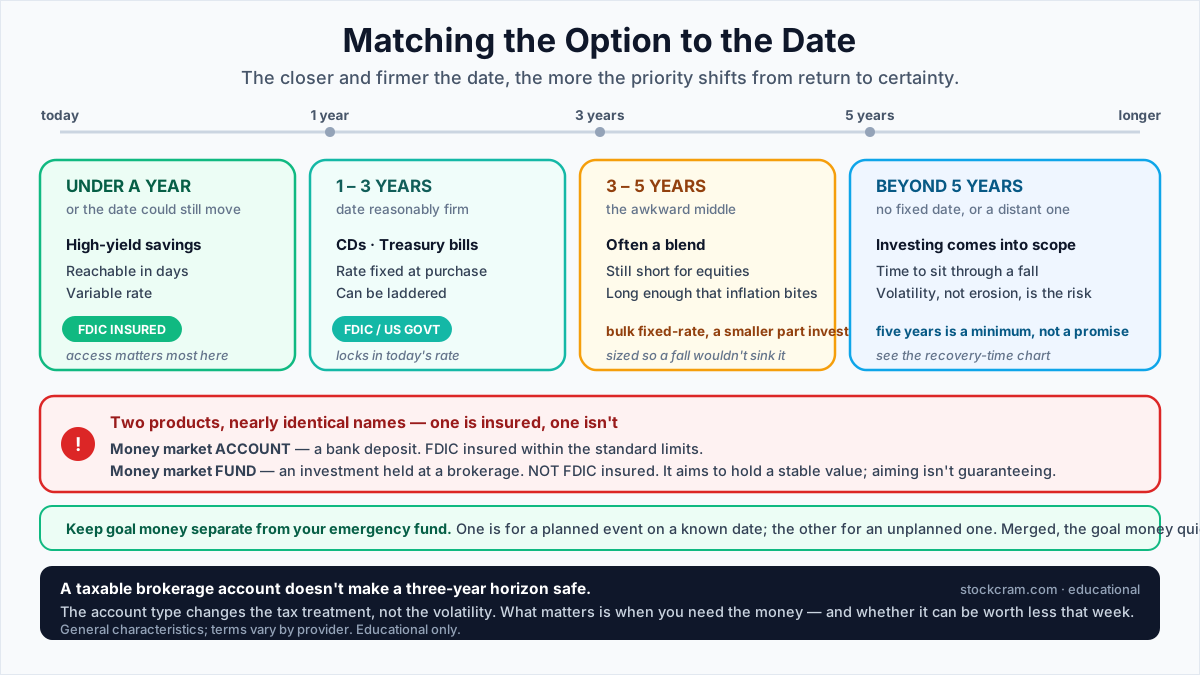
Find your date on the top line and read down. Everything else in this lesson is detail on whichever band you landed in.
Treasury bills, briefly
A T-bill is a short-term loan to the U.S. government, sold at a discount and repaid at face value, and the gap is your return; a $1,000 bill bought at $978 returns $22. Terms run from 4 weeks to 52 weeks, and the interest is generally exempt from state and local income tax, which can matter in a high-tax state. Treasury Bonds covers the wider family.
Matching the Option to the Date
The horizon does most of the choosing. The closer and more fixed the date, the more the priority shifts from return toward certainty.
Under a year, or date not yet fixed
Access matters most. A high-yield savings account keeps the money reachable and the rate competitive. Locking money up for a date you might move isn't worth a small rate advantage.
One to three years, date reasonably firm
A fixed rate becomes more attractive because it removes the risk of rates falling before you get there. CDs and T-bills can be laddered, with several maturing at intervals, so some of the money frees up periodically.
Three to five years
The awkward middle. Still short for equities, long enough that inflation erodes cash meaningfully. The deciding variable here isn't only the date. It's what a fall would cost you. If the goal is fixed (a specific sum, on a specific date, where being short means it doesn't happen), keeping the money out of the market is the safer framework even close to five years. Investing a portion becomes reasonable when the date or the amount can flex enough that a bad year wouldn't derail it.
Beyond five years
Now the reasoning from earlier lessons applies and investing comes into scope, with the caveat that five years is a minimum rather than a guarantee.
Laddering, in one line
Rather than one 3-year CD, buy three CDs maturing at 1, 2 and 3 years. With $9,000 split across 1, 2 and 3-year CDs, $3,000 frees up each year, so you're not fully locked in, and you're not betting everything on the rate available on a single day.
Keep It Separate From the Emergency Fund
A goal fund and an emergency fund can look identical (both cash, both in savings) but they do different jobs, and merging them tends to end badly.
One is for a planned event on a known date. The other is for an unplanned event on an unknown one. Held in a single pot, the deposit money quietly becomes the emergency money, and the first genuine emergency sets the goal back by however much it costs. Separate accounts are a small administrative cost for a large clarity gain.
The inflation trade, stated plainly
Holding cash for a multi-year goal means accepting that inflation may erode some of its buying power, which is particularly relevant for a house deposit, since property prices can move faster than savings rates. There is no option here without a downside. The market carries volatility; cash carries erosion. You're choosing which risk fits the deadline.
Where This Leaves You
Across this course the picture has become a set of buckets sorted by when the money is needed: a cushion for surprises, a separate pot for goals with dates, expensive debt cleared because its rate beats what investing is likely to return, and a long-horizon portfolio for everything beyond that.
That's the foundation. What actually goes into the long-horizon portfolio, what a stock is, how an index fund works, why diversification matters) is the Foundations course. And because every rate in this lesson moves with Fed policy, The Fed & Interest Rates explains why the numbers you looked up today won't be the numbers next year.
Sources & Further Reading
- Treasury Bills, U.S. Department of the Treasury, TreasuryDirect
- Deposit Insurance At A Glance, Federal Deposit Insurance Corporation
- Money Market Funds, U.S. Securities and Exchange Commission, Office of Investor Education
Educational use only
Educational content only. StockCram isn't a broker or adviser, and we have no affiliation with any bank, fund or institution mentioned. Nothing here is a recommendation about where to hold your money.