

A Fund With One Job
An emergency fund is money set aside to cover an unexpected expense or a gap in income. Its job is narrow: be available, in full, at short notice, on a day you did not plan for. Every design decision follows from that.
The phrase that captures it best comes from Dave Ramsey: an emergency fund "turns a crisis into an inconvenience." A $900 car repair is annoying if you have cash. It's the start of a debt spiral if you don't.
How Much: Start From Your Own Numbers
The common guidance is three to six months of expenses. That's a reasonable starting range, but two things about it are usually left unsaid.
It means essential expenses, not total spending: the figure from the first lesson. Rent, utilities, groceries, insurance, minimum debt payments, transport. Not restaurants and holidays, because in the scenario this fund exists for, those stop.
As for the range itself, three to six months is a widely used rule of thumb rather than a formula, and it isn't derived from any single statistic. One reason a range that size is useful is that a loss of income tends to last months rather than weeks. The U.S. Bureau of Labor Statistics publishes median and average duration of unemployment monthly, and the two differ a lot, because a minority of long spells pull the average well above the median. Treating the median as a floor and the average as a reminder of the tail is one way to read it, not the origin of the rule. Sizing to the median covers a typical case; sizing nearer the average covers a bad one.
The arithmetic
Essential monthly expenses × number of months = your target.
Using the first lesson's example: $2,980 essentials × 3 months = $8,940. × 6 months = $17,880.
Sizing against that person's *total* $3,370 spending instead would set a 6-month target of $20,220, about $2,300 of extra saving before they'd let themselves invest anything. The Emergency Fund Calculator runs this sum against your own numbers.
Where you sit in the range depends on how replaceable your income is and how many people depend on it.
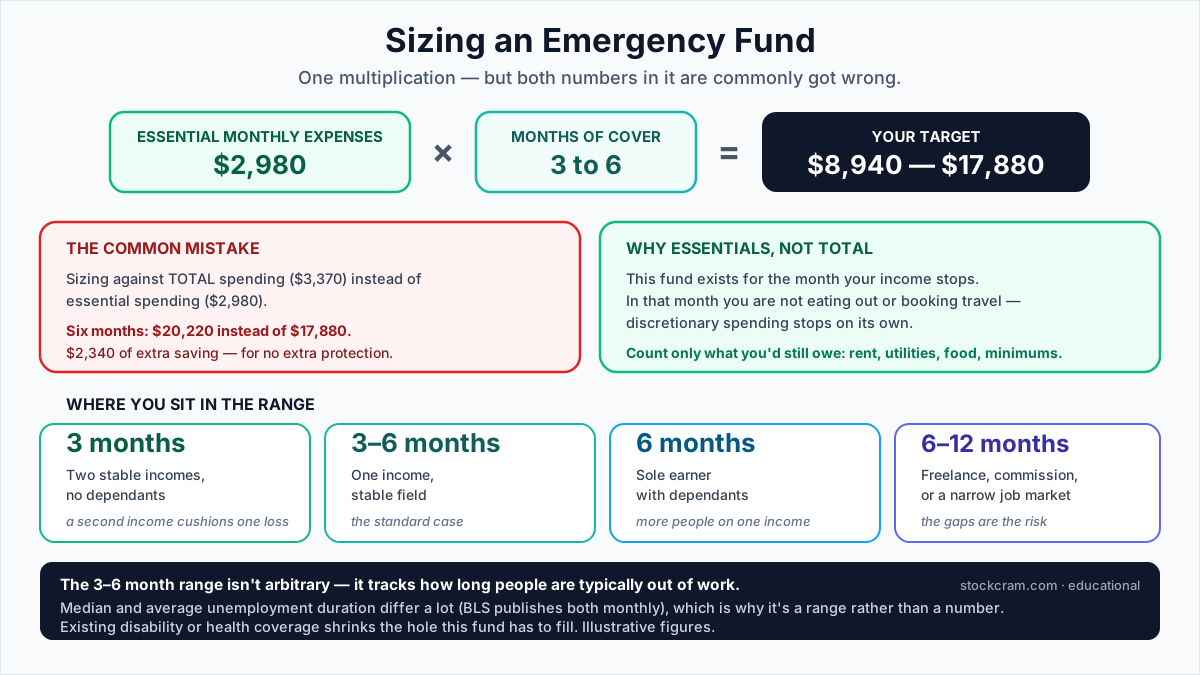
The right-hand column is the one to sit with. The range exists because circumstances differ, not because the guidance is vague.
| Situation | Common range | Why |
|---|---|---|
| Two stable incomes, no dependants | 3 months | A second income cushions a single job loss |
| One income, stable field | 3–6 months | The standard case |
| Sole earner with dependants | 6 months | More people relying on one income stream |
| Freelance or commission-based | 6–12 months | Income arrives unevenly; the gaps are the risk |
| Specialised role, few local employers | 6–12 months | A narrow job market takes longer to re-enter |
Illustrative ranges, not prescriptions. Your own circumstances determine the right figure.
Existing insurance shifts this too. Someone with solid disability coverage and a low health-plan out-of-pocket maximum is protected against a different set of scenarios than someone with neither, and the fund is covering a smaller hole. Disability insurance in particular overlaps directly with the income-loss case this fund is sized for.
Where It Should Sit
The requirements are unglamorous: the balance shouldn't fall, and you should be able to reach it within a few days. That rules out the stock market, where the money would be worth least precisely when a recession costs you your job. The two risks arrive together.
Fits the job
- High-yield savings account: FDIC insured, accessible in days
- Money market account: a bank deposit, also FDIC insured
- No-penalty CD: fixed rate, withdrawable without a fee
Doesn't fit
- Stocks or stock funds, which can fall exactly when you need them
- Standard CDs, where early withdrawal triggers a penalty
- Cash at home, with no insurance, no interest, easy to lose
Two products, nearly identical names
A money market account is a bank deposit and is FDIC insured. A money market fund is an investment held at a brokerage and is not. They aim to hold a stable value, but aiming isn't guaranteeing. People sometimes believe they hold one when they hold the other.
Separately: deposits at federally insured credit unions carry equivalent protection through the NCUA rather than the FDIC. Different agency, same idea. A credit union account isn't less protected for not saying FDIC.
Why the Rate Keeps Changing
Savings rates are variable. They aren't set by the bank in isolation; they track the Federal Reserve's policy rate, which the Fed moves to manage inflation and employment. When the Fed raises rates, savings rates tend to follow within a month or two. When it cuts, they fall the same way.
This is why quoting a specific APY in a lesson is a mistake: whatever number is printed goes stale as soon as policy shifts. The useful skill is knowing that the rate moves, and checking the current one when it matters. The Fed & Interest Rates covers who sets these rates and why they change.
Comparing accounts
Compare using APY, not the raw interest rate. APY already includes the effect of compounding, so it's the like-for-like number. The gap between the largest brick-and-mortar banks and online-only banks is usually wide, often the difference between a rate near zero and one near the policy rate.
Your Emergency Fund Isn't Free
Cash is usually presented as the safe option, full stop. It's more accurate to say it trades one risk for another.
The balance won't fall, which is the point. But inflation erodes what that balance buys, and when inflation runs above your savings rate, the fund loses purchasing power every year even as the number on the statement grows. There's also opportunity cost: money held in cash isn't invested, and over long periods that gap compounds. And the interest is generally taxable as ordinary income, so the after-tax return is lower than the advertised APY.
None of that argues against having a fund. It argues against having an enormous one. "As much as possible" isn't the answer. Beyond a sensible target, each extra month of cash is buying progressively less protection at a steady cost.
Building It From a Small Surplus
A full six-month fund is a large number, and staring at it can be paralysing. The useful framing is that the first portion already does meaningful work: a starter amount covers the everyday emergencies that are most likely to happen, even though it would not carry you through a long loss of income.
A starter amount first
Enough to cover an ordinary surprise: a repair, an excess, a vet bill. This handles the most frequent emergencies and is reachable in months rather than years.
Then decide the sequence
With a starter cushion in place, the question becomes whether the next dollar goes to the fund or to a high-rate balance. The debt lesson has the arithmetic for that comparison.
Then the full target
Build to your chosen number of months. Automating the transfer on payday removes the monthly decision, which is the part that usually slips.
When you use it, that's success
Spending the fund isn't a failure of discipline; it's the fund doing its job. The only follow-up is rebuilding it. People who treat drawing on it as a defeat sometimes borrow instead to keep the balance intact, which defeats the purpose entirely.
Sources & Further Reading
- Duration of Unemployment, U.S. Bureau of Labor Statistics, Current Population Survey (median and average weeks unemployed, updated monthly)
- Deposit Insurance At A Glance, Federal Deposit Insurance Corporation, for coverage limits and what is and isn't insured
- An Essential Guide to Building an Emergency Fund, Consumer Financial Protection Bureau
Educational use only
Educational content only. StockCram isn't a broker or adviser, and we have no affiliation with any bank or institution mentioned. Nothing here is a recommendation about where to hold your money.