Anthropic IPO Explained: Date, Ticker, Price & How to Buy

Anthropic has submitted a confidential draft to the SEC but is still private. No ticker, no date, no IPO price yet - here's what is actually confirmed, and what it means for retail buyers.

Sean Sha
By Sean Sha(updated )20 min read

Educational purposes only. This content does not constitute investment advice. Read our disclaimer

StockCram is not a broker-dealer, investment adviser, or financial institution. All content is for educational and informational purposes only and should not be construed as personalized investment advice. Consult a qualified financial professional before making investment decisions. Past performance does not guarantee future results.
Anthropic IPO Explained: Date, Ticker, Price & How to Buy
Share
20 min read

Anthropic IPO at a glance

Latest update, September 10, 2026. Anthropic remains private. The company has announced no public filing, official ticker, exchange, IPO price or trading date, though journalists have reported a listing window and the banks running the offering. The reported timetable has since slipped. On September 5 Reuters reported that the prospectus was no longer expected within days but in late September, that marketing would begin in mid-October at the earliest, and that the listing would be completed shortly before the November midterm elections. Reuters cautioned that the plans, including the timing, are subject to change. None of it is company-confirmed.

The table below is the fastest way to see where this actually stands. Every row carries one of four labels, and the difference between them matters more than it sounds. Company-stated means Anthropic said it. Press-reported means journalists reported it and Anthropic has not confirmed it. SEC-filed means it sits in a document the SEC can hold the company to. Not announced means Anthropic has not publicly announced it, which is not the same as saying it does not exist or that nobody has reported it. Publicly checkable means you can verify it yourself, usually on the SEC's EDGAR database.

Key Takeaway: The process of going public has started. No part of it that would let you buy shares has finished, and nothing here is SEC-filed yet.

Where the Anthropic IPO stands right now

Status as of September 4, 2026. No row here is SEC-filed yet.

AnswerStatusQuestion
NoPublicly checkablePublicly traded?
Submitted to the SEC confidentiallyCompany-stated (June 1, 2026)Draft registration statement
Not available yetPublicly checkablePublic S-1 and prospectus
Not publicly announcedNot announcedTicker symbol
Not publicly announcedNot announcedExchange
Morgan Stanley and Goldman Sachs leading, JPMorgan in the syndicate; Citigroup reported added in AugustPress-reported (Bloomberg, June 3 and August 20, 2026)Underwriters
Prospectus late September, listing before the November midtermsPress-reported (Reuters, September 5)IPO date
Not publicly announcedNot announcedIPO price
$965 billion post-money (post-money includes the money just raised, explained below)Company-stated (Series H, May 28, 2026)Latest primary valuation
Above $65 billion (a recent period annualized, not a full year, explained below)Press-reported, end of July 2026Revenue run-rate
Not through a normal brokeragePublicly checkableCan retail buy today?

If you have asked Claude something this year, you have used a product built by a company almost no ordinary investor can own a piece of. It has now taken the first step toward the stock market, which means it is about to be everywhere — and if you go looking for the stock today, several websites will cheerfully show you a price.

None of those is an exchange-traded public stock price. This page walks through what is company-confirmed about the Anthropic IPO, what is press-reported, and what remains unknown: the date, the ticker, the price, and how buying would work if and when it lists. It also covers the bit almost nobody explains, which is why the IPO price and the price you would really pay are usually two different numbers.

No jargon left standing. Where things stand first, then the questions in the order people actually ask them, then the argument about what Anthropic is worth, with both sides. Every figure is labeled by where it came from.

Is Anthropic publicly traded?

No. As of September 4, 2026, Anthropic is a private company. Its shares are not listed on the Nasdaq, the NYSE or any other public exchange, and you cannot buy them through a standard brokerage account. It has confidentially submitted a draft registration statement, which is a step toward an IPO rather than the IPO itself. Submitted is not the same as filed: a confidential submission starts the SEC's review without becoming public, and only a public filing puts the document on the record.

A company going public moves through several stages, and only the last one produces something you can buy. Anthropic announced on June 1, 2026 that it had confidentially submitted a draft registration statement on Form S-1 to the SEC. An S-1 is the registration document a company files before selling shares to the public; it is where the financials, the share structure and the risk factors get disclosed. Submitting it confidentially means the SEC can begin reviewing while the contents stay private. Outsiders see nothing.

When the S-1 becomes public, it contains the prospectus investors can read, and that is the document that matters to you. It becomes visible on the SEC's EDGAR database, and details like the intended exchange and the ticker symbol would normally appear in it. No public version exists yet.

After that come the roadshow, the pricing, and then the first day of trading. That puts Anthropic at the start of the sequence, not the end. For a fuller walk through the mechanics, see what an IPO actually is.

Key Takeaway: The company sits at the start of the process of going public.

What is Anthropic's stock ticker symbol?

Anthropic does not have an official stock ticker symbol. It has not announced one, and it has not confirmed which exchange it intends to list on. The ticker should become public during the filing and exchange-listing process, and would be confirmed before trading begins, if the listing proceeds.

We are deliberately not going to guess at what it might be. Inventing a plausible-looking symbol for a company that has not announced one is how bad information starts circulating, and you can see the results of that further down this page.

Once trading begins, a real ticker will have a live exchange quote, availability through brokerages, and an order you can actually place. Not one of those things exists for Anthropic today.

This page is updated when that changes, and the status table above is the first thing corrected.

Key Takeaway: Anything presented as an Anthropic ticker today is something else.

Is ANTH.PVT or ANTHR.FG the Anthropic ticker?

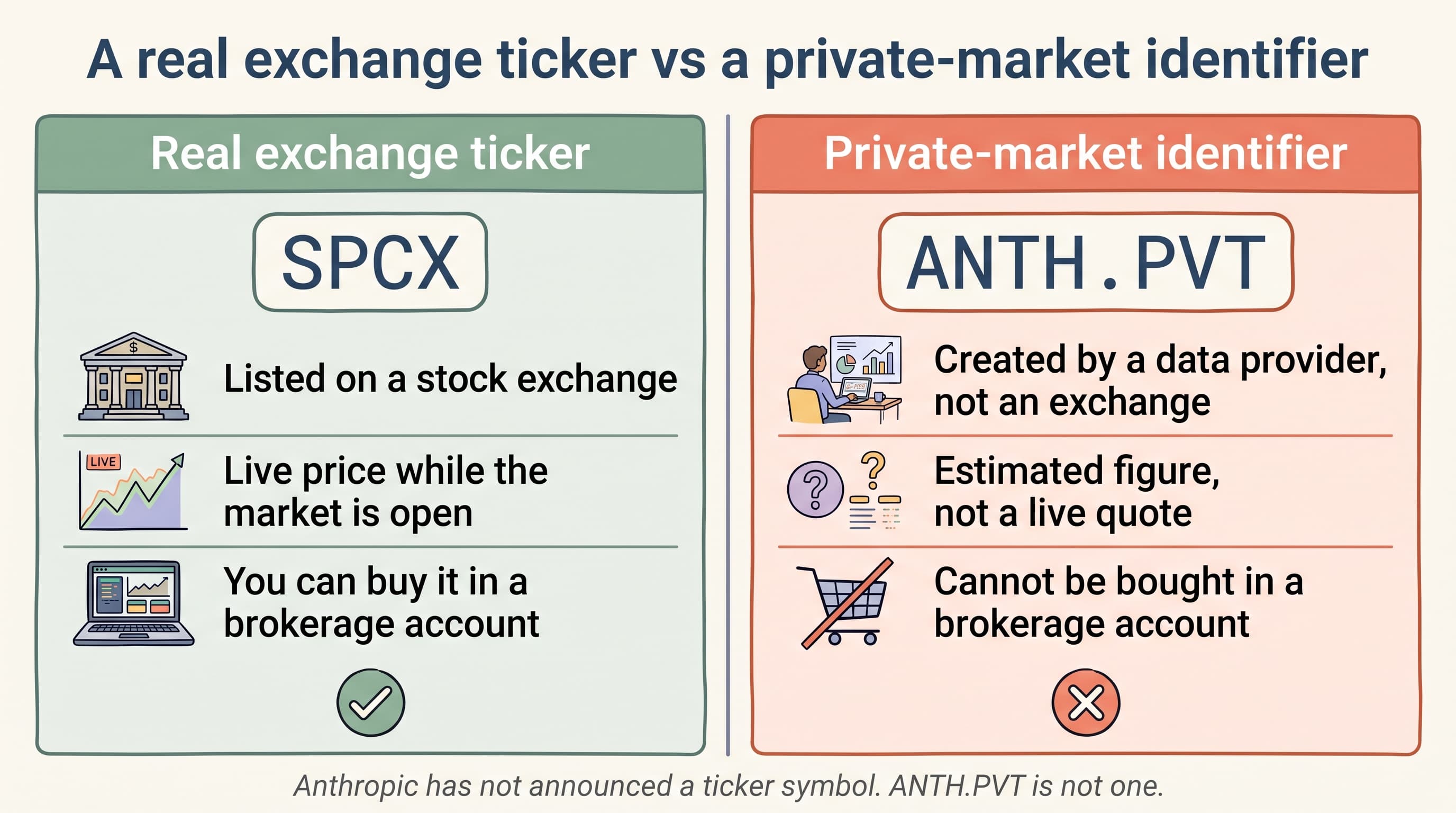
No. Codes such as ANTH.PVT, ANTHR.FG, ANTHRO and ANTHZZX shown by financial-data platforms are third-party or private-company identifiers. They are not Anthropic's official exchange ticker, and they do not mean Anthropic is publicly traded.

Data providers need somewhere to file a private company in a system built for public ones. So they assign it an internal reference, and because their pages are laid out for listed stocks, that reference lands in the slot where a ticker normally sits. It looks like a ticker because it is sitting in a ticker-shaped hole.

You cannot buy any of them. No order you can enter at your brokerage will fill against ANTH.PVT, because the code is a label in a database rather than a security trading on a venue.

This matters because people act on it. Someone searches for the ticker, lands on a page showing a code and a number, and concludes they have found a tradeable stock. Given what is on the screen, that conclusion is reasonable. That reading is also wrong.

  • These are vendor or private-company identifiers, not exchange tickers
  • No brokerage order can fill against any of them

Key Takeaway: Mistaking a vendor code for a ticker is the most common way people convince themselves they have found Anthropic stock.

A real exchange ticker next to a private-market identifier: what each one is, and which of them you can actually buy
SPCX is a real Nasdaq ticker; ANTH.PVT is a data provider's identifier. Anthropic has not announced a ticker symbol.
Private-company identifier vs public stock ticker

What the codes on finance sites actually are.

CodeTradeableWhat It Is
ANTH.PVTNoYahoo Finance private-company identifier
ANTHR.FGNoThird-party identifier used by a private-market data provider
ANTHRO / ANTHZZXNoOther platforms' internal reference codes
A real exchange tickerYes, once listedOfficial symbol used for the exchange listing, quoted live once trading begins

Does Anthropic have a stock price today?

Anthropic does not have a public stock price. Some financial websites display an estimated or private-market figure for Anthropic shares, but those are not prices set by trading on a public exchange.

The clearest example is Yahoo Finance, which showed $589.01 against ANTH.PVT when this page was last checked on September 4, 2026. That figure is a Forge Price, a modeled estimate built from funding rounds, private transactions and indications of interest. Yahoo says plainly that it "is not a quotation."

So the number is not invented, and the site is not hiding anything. It is a calculation based on a private market that ordinary investors cannot access through a normal brokerage account, and Yahoo labels it as one. But it is not a stock price. A listed share price comes from buyers and sellers transacting continuously on an exchange, and nothing like that exists for Anthropic today.

The providers do not even agree with each other, and not by a little. Around the same period, Nasdaq Private Market put Anthropic at roughly $730 a share, while Hiive showed figures above $1,300. Yahoo's Forge Price sat near $589. The spread is more than two to one on the same company on the same days. No provider here is malfunctioning. They are modeling different inputs, from different transactions, with different methods, because there is no continuous public market producing a single authoritative number.

If you searched for the Anthropic stock price and found a number, that is almost certainly what you found.

Key Takeaway: Private-market estimates for Anthropic ranged from about $589 to over $1,300 a share around the same period. None is a public stock price.

When is the Anthropic IPO date?

No Anthropic IPO date has been confirmed, and the reported timetable has already moved once. Reuters reported on August 27, 2026, citing The Information, that the prospectus would be made public after Labor Day with a potential listing in late September or early October. On September 5 Reuters reported that the prospectus was not expected until late September, that marketing would begin in mid-October at the earliest, and that the listing would be completed days before the November midterm elections. Treat that as a reported timetable rather than a date announced by Anthropic, and note that it has already slipped once.

Anthropic has not published an IPO date. Its own Series H announcement in May does not mention an IPO, a listing window, or any month. What exists is reporting, attributed to people familiar with the process, relayed by Reuters from The Information.

Even a well-sourced timetable is not a date. IPO timing depends on SEC review finishing, on market conditions holding, and on the company deciding demand is there. Any of those can move it. Companies have delayed listings by weeks over a bad market stretch and by months over a review question.

There is a reason so much on this page is reported rather than stated by Anthropic. Securities rules make companies especially cautious about IPO-related publicity at this stage. Ordinary business communications can continue, but statements that could be viewed as promoting the offering are more constrained.

One mechanical rule gives you something concrete to watch. A company using the SEC's confidential review process has to confirm it will publicly file the registration statement at least 15 days before any roadshow. The roadshow comes before pricing and the first trade. If a listing really is happening in late September or early October, the public filing cannot be far away.

It might not happen at all. Companies withdraw, postpone, or change route. This page assumes a conventional underwritten IPO throughout, because that is what has been reported, but a direct listing uses the same S-1 and has no offer price and no allocation at all.

The sequence itself is fixed even when the calendar is not. A confidential draft goes to the SEC, then a public filing appears, then the roadshow, then pricing, then the first trade. Only the first step is complete. You can watch for the second one on the SEC's EDGAR database, and that is the moment most of the unknowns on this page start getting answers.

For a sense of how the last stages actually play out, how the SpaceX debut actually traded walks through a comparable listing from pricing through the first close.

  • No date confirmed by Anthropic
  • Reported timetable slipped on September 5: prospectus late September, listing before the November midterms (Reuters)
  • The public filing has to come at least 15 days before any roadshow
  • The stage sequence is fixed even when the calendar moves

Key Takeaway: The late-September window is reported, not confirmed by Anthropic.

The five stages of going public, and where Anthropic sits today
One stage is complete. The remaining four have not been announced, and stage timing is not confirmed by Anthropic.

What will Anthropic's IPO price be?

Anthropic has not announced an IPO price, a price range, or how many shares it will sell. Those numbers are set late in the process, usually the night before trading begins.

The first real price signal arrives earlier, though: an amended public filing carries an indicative price range, weeks ahead of pricing night, and that range is often revised up or down before the final number is set. That range is the number you would actually encounter first. Its most recent company-stated valuation is $965 billion post-money, but that came from a private funding round rather than from an IPO.

Two completely unrelated $65 billion figures are circulating. One is the Series H raise. The other is the reported revenue run-rate at the end of July. They have nothing to do with each other, and seeing them in the same article is not a sign that either is wrong.

The $65 billion figure you have seen is not the IPO raise. It is the Series H, a private funding round Anthropic announced on May 28, 2026, which valued the company at $965 billion post-money. Money raised in a private round comes from a named group of investors. An IPO is different: it can include newly issued shares that raise money for the company and, in some offerings, shares sold by existing holders. Either way, Anthropic has not published those numbers.

Three different numbers get blended together constantly.

  • No IPO price, price range or share count announced
  • The $65 billion was the Series H, not the IPO
  • IPO pricing is typically finalized shortly before trading begins
  • An amended public filing carries an indicative price range weeks before pricing night

Key Takeaway: The figure everyone quotes came from a private funding round months before any IPO price.

Series H vs IPO: what each number actually means

Three different figures that get reported as if they were one.

FigureStatusWhat It Is
$65 billionCompany-stated (May 28, 2026)Series H private funding round
$965 billionCompany-stated, negotiated privatelyPost-money valuation from that round
Company IPO proceedsNot announcedMoney Anthropic receives from newly issued shares
IPO price per shareNot announcedOffer price, typically set shortly before trading begins
Market capitalizationPublicly checkable: does not exist yetShare price multiplied by shares outstanding, once listed

How can I buy Anthropic stock?

You cannot buy Anthropic stock through a normal brokerage today because it is not listed. Once it lists, buying it works like buying any other listed share. Some brokerages run IPO participation programs that occasionally allocate shares at the offer price, but access is limited and never guaranteed.

There are two routes to ending up with shares on day one, and they are not equally available.

The first is an allocation at the offer price. This is the route institutions take, and a slice of it sometimes reaches retail customers through brokerage participation programs. Eligibility rules vary by broker, allocations are rationed when demand is high, and requesting shares is not the same as receiving them.

The second is buying on the open market once trading has started. Anyone with a brokerage account can do this, and it is how most individual investors actually end up holding a newly listed stock. The catch is that you pay whatever the market is asking at that moment, which is often not the offer price. That gap is covered in detail further down.

Reuters, citing The Information, reported that Anthropic is considering allowing existing shareholders to sell shares as part of the IPO. Reuters reported that this would set Anthropic apart from the SpaceX and Cerebras listings earlier this year, in which existing stockholders did not sell. If it holds, it means some of the shares changing hands would be coming from existing holders rather than newly issued by the company. Again: reported, not filed.

StockCram is not affiliated with, endorsed by, or sponsored by any brokerage mentioned on this page.

  • Not purchasable today - Anthropic is not listed
  • Offer-price allocation is limited and never guaranteed
  • Reported: existing shareholders may be allowed to sell into the IPO

Key Takeaway: There are two ways to end up holding IPO shares, and most people only ever get the second one.

Two routes to holding shares on day one

Most individual investors only ever have access to the second.

PriceRouteAllocation GuaranteedWho Typically Has Access
Offer priceIPO allocationNoInstitutions, plus some eligible retail via broker programs
Market priceOpen-market purchaseNo allocation neededInvestors with brokerage access after listing

Can you buy Anthropic stock before the IPO?

You cannot buy Anthropic shares through a normal brokerage account before its IPO. Some accredited or institutional investors may be able to take part in board-approved private transactions, but Anthropic says transfers made without that approval are void and will not be recognized on its books.

That is Anthropic's own language, not a cautious paraphrase. The generic explanation you will find elsewhere is that accredited investors can buy pre-IPO shares on private marketplaces. As a general statement about private companies, that holds. As a description of Anthropic specifically it falls down badly.

Anthropic's published guidance warns about unauthorized sales of its stock. Its position is that transfer restrictions in its bylaws apply to both preferred and common stock, that any transfer without board approval is void rather than merely disputed, and that it does not permit special purpose vehicles to hold its shares. Where a transfer into such a vehicle lacked approval, the company's position is that the whole chain fails. It also publishes a short list of firms it says are not authorized to buy or sell its shares.

We are describing the mechanism here, not pointing you toward it. Void is a strong word and it is the right one to notice. A buyer in that position is not a shareholder in a dispute; on the company's account they are not a shareholder at all. A marketplace can show you a listing on a company this restricted. Whether Anthropic will acknowledge the transfer is a separate matter.

For the wider picture, the wider 2026 AI IPO wave covers the whole group.

Key Takeaway: Anthropic's own position is that an unapproved transfer is void, which makes company approval the question that actually matters.

Can you invest in Claude?

There is no Claude stock. Claude is a product, not a company. Anthropic makes it, and Anthropic is privately held, so no Claude ticker exists and there is no way to invest in Claude directly.

Plenty of people know the product long before they know the company behind it, which is exactly how you end up searching for a Claude ticker. The same pattern shows up with any product that becomes better known than its maker.

So searches for Claude stock, Claude ticker, or how to invest in Claude are all really searches for Anthropic, and the answer is the one on the rest of this page. Anthropic is private, and nothing trades on an exchange today.

Several large listed companies have invested in Anthropic, and it is tempting to treat buying one of those as a way of owning a slice of Anthropic. It does not really work like that. When you buy shares in a large public company, you are buying that company's entire business, of which an Anthropic stake may be a very small part. Its share price will be driven overwhelmingly by everything else that company does.

If the mechanics of how ownership and share prices actually work are new to you, how share prices and valuation work starts from the beginning.

Key Takeaway: Searches for Claude stock are really searches for Anthropic, which is private.

Anthropic's $965 billion valuation explained

Anthropic's $965 billion valuation is a post-money figure from its Series H funding round, which the company announced on May 28, 2026 and which raised $65 billion. It reflects what a group of private investors agreed to pay for a slice of the company. Not a market price, and not what the company would be worth on an exchange.

Post-money is simpler than the word suggests. Work it backwards. If investors put in $65 billion and the agreed post-money valuation is $965 billion, then everything that existed before the money arrived was valued at $900 billion. That earlier figure is the pre-money valuation. The post-money number is broadly the pre-money number plus the cash that came in. That arithmetic assumes the whole raise bought newly issued shares; rounds this size often include tranches, employee share sales or option-pool changes, any of which make the clean subtraction approximate.

A post-money valuation describes the company and the check at the same time. Raise more money at the same pre-money value and the post-money number climbs, without anything about the business having changed that morning.

The Series H was led by Altimeter Capital, Dragoneer, Greenoaks and Sequoia Capital, alongside a long list of other institutions. It followed the Series G in February 2026, which raised $30 billion at a $380 billion post-money valuation.

The revenue line underneath those rounds is where company-stated and press-reported figures sit side by side. Anthropic said its run-rate revenue reached $14 billion at the time of the Series G in February, and that it had crossed $47 billion by the Series H in May. In August, Axios reported that the figure had passed $65 billion by the end of July, based on an update Anthropic shared with investors. That last number is reported rather than announced, and none of the three has appeared in an audited filing.

Run-rate revenue takes a recent short period and multiplies it out to a year. Run-rate is real revenue from a short period, annualized, not revenue actually earned over twelve months.

Two figures that look contradictory are not. Anthropic's preliminary second-quarter revenue was reported above $11.5 billion for three months, while the run-rate at the end of July was reported above $65 billion. Both can hold at once: a quarter counts what was booked over three months, and a run-rate multiplies out the most recent stretch, so a fast-growing company's run-rate always runs ahead of what it has actually banked. The arithmetic is just multiplication: any company running at roughly $5.4 billion in its latest month would show a $65 billion run-rate, whatever it booked in the quarter before.

Comparisons between the AI labs deserve one more caveat. Anthropic and its rivals have been reported to account for cloud-partner revenue differently: Anthropic is reported to recognize the full value of Claude sold through partners such as Amazon Bedrock and Google Cloud, and to book the partner's share as a cost, while OpenAI is reported to recognize only its own share. The difference in approach has been publicly debated between the two companies. Headline run-rate figures across the two companies may therefore not be directly comparable, and the public filing should make Anthropic's revenue recognition much clearer.

A negotiated private valuation and a public market price are different kinds of number. A private round is one agreement, struck once, between parties who chose each other. A market price is continuous, made by anyone who wants to trade, and it moves daily. Companies have listed above their last private valuation and companies have listed below it. We covered both sides of the wider valuation argument in whether AI valuations are a bubble.

The underlying concepts sit in how private valuations are set and market capitalization.

Working out pre-money from post-money

Scenario: Anthropic's Series H, using the announced figures

Post-money valuation of $965 billion minus the $65 billion raised gives a pre-money valuation of $900 billion. The pre-money figure is what the existing business was valued at before the new cash arrived; the post-money figure includes it.

Why post-money can rise without the business changing

Scenario: The same company raises a larger round at the same pre-money value

If the pre-money valuation is agreed at $900 billion and the raise is $100 billion instead of $65 billion, the post-money figure becomes $1 trillion rather than $965 billion. Nothing about the underlying business changed that day; the size of the check did.

  • $965 billion is post-money from the Series H, announced May 28, 2026
  • Post-money is broadly pre-money plus the money raised, though tranches and share sales make it approximate
  • Run-rate: $14B in February and $47B in May, both company-stated; over $65B by end-July, reported

Key Takeaway: A private valuation is a negotiated number between chosen parties, not a price the open market has tested.

Anthropic's revenue run-rate: company-stated vs reported

Run-rate is an annualized projection from a recent period, not audited annual revenue.

DateSourceRun Rate
February 2026Company-stated (Series G)$14 billion
May 2026Company-stated (Series H)Crossed $47 billion
End of July 2026Press-reported (August, from an investor update)Passed $65 billion
Audited figuresSEC-filed: would arrive with the public filingNone public

The retail reality: IPO price vs the price you may actually pay

The IPO price is not necessarily the price most retail investors will pay. Shares are sold at the offer price to allocated buyers first. Trading then opens at whatever the market sets, which is often higher. Buying after the open means paying the market price, not the offer price.

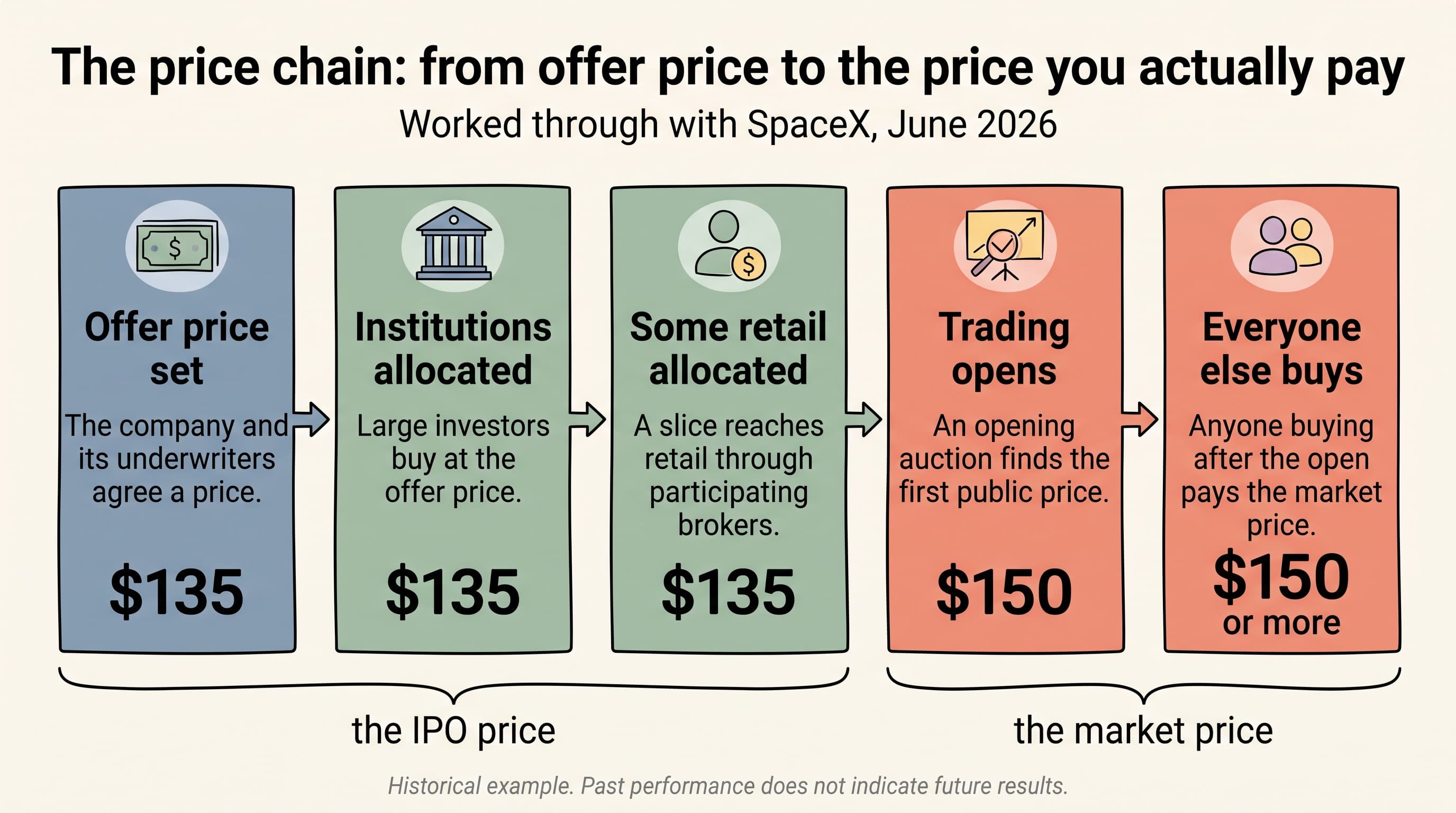
The chain runs like this. The company and its underwriters set an offer price. Allocated buyers, mostly institutions plus whatever slice reaches retail through brokerage programs, receive shares at that price. Then trading opens, and from that second onward everyone pays whatever the market is asking.

So two people can both say they bought at the IPO and mean completely different things.

SpaceX makes the point concretely, because the numbers are recent and public. It priced at $135 a share. When trading opened the next morning the first public trade cleared at $150, and it closed the day at $160.95. Someone allocated shares paid $135. Someone who opened their brokerage app after trading started and bought paid $150 or more. Both of them would tell you they got into the SpaceX IPO.

One claim gets overstated everywhere, though: retail allocation is not zero. SpaceX originally targeted around 30 percent of its offering for retail buyers and cut it to the low 20 percent range before pricing, which CNBC reported on June 11, 2026 as institutional demand crowded retail out. Against a typical IPO's 5 to 10 percent, that is unusually generous rather than absent.

The gap opens when more money wants in than there is stock to go around at the offer price, so the first public trade clears higher. None of that is guaranteed, though. Shares can and do open below their offer price, which is sometimes described as breaking issue, and then the arithmetic runs the other way.

The calculator below runs both cases. It opens on the real SpaceX numbers, and you can put in any pair of prices you like. On how first days behave generally, see first-day volatility and what happened on SpaceX's first day.

Same event, two different prices

Scenario: SpaceX, June 12, 2026

An allocated buyer paid the $135 offer price. Someone buying through a brokerage after trading opened paid $150 or more. Both describe it as buying at the IPO; only one of them paid the IPO price.

When an IPO opens lower

Scenario: Demand comes in weaker than the underwriters expected

Shares can open below the offer price. In that case the person who bought after the open pays less than the allocated buyer did, and the same money buys more shares rather than fewer.

  • Offer price, then allocation, then trading opens, then everyone else pays market
  • SpaceX: $135 offer, opened at $150, closed $160.95
  • Retail allocation is limited and rationed, not zero

Key Takeaway: "I bought it at the IPO" and "I paid the IPO price" are usually two different claims.

The price chain: how the offer price becomes the price you actually pay
Worked through with SpaceX's June 2026 debut. Historical example; past performance does not indicate future results.

IPO Offer Price vs Opening Price Calculator

Full page

What Anthropic's public filing will finally reveal

The public filing will be the first public SEC disclosure containing audited financial statements. A registration statement of this kind typically includes audited revenue and losses, the share structure, risk factors, what the company intends to do with the money, and the intended exchange and ticker. Until it is public, most figures circulating about Anthropic are reported rather than filed.

Reported means a journalist has sourced it, often well, often from people genuinely close to the process. Filed means the company has put its name to it in a document the SEC can hold it to. Both are useful. Only one carries legal weight.

Most financial figures available today are either company-stated or reported by journalists rather than disclosed in a public SEC filing. The run-rate figures came from the company's own announcements and investor updates rather than from audited statements. The listing window came from reporting. The idea that existing shareholders may sell into the offering came from reporting. Not one of those figures has been filed.

Reuters, citing The Information, also reported that Anthropic is weighing lockup periods longer than the customary 180 days. A lockup is the window after listing during which insiders and early investors are contractually barred from selling. A longer one would mean less insider stock reaching the market early, which changes the supply picture in the months after listing. If you want the mechanics, see when insider lockups expire. The underwriters running the offering set these terms alongside the company, and the banks running the offering explains that role.

Structurally, Anthropic is a Delaware public benefit corporation, and its Long-Term Benefit Trust selects members of its board. Since April 2026, directors chosen by that trust have held a majority of board seats. A Delaware public benefit corporation's board is directed to balance the stockholders' pecuniary interests, the interests of those materially affected by the company's conduct, and the specific public benefit in its charter, rather than shareholder returns alone. That is unusual for a company approaching a listing, and the share classes and voting rights that go with it are exactly the kind of detail the public filing would spell out.

When the public filing lands, the table below is what changes.

  • Most key financial details are not filed yet
  • The filing brings audited financials, share structure and risk factors
  • Reported: lockups may run longer than the customary 180 days

Key Takeaway: Most current financial detail is company-stated or reported rather than filed, and the public S-1 is where that changes.

What we know now vs what the public filing should tell us

The moment reported becomes filed.

NowItemAfter Filing
$47B run-rate stated in May; over $65B reported by end-JulyRevenueAudited figures across multiple periods
Positive adjusted operating income reported for a recent quarter, unauditedProfitabilityAudited profit or loss, with detail
Not disclosedShare structureShare classes, voting rights, count
Neither announcedTicker and exchangeNormally disclosed
UnknownUse of proceedsStated explicitly
UnknownRisk factorsListed at length, in the company's own words
Reported as possibly longer than 180 daysLockup termsSpecified
Public benefit corporation; trust-appointed board majorityCorporate formHow the governance structure carries into a listed company

The bull case and the bear case

Supporters point to Anthropic's reported revenue growth, its enterprise adoption, and how few pure-play frontier AI companies are available on public markets. Skeptics point to heavy capital requirements, profitability that has not been established in audited public financial statements, concentrated competition, and a valuation set in a private round rather than by an open market.

Both sides are working from the same short list of facts. No audited financial statements are publicly available yet. Everyone is reasoning from run-rate figures, a couple of funding rounds, and a set of impressions about the industry.

The bull argument runs roughly like this. Revenue has grown fast on the numbers available: $47 billion run-rate stated by the company in May, and over $65 billion by the end of July according to August reporting. Anthropic also disclosed preliminary second-quarter figures to prospective investors in August, reported on August 15 as revenue above $11.5 billion with positive adjusted operating income. Enterprise customers tend to stay put once they have built on something. And there are very few ways to own a frontier AI lab directly through a public market, which supporters argue creates real scarcity value.

The bear argument uses the same facts differently. Training and serving frontier models consumes enormous capital. That profitability figure is adjusted, which is not standardized accounting: the company excluded certain costs, and it decides which ones. The figures are preliminary and private rather than audited, they cover a single quarter, and long-term profitability has not been established in audited public financial statements. The competitive set includes some of the best-funded companies in the world. And the $965 billion figure was negotiated with a chosen group of investors rather than discovered by an open market, which skeptics argue makes it a weaker anchor than it looks.

We are not going to hand you a verdict, and it would be worth nothing if we did. What would actually settle parts of this is the public filing, because public investors cannot yet verify those figures against an SEC filing.

  • No audited financial statements are publicly available yet
  • The public filing is what would settle parts of this

Key Takeaway: Both cases rest on the same facts and disagree about what they are worth, which is exactly why the filing matters.

Bull case and bear case, side by side

Both arguments draw on the same limited public record.

TopicBear CaseBull Case
RevenueSkeptics argue: run-rate is an annualized projection, and none of it is auditedSupporters argue: $47B run-rate stated in May; over $65B reported by end-July
ProfitabilitySkeptics argue: preliminary and unaudited; not established in audited public statementsSupporters argue: positive adjusted operating income in preliminary Q2 2026 figures
Capital needsSkeptics argue: frontier models require continuous heavy spendingSupporters argue: large raises signal investor conviction
CompetitionSkeptics argue: rivals include some of the best-funded companies in the worldSupporters argue: enterprise adoption tends to be sticky
ValuationSkeptics argue: $965B was negotiated privately, not tested by an open marketSupporters argue: few pure-play frontier AI companies are publicly investable

Frequently Asked Questions About the Anthropic IPO

The questions people most often ask about Anthropic going public, answered as of September 4, 2026.

No. Anthropic remains private today. It announced on June 1, 2026 that it had confidentially submitted a draft registration statement to the SEC, which begins the review process, but no public listing has occurred and no shares trade on any exchange.

No ticker symbol or listing exchange has been announced. Codes such as ANTH.PVT and ANTHR.FG that appear on some finance sites are vendor or private-company identifiers, not exchange tickers, and cannot be traded through a normal brokerage.

Yahoo displays a Forge Price for the identifier ANTH.PVT, which it describes as a derived data point calculated from funding rounds, secondary transactions and indications of interest. Yahoo states directly that it is not a quotation and does not indicate available supply or demand.

No. Claude is a product made by Anthropic, not a separate company, so there is no Claude stock and no Claude ticker. Anthropic itself is privately held and not available on any exchange.

No. The $65 billion was its Series H private funding round, announced on May 28, 2026, which valued the company at $965 billion post-money. How much it would raise in an IPO, and at what price, has not been determined.

Some may. Certain brokerages run IPO participation programs that can allocate shares at the offer price, though access is limited and never guaranteed. Most people who buy on the first day are buying after trading opens, at the market price rather than the offer price.

No date has been confirmed by Anthropic. Reuters reported on September 5, 2026 that the prospectus is not expected until late September, that marketing would begin in mid-October at the earliest, and that the listing would be completed days before the November midterm elections. An earlier report on August 27 had pointed to a listing in late September or early October, so the reported timetable has already moved once. It is reported, not company-confirmed, and IPO timing routinely moves.

Key Takeaway: The short version: private, no ticker, no date, no price, and the numbers circulating are reported rather than filed.

The Bottom Line

As of September 4, 2026, Anthropic is private. It confidentially submitted a draft registration statement announced on June 1, and no public filing, ticker, exchange, price or trading date has been announced. The $965 billion valuation everyone quotes came from the Series H private round announced on May 28, not from an IPO, and the $65 billion attached to it was that round rather than an IPO raise. The codes you see on finance sites are vendor identifiers, and the prices beside them are derived estimates rather than exchange quotes.

The public filing is the moment reported becomes filed. When it lands, this page gets updated: the status table first, then the ticker, exchange and price sections. Until then, the honest answer to most Anthropic IPO questions is that nobody outside the company knows yet.

The one thing to carry away from this page is the gap between the offer price and the price you would actually pay. It applies to every IPO, not just this one, and it is the difference between two people who both say they got in early.

Key Takeaways

Anthropic is still private

A confidential draft registration statement, announced June 1, 2026, is a step toward an IPO rather than the IPO itself. No public filing exists yet.

There is no Anthropic ticker yet

Codes like ANTH.PVT and ANTHR.FG are vendor or private-company identifiers used by data platforms. They are not exchange tickers and cannot be traded.

The $65 billion was the Series H, not the IPO

Announced May 28, 2026, it set the $965 billion post-money valuation. The IPO size and price have not been determined.

The IPO price is not necessarily the price you pay

Offer-price allocation is limited and rationed. Buying once trading opens means paying the market price, as SpaceX showed at $135 offer against a $150 open.

Almost everything known today is reported, not filed

Revenue and profitability figures are currently company-stated or press-reported. The public filing is where audited financial statements arrive.

Sources & Further Reading

Enjoyed this article?

Share

Related Articles

Read The Trillion-Dollar AI IPO Wave: SpaceX, Anthropic, OpenAI Explained

The Trillion-Dollar AI IPO Wave: SpaceX, Anthropic, OpenAI Explained

Three AI giants approached public markets in 2026 at a combined ~$3.6T target, but the paths diverged. SpaceX went public June 12 with a record IPO, then slid below its $135 offer price; Anthropic is on track for an October 2026 listing; OpenAI has delayed, now eyeing 2027.

37 min read
Read Article