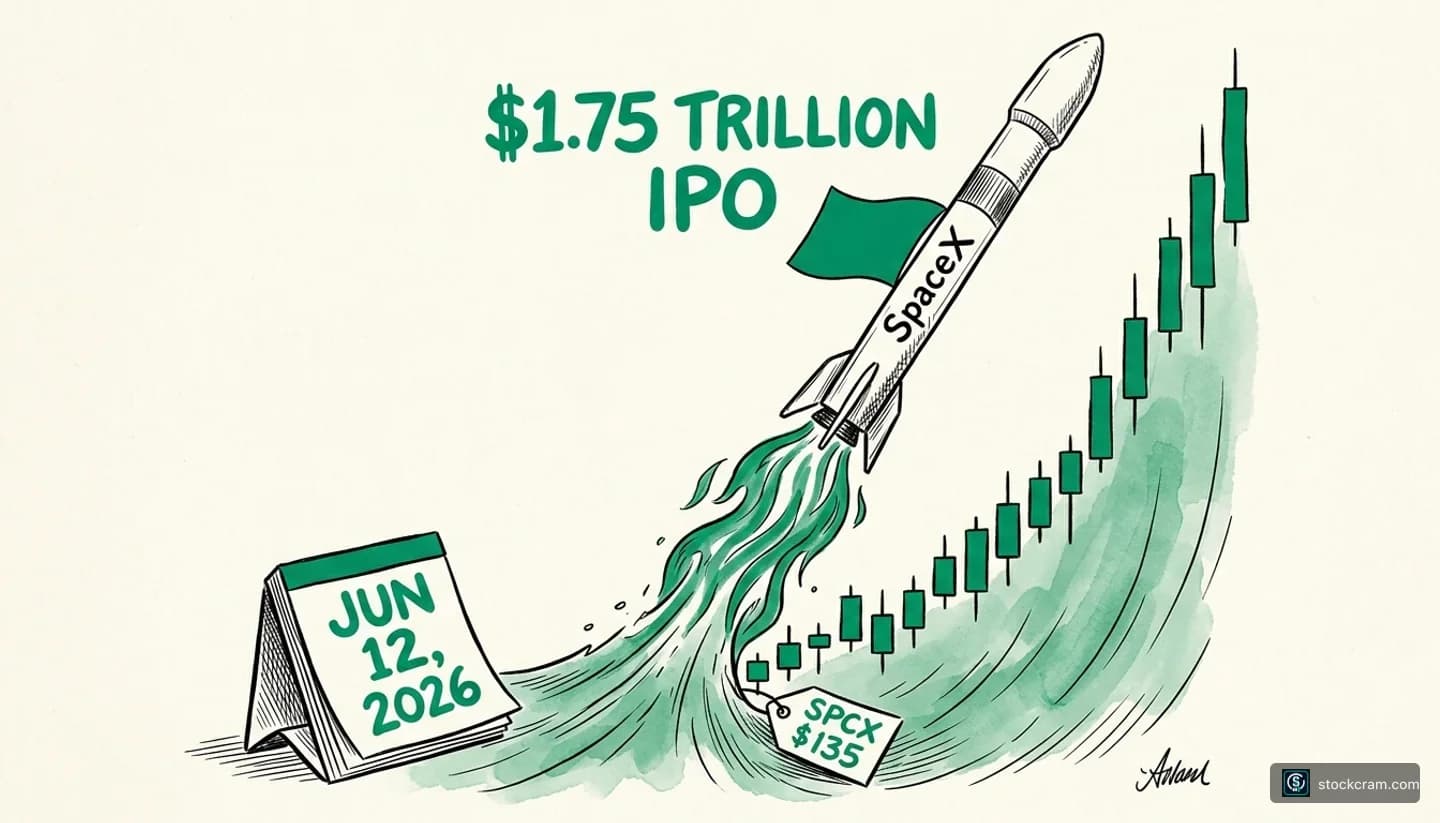
SpaceX's first trading session is now complete. Here is what actually happened: the confirmed Day-One result, which supersedes the pre-trade expectations described in the mechanics sections below.
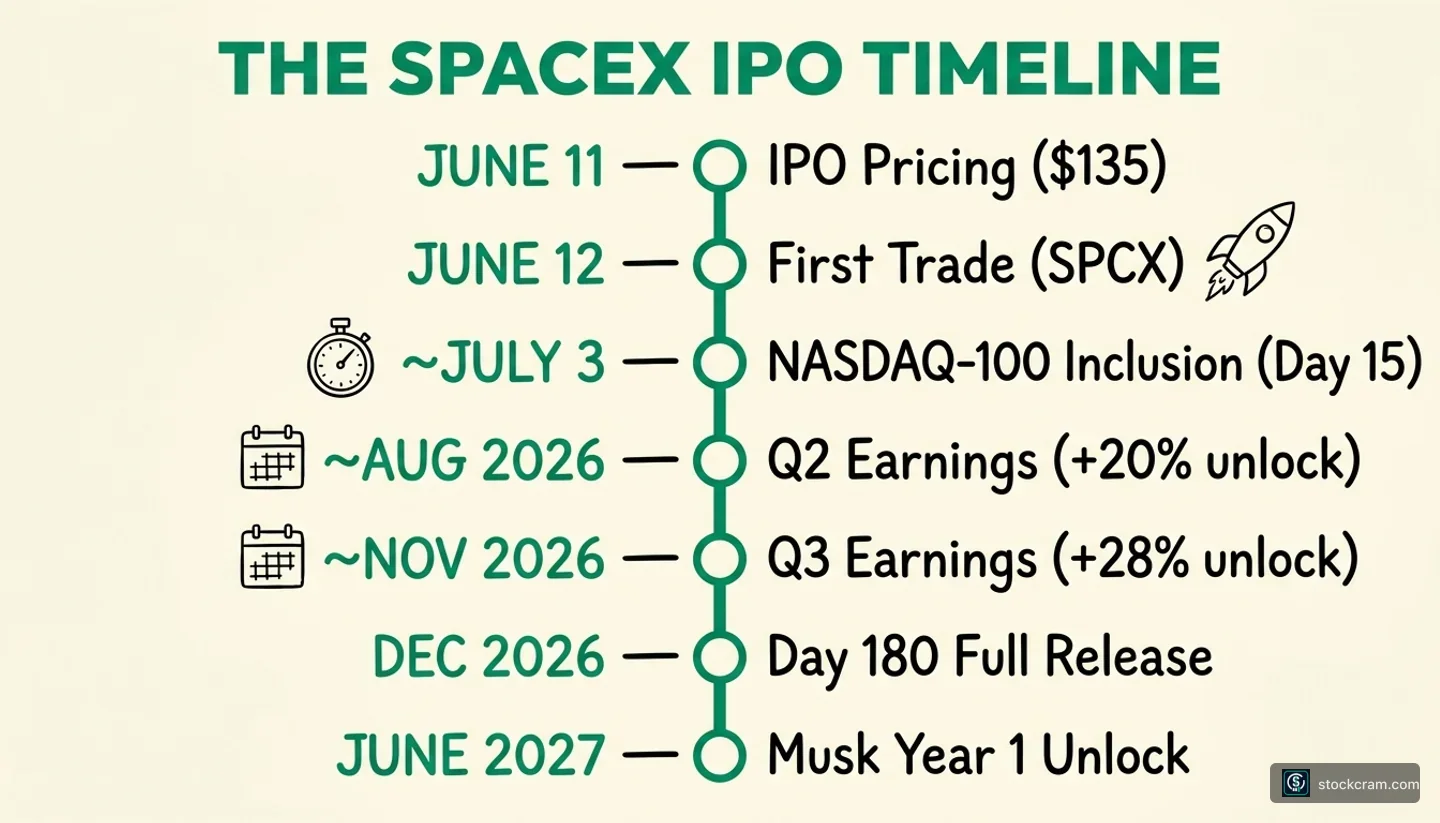
SPCX did not trade the instant the market opened. As is normal for an offering this size, NASDAQ first ran its opening price-discovery auction (the Cross) before any shares changed hands. Official indications first printed around 9:50 a.m. ET near $171–175, roughly 27–30% above the $135 IPO price, and the stock opened for trading shortly after, with the first public trade clearing near $150. That delayed open was the standard IPO auction process, not a sign of trouble and not an LULD volatility halt. (CBS News; NPR; 24/7 Wall St..)
From there SPCX ran higher, touched an intraday high of $176.52 (about +31% over the IPO price), then gave some of that back to close its first day at $160.95, up roughly 19% from the $135 IPO price. That put SpaceX's market capitalization at approximately $2.1 trillion, instantly among the most valuable U.S. companies and confirming the largest IPO on record by a wide margin, surpassing Saudi Aramco's 2019 debut.
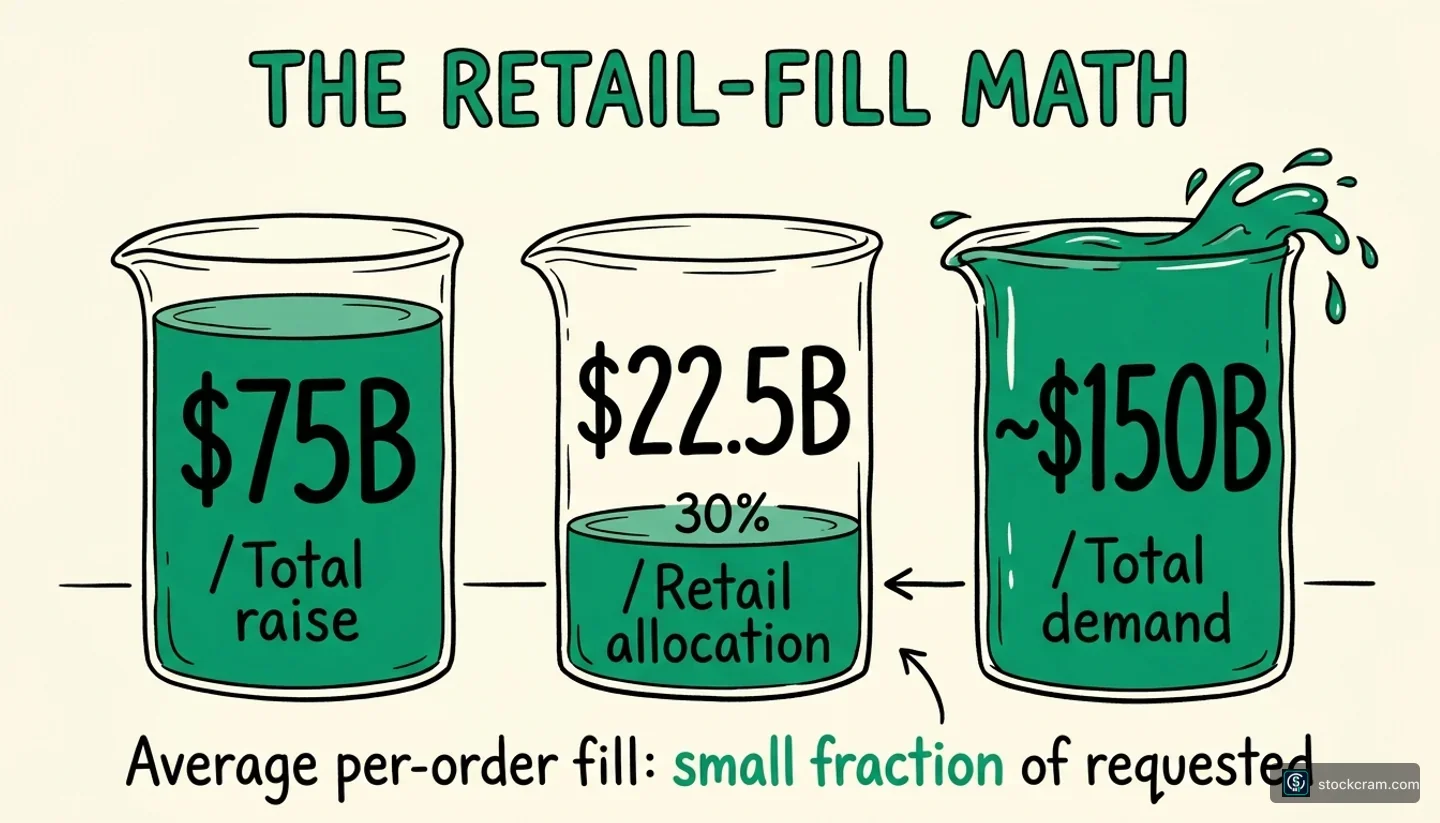
The retail allocation was cut before pricing. The 30% carve-out described throughout the sections below was the plan, not the outcome. CNBC reported on June 11, 2026 that SpaceX trimmed the retail tranche to the low 20% range as institutional demand crowded it out — the exact scenario flagged in the risk section below. It was still, by a wide margin, the largest direct-to-retail allocation any mega-IPO has extended, against a 5–10% norm. (CNBC.)
What the Day-One print does and doesn't tell us. A first-day close above the IPO price means demand cleared at a premium on Day One: buyers at the open paid less than the intraday high but more than the $135 IPO allocation price, exactly the premium dynamic the retail-access section flagged. What it does not tell us is anything definitive about the next 30, 90, or 180 days. The durable questions are still ahead: NASDAQ-100 Fast Entry (~15 trading days out, an early-July window), the staggered lockup tranches running through late 2026, and whether 2025's $4.94B net loss narrows toward the profitability gate that keeps SPCX out of the S&P 500. Those are the signals tracked in the watchlist below. Historical data shown; past performance does not indicate future results.
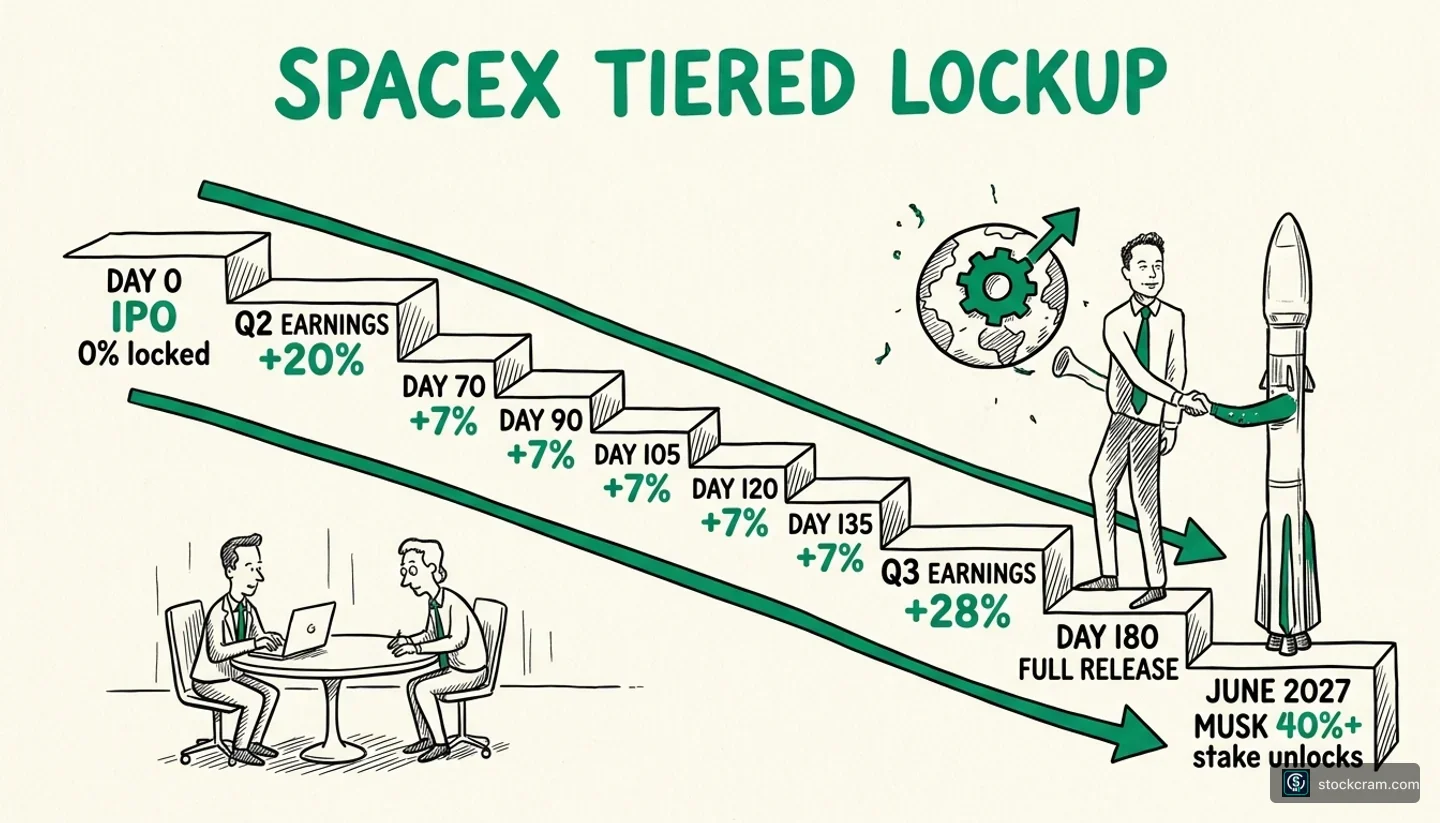
Since the debut (as of late July 2026): After closing its first day at $160.95, SPCX peaked at $225.64 on June 16, then fell sharply. By mid-July it had dropped below its $135 IPO price, and on July 23 it set an all-time low of $110.85, trading near $113 on July 25, then setting a new 52-week low of $104.83 on August 3 before bouncing to around $133 by August 8, well below both its June peak (~$225) and its $135 IPO price. On July 7 it became the fastest company ever added to the NASDAQ-100 (about $4.3 billion of passive inflows), but the stock sold off into and after inclusion in a textbook 'sell the news.' The second-quarter report was released August 4, 2026 (revenue $7.81B, up 92% year-over-year, beating estimates; net loss $541M; adjusted EBITDA $3.5B). The first lockup tranche expired August 6, releasing up to 911.5 million shares. Historical data shown; past performance does not indicate future results. (CNBC, "SpaceX stock sinks below $135 IPO price", July 2026; Investing.com.)
Update (August 8, 2026): SpaceX reported Q2 2026 earnings on August 4, revenue $7.81B (up 92% year-over-year, beating estimates), adjusted EBITDA $3.5B, and a net loss of $541M. The stock fell about 8% in after-hours trading on concerns over $18.4B in quarterly capex, well above analyst forecasts. The first lockup tranche expired August 6, releasing up to 911.5 million shares (about 6.97% of shares outstanding, as the post forecast). SPCX bounced 16% on August 7 and 8, trading at $141.50 as of August 30, up from a new 52-week low of $104.83 set August 3. The Tesla-SpaceX merger conversation heated up in late July when Musk hinted at 'more and more overlap' on Tesla's July 22 earnings call, though he stopped short of confirmation. The post's framing of the merger as material rumor remains accurate. Historically, past performance does not predict future results. (Investing.com; CNBC Q2 earnings; CNN lockup; Electrek merger.)
Update (August 17, 2026): SPCX has recovered to around $140 as of August 17, trading above both its $135 IPO price and the ~$133 level from August 8. The stock bounced after the August 6 lockup expiration released 911.5 million shares, contrary to widespread predictions of a sustained selloff. ARK Invest's August 11 podcast maintained merger speculation at similar probability levels to Wedbush's earlier estimates, with Cathie Wood's team suggesting an announcement could come before year-end 2026. The post's framework (NASDAQ-100 inclusion on July 7, Q2 earnings August 4, first lockup August 6) all occurred as described. Historically, past performance does not predict future results.
Update (August 24, 2026): SPCX traded around $137 as of August 23, holding near its $135 IPO price after the second lockup tranche (Day 70) expired August 20, releasing additional shares. Prediction markets now show 65% probability of a Tesla-SpaceX merger before 2028 (Kalshi), down from earlier peaks but consistent with the post's framing as material rumor. The stock has stabilized in the $130s after bouncing from its August 3 low of $104.83, with the next major catalyst being the Day 90 lockup tranche on September 9-10. Historically, past performance does not predict future results.
Update (August 31, 2026): SPCX closed at $141.50 on August 30, holding above its $135 IPO price after the Day 70 lockup tranche (August 20) released additional shares. The next catalyst is the Day 90 lockup expiration on September 9-10, releasing roughly 319 million shares (about 2.44% of shares outstanding). The stock has stabilized in the low $140s after bouncing from its August 3 low of $104.83. Historically, past performance does not predict future results. (Investing.com.)