Robinhood Agentic Trading: How It Works and the Risks

Robinhood agentic trading lets an AI agent place trades in a dedicated, funded account. A calm, plain-English walkthrough of how it works and the risks.

Sean Sha
By Sean Sha15 min read

Educational purposes only. This content does not constitute investment advice. Read our disclaimer

StockCram is not a broker-dealer, investment adviser, or financial institution. All content is for educational and informational purposes only and should not be construed as personalized investment advice. Consult a qualified financial professional before making investment decisions. Past performance does not guarantee future results.
Robinhood Agentic Trading: How It Works and the Risks
Share
15 min read

In May 2026, Robinhood opened a new path for AI agents to place real trades through a dedicated Robinhood account. The headline sounds futuristic. The practical questions are duller and more important: what permissions does the agent get, what account can it touch, and who is on the hook if it goes wrong? People search for this as Robinhood AI trading, AI agent trading, and even an AI bot that trades stocks.

With Robinhood agentic trading, you connect an AI agent to a dedicated, real-money account where it can research, quote, and place orders on its own. This is different from asking ChatGPT for stock ideas, because the connected agent can submit orders inside the dedicated account. Below, we walk through what it is, how it works, the safety design Robinhood built around it, and the risks in Robinhood's own words. Everything here is educational only, never a recommendation to use it.

We define agentic trading, follow the mechanics step by step (connect an agent via Robinhood MCP, fund a dedicated account, let it trade), look at the capital isolation and disconnect control, cover what it can trade, and read Robinhood's own risk disclosures closely. For the deeper background, our guides on Can AI trade stocks for you? and How AI trading works are the resources to bookmark.

Robinhood Agentic Trading: What It Is and What Just Happened

With Robinhood agentic trading, an outside AI agent connects to your Robinhood account and places trades on its own, inside a dedicated, real-money account you fund and control. Robinhood launched it in beta on May 27, 2026 with equities only; its launch post described options, crypto, event contracts, and futures as coming soon. Everything runs through software Robinhood calls its "Trading MCP" server (MCP stands for Model Context Protocol, the open standard that lets an AI assistant talk to an outside tool).

In plain terms, "agentic" means an AI that acts, not only one that answers questions. A chatbot gives an answer. An agent can use tools, follow instructions, and take actions, including placing an order if you have authorized it. Applied to a brokerage account, that means this: instead of you tapping buttons to buy or sell, you connect an AI agent that can research, pull quotes, and place orders for you. This is the idea people are searching for as Robinhood AI trading or an AI bot that trades stocks, and Robinhood's version is one specific implementation of AI agent trading. What makes it different from a person using a chatbot for stock ideas is that the agent is wired directly into the brokerage: nobody copies a suggestion into the app by hand. Through the Trading MCP connection, the agent submits orders itself in the dedicated account you set up for it. For the broader idea of software trading on your behalf, our beginner guides go deeper.

Editor's note: checked and current as of July 27, 2026. Product details change fast, so verify against Robinhood's own pages before assuming anything applies to your account.

A quick disclosure. StockCram is not affiliated with, endorsed by, or sponsored by Robinhood or any AI provider mentioned on this page. What follows is an educational walkthrough verified against Robinhood's own pages on July 27, 2026, not a recommendation to use it. Connecting an AI to a live brokerage account that can spend real money is high-risk. In Robinhood's own words, agentic trading involves significant risk, including the possible loss of your entire investment. Nothing here is investment advice, and past performance does not indicate future results.

  • Robinhood agentic trading lets an external AI agent place trades inside a dedicated, real-money account you fund and control.
  • "Agentic" means an AI that takes actions, not just one that answers questions; wired into the brokerage, it submits orders rather than suggesting them.
  • It launched in beta on May 27, 2026 with equities only, running through Robinhood's "Trading MCP" (Model Context Protocol) server.

Key Takeaway: Robinhood agentic trading connects an outside AI to a dedicated, funded, real-money account through its Trading MCP server. It is described here for education only, and it is high-risk by Robinhood's own account.

Robinhood Agentic Trading at a Glance

Before the step-by-step, here is the whole product in one view. Details can change, so treat this as a snapshot verified against Robinhood's pages on July 27, 2026.

Key Takeaway: One separate account, long equities and options today, broad read access but trade access confined to the Agentic Account, and a range of MCP-compatible AI clients.

Robinhood agentic trading at a glance

A snapshot of the reported product. Verify current details on Robinhood's own pages.

DetailFeature
Separate self-directed Agentic AccountAccount
Long equities and optionsCurrent order support
Desktop requiredSetup device
ChatGPT, Claude, Codex, Cursor, Grok and othersAI clients
Account numbers, balances, positions, transactions, watchlists and scansRead access
Agentic Account onlyTrade access
Can be reviewed, but may be configured to act without confirmationHuman approval
Announced as rolling out soon, not clearly listed in current trading docsCrypto

How Does Robinhood Agentic Trading Work?

Here is how Robinhood agentic trading works, step by step.

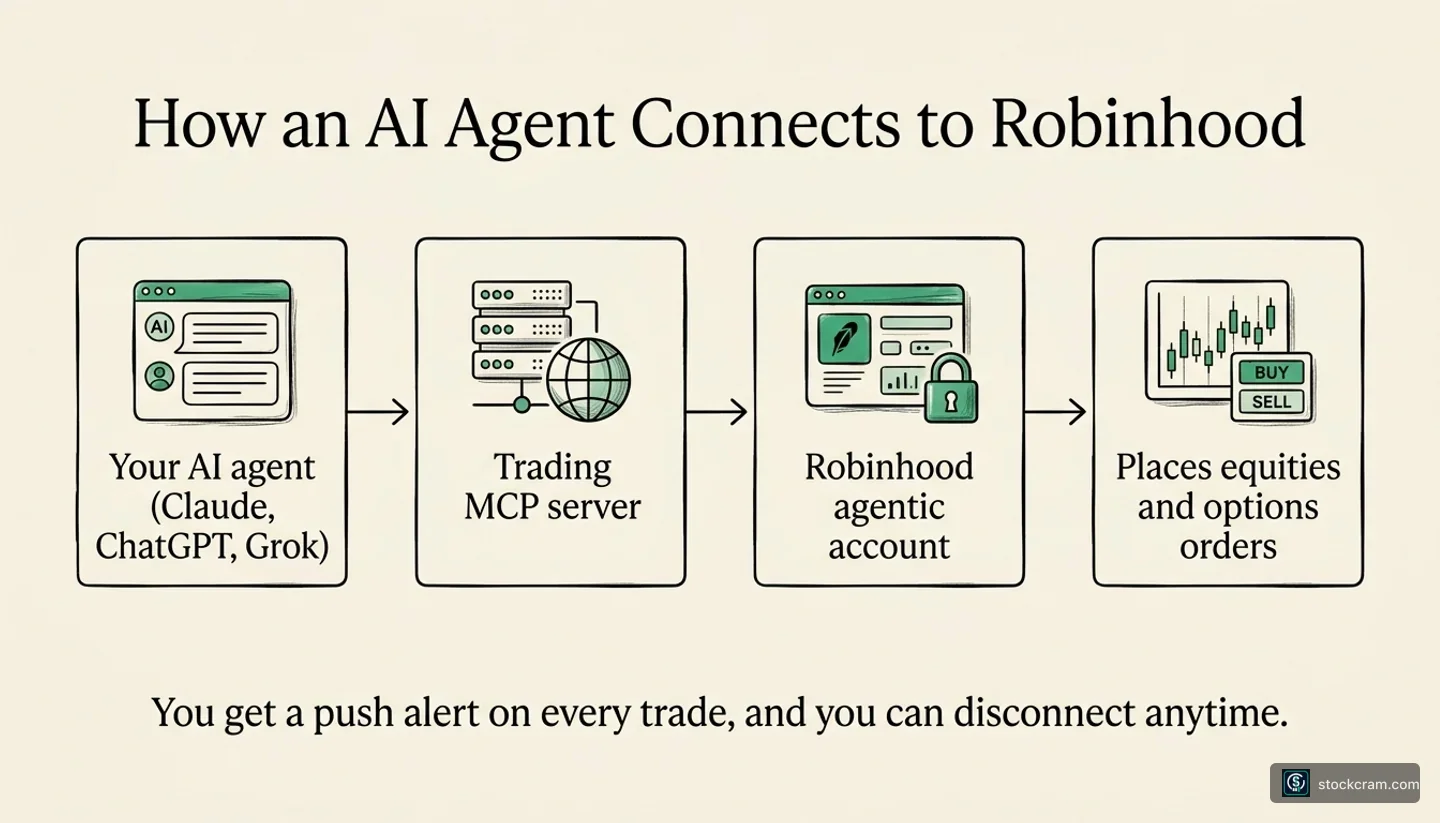
The connection path looks like this:

Diagram showing an AI agent connecting through Robinhood's Trading MCP to a dedicated Agentic Account.

Step 1: You connect an AI agent through MCP. Robinhood exposes its Trading MCP server, and you point a compatible AI client at it using a configuration URL. That handshake is what gives the agent permission to see account context and place orders.

Step 2: The agent works inside a dedicated "Agentic Account." This is not your main portfolio. It is a separate, real-money account you open specifically for the agent, and you move a set amount of cash into it. Robinhood's support pages say users can have up to 10 self-directed individual investing accounts total for investing purposes, of which the Agentic Account is one.

Step 3: The agent can research, quote, and place orders. Inside that account, the connected AI can read market data, pull live quotes, and submit orders for the instruments Robinhood supports. Robinhood says a connected agent can also read broad account information across your Robinhood accounts, including positions, balances, transactions, order history, watchlists, and scans, so it can factor in what you already hold. That read access is separate from spending power: the agent can only place trades in the Agentic Account (more on that boundary in the next section).

The important thing to separate is read access from trading access, and the table below lays it out.

  • You connect a compatible AI client to Robinhood's Trading MCP server via a config URL.
  • The agent operates inside a dedicated, real-money Agentic Account, not your main portfolio; you can have up to 10 self-directed individual investing accounts total.
  • The agent can read broad account information for context, but trading is confined to the Agentic Account.

Key Takeaway: The flow is: connect an AI agent through MCP, fund a dedicated Agentic Account, and the agent can then research, quote, and place orders inside that account only. The table separates read access from trading access and shows there is no built-in loss cap.

What the agent can and cannot do

Summary of the permission model. Check Robinhood's own pages for current details.

Can DoCannot DoCapability
YesRead broad account information across your Robinhood accounts for context
YesPull live quotes and market data
YesPlace orders in the dedicated Agentic Account
NoPlace orders in another Robinhood account
NoUse buying power outside the Agentic Account
No such guarantee (options and some strategies can lose more than the amount invested)Guarantee your losses cannot exceed the amount you deposited
Designed to prevent new agent activity after you disconnect. Orders already submitted, pending, or executed quickly may not be stoppable in real time. Check Robinhood's current terms.Trade after you disconnect it (one-tap disconnect)

The Safety Design (and Why It Is a Design, Not a Guarantee)

Robinhood built several guardrails around agentic trading. These are containment controls. They are not loss protection, and you can still lose money.

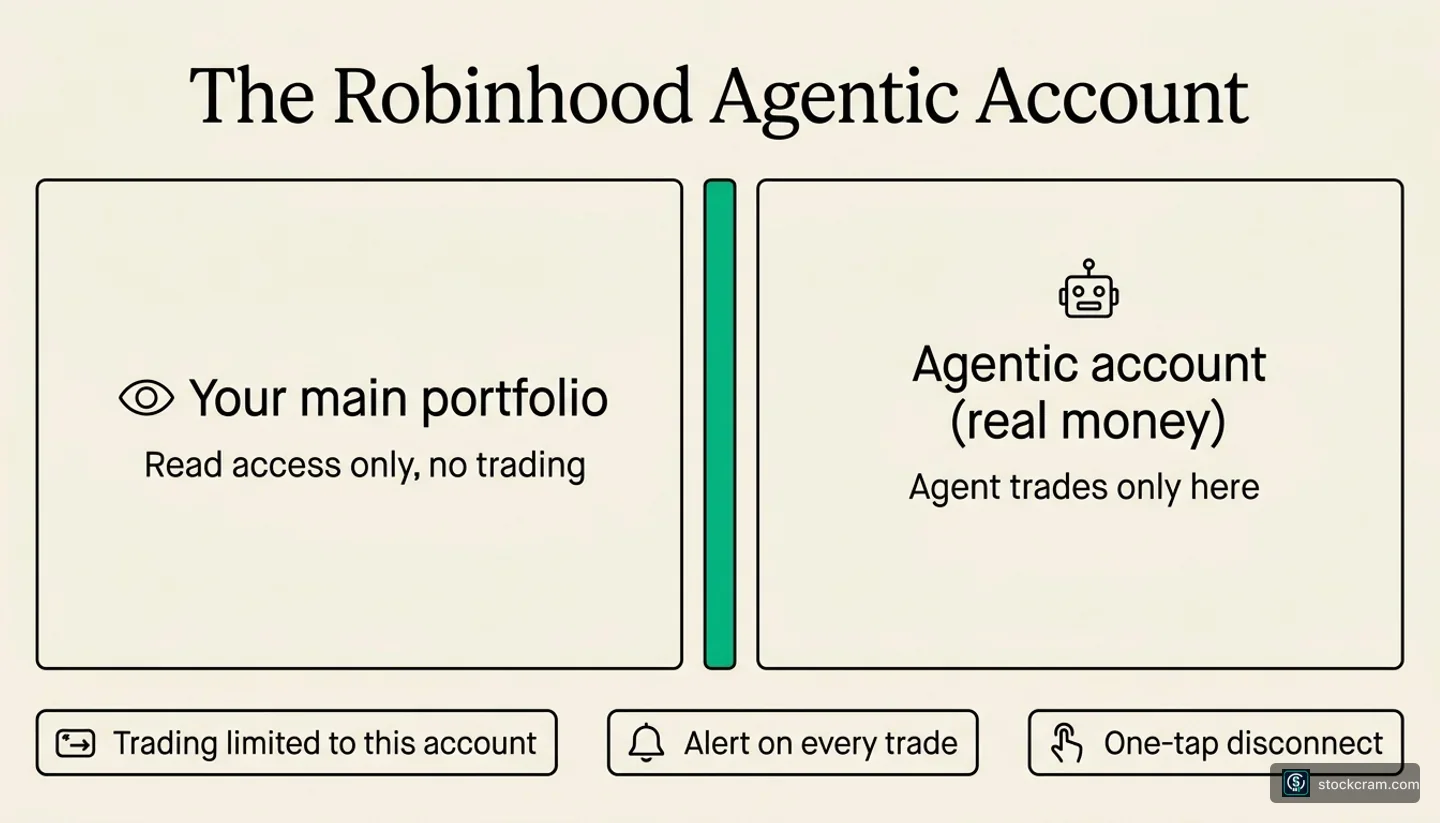
Here is how the account is walled off:

Diagram showing read-only access to other Robinhood accounts and trading access limited to the Agentic Account.

Capital isolation. This is the central idea. You decide how much money to transfer into the Agentic Account, and the agent can place orders only inside that account, though it can read information from your other Robinhood accounts. Your main portfolio sits behind that boundary. This is a containment design, not a guarantee: it does not make losses predictable or risk-free, and product rules, order timing, fees, or options mechanics can still complicate outcomes. Options and some strategies can even lose more than the amount you put in, so do not read the isolation as a cap on losses.

Per-trade notifications. On every trade the agent makes, Robinhood sends a push notification, with a real-time activity feed and profit-and-loss visible in the app.

Order previews. Robinhood shows order previews before an order is submitted, so you can see what is about to happen.

A one-tap disconnect. Robinhood says you can disconnect the agent at any time with the tap of a button. This is designed to prevent new agent activity after you disconnect. Orders already submitted, pending, or executed quickly may not be stoppable in real time.

These containment features do not remove the underlying risk. As the disclosures covered next make clear, Robinhood notes fast-moving AI strategies can be hard to monitor or stop in real time, even with a disconnect button in reach.

  • Capital isolation: you choose how much to transfer into the Agentic Account, and the agent can trade only inside it while reading information from your other accounts.
  • Robinhood provides per-trade notifications, order previews before submission, and a real-time activity feed with P&L.
  • One-tap disconnect is designed to prevent new agent activity; orders already submitted or executing may not be stoppable in real time.

Key Takeaway: Isolation, notifications, order previews, and disconnect contain where the agent can act; they do not guarantee against loss, and options can lose more than you deposit. Robinhood itself notes fast AI strategies can be hard to stop in real time.

What Can the Robinhood AI Trading Account Trade Now?

As of July 27, 2026, Robinhood's trading support page lists long equities and options orders. Equities were there at the May 27, 2026 beta launch, with options among the things Robinhood said were coming next.

Crypto is a different story. Robinhood separately announced that Agentic Accounts for crypto would begin rolling out soon, but its current trading documentation does not yet clearly list crypto as a supported order type. Check Robinhood's own pages for the current list before assuming crypto is available in your account.

On the agent side, Robinhood's Trading MCP is designed to work with any MCP-compatible client. Supported clients include Claude Desktop, Claude Code, ChatGPT, Codex and the Codex CLI, Cursor, and Grok, plus any other MCP-compatible client you can point at the configuration URL. That list moves fast, so it may look different by the time you read this.

One caution: an agent being able to trade options or crypto does not make those instruments simpler or less risky. Both carry substantial risk on their own, before you add an autonomous system on top. If those instruments are new to you, our glossary entries on volatility and the market order are useful plain-English starting points.

  • As of July 27, 2026, Robinhood's trading support page lists long equities and options orders; equities were available at the May 27, 2026 beta launch.
  • Robinhood announced crypto Agentic Accounts rolling out soon, but its current trading documentation does not yet clearly list crypto as a supported order type.
  • Supported clients include Claude Desktop, Claude Code, ChatGPT, Codex/Codex CLI, Cursor, and Grok, plus any MCP-compatible client.

Key Takeaway: The current scope is long equities and options; crypto was announced as rolling out soon but is not clearly listed in the trading docs yet. The instruments themselves stay risky regardless of the agent.

Is Robinhood Agentic Trading Safe? Robinhood's Own Risk Disclosures

It has containment controls, but Robinhood does not describe it as safe or appropriate for everyone. The most useful answer here is to read what Robinhood itself says. Robinhood's disclosures identify the following risks:

  • Agentic trading involves significant risk, including the possible loss of your entire investment.
  • AI strategies can perform poorly, move fast, and be hard to monitor or stop in real time.
  • Agents can make errors, misinterpret instructions, act on outdated information, and behave unexpectedly.
  • Robinhood does not guarantee the output of any agent and is not responsible for agent-generated losses.
  • You are responsible for reviewing the activity in your account and you assume all of the risk, including any risk arising from a third-party AI provider's use of your data.

Those warnings are central to the product, not a side note; they define where Robinhood says responsibility sits.

There is also a security dimension. An agent that reads and acts on text can be exposed to prompt-injection risk, where crafted inputs, hidden in a webpage, a document, or market data the agent reads, try to steer its behavior toward actions you never intended. The Model Context Protocol project publishes security best practices precisely because connecting an autonomous agent to real tools widens the attack surface. Before connecting anything, understand what a given AI client does with the information it touches and how it defends against manipulated inputs.

One more point: a working connection is not the same as a profitable strategy. A clean connection only proves an order can reach the broker; it says nothing about whether the strategy makes money. The product can execute orders smoothly and still underperform or lose money. No AI strategy can promise results, and past performance does not indicate future results.

  • Robinhood states agentic trading involves significant risk, up to possible loss of your entire investment, and that agents can err or act on outdated information.
  • Robinhood does not guarantee agent output and says it is not responsible for agent-generated losses; you assume the risk of a third-party provider's use of your data.
  • Connecting an autonomous agent to real tools adds prompt-injection and security risk, and a working connection is not the same as a profitable strategy.

Key Takeaway: Robinhood's own disclosures describe significant risk up to total loss, agent errors, no guarantee of output, and data and prompt-injection risk you assume yourself.

Who Is Responsible for the Trades?

You own every order. Trades are placed in your name, inside your account, with your money. If the agent makes an error, misreads an instruction, or behaves in a way you did not expect, the resulting position and any loss are yours.

Robinhood also draws a hard line on supervision: it says it does not control, supervise, monitor, recommend, or audit the third-party AI agents you connect. Once you authorize an agent, Robinhood is not watching over its decisions for you, and there is no adviser managing the account on your behalf. The Agentic Account is a self-directed brokerage account, not an advisory relationship: Robinhood executes the orders as a broker, but the third-party AI is making the decisions. Robinhood does not guarantee agent output and is not responsible for agent-generated losses. The review duty lands on you too: you are responsible for reviewing the activity in your account. That is why the per-trade notifications and the disconnect control exist, so you have the tools to keep watch and cut off the agent, but the watching is your job.

There is also a data dimension. Connecting a third-party AI means that provider may process information about your account and your instructions. Robinhood says that once data is shared with your chosen AI provider, it leaves Robinhood's security environment and is governed by that provider's terms, and that you assume the risk that comes from a third-party AI provider's use of your data.

The agent is a tool acting on your behalf, and accountability does not transfer to the tool. Tax and reporting stay with you as well, the same as any self-directed trading: an agent does not change who reports the gains, losses, or events. In automated trading that human-in-the-loop principle is general, and the course lesson on regulation, reality, and the human in the loop covers why a human stays responsible even when software does the trading.

  • The Agentic Account is self-directed, not an advisory relationship, and accountability does not transfer to the AI.
  • Robinhood says it does not control, supervise, monitor, recommend, or audit third-party AI agents, and you carry the duty to review your account activity.
  • A third-party AI provider may process your account data once it leaves Robinhood's environment, and tax and reporting stay your responsibility.

Key Takeaway: The account is self-directed and unsupervised: Robinhood executes but does not oversee the agent, and you carry the review and tax duties and assume the third-party data risk.

What to Understand Before Considering a Robinhood Agentic Account

Educational context only: these are the concepts to understand before evaluating any AI-connected brokerage product.

Automation still means work. Even with an agent doing the clicking, the responsibility to monitor, fund, and stop it stays with you. "Set it and forget it" is the opposite of what Robinhood's own disclosures describe.

Isolation limits blast radius, not the chance of loss. Robinhood confines the agent's trading to the cash in the Agentic Account, but that does nothing to make the strategy inside that account any good, and it is not a guarantee against loss.

Risk management is its own discipline. How much to allocate, how to size positions, and how to think about drawdowns are questions that exist independent of any AI. Our glossary entry on risk management is a plain-English starting point.

The instruments still matter. An agent trading options and crypto does not make them safer. Autonomy adds a layer of things that can go wrong on top of already-volatile instruments.

If the mechanics are new, learn before any live money is involved. A safe way to explore how an automated strategy behaves without real funds is paper trading an algorithm. The algorithmic-trading course lesson on where AI and machine learning actually fit gives an honest picture of what these systems can and cannot do. For the wider market backdrop on AI enthusiasm, our sibling explainer asks whether we are in another AI bubble.

  • Automated is not hands-off: monitoring, funding, and stopping the agent stay with you, and isolation limits blast radius, not the chance of loss.
  • Risk management (allocation, position sizing, drawdowns) is a discipline of its own, and the instruments stay risky regardless of the agent.
  • Practice and study first; paper trading an algorithm lets you see how automation behaves without real money.

Key Takeaway: Before considering an agentic account, understand that automation is not hands-off, isolation is not safety, and the instruments stay risky. Practice with paper trading and the course lessons, not a funded account.

The Bottom Line

Robinhood agentic trading connects an external AI agent to a dedicated, real-money account through Robinhood's Trading MCP server. As of July 27, 2026, Robinhood's trading support page lists long equities and options orders; Robinhood separately announced crypto Agentic Accounts rolling out soon, though its current trading documentation does not yet clearly list crypto as a supported order type.

Robinhood wrapped the product in real containment design: capital isolation to the Agentic Account, per-trade notifications, order previews, and a one-tap disconnect. It paired that with unusually blunt disclosures. Robinhood says agentic trading carries significant risk up to total loss, that agents can err or act on stale information, that it does not guarantee output, and that it does not control, supervise, monitor, recommend, or audit the AI agents you connect. Isolation limits what the agent can reach, but it does not cap your losses or make the trades themselves safer, and connecting an autonomous agent adds data and prompt-injection risk on top.

If this topic interests you, the useful next step is understanding, not a funded account. Start with Can AI trade stocks for you? and How AI trading works, then read the algorithmic-trading lesson on regulation, reality, and the human in the loop.

Want a no-hype way to think this through? Create a free StockCram account to work through the AI-trading guides and lessons before any live money is involved.

  • The product connects an AI agent to a dedicated, real-money account via the Trading MCP server; current support is long equities and options, with crypto announced as rolling out soon.
  • Containment design (capital isolation, notifications, order previews, disconnect) limits blast radius, not the chance of loss, and does not cap losses.
  • Accountability stays with you; Robinhood does not supervise the agent, and connecting one adds data and prompt-injection risk.

Key Takeaway: Robinhood built real containment around a genuinely high-risk product, but the accountability, the monitoring, and the loss are yours. Learn the fundamentals before going anywhere near live money.

Frequently Asked Questions About Robinhood Agentic Trading

Quick, plain-English answers to the questions readers ask most. All product details are verified against Robinhood's pages as of July 27, 2026; none of this is advice.

Sources

Product details above rely primarily on Robinhood's newsroom, support pages, and product disclosures. Third-party coverage is used only where Robinhood's public documentation is less specific. A short credited list:

Last reviewed: July 27, 2026.

Key Takeaway: Read the primary sources yourself. Product details here rely on Robinhood's newsroom, support pages, and disclosures, and features can change after this July 27, 2026 snapshot.

Key Takeaways

It connects an outside AI to a dedicated, real-money account.

A compatible AI agent can research, quote, and place orders inside a dedicated Agentic Account you fund separately, all through Robinhood's Trading MCP server. Launched in beta May 27, 2026 with equities only.

Capital isolation limits blast radius, not the chance of loss.

The agent can read broad account information for context, but it can trade only inside the Agentic Account you fund. That contains where it can act; it does not guarantee against loss. The funded balance can be lost in full, and options and some strategies can lose more than the amount you deposited.

Current scope is long equities and options; crypto is announced as rolling out soon.

As of July 27, 2026, Robinhood's trading support page lists long equities and options orders. Robinhood separately announced crypto Agentic Accounts rolling out soon, but its trading docs do not yet clearly list crypto. Those instruments carry substantial risk on their own.

Robinhood's own disclosures are blunt about the risk.

Robinhood states agentic trading involves significant risk including possible total loss, that agents can err or act on outdated info, that it does not guarantee output, and that it does not supervise the AI agents you connect.

You own every order.

Accountability does not transfer to the AI. You carry the duty to review activity, and you assume the risk of a third-party AI provider's use of your data. The disconnect control and per-trade notifications are your tools, but the watching is your job.

Mechanically impressive is not the same as profitable.

A working connection only proves an order can reach the broker. A tidy technical setup can still underperform or lose money. Nobody can promise profits, and past performance does not indicate future results.
Enjoyed this article?

Share

Related Articles