iPhone Duo: Apple Stock After 8 Major Launches

Apple has unveiled the iPhone Duo, its first foldable iPhone, from $1,999. We analyzed what Apple stock actually did after eight major Apple launches, each compared with the S&P 500.

Sean Sha
By Sean Sha(updated )13 min read

Educational purposes only. This content does not constitute investment advice. Read our disclaimer

StockCram is not a broker-dealer, investment adviser, or financial institution. All content is for educational and informational purposes only and should not be construed as personalized investment advice. Consult a qualified financial professional before making investment decisions. Past performance does not guarantee future results.
iPhone Duo: Apple Stock After 8 Major Launches
Share
13 min read

iPhone Duo: what Apple confirmed, and what it did not

Confirmed September 9, 2026, 2:21 p.m. ET. Apple has published the iPhone Duo on its own product and technical-specification pages. The name, price, displays, storage and dates below are Apple's own, taken from apple.com rather than from reporting.

That matters for a reason this page was built around. Until an hour ago every specific circulating traced to one Bloomberg report, and some of it was wrong: the leaked displays were 7.8 and 5.5 inches, and Apple's are 7.6 and 5.4. Rows are labeled by where they came from, and the ones Apple has not stated are still marked as such.

AAPL at the close, September 9. Apple finished at $315.34, down 0.3 percent from Tuesday's close of $316.22. Over the same session SPY, the S&P 500 index fund this page measures against, fell about 0.5 percent, so Apple ended the day down slightly less than the broad market. Most of what moved Apple today moved the rest of the market too, which is the reason not to read a keynote into one session.

The path was far wider than the finish suggests. The stock traded as low as $309.90, about 2 percent below Tuesday's close, consistent with the roughly 1.8 percent fall Reuters reported while the presentation was still running, and as high as $319.15. It covered nearly 3 percent of ground to finish 0.3 percent lower. The close is the number the history further down this page is measured on.

Key Takeaway: Apple confirmed the iPhone Duo at $1,999, shipping October 23. The leaked display sizes were both wrong by a fifth of an inch.

iPhone Duo: confirmed details

Taken from Apple's iPhone Duo product and technical-specification pages on September 9, 2026.

AnswerStatusQuestion
iPhone DuoCompany-stated (Apple)Name
$1,999 (256GB)Company-stated (Apple Store)Starting price
7.6-inch Super Retina XDR folding, nano-textureCompany-stated (Apple)Inner display
5.4-inch Super Retina XDRCompany-stated (Apple)Outer display
256GB, 512GB, 1TB, 2TBCompany-stated (Apple)Storage
Star White, Night SkyCompany-stated (Apple)Colors
October 16, 5:00 a.m. PTCompany-stated (Apple)Pre-order
October 23Company-stated (Apple)Available
256GB $1,999 · 512GB $2,199 · 1TB $2,599 · 2TB $3,199Company-stated (Apple Store)Full price ladder
$315.34 at the close, down 0.3% from $316.22 on September 8Market data, closeAAPL on announcement day

Everyone remembers that Apple announcements send the stock up. The original iPhone is the proof people reach for. It is also the announcement after which Apple stock fell 12 percent in a month.

Apple has now confirmed it: the iPhone Duo, from $1,999, pre-orders October 16 and on sale October 23. Apple today: AAPL▲ 1.74%. We measured what Apple stock did after eight major Apple announcements we selected since 2007, over the announcement week, one month and twelve months, and compared every one against the S&P 500.

The confirmed details first, briefly, then the data. The short answer: over twelve months Apple beat the market after five of the eight, but the announcement-week moves themselves were small and inconsistent, and the three most recent launches all trailed the index.

What has Apple stock done after big announcements?

Over twelve months, mostly it rose. In the week containing the announcement, the moves were small and inconsistent.

We took eight major Apple announcements we selected from 2007 onwards and measured split- and dividend-adjusted prices forward from each date. We selected announcements that introduced a new product category, a major platform transition, or an unusually significant iPhone redesign. Those eight are an illustrative sample chosen by us, not every Apple launch, and a different eight would give different numbers.

The median move was just +0.7 percent: five were positive, two were negative and one was flat. The short-term response was mixed rather than reliably bullish.

The original iPhone, the most celebrated product launch in modern business history, was followed by a 12 percent fall over the next month and was still lower after three. Anyone who bought on the announcement because the product looked revolutionary spent a quarter underwater. The product was revolutionary. The stock did not care for a while.

What is Apple stock doing right now? This page is about history. The live Apple page carries the current quote, an explanation of what is driving it, earnings dates and a comparison against the S&P 500.

Apple stock after eight major announcements

Returns use the first weekly adjusted close on or after each announcement. See the methodology below. Historical data shown; past performance does not indicate future results.

DateAnnouncementAfter 1 MonthAfter 12 MonthsWeek Containing Announcement
2007-01-09The original iPhone-12.0%+82.5%+11.3%
2010-01-27iPad+6.5%+75.0%-2.9%
2014-09-09Apple Watch-0.9%+14.3%+2.7%
2016-09-07AirPods+10.6%+56.5%-4.3%
2017-09-12iPhone X-1.8%+42.1%+0.8%
2020-11-10M1 Macs+2.6%+26.5%+0.5%
2023-06-05Vision Pro+5.4%+9.4%+0.0%
2024-06-10Apple Intelligence+8.5%-7.1%+7.9%

Why those returns overstate the effect

A rising number does not by itself mean a good decision. A useful comparison is whether Apple beat a broad index over the same period. Between 2007 and 2026 the whole US market rose a great deal, so a stock could gain 26 percent in a year and still have been the worse place to have put money.

The fair comparison is against a broad index. We used SPY, an S&P 500 index fund, over identical windows, and subtracted. What remains is Apple's performance relative to the broader market over the same period.

On that basis the record thins. Apple beat the index after five of the eight announcements rather than seven. The iPad's 75 percent becomes 54 once you remove a market recovering hard through 2010, and the M1 Mac announcement flips from a 27 percent gain to actually trailing the index.

The calculator below turns a percentage into an actual amount of money. If you are new to how any of this fits together, the investing foundations course starts from scratch.

New to investing? You have just seen why a 26.5 percent gain can still be a disappointing result: the market returned more over the same stretch. That comparison is the whole point of a benchmark. What an index fund is, and why the S&P 500 is the yardstick explains it in a few minutes, and the investing foundations course starts further back.

Return on Investment Calculator

Full page
Apple versus the S&P 500, twelve months after each announcement

Excess return is Apple's twelve-month return minus the S&P 500's over the same window, both from the first weekly adjusted close on or after the announcement. Historical data shown; past performance does not indicate future results.

AAPL 12MS&P 500 12MAnnouncementExcess Return
+82.5%-0.4%The original iPhone+82.9%
+75.0%+21.3%iPad+53.7%
+14.3%+0.7%Apple Watch+13.5%
+56.5%+18.0%AirPods+38.6%
+42.1%+18.3%iPhone X+23.8%
+26.5%+32.3%M1 Macs-5.8%
+9.4%+26.0%Vision Pro-16.6%
-7.1%+11.4%Apple Intelligence-18.5%

Why have Apple's recent major launches lagged the market?

On this sample the split is clean enough to be uncomfortable. The first five announcements all beat the market over the following year. The three most recent all trailed it.

Before reading anything into that, the caveats matter more than the pattern. Eight events is a very small sample. We chose them ourselves. They are not equivalent to each other: a new product category, a silicon transition and a software feature set are three different kinds of event. And a twelve-month window contains earnings, Fed decisions, recessions, tariffs and everything else that moved markets in between. These numbers show what followed each announcement. They cannot show that the announcement caused it.

There is a plausible mechanical reason why the effect would shrink, though, and it has nothing to do with the products getting worse. In 2007 Apple was worth a fraction of what it is now, and a genuinely new category could move the whole company. Today Apple is among the largest companies on earth, and its market value reflects a business far broader than one phone. At today's scale, even a multibillion-dollar new product is a smaller share of the business than the original iPhone was in 2007. Whether it moves the stock depends on the additional revenue and profit investors come to expect, and on how much of that expectation is already reflected in the market capitalization. The next section puts numbers on the scale part.

Key Takeaway: The three most recent announcements trailed the market over the following year. That is an observation about this sample, not a demonstration of cause.

How big would a $1,999 foldable actually be for Apple?

Smaller than the headlines imply.

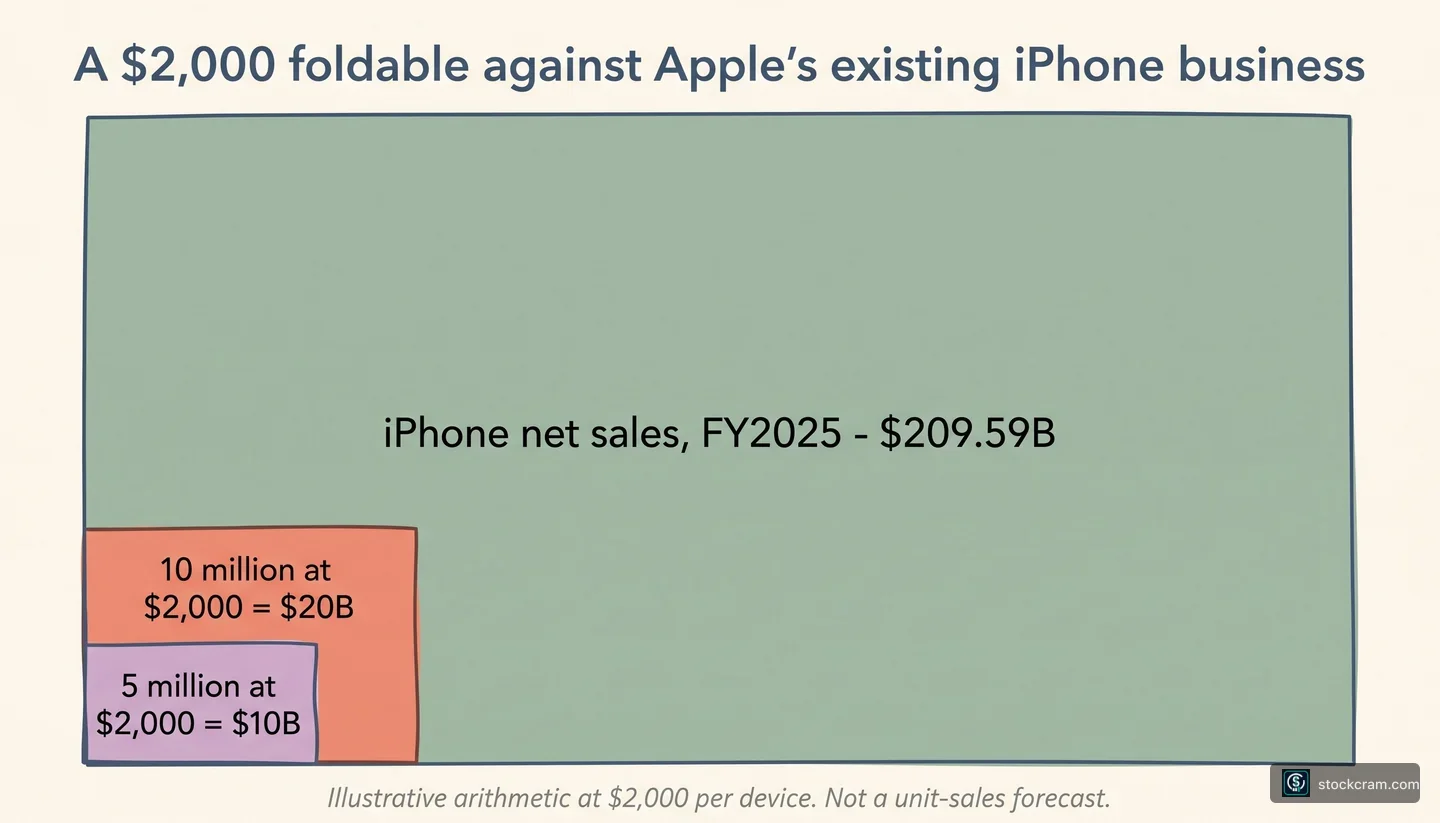
Seen at true scale, the gap is the point. Apple's iPhone revenue was $209.59 billion in the fiscal year ending September 2025, just over half of the company's $416.16 billion total. Any new phone gets measured against that base.

So run the hypothetical. At a simple $2,000-per-device assumption, close to the confirmed $1,999 starting price, five million phones represents $10 billion of retail sales value, and ten million represents $20 billion. Against $209.59 billion of existing iPhone net sales, even the larger figure is under a tenth of the iPhone line.

That $2,000 is a starting retail price, not Apple's average selling price and not necessarily what Apple recognizes as net sales per device once storage tiers, geographies and third-party retailers are involved. Treat it as scale arithmetic, not a revenue estimate.

Two things make even that overstated. Some buyers would have bought a different iPhone anyway, so part of the revenue is substituted rather than added. And revenue is not profit: a folding display is expensive, and Apple does not disclose what any individual model costs to build.

A foldable can still matter. A halo product can strengthen the brand, pull buyers toward the wider ecosystem, and shift the valuation investors place on the company. It does mean one new device is unlikely to move a company this size the way the original iPhone moved a much smaller one.

A $1,999 foldable against Apple's existing iPhone business, drawn to true relative scale
Illustrative arithmetic at $2,000 per device against Apple's FY2025 reported iPhone net sales. Not a unit-sales forecast and not an Apple revenue forecast.
The same comparison in numbers

Illustrative arithmetic at $2,000 per device. Not a unit-sales forecast and not an Apple revenue forecast. iPhone net sales from Apple's FY2025 Form 10-K.

ScenarioIllustrative Sales ValueEquivalent to FY2025 iPhone Net Sales
FY2025 iPhone net sales (reported)$209.59B100%
5 million devices at $2,000$10B4.8%
10 million devices at $2,000$20B9.5%

What actually moves Apple stock?

Announcements are theater with a share price attached. What tends to move the number over months is duller and arrives later.

Start with demand, which is harder to see than people assume. Apple has not disclosed iPhone unit sales since fiscal 2019, when it stopped reporting units for iPhone, Mac and iPad, and it does not break out unit sales or margins for individual iPhone models in its periodic financial reporting. A foldable's success therefore shows up indirectly: in total iPhone revenue, in how long it stays out of stock, bearing in mind that long waits can mean constrained supply as much as strong demand, in what management says on the earnings call, and in the gross margin for the hardware business as a whole.

Then there is what management says about the next quarter. That forward statement is called guidance, and it frequently moves the stock more than the results themselves, because markets price expectations rather than history. It is also why earnings day so often moves a stock more than a launch does.

Margin is the last piece. A $2,000 phone with an expensive folding display can lift revenue while earning less on each dollar than a conventional iPhone. Whether it helps profit depends on build cost, which nobody outside Apple knows.

None of that is visible during a keynote.

What does "buy the rumor, sell the news" mean?

It describes a pattern in investor behavior where a share price rises while people anticipate an event and then falls once the event actually happens, because the expectation was already reflected in the price.

The mechanism is simple enough. If everyone expects a foldable iPhone at about $2,000 in October, that expectation is in the price before the announcement. The announcement itself then delivers little additional positive surprise, and there is less left to push the price higher. Any disappointment in the detail can push it down.

Apple's own history shows the shape. The stock fell 12 percent in the month after the original iPhone was unveiled and rose 82 percent over the following year. Nothing about the product changed in between. What changed was the information available: the phone shipped, early demand became visible, Apple reported two more quarters of earnings, and the wider market moved. Attributing the full twelve months to the announcement would be a stretch.

The phrase is a description of investor behavior, not a rule you can act on. Prices sometimes rise on the news too, and knowing the phrase tells you nothing about which will happen next.

What did Apple confirm, and what did the leaks get wrong?

Apple confirmed the iPhone Duo on its own product pages, and that confirmation is what moves a row in the table above from reported to stated: $1,999 to start, a 7.6-inch inner display and a 5.4-inch outer one, four storage tiers up to 2TB, in Star White and Night Sky, pre-orders October 16 and on sale October 23.

Before that, every one of those specifics came from a single Bloomberg report published hours earlier. Most of it held up: the name, the $1,999 starting price and the October window were all right. Three things were not. The leak put the inner display at 7.8 inches and the outer at 5.5, and Apple's are 7.6 and 5.4. Its top-tier estimate of about $3,000 came in under Apple's confirmed $3,199 for 2TB. And the vague "October" firmed into two exact dates.

That is a small gap, and it is the entire argument for labeling where a number came from. A fifth of an inch does not change an investment case. It does show that well-sourced reporting from a reporter with a strong record is still not the same thing as the company saying it, and the habit of checking which one you are reading is worth more on the numbers that do move money.

Key Takeaway: The leaks got the name, price and month right, and both display sizes wrong.

What to watch after the keynote

Four things turn today's reporting into facts, and none of them is the keynote applause.

Apple's product pages have already answered the first round, which is where a confirmed price, name and ship date appear. Every figure in the tracker is now company-stated.

Pre-orders and October shipping timelines are the next signal. They are an earlier signal than launch-day commentary, though a long wait can reflect limited supply as much as strong demand.

The holiday-quarter earnings release follows, the first reported quarter whose iPhone revenue would include foldable sales, though Apple is unlikely to break those out separately, alongside management's guidance for the quarter after.

Then the price itself. At $1,999 to start, the iPhone Duo is the most expensive iPhone Apple has sold, and how buyers respond to that price is still an open question.

StockCram is an educational publisher. Nothing here is a recommendation to buy or sell any security.

How we calculated these returns

Every return on this page is ours. Here is exactly how we got them.

Prices are weekly adjusted closes for AAPL and SPY from Alpha Vantage's TIME_SERIES_WEEKLY_ADJUSTED endpoint, retrieved on September 9, 2026. Adjusted closes account for stock splits and dividends, which matters for Apple: an unadjusted 2007 price would be meaningless after four splits.

For each announcement we take the first weekly close on or after the announcement date as the starting point, then the first weekly close on or after 30, 91 and 365 days later. The announcement-week figure is the move from the prior week's close to that first close. Because the series is weekly, these are week-resolution windows rather than exact trading-day counts, which is a real limitation: it means we cannot isolate a single-day reaction to a keynote.

Excess return is Apple's return minus SPY's over the identical window. SPY is used as the S&P 500 proxy and its adjusted closes include dividends, so both sides of the subtraction are on the same basis.

The eight announcements were selected by us as introductions of a new product category, a major platform transition, or an unusually significant iPhone redesign. Selection is a judgment, not a formula, and a different one would produce different numbers.

Frequently asked questions about the foldable iPhone and Apple stock

The questions people are searching for, answered as of September 9, 2026, after Apple confirmed the device.

Yes. Apple published the iPhone Duo on its own product and technical-specification pages on September 9, 2026, confirming the name, a $1,999 starting price, a 7.6-inch inner display and a 5.4-inch outer one, storage from 256GB to 2TB, and availability from October 23 with pre-orders from October 16.

The iPhone Duo price starts at $1,999 for 256GB, confirmed by Apple. The full ladder is $2,199 for 512GB, $2,599 for 1TB and $3,199 for 2TB.

iPhone Duo, confirmed by Apple on its own product pages. Earlier reporting had also used iPhone Fold and iPhone Ultra.

Mostly. Bloomberg had the name, the $1,999 starting price and the October window right. Three details were off: the inner display was reported at 7.8 inches and the outer at 5.5, against Apple's 7.6 and 5.4; the top-tier price was put at about $3,000, against Apple's $3,199; and "October" firmed into pre-orders on October 16 and availability on October 23.

In the eight-announcement sample we selected, AAPL rose over the following twelve months after seven of them, with a median gain of about 34 percent. Measured against the S&P 500 the record is weaker: Apple beat the index after five of eight. The three most recent lagged it. This is a small hand-picked sample and past performance does not indicate future results.

It fell about 12 percent in the month after the January 2007 announcement and was still lower after three months, then rose about 82 percent over the following twelve months while the S&P 500 was roughly flat.

Expectations are priced in before an event. When the announcement delivers what was already anticipated, there is no new information to push the price higher. Investors often call this buying the rumor and selling the news.

Apple's newsroom is the source for confirmed product details. Quarterly earnings show total iPhone revenue and broader financial results, but Apple does not disclose unit sales or margins for individual iPhone models.

The Bottom Line

Apple has confirmed the iPhone Duo at $1,999, on sale October 23. The history is more interesting than the folklore suggests. Apple stock rose over the twelve months following seven of the eight announcements we selected, but it beat the S&P 500 after only five, and the three most recent announcements all trailed the market.

Key Takeaways

Apple confirmed the iPhone Duo from $1,999

Name, price ladder to $3,199, displays, storage and dates all come from Apple's own pages. The leaks missed both display sizes and undershot the top-tier price.

The announcement week was mixed, not reliably bullish

Median move across the eight announcement weeks was +0.7%: five positive, two negative, one flat.

Twelve months looks much better than one

Seven of eight announcements were followed by gains over a year, median about 34 percent, but three of eight were negative after a month.

Against the market the record is thinner

Apple beat the S&P 500 after five of eight announcements. Raw returns flatter it because the whole market rose.

Recent launches have trailed the market

M1 Macs, Vision Pro and Apple Intelligence all lagged the S&P 500 over the following year. That is a pattern in a small hand-picked sample, not proof of a cause.

Enjoyed this article?

Share

Related Articles

Read The Trillion-Dollar AI IPO Wave: SpaceX, Anthropic, OpenAI Explained

The Trillion-Dollar AI IPO Wave: SpaceX, Anthropic, OpenAI Explained

Three AI giants approached public markets in 2026 at a combined ~$3.6T target, but the paths diverged. SpaceX went public June 12 with a record IPO, then slid below its $135 offer price; Anthropic is on track for an October 2026 listing; OpenAI has delayed, now eyeing 2027.

37 min read
Read Article