


An Algorithm Is Just a Recipe
Strip away the mystique and an algorithm is nothing more than a recipe written for a computer: "if these conditions are true, place this order." A human decides the rules in advance; the software follows them exactly, without getting bored, tired, hopeful, or scared. That's the whole idea. Where a person might stare at a screen and hesitate, a program checks its conditions thousands of times a second and acts the instant they're met.
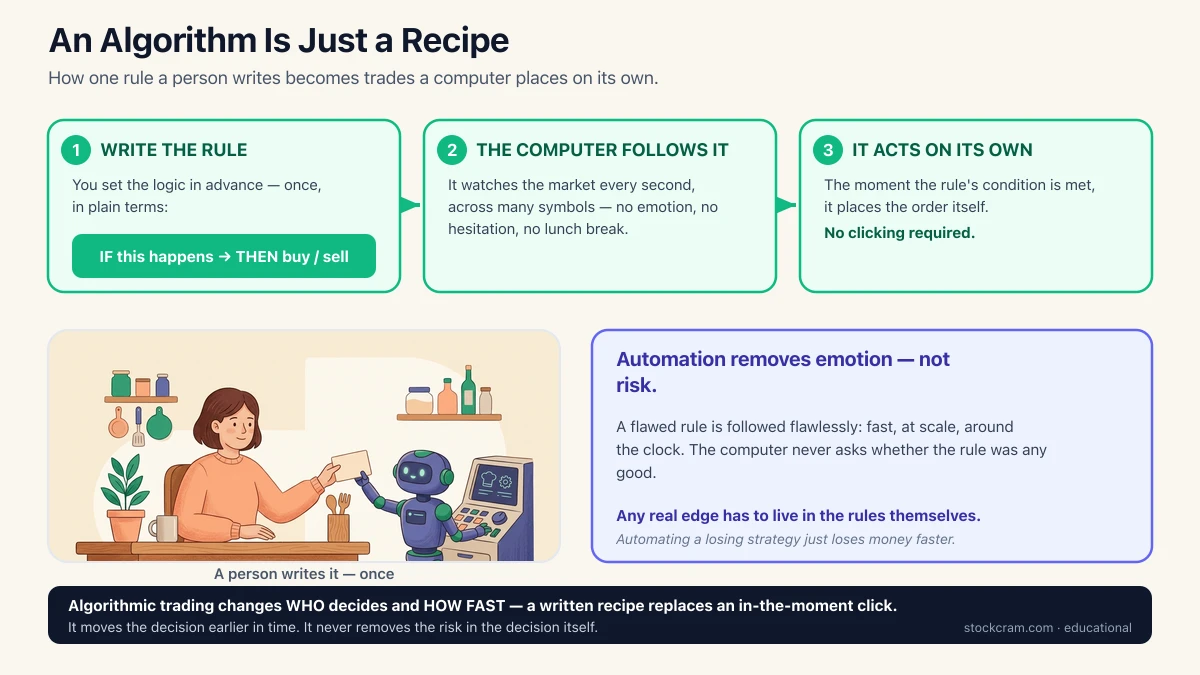
A rule can be simple enough to write on an index card — "if a stock's price crosses above its average price of the last 200 days, buy 10 shares; if it falls back below, sell them." It can also be a sprawling system weighing dozens of inputs. Either way, the machine isn't thinking. It's executing a plan a person already made.
The One-Sentence Version
Algorithmic trading is handing your pre-decided rules to a computer so it can place the orders for you — faster and without emotion, but never smarter than the rules themselves.
Discretionary vs. Algorithmic Trading
Most people picture a discretionary trader: a human who reads the news, studies a chart, and decides in the moment whether to buy or sell. Algorithmic trading moves that decision earlier in time. You still make the choices — but you make them before the trade, encode them as rules, and let the computer handle the clicking. Here's how the two compare across the things that actually matter:
| Dimension | Discretionary (human decides live) | Algorithmic (rules decide) |
|---|---|---|
| Who pulls the trigger | A person, in the moment | Pre-written rules, automatically |
| Speed | Seconds to minutes to react | Milliseconds — reacts the instant conditions are met |
| Emotion | Fear and greed affect every click | None at execution — but the rules can still be flawed |
| How many markets at once | A handful a person can watch | Hundreds or thousands, in parallel |
| Main failure mode | Hesitation, panic, second-guessing | Following a bad rule perfectly, at scale |
Neither column is 'better' — they trade different strengths. Automation fixes the emotion problem and creates a new one: a mistake, executed flawlessly and fast.
Notice the last row. Automation genuinely solves the discipline problem — the algorithm won't chicken out or chase a hot tip. But it will follow a broken rule with the same flawless obedience it follows a good one. That trade-off is the thread running through this entire course.
Who Actually Uses Algorithmic Trading?
It runs across a huge range of scale. At one end are giant institutions — hedge funds and market-making firms — running high-frequency systems that trade millions of times a day. In the middle are smaller professional quant shops. At the other end is a hobbyist running a modest script from a laptop. Today, algorithms of some kind place the majority of share volume on major U.S. exchanges, so even a buy-and-hold investor is trading inside a market shaped by them.
Automation ≠ an edge
A common myth is that automating a strategy makes it profitable. It doesn't. Automation changes how orders get placed — reliably and fast — not whether the underlying idea has any advantage. A losing strategy, automated, simply loses money more efficiently. The edge has to come from the rules; the computer only executes them.
A Simple Worked Example
Say you write one rule: "Each morning, if Stock XYZ opened at least 2% below yesterday's close, buy 5 shares; sell them at the end of the day." You've now described a complete, if crude, algorithm. A program can check that condition every morning at the open and act on it without you lifting a finger. It will never forget, never oversleep, and never talk itself out of the trade.
But look at everything the rule doesn't handle: what if the stock keeps falling all day? What if there's no buyer at the price you want? What if the 2% dip happens because the company just collapsed? A real system has to answer those questions with more rules — which is exactly why the rest of this course exists. The recipe is easy to start; making it robust is the hard part.
Sources & Further Reading
- Staff Report on Algorithmic Trading in U.S. Capital Markets (2020) — U.S. Securities and Exchange Commission
- Concept Release on Equity Market Structure (2010) — U.S. Securities and Exchange Commission
Educational use only
Educational content only. StockCram isn't a broker or adviser, and we have no affiliation with any institution or tool we mention. Nothing here is a recommendation to trade in any particular way.