


Four Families, One Idea Each
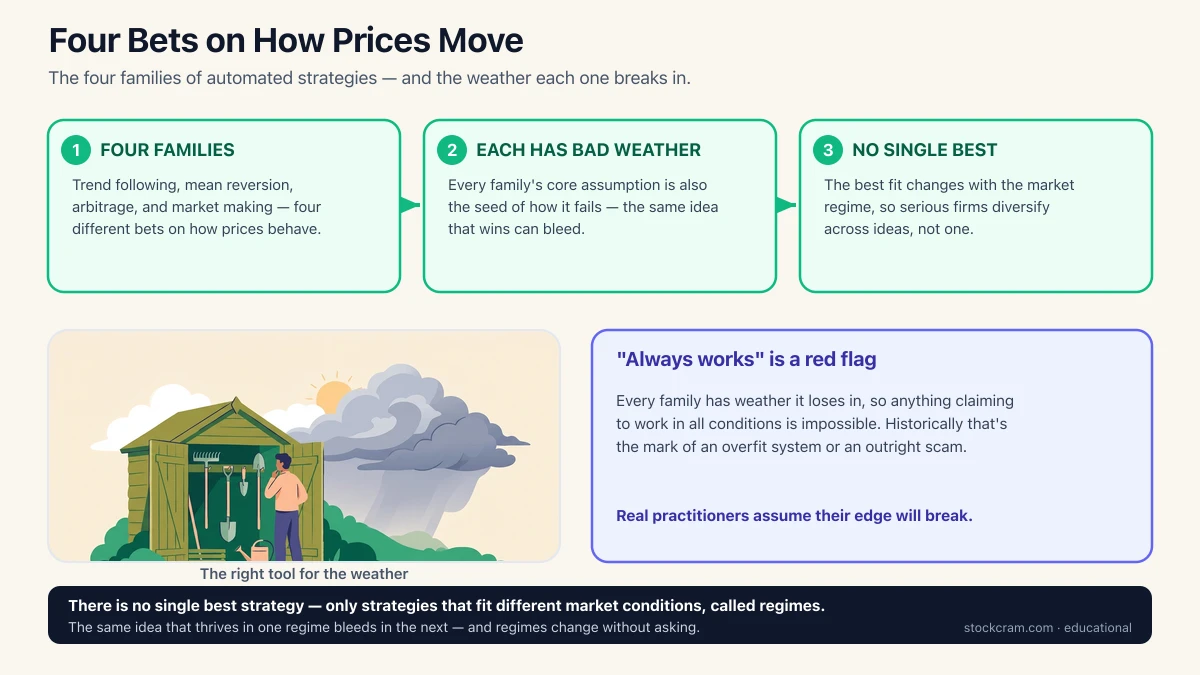
So far we've treated an algorithm as an empty recipe. Now let's fill it in with the recipes you'll actually meet. Many of the alpha-seeking strategies you'll come across are variations on four core ideas — trend following, mean reversion, arbitrage, and market making. This isn't the whole map: plenty of other categories exist too (execution algorithms, event-driven, factor, volatility, and statistical-arbitrage strategies), but this lesson focuses on these four broad, foundational families. Think of them as four different bets about how prices behave. None is secret, none is magic, and — this is the important part — each is only a tendency that markets have shown historically, not a rule they're forced to obey. Every family has weather it thrives in and weather that quietly drains it.
These are categories, not recommendations
We're describing how each idea works and where it breaks — as concepts, the way a biology class describes different animals. Nothing here is a suggestion to trade one way or another. The goal is to recognize these families when you read about them, not to pick one.
Trend Following — Ride the Move
Trend following makes one simple bet: a price already moving in one direction tends to keep moving that way, at least for a while. It's the momentum idea — a ball rolling downhill keeps rolling. A textbook version uses a moving average: buy when the price rises above its average of the last 200 days, and exit when it falls back below. The rule never tries to call the top or the bottom; it just tries to sit inside the middle of a move.
Where does it struggle? In choppy, sideways markets that drift up and down without going anywhere. There, the price keeps poking above the average (buy) and dropping below it (sell), handing the system a string of small losses — death by a thousand paper cuts. Historically, trend following pays for those many small losses by occasionally catching one enormous winner that runs for months. But that payoff is lumpy and rare, and there's no promise the next big trend ever shows up.
Mean Reversion — Bet on the Snap-Back
Mean reversion is trend following's mirror image. It bets the opposite: when a price stretches unusually far from its average, it tends to snap back toward it — like a rubber band pulled tight, or a bungee cord. So where a trend follower buys strength, a mean-reversion system buys weakness: it treats a sharp drop below the average as 'too cheap for now' and expects a bounce back to normal.
And here's the catch, which is exactly why it mirrors trend following: mean reversion struggles badly in a strong, one-way trend. When a price is genuinely collapsing, the system keeps 'buying the dip' — buying, buying, buying as the thing falls further and the rubber band, instead of snapping back, just keeps stretching. The same feature that wins in a calm, range-bound market (fading extremes) is what gets it run over when a real trend arrives. One family's best weather is the other family's worst.
Arbitrage — Same Thing, Two Prices
Arbitrage doesn't guess direction at all. It looks for the same asset priced differently in two places and pockets the gap: buy where it's cheap and sell where it's dear, at the same moment, so you're not exposed to which way the price then moves. Picture a bottle of water that costs $1 in one shop and $1.02 next door — buy at the first, sell at the second, keep the two cents. In theory it's as close to 'risk-free' as trading gets.
In practice it isn't. Those price gaps are tiny and vanish in milliseconds as everyone races to grab them, so arbitrage is dominated by the fastest players — high-frequency firms with the lowest latency money can buy. And 'risk-free' quietly assumes both trades actually fill at the prices you saw; if one leg fills and the other doesn't, or the gap closes mid-trade, the 'free' money turns into a real loss. It's a tendency that works right up until the plumbing hiccups.
Market Making — Getting Paid to Wait
Market making earns money a fourth way: by being the shop that's always open. A market maker continuously posts both a price it will buy at and a slightly higher price it will sell at, and collects the difference — the bid-ask spread — over thousands of trades. In return it provides liquidity: it's the ready counterparty so you can buy or sell right now instead of waiting for someone else to show up. Like a currency booth at the airport, it profits a sliver on each exchange by handling enormous volume.
Its danger is inventory risk: getting stuck holding a position when the price gaps against its quote. If a market maker is buying at $10.00 and bad news hits, it can be left holding shares it paid $10 for while the real price craters to $9 — the spread it earned is dwarfed by the loss on what it's now stuck with. Because it demands constant, fast quoting across many names at once, market making is now almost entirely automated; a human simply can't post and update quotes fast enough to compete.
Why There's No "Best" Strategy
Line the four families up side by side and each one's core assumption turns out to be the seed of how it fails:
| Strategy family | Core assumption | Struggles when… |
|---|---|---|
| Trend following | A move in one direction tends to continue | Markets are choppy and sideways — many small losses |
| Mean reversion | A price stretched far from its average tends to snap back | A strong trend keeps running — it 'buys the dip' all the way down |
| Arbitrage | The same asset shouldn't trade at two prices at once | The gap vanishes in milliseconds, or one leg of the trade fails to fill |
| Market making | Quoting both sides earns the spread for providing liquidity | The price gaps against the quote, leaving it stuck holding a loser |
Each family's strength is also its weakness: the exact market that suits one tends to punish another.
That last column is the whole lesson. Trend following wants strong trends; mean reversion wants calm, range-bound markets — the two literally want opposite weather. So there is no single 'best' strategy, only strategies that fit different market conditions (quants call these regimes). The same idea that prints money in one regime bleeds it in the next, and regimes change without asking permission.
"Always works" is a red flag
Because every one of these families has weather it loses in, any strategy or product that claims to work in all conditions is telling you something impossible. Historically, that claim has been a hallmark of overfit systems (see the backtesting lesson) or outright scams. Real practitioners assume their edge will break; they just try to know when.
This is also why serious quant firms don't run one strategy — they diversify across ideas, hoping that when trend following is having a miserable year, something like mean reversion or market making is having a good one. It's the same logic as diversification in an ordinary portfolio, applied to strategies instead of stocks. No family is a machine that always wins; the honest goal is a mix whose bad patches don't all arrive on the same day.
Educational use only
Educational content only. StockCram isn't a broker or adviser, and we have no affiliation with any institution or tool we mention. Nothing here is a recommendation to trade in any particular way.