


Most Automation Is Perfectly Legal
The vast majority of automated trading is completely legal and completely ordinary — which surprises a lot of people. When a firm runs a market-making program that quotes prices all day, or an arbitrage system that buys something cheap in one place and sells it dearer in another, or when you simply hand your own strategy to a computer to execute — none of that is a loophole. It's just trading, done by software instead of a hand on a mouse.
A quick scope note
This is a simplified, U.S.-focused educational overview — not legal or compliance advice.
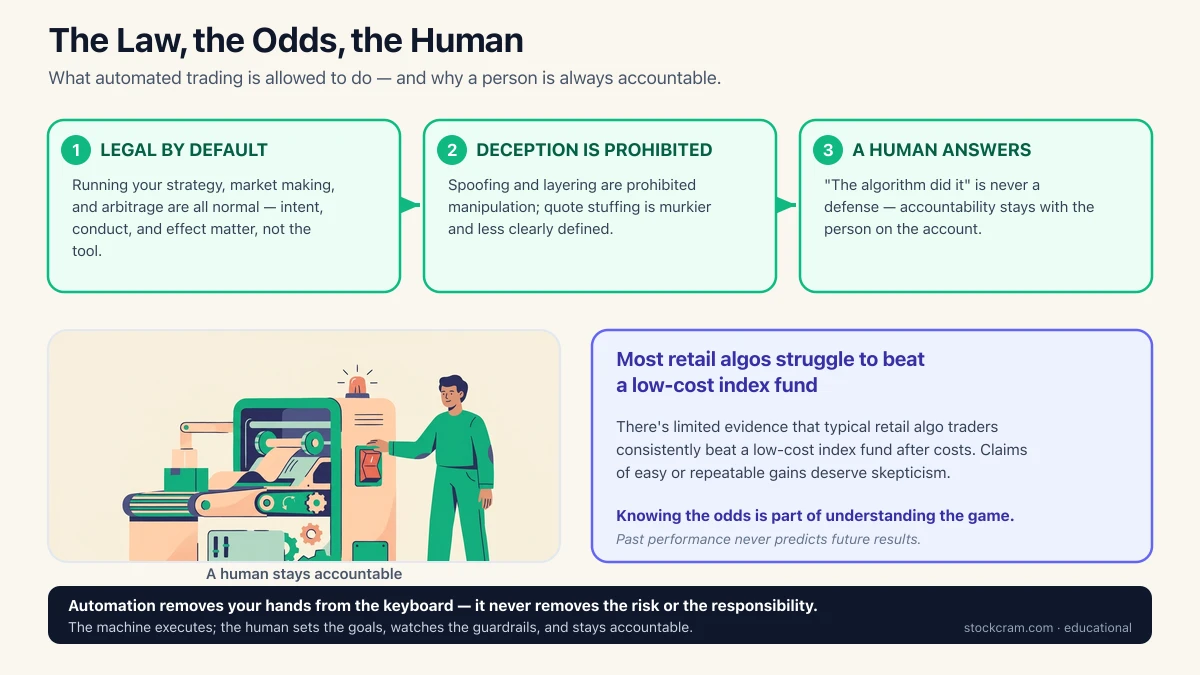
The law doesn't care whether a human or a machine clicked the button. What matters is broader than the tool — intent, conduct, effect, applicable rules, and required controls may all matter — including what you were trying to make happen in the market and what actually happened. That idea is the key to the whole legal-versus-illegal question.
Where the Law Draws the Line
So how do you tell a legal automated trade from an illegal one? The test is almost never the tool — it's what the trader is actually trying to do. Here are five behaviors side by side:
| Behavior | Legal or illegal? | Why |
|---|---|---|
| Running your own strategy automatically | Legal | You're placing real orders you intend to fill — automation is just the tool doing the clicking. |
| Market making / providing liquidity | Legal | Quoting both a buy and a sell price all day is a normal, useful role that helps others trade. |
| Spoofing — orders you never intend to fill | Illegal | Fake orders placed to trick others about supply and demand; explicitly banned in futures by the Dodd-Frank Act, and illegal as fraud in stocks. |
| Quote stuffing to slow others down | Treated as illegal | Flooding the market purely to clog it and slow others down is widely regarded as manipulation, though less clearly defined in statute than spoofing. |
| Trading on material non-public info via a bot | Illegal | It's still insider trading — automating the trade doesn't change the crime. |
The legal rows share one thing: real orders, honestly meant. The illegal rows all involve deception — a bot doesn't launder that.
The reasons in that last column share one thread: the illegal rows all involve deception — pretending to want a trade you don't (spoofing and its cousin layering, stacking fake orders to fake demand), clogging the pipes so others can't react, or acting on secrets you're not allowed to use. A computer doing the tricking doesn't make it cleaner. In the U.S. these fall under the SEC, and for futures the CFTC, and the regulator treats the bot exactly like the hand that would have done it.
"The Algorithm Did It" Isn't a Defense
Even trading that's perfectly legal in spirit still runs inside a cage of rules. Exchanges have circuit breakers — automatic pauses that halt trading when prices move too violently — plus their own rulebooks about how orders may be placed. Your broker adds another layer, enforcing position limits and shutting off accounts that misbehave. None of these ask permission from your algorithm; they act on it.
And underneath all of them sits a rule that's easy to forget when a machine is doing the work: a person is responsible for what their system does. "The algorithm did it" has never been a legal defense. If your bot floods the market or breaks a rule at three in the morning while you sleep, the accountability is yours, not the code's. Automation moves your hands off the keyboard — it doesn't move your name off the account.
The Honest Odds
Now the reality check this course promised to be honest about. Worth saying plainly: there is limited evidence that typical retail algorithmic traders consistently outperform diversified passive investments like a low-cost index fund after costs, and claims of easy or repeatable excess returns deserve skepticism. This isn't a scare story or a reason to walk away — it's just measured humility, the same way most amateur runners never win a marathon. Knowing the odds is part of understanding the game, not a verdict on whether to play it.
Why is it so hard? Three reasons keep showing up. First, real-world costs — slippage, fees, and spreads quietly eat returns that looked clean on paper. Second, competition: on the other side of your trade often sit firms with faster computers, better data, and teams of specialists. Third, and most common, overfitting — a strategy tuned so tightly to the past that it dazzles in a backtest and then falls apart the instant it meets a market it hasn't seen before.
Understanding is the real prize
Here's the reframe that matters: the point of this course was never to get you trading. It was to help you understand the machine — so when a headline shouts that "AI is taking over the markets," you can tell the real part from the hype. That understanding is valuable whether you ever place a single automated order or not.
Why a Human Stays in the Loop
If algorithms are so fast and tireless, why not hand them the keys entirely? Because of the one thing they fundamentally lack: judgment. An algorithm optimizes exactly what you told it to, with zero sense of whether the situation still makes sense. Tell it to buy every dip and it will keep buying straight into a company that's collapsing, because "is this still a good idea?" was never one of its rules.
So a human stays at the center — not clicking every trade, but doing the things no rulebook can: setting the goals, watching the guardrails, and deciding when to hit the kill switch, the master off-button that stops everything. The person defines what "good" even means, notices when reality has drifted away from the plan, and carries the responsibility when it goes wrong. AI and faster automation change the tools dramatically. They don't change this one fact: the machine executes, and the human is accountable.
One Recipe, Twelve Lessons
Look how far a single idea has stretched. We started with a plain sentence — an algorithm is just a recipe: "if these conditions are true, place this order." From there we opened up its anatomy, turned vague ideas into testable rules, fed them data, ran them through backtests, found the narrow place where AI actually fits, walked the main strategy families, sent orders into a real market, managed the risk, and tested it all on paper before a single dollar moved.
The throughline never changed. Automation is a genuinely powerful tool: it removes emotion from the moment of the trade and lets one system watch more markets than any person could. But it never removes risk, and it never removes responsibility — those stay with the human at every step. Hold onto that and you're reading the whole field clearly, which was the entire point.
You've reached the finish line
That's the course. Next is the Course Summary — a one-page recap of everything you've met, and where you earn the Algo Architect badge. You've built an honest mental model of how these systems really work; carry it into whatever you read next.
Sources & Further Reading
- Disruptive Trading Practices Fact Sheet — spoofing under Dodd-Frank (CEA §4c(a)(5)) — U.S. Commodity Futures Trading Commission
- Quote Stuffing (Egginton, Van Ness & Van Ness, 2016) — Financial Management
- Trading Is Hazardous to Your Wealth (Barber & Odean, 2000) — The Journal of Finance
- SPIVA U.S. Scorecard — S&P Dow Jones Indices
Educational use only
Educational content only. StockCram isn't a broker or adviser, and we have no affiliation with any institution or tool we mention. Nothing here is a recommendation to trade in any particular way.