

A Broker API Is a Drive-Through Window
In plain English, a broker API (application programming interface) is a doorway that lets your program talk to your broker without a human clicking anything. Through that doorway your code can ask for prices, check the account balance, and send or cancel orders. The broker's computers answer back. That's the whole job: it's how software, rather than a person at a screen, gets to place a trade.
The best analogy is a drive-through window. You can't wander into the kitchen and cook whatever you like. You pull up to a speaker and choose from a strict menu of things you're allowed to ask for: "what's the price of XYZ?", "how much cash is in the account?", "buy 10 shares." The broker decides what's on the menu and what each request has to look like. Your program orders from that menu; the broker fills it. Anything not on the menu simply isn't available.
The One-Sentence Version
A broker API is a strict, machine-readable menu your program orders from — request prices and account info, send or cancel orders — so software can trade without a human at the keyboard.
The Layers of a Trading Stack
The API is just one doorway near the end of a longer assembly line. Getting from a trading idea to a live order usually passes through a stack of layers, each with one job. Here's the whole stack in order, and — just as important — what stops working if any single layer fails:
| Layer | Its job | What breaks if it fails |
|---|---|---|
| Data feed | Supplies the prices and volume the system reads | The strategy is blind — it decides on stale or missing numbers |
| Research / backtesting | Where a strategy is written and tested on history | Ideas ship untested; nobody knows if the rules ever worked |
| Strategy code | The actual rules — what to buy or sell, and when | The wrong decision gets made, correctly, every time |
| Execution / order layer | Runs the risk checks from Lesson 2, translates a decision into API calls, and tracks fills | Orders are malformed, duplicated, or lost after sending |
| Broker API + broker | The gateway that routes the order to the market | Nothing reaches the market; the order never happens |
| Monitoring / logging | Records what happened so a human can see and step in | Failures happen silently — you find out from the balance |
Six layers, one direction of travel. A failure in any single layer can quietly break the whole chain — and the last one is how you even find out.
That last column is the part to sit with: each layer fails in its own way, and most failures are silent unless the monitoring layer catches them. That's why the humble logging box at the bottom matters as much as the clever strategy at the top — it's the only layer whose job is to tell you the others broke.
Paper vs. Live: One Key, Two Worlds
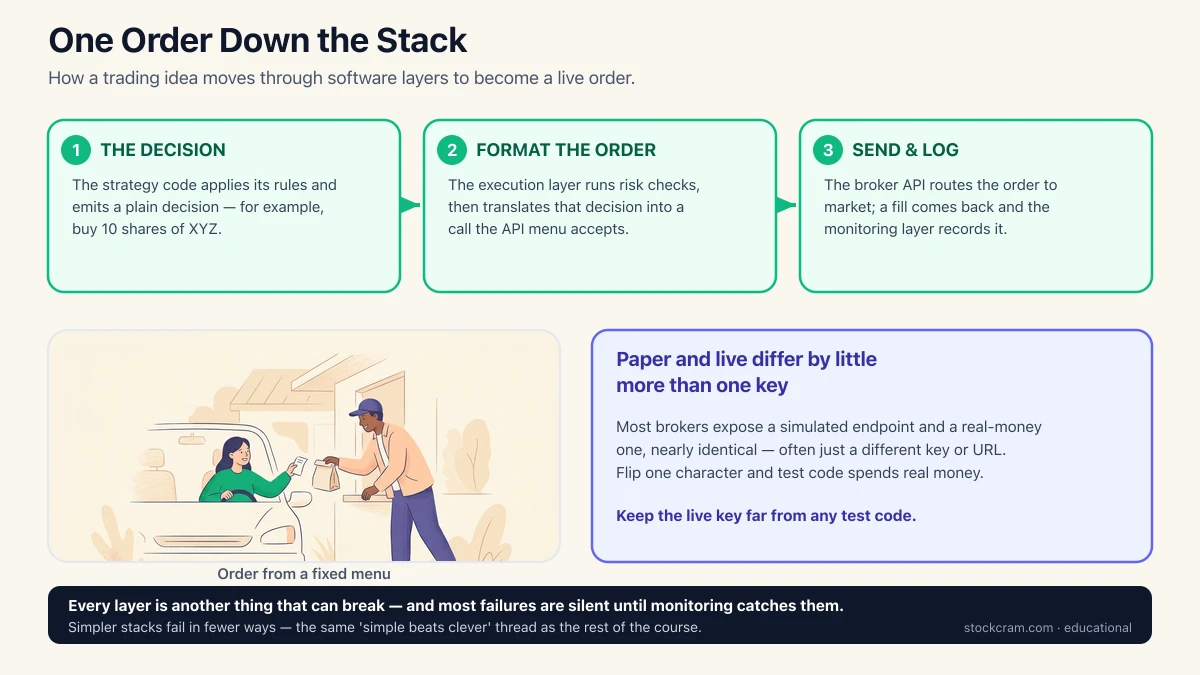
One detail catches people out. Most serious brokers expose two doorways through the same API: a paper trading endpoint that simulates fills with fake money, and a live endpoint that spends real money. How different those two worlds really are depends on the broker — permissions, account IDs, data subscriptions and entitlements, and which order types are supported can all differ between paper and live. But at some brokers the two look dangerously similar, separated mainly by a single key or a slightly different URL. Where that's the case, flip one character and code you wrote to practice is suddenly placing real orders.
The character that costs real money
At some brokers the paper and live endpoints are separated by little more than a key or a URL, so a careless copy-paste can point real money at code you only meant to test. This is a genuine failure mode, not a hypothetical — the safeguard is treating the live key as something that lives far away from test code, never as a value you swap in casually.
Every Layer Is Another Thing That Can Break
It's tempting to keep bolting on layers — a fancier data feed, an extra optimization step, a second execution path. But each addition is another thing that can break at 3 a.m. when nobody's watching. A stack with six moving parts has six ways to fail; a stack with twelve has twelve, plus all the new ways they can trip over each other. Simpler stacks fail in fewer ways — which is the same "simple beats clever" thread that runs through this whole course.
This is the real trade-off behind building it yourself versus reusing something that exists. Reusing a well-worn layer means fewer bugs you have to discover the hard way, at the cost of doing things its way. Building your own gives you control and one more thing to maintain forever. Neither is "correct" — but every layer you add, whoever built it, is a layer you're now responsible for understanding when it fails.
Following One Order Down the Stack
Let's trace a single decision all the way through. Say the strategy code decides: "buy 10 shares of XYZ." Watch it travel: the strategy emits that decision → the execution layer formats it into a proper order the API menu accepts → the broker API receives it → the broker routes it to the market → a fill comes back → the monitoring layer logs it. Six handoffs, and the trade only counts once the fill returns and gets recorded.
Now break the chain in two ordinary ways. First, a wrong endpoint: the execution layer sends that same "buy 10 shares" to the live URL instead of the paper one — the order is perfectly formed, so nothing errors; it just spends real money you meant to simulate. Second, a dropped network connection: the order reaches the broker and fills, but the connection drops before the confirmation comes back. Your monitoring never sees the fill, so the system thinks it owns nothing — while the broker says you own 10 shares. Same tiny order, two very different disasters, both living in the gaps between the layers.
Educational use only
Educational content only. StockCram isn't a broker or adviser, and we have no affiliation with any institution or tool we mention. Nothing here is a recommendation to trade in any particular way.