

An Order Is a Request, Not a Trade
When you tap Buy on your broker's app, you're not buying directly from the stock market. You're submitting a request to your broker — something like 'I want 10 shares of Apple.' Your broker then finds someone willing to sell on the other side.
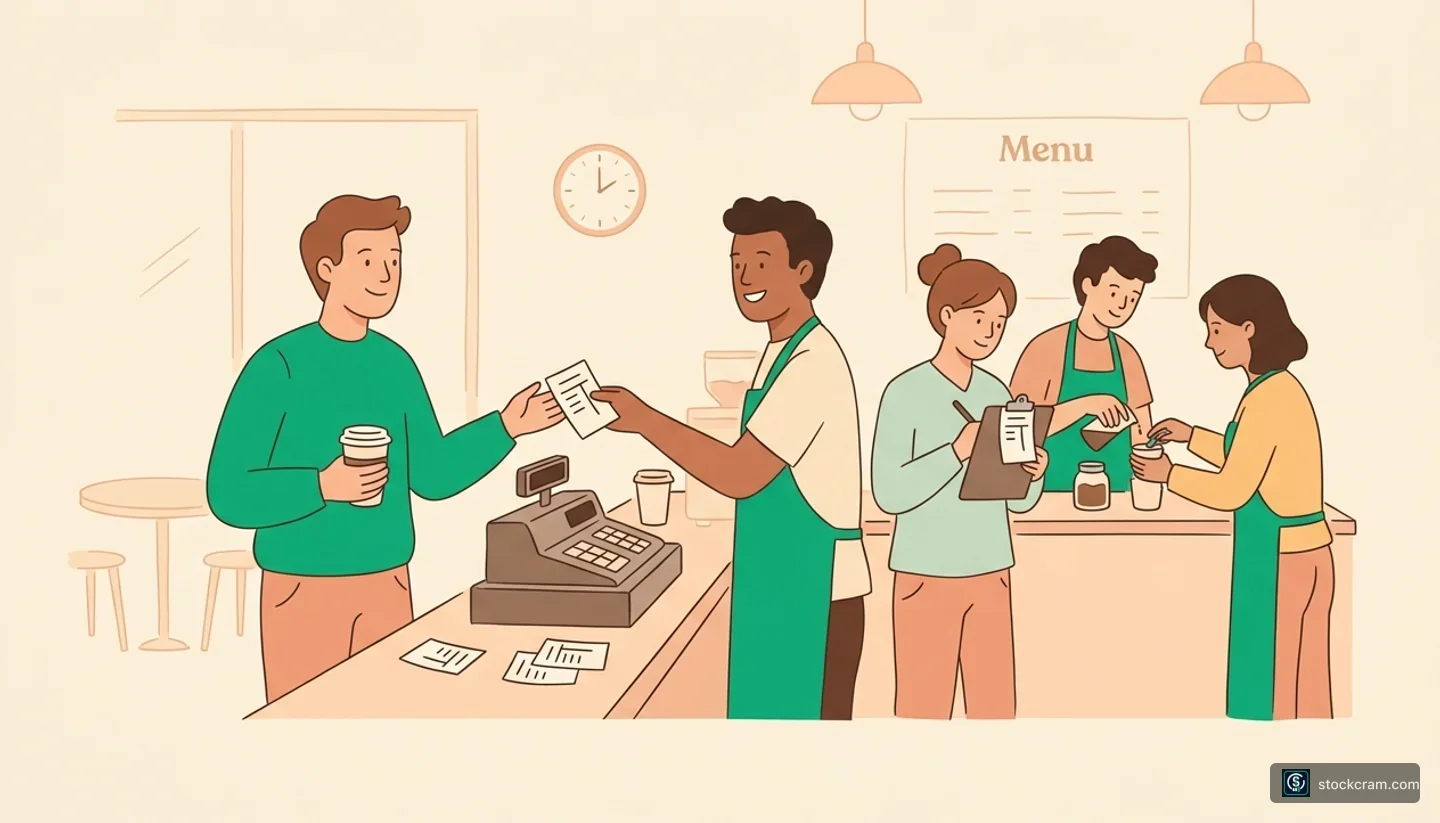
Think of It Like Ordering Pizza
You don't drive to the kitchen and grab a pizza yourself. You tell a delivery app what you want, the app sends the order to a restaurant, the restaurant prepares it, and a driver brings it to you. Behind the scenes there are five companies involved, but to you it looks like one tap.
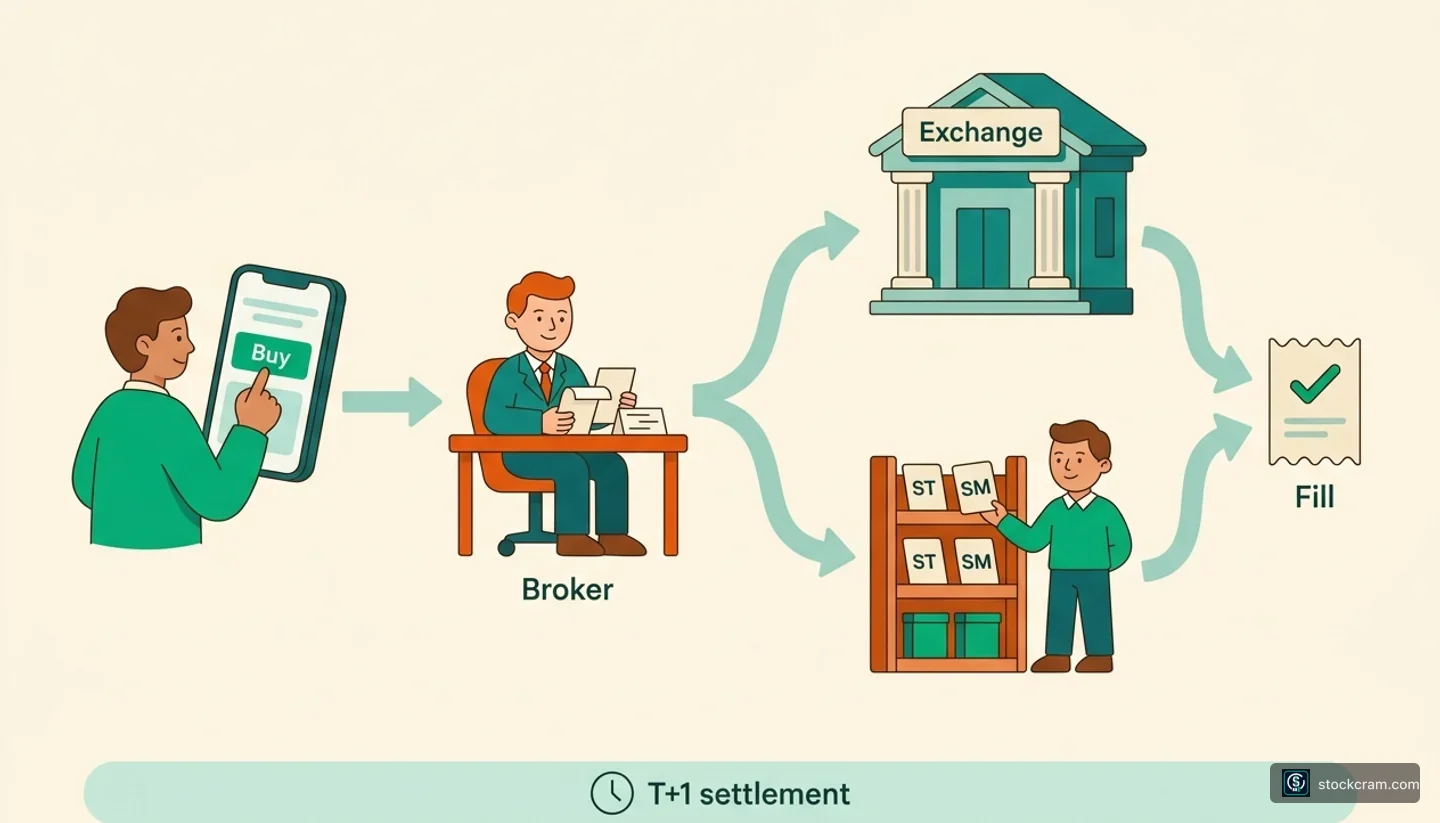
A stock order works the same way. You tap Buy, your broker forwards the order, a stock exchange or market maker matches it, and the shares show up in your account.
The Four Steps Every Order Goes Through
Place
You tap Buy (or Sell) in your broker's app and pick the order type and quantity.
Route
Your broker sends the order wherever it can get a fill, usually a stock exchange or a market maker.
Match
Your order meets an opposite order — either another retail order on an exchange, or a market maker taking the opposite side from its own inventory. For a heavily-traded stock during market hours, this takes milliseconds.
Settle
Shares move to your account, cash moves out. In the US this is now T+1 — one business day after the trade.
Follow One Order Through
Say you place a market order to buy 10 shares of a stock trading around $50. You tap Buy at 10:30 AM. Your broker routes it, a market maker matches it at $50.02 (the ask) in a fraction of a second, and your account shows 10 shares almost instantly. About $500.20 leaves your buying power.
The shares show up in your account view immediately so you can track the position, but the legal transfer happens the next business day. That two-cent gap above the $50.00 you saw on screen? That's the spread at work.
Sometimes only part of your order fills
If there aren't enough shares available on the other side at your price, you get a partial fill — some now, the rest sits open as a remaining order. It's most common on thinly-traded stocks or large orders, and is the reason limit orders sometimes fill in pieces over time. Lesson 3 covers this in depth.
Where the Match Actually Happens
Most US stock orders are matched in one of two places. The first is a stock exchange like the NYSE or Nasdaq — a giant electronic order book where buyers and sellers post bids and offers. The second is a market maker — a firm that holds inventory of stocks and stands ready to buy or sell at any moment. Many small retail orders are filled by market makers, not exchanges.
What is the NBBO?
The NBBO stands for National Best Bid and Offer, the highest price any buyer is offering and the lowest price any seller is asking, across all US exchanges combined. By law, your broker must give you a price at least as good as the NBBO at the moment your order is matched. It's a floor on execution quality, not a guarantee of the best possible price.
What the Order Type Decides
The most important choice you make when placing an order is the order type. The order type tells the system what tradeoff you want to make:
Speed First — Market Order
- Fills almost immediately during market hours
- You accept whatever price the market is showing right now
- Can suffer from slippage on thin or volatile stocks
Price First — Limit Order
- You set the maximum you'll pay (or minimum you'll accept)
- May not fill at all if the market never reaches your price
- Gives you control, costs you certainty
The Bid-Ask Spread: An Invisible Cost
Every stock has two prices at any moment: the bid (the highest price someone is willing to pay) and the ask (the lowest price someone is willing to sell for). The gap between them is the spread. You don't see the spread as a line item on your trade confirmation, but it's there in every transaction.
For a heavily-traded stock, the spread is usually a single cent. For a small, thinly-traded stock, it can be 20 cents or more. When you buy with a market order, you typically pay the ask; when you sell, you typically receive the bid. The wider the spread, the higher this invisible cost.
| Stock type | Typical spread | Cost on 100 shares |
|---|---|---|
| Mega-cap (e.g. AAPL) | $0.01 | About $1 |
| Mid-cap | $0.05 | About $5 |
| Small / thinly-traded | $0.20+ | $20 or more |
| Penny stock | 5–10% of price | $20–$100 or more |
Illustrative ranges only. Spreads vary by time of day, volatility, and listing venue.
Settlement: T+1
In the US, most stock trades settle on T+1 — one business day after the trade. The match happens immediately; the legal transfer of shares and cash completes the next business day. Until May 2024 the standard was T+2, so this is a relatively recent change.
Why Settlement Matters
If you sell a stock on Monday in a cash account, the cash isn't fully available until Tuesday. Trying to withdraw or reinvest those funds before settlement can trigger a good faith violation — a warning from your broker, and repeated violations can restrict your account.
Educational use only
StockCram is an educational platform — not a broker, dealer, or financial adviser, and is not affiliated with any brokerage mentioned in this lesson.