


The Tradeoff Triangle
Across this whole course, one theme keeps returning: every order balances speed, price, and certainty of execution. No order maxes out all three — choosing an order type means deciding which one matters most for that trade.
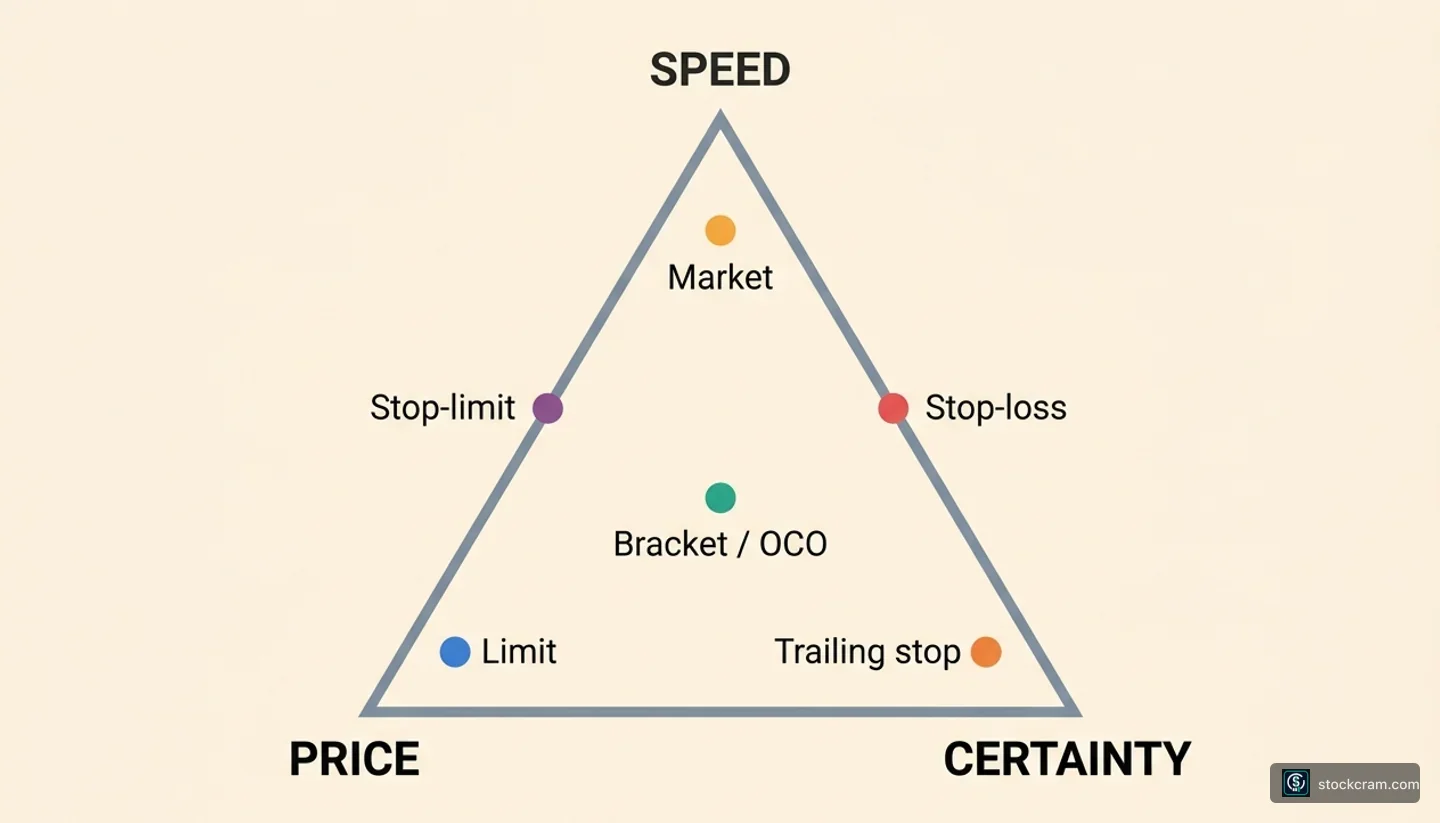
The Core Tension
Market orders favor speed and certainty of filling. Limit orders favor price. Stops add a trigger. Every other order type in this course is one of those three with a wrinkle added.
A Quick Comparison
| Order type | What it does | The catch |
|---|---|---|
| Market | Fills instantly at the best available price | Price not guaranteed (slippage) |
| Limit | Fills only at your price or better | May not fill at all |
| Stop-loss | Triggers a market order at a price level | Fills at market, not your stop (gap risk) |
| Stop-limit | Triggers a limit order at a price level | May not fill on a gap |
| Trailing stop | Trigger that ratchets up with the price | Whipsaw on tight trails, gap risk on wide ones |
| Bracket | Entry plus paired profit-target and stop-loss | Doesn't protect against the gap itself |
| OCO | Two linked orders — one fills, the other cancels | Both are still subject to their underlying mechanics |
The whole toolkit, side by side.
Questions Investors Weigh
How much does price precision matter?
If a few cents matter, a limit order gives control. If getting filled matters more, a market order is simpler.
How liquid is the stock?
On heavily-traded names, market orders behave predictably. On thin ones, limit orders guard against slippage.
Do I want an automatic trigger?
Stops and trailing stops act on a price level without you watching — with their own gap tradeoffs.
There's No Universal 'Right' Order
The best order type is situational, not fixed. This is educational framing, not advice, it doesn't tell you when to buy or sell, only how each tool behaves so you can understand your choices.
Putting It Together
You now know the full toolkit: how orders are routed and filled, market vs limit, stops and trailing stops, how time in force sets the clock, and how bracket and OCO orders pair an entry with its exits in one ticket. Each is a lever; the situation decides which to pull.
Speed vs Price
- Market = speed
- Limit = price
- You're always trading one for the other
Triggers + Time
- Stops add a trigger price
- Time in force sets how long you wait
- Both shape your exposure
Pairing Orders
- Bracket = entry + profit + stop
- OCO = one fills, the other cancels
- Decide the exit before the entry
Beyond This Course
Three order topics deliberately scoped out of this course are worth knowing about as next steps. Each gets its own deeper coverage elsewhere on StockCram.
Extended-hours orders
- Pre-market (4 AM–9:30 AM ET) and after-hours (4 PM–8 PM ET) trading
- Spreads can widen 5–10x and volume is a fraction of regular hours
- Most brokers only accept limit orders outside regular hours
Margin and short orders
- Buying with borrowed money — amplifies gains and losses
- Selling shares you don't own (short) — borrow, sell, hope to buy back lower
- A margin call can force-sell positions at the worst possible time
Conditional and algorithmic orders
- Iceberg: hides most of a large order, shows only a small visible slice
- Peg: tracks the bid or ask automatically
- Mid-point: tries to fill at the midpoint of the bid-ask spread
Continue Your Learning
Revisit any lesson in this course, browse the related glossary terms, or jump to the Trade Smart path hub to see what's next in active-trading education. Understanding the tools is what lets you read your broker's order ticket with confidence.
Educational use only
For learning, not advice. StockCram is independent of any brokerage referenced here.