


What Is a Market Order?
A market order is the simplest instruction you can give your broker: 'Buy (or sell) this stock right now, at whatever the best available price is.' You're not naming a price — you're choosing to prioritize getting it done over getting a specific price.
The One-Sentence Version
A market order trades price certainty for execution certainty. You're almost guaranteed to get filled — you're not guaranteed the exact price you saw on screen.
How a Market Order Fills
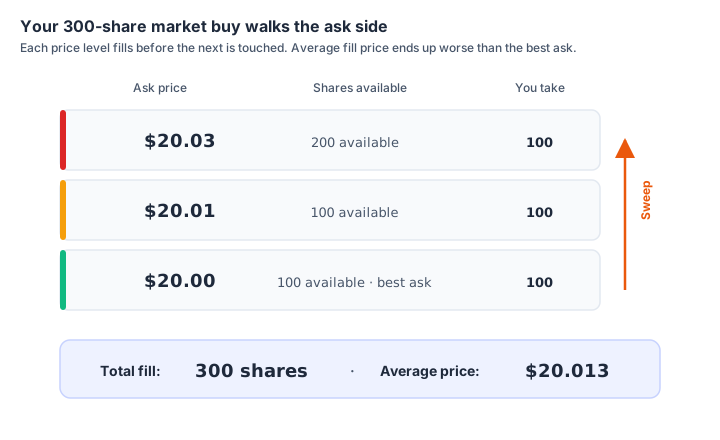
When you submit a market buy, it matches against the lowest ask prices sitting in the order book, the live list of everyone's buy and sell orders. Want more shares than are available at the best price? Your order climbs to the next price level to finish the job.
Follow One Market Order
You place a market order for 300 shares. The order book is offering 100 shares at $20.00, 100 at $20.01, and 100 at $20.03.
Your order sweeps all three levels: 100 at $20.00, 100 at $20.01, and 100 at $20.03, for an average of $20.013 per share. On a heavily-traded stock those levels sit a penny apart; on a thin one they can be far apart.
Sometimes you even get price improvement — a fill a hair better than the quote, because firms compete to handle your order. On a single share it's trivial; across many trades it adds up.
When a Market Order Makes Sense
Good Fit
- Large, heavily-traded stocks with tight spreads
- During regular market hours
- When getting filled matters more than a few cents
Risky Fit
- Thin, low-liquidity stocks
- Pre-market or after-hours sessions
- Fast-moving or news-driven moments
The Slippage Risk
Slippage is the gap between the price you expected and the price you got. Because a market order accepts whatever the book offers, a sudden move or a wide spread can fill you noticeably away from the last quote.
Where Market Orders Bite
The danger zones are low-liquidity stocks and the seconds right after news. A market order on a thinly-traded stock can 'walk the book,' filling far from where you expected. In those moments a limit order gives you a guardrail.
Why the Fill Isn't the Price You Saw
The last-traded price is history — it's what someone already paid. Your market order fills against the current bid and ask, which may have moved since. On a heavily-traded stock the difference is pennies, so the quote you see is a close estimate, not a promise.
| Feature | Market order |
|---|---|
| Speed | Fastest, usually instant during market hours |
| Price control | None, you take the best available |
| Will it fill? | Almost always, if there's someone on the other side |
| Main risk | Slippage on thin or fast-moving stocks |
A market order at a glance.
Educational use only
Educational content only. StockCram isn't a broker or adviser, and we have no affiliation with any platform we name.