


What Is a Stop Order?
A stop order stays dormant until the stock crosses a price you choose, the stop price. Until then it does nothing. The moment the market touches your trigger, the order activates and tries to execute.
The Key Idea
A regular order acts now. A stop order waits for a trigger, then acts. It's an 'if the price reaches X, then trade' instruction.
Most beginners meet stops as a sell-side tool — to cap a loss on a stock they already own. But stops work in both directions: a sell stop sits *below* the current price (the classic stop-loss), and a buy stop sits *above* it, triggering only if the price rises through that level. Buy stops are sometimes used to enter after a breakout. The rest of this lesson covers the sell side; the mechanics on the buy side are mirror-symmetric.
Stop-Loss: Trigger → Market Order
A stop-loss turns into a market order the instant the stop price is hit. Because it becomes a market order, it's almost guaranteed to fill, but not at a guaranteed price. This is the order most people mean when they say 'set a stop.'
You set it
You own a stock at $50 and place a stop-loss with a $45 stop price.
It waits
While the stock stays above $45, nothing happens.
It triggers
The stock falls to $45 and your stop-loss converts to a market order.
It fills
The market order sells at the best available price — $45, or lower if the stock is dropping fast.
Stop-Limit: Trigger → Limit Order
A stop-limit order is similar, but when triggered it becomes a limit order instead of a market order. You set two prices: the stop (the trigger) and the limit (the worst price you'll accept). This protects your price, but if the market blows past your limit, the order may never fill.
Stop-Loss
- Triggers into a market order
- Almost always fills
- No control over the fill price
Stop-Limit
- Triggers into a limit order
- Price-protected at your limit
- May not fill if price gaps past the limit
The Big Risk: Gaps
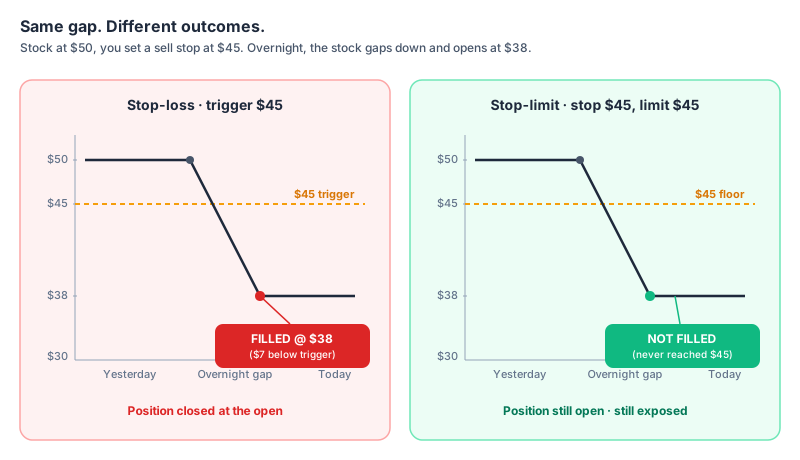
Stops have a weak spot: gap risk. A stock can 'gap' — jump from one price to a very different one without trading in between, often overnight or on news. A $45 stop-loss can fill well below $45 if the stock opens at $40. A stop-limit avoids the bad fill but may not execute at all.
Stops Don't Guarantee Your Price
A stop-loss limits when you exit, not the exact price you get. In fast drops or overnight gaps, the fill can be meaningfully below the stop. Neither stop type removes risk; each just chooses which tradeoff you accept.
| Feature | Stop-Loss | Stop-Limit |
|---|---|---|
| Becomes | Market order | Limit order |
| Will it fill? | Almost always | Only at your limit or better |
| Price control | None | Full |
| Gap weakness | Bad fill price | May not fill at all |
The core tradeoff: fill certainty vs price certainty.
A stop-loss is only half the decision, the other half is how many shares to buy given that stop. Size a position from your account, risk, and stop distance:
Position Size Calculator
Educational use only
StockCram is an educational platform — not a broker, dealer, or financial adviser, and is not affiliated with any brokerage mentioned in this lesson.