


What Is a Trailing Stop?
A trailing stop is a stop order that moves. Instead of fixing the trigger at one price, you set it a fixed distance below the current price — as a dollar amount or a percentage. As the stock climbs, the trigger climbs with it. When the stock falls, the trigger stays put.
The One-Sentence Version
A trailing stop ratchets up with the price and never moves down, so it follows gains automatically and triggers only after a set-size pullback.
How the Trail Works
Follow One Trailing Stop
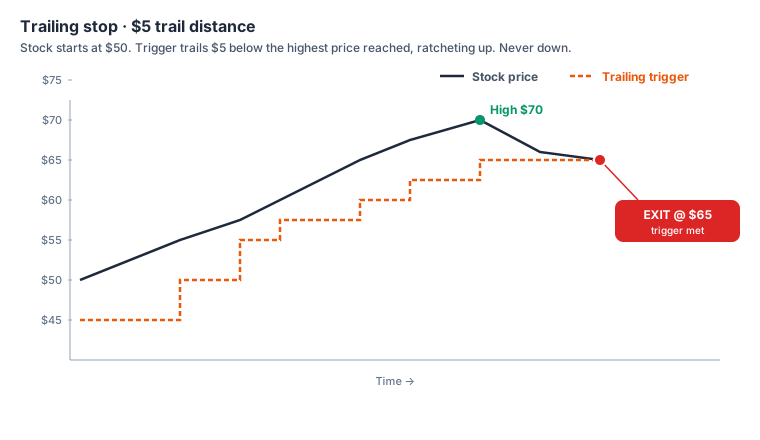
You own a stock at $50 and set a trailing stop of $5. The trigger starts at $45.
The stock rises to $60, the trigger trails up to $55. It rises to $70, the trigger is now $65. The stock then falls to $65, hits the trigger, and the order activates. You never had to move the stop by hand.
Notice the trigger only ever moved up. The $5 trail locked in more and more of the rise. Set it as a percentage instead (say 10%) and the distance scales with the price.
The High-Water Mark
A trailing stop tracks the highest price reached since you placed it — its high-water mark, and keeps the trigger a fixed distance below that peak. New highs lift the trigger; dips don't lower it.
Choosing the Trail Distance
Tight Trail (small %)
- Locks in more of a gain
- Triggers on small pullbacks
- Can exit during normal wobble
Wide Trail (large %)
- Gives the stock room to move
- Survives normal volatility
- Gives back more before triggering
There's No Magic Number
A trail too tight gets shaken out by normal price noise; too wide gives back a lot before triggering. The right distance depends on how much a given stock normally moves — there's no universally correct setting, and a trailing stop carries the same gap risk as any stop.
Trailing Stop vs Trailing Stop-Limit
Like regular stops, trailing stops come in two flavors. A standard trailing stop triggers into a market order — fills almost surely, price not guaranteed. A trailing stop-limit triggers into a limit order — price-protected, but may not fill in a fast drop.
| Feature | Trailing stop |
|---|---|
| Trigger | Moves up with the price, never down |
| Set as | A dollar amount or a percentage |
| Becomes | Market order (or limit, if trailing stop-limit) |
| Main risk | Whipsaw on tight trails; gap risk like any stop |
A trailing stop automates what you'd otherwise adjust by hand.
Your trail distance is effectively your stop distance. See how that maps to a share count for a given account size and risk:
Position Size Calculator
Educational use only
Educational content only. StockCram isn't a broker or adviser, and we have no affiliation with any platform we name.