

The Number Everything Else Depends On
Every piece of investing advice you will ever read assumes something it rarely says out loud: that there is money left over at the end of the month. Contribute monthly, build an emergency fund, pay extra toward a balance. All of it needs a gap between what comes in and what goes out.
That gap is your surplus. It is the first thing worth measuring, because a plan built on a surplus you don't have will fail in month two.
The whole lesson in one line
Income minus spending equals your surplus. Everything after this (how much you invest, how big your cushion needs to be, how fast a debt clears) is that one number in different clothes.
Three Kinds of Spending
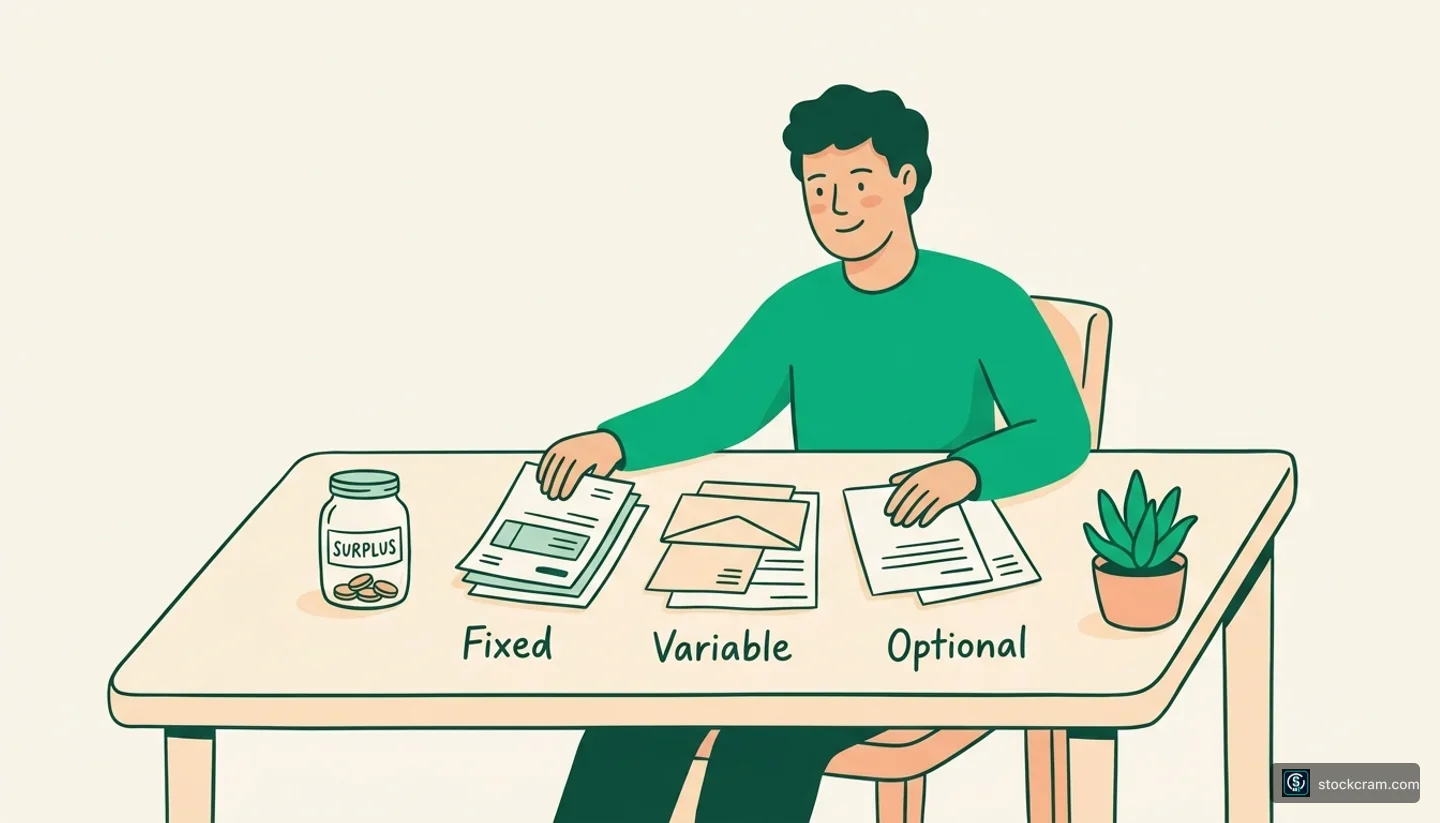
Adding up "what I spend" as a single figure hides the thing you need. Money leaving your account behaves in three quite different ways, and the difference matters because only one of them is genuinely hard to change.
Fixed
- Rent or mortgage
- Insurance premiums
- Loan and card minimums
- Same amount, same date, every month
Variable but necessary
- Groceries
- Utilities
- Fuel or transit
- Phone
- Unavoidable, but the amount moves
Discretionary
- Subscriptions and streaming: fixed in amount, optional by nature
- Eating out
- Travel
- Anything you'd cut in a hard month
- Optional by definition
Fixed doesn't mean essential
These three buckets sort spending by how easily the amount changes, which is what matters when you're looking for surplus. They do not sort it by how necessary it is, which is a different question with a different answer. A streaming subscription is fixed in amount and entirely optional; groceries vary every week and are not optional at all.
Keep the two apart, because the next lesson sizes an emergency fund against your essential spending, the things that continue when income stops. Fixed-but-optional costs don't belong in that number.
Fixed costs are the ones that keep arriving whether or not you have a job. Variable-but-necessary costs shrink under pressure but never reach zero. Discretionary spending is where a surplus usually hides, and also where a budget usually falls apart, because it's the only column anyone tries to cut.
A Worked Example
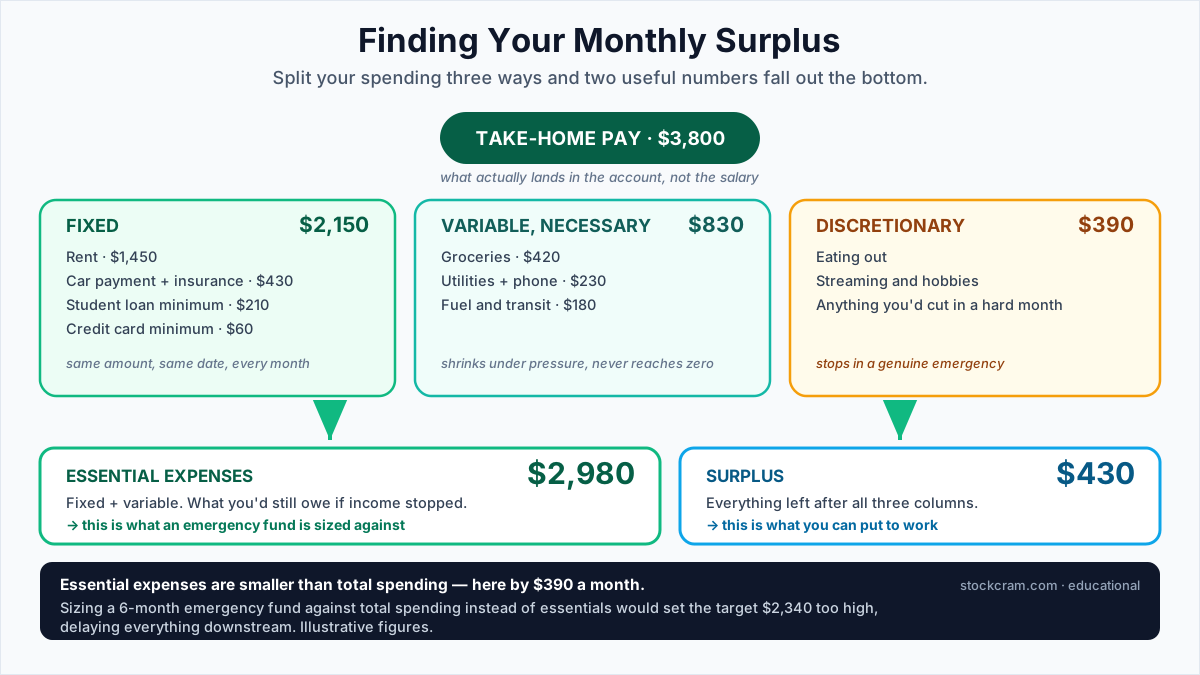
Numbers make this concrete. Take someone bringing home $3,800 a month after tax, the figure that actually lands in the account, not the salary on the contract.
| Category | Monthly | Type |
|---|---|---|
| Take-home pay | +$3,800 | Income |
| Rent | $1,450 | Fixed |
| Car payment + insurance | $430 | Fixed |
| Student loan minimum | $210 | Fixed |
| Credit card minimum | $60 | Fixed |
| Groceries | $420 | Variable, necessary |
| Utilities + phone | $230 | Variable, necessary |
| Fuel and transit | $180 | Variable, necessary |
| Eating out, streaming, hobbies | $390 | Discretionary |
| Surplus | +$430 | What's left |
Illustrative figures. The point is the structure, not the amounts.
Two numbers come out of this table, and they get used differently.
The surplus is $430. That's what could go toward an emergency fund, an extra debt payment, or investing. The essential expenses total $2,980, everything except the discretionary column. That second number is the one an emergency fund gets sized against, and it's meaningfully smaller than the $3,370 this person actually spends. Sizing a cushion against total spending would overshoot by nearly $400 a month, which across six months is more than $2,300 of extra saving before you'd let yourself invest anything.
Laid out side by side, the split and the two numbers it produces look like this.
Keep both figures somewhere you can find them. The rest of this course asks for one or the other in almost every lesson.
Take-home, not salary
Use what lands in your account. Tax, FICA, health premiums and retirement contributions come out before you see it, so budgeting against gross salary overstates what you have, often by a quarter or more. The Take-Home Pay Calculator works this out if you only know the gross figure.
The Costs That Don't Arrive Monthly
A monthly view misses anything that arrives annually. Car registration, insurance paid yearly, holidays, a dental bill, replacing a laptop. None of these show up in a typical month, and all of them are predictable enough to plan for.
The fix is arithmetic rather than willpower: total the irregular costs you can foresee across a year, divide by twelve, and treat the result as another fixed line. If that comes to $1,800 a year, it's $150 a month, and the $430 surplus above is really $280. That is a duller number, and it's the one that survives contact with a real year.
This is why budgets fail in month four
The first three months usually go fine. Then the insurance renewal lands, there was no line for it, and the shortfall goes on a card, where it starts costing APR. The annual costs weren't unforeseeable. They just weren't in the plan. The Emergency Fund Calculator uses the same essentials figure you just worked out, which is the subject of Your Emergency Fund.
When the Surplus Is Zero
Plenty of people run this calculation and find nothing left, or less than nothing. That is worth knowing rather than avoiding, and it does not mean the rest of this course is irrelevant. It changes which part applies first.
A negative surplus means the gap is being filled by borrowing, and borrowing has a rate attached. When that rate is high, the balance grows faster than most investments have historically returned, which makes it the more pressing number. The lesson on good debt vs bad debt covers how to compare those rates properly.
Measure before you change anything
Three months of actual statements, not an estimate. Most people are surprised by at least one category, and guessing tends to flatter.
Look at fixed costs, not just discretionary
The instinct is to cut coffee. But a fixed cost is a decision that repeats every month without being re-made: refinancing, changing a plan, or cancelling something that renews has a larger effect than most week-to-week trimming, and only has to be done once.
Treat a small surplus as real
$50 a month is not nothing. It's $600 a year, and it's the difference between a plan that exists and one that doesn't.
Why This Comes First
The rest of this course keeps referring back to the two numbers from this lesson. Your essential expenses size the emergency fund in the next lesson but one. Your surplus determines how quickly that fund gets built, how much extra can go toward a balance, and what a monthly contribution can realistically be.
It also sets a realistic pace. Someone with a $280 surplus and a three-month target of $8,940 is looking at roughly two and a half years to fully fund it, which is worth knowing at the start, because it usually prompts a conversation about doing things in parallel rather than strictly in sequence.
One number, two jobs
Surplus = income − all spending. This is what you can put to work.
Essential expenses = all spending − discretionary. This is what your emergency fund is measured against.
Write both down. Every later lesson uses one or the other.
Sources & Further Reading
- Consumer Expenditure Surveys, U.S. Bureau of Labor Statistics, for how household spending splits across categories
- Budgeting and Saving, Consumer Financial Protection Bureau
Educational use only
Educational content only. StockCram isn't a broker or adviser, and we have no affiliation with any institution or tool we mention. Nothing here is a recommendation about how you should use your money.