

A Bond Has a Price You Can Trade At
When you buy a bond, you don't have to hold it until maturity. You can sell it to someone else first — and the price they'll pay isn't always the face value printed on it. That market price can sit above or below face value, and it moves day to day, just like a stock's price moves.
The One-Sentence Version
A bond's face value is fixed, but its market price floats. The single biggest thing that pushes that price around is what's happening to interest rates.
The Key Idea: Prices and Rates See-Saw
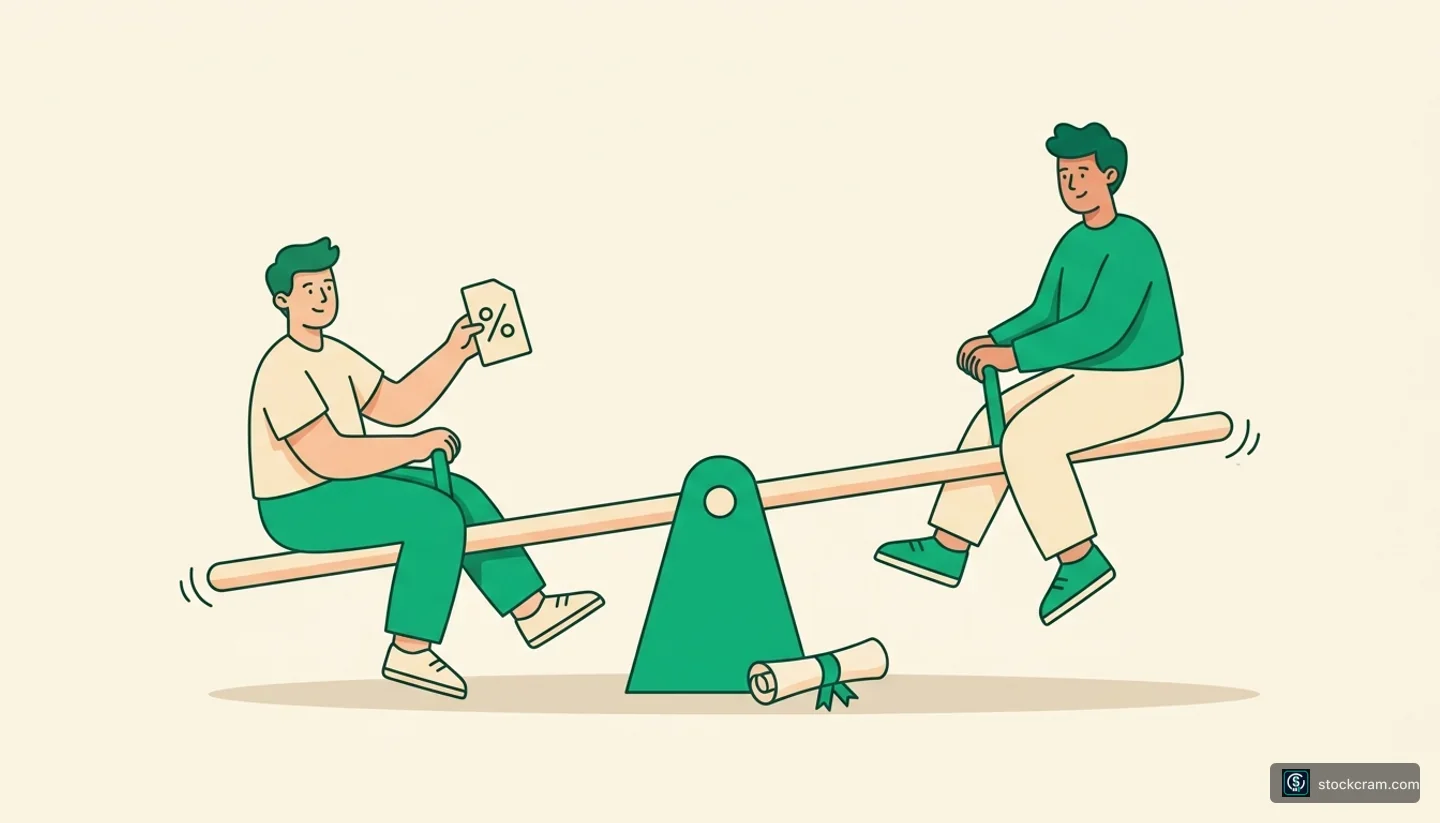
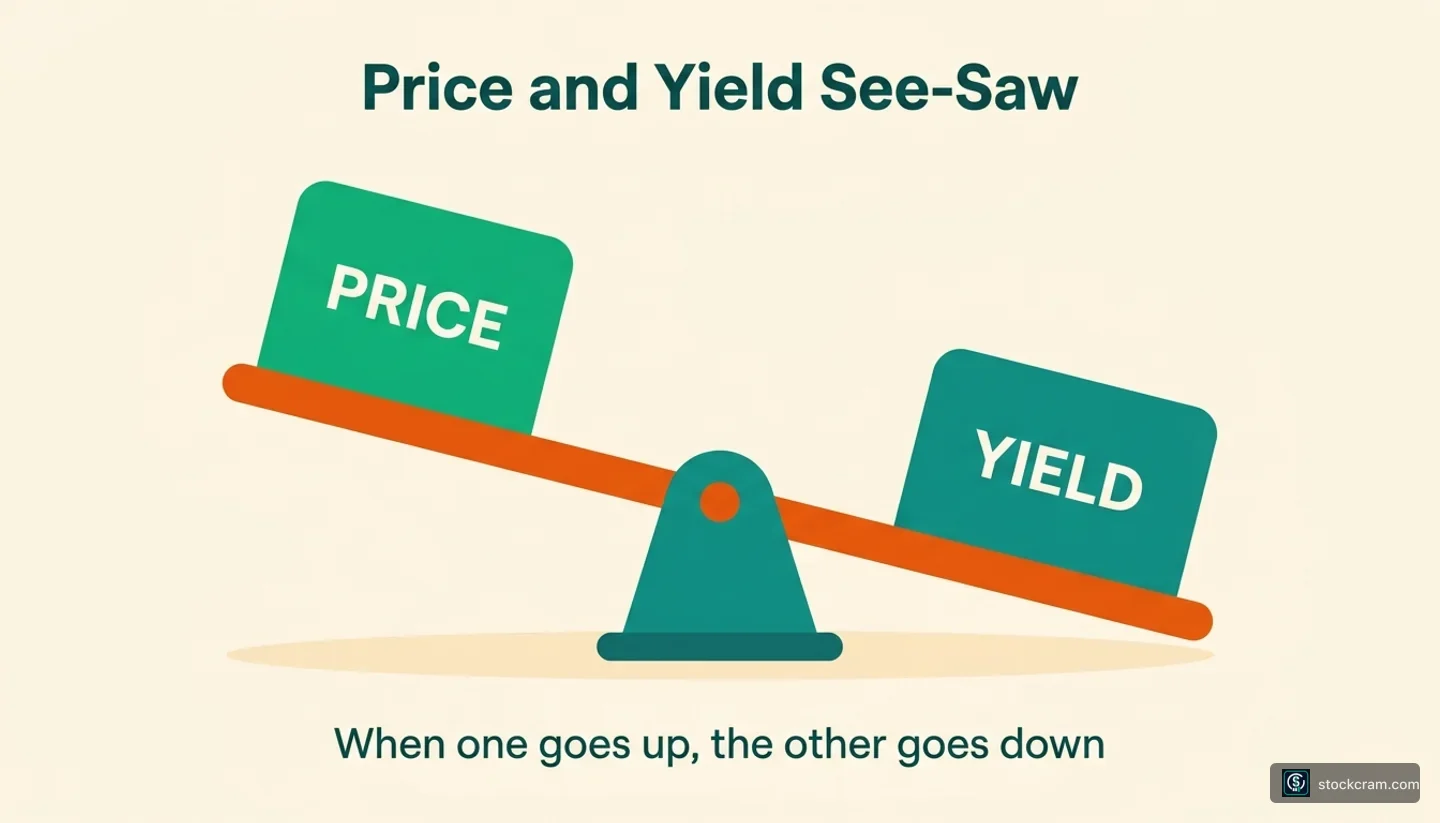
One rule explains almost everything about bond prices: bond prices and interest rates move in opposite directions. When rates go up, existing bond prices go down. When rates go down, existing bond prices go up. Picture a see-saw — push the rates side up, and the price side drops, exactly like this:
So why does the see-saw tip at all? Blame a shopper's instinct:
Why the See-Saw Exists
Would you pay full price for a coupon that pays less than a brand-new one? Of course not. So when newer bonds start paying more interest, the older, lower-paying bonds have to get cheaper to stay worth buying.
Flip it around and the same logic holds. When new bonds pay less, the older higher-paying ones suddenly look like a bargain, so their price climbs.
Why Bond Prices Fall When Rates Rise
Walk through the mechanics with stylized numbers. These are illustrative — real bonds involve more math — but the logic is exactly right.
Follow One Bond (illustrative)
You own a bond with a $1,000 face value paying a 3% coupon — that's $30 a year. Nice and steady.
Then interest rates rise, and brand-new $1,000 bonds start paying 5%, or $50 a year. Now nobody wants your bond at full price — why pay $1,000 for $30 a year when $1,000 buys $50 a year next door?
So your bond's price has to drop. It falls until that $30 a year works out to roughly a 5% return for a new buyer — same $30 coupon, lower price, higher yield for whoever buys it now. Exactly how far the price slips depends on how many years are left until it matures: the more years of below-market coupons you're stuck with, the bigger the drop.
Notice the coupon never changed — it's still $30 a year. What changed is the price someone will pay for that $30 stream. A lower price on the same payment means a higher yield. That's the see-saw in action: price down, yield up.
And When Rates Fall, Prices Rise
The see-saw works both ways. If rates fall instead — say new bonds now pay only 2%, or $20 a year — then your old bond paying $30 a year looks generous. Buyers will compete for it and bid its price above face value, because a richer coupon is worth paying up for.
| What rates do | What happens to existing bond prices | What happens to their yield |
|---|---|---|
| Rates rise | Prices fall (older bonds pay too little) | Yield rises |
| Rates fall | Prices rise (older bonds pay relatively more) | Yield falls |
The bond see-saw at a glance. Price and yield always move opposite ways. Historically, this relationship has held across the bond market.
Longer Bonds Swing More
Not every bond reacts the same. The longer a bond's maturity, the more its price moves when rates change. A bond with one year left is barely affected — you get your money back soon anyway. A 30-year bond locks in that lower-paying coupon for decades, so its price has to move much more to make up the difference.
The Longer the Bond, the Bigger the Swing
A short bond is like being stuck with a bad coupon for a week — annoying, but minor. A long bond is like being stuck with it for 30 years — which is why long-dated bonds historically move the most when rates shift. This sensitivity is a general mechanic, not a guarantee about any single bond.
What Moves Rates in the First Place
If rates are the lever, what pulls it? A big driver is the Federal Reserve, which sets a key short-term rate that ripples through the whole bond market. We go deep on that in The Fed & Interest Rates — for now, the takeaway is simply that rates move, and when they do, bond prices move the other way.
Educational use only
Educational content only. StockCram isn't a broker or adviser, and we have no affiliation with any institution we name.