


What Are Treasury Bonds?
When the U.S. government spends more than it collects, it borrows the difference — and the way it borrows is by issuing bonds. A Treasury is simply a bond sold by the U.S. government. You lend it money, it pays you interest for a set period, and it returns your original amount at the end. Same deal as any bond; the borrower just happens to be the U.S. government.
The One-Sentence Version
A Treasury is an IOU from the U.S. government. People call the whole family "Treasuries" — and they're widely held by banks, pension funds, and governments all over the world.
The Three Types, by Length
Treasuries all work the same way — the main thing that separates them is how long until you get your money back. There are three, and they're named by their length. Picture them as a ladder from short to long:
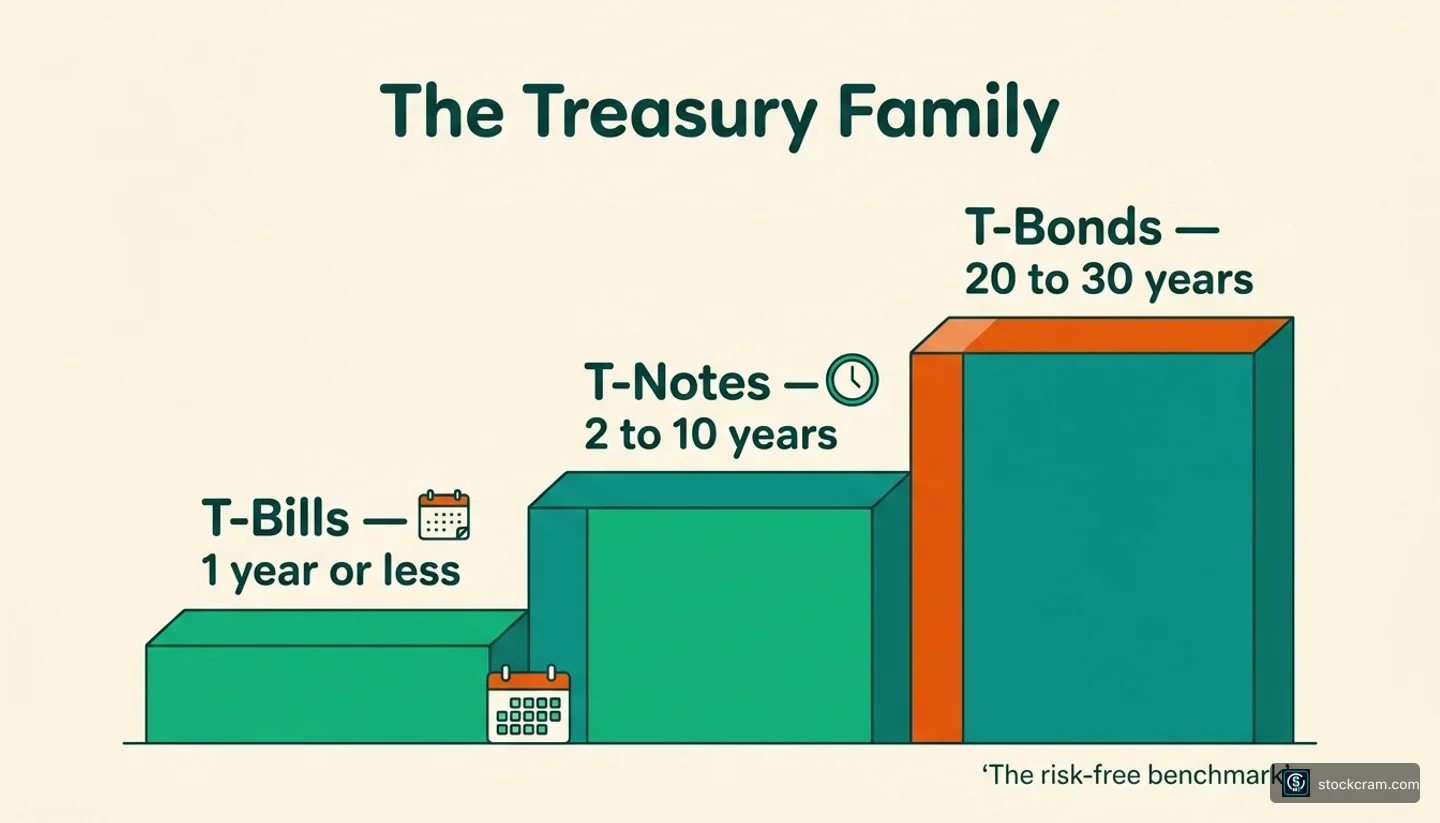
Here's how each rung of that ladder breaks down.
T-Bills
- Treasury bills mature in a year or less
- The shortest, most cash-like Treasury
- Sold at a discount instead of paying a coupon
Treasury Notes
- Treasury notes run 2 to 10 years
- The middle ground in length
- Pay interest twice a year
Treasury Bonds
- Treasury bonds run 20 to 30 years
- The longest of the family
- Pay interest twice a year
A Note on the Name
Confusingly, "Treasury bond" means two things. Sometimes it's the specific 20-to-30-year version above. Other times people say "Treasury bonds" loosely to mean all government debt. We'll use the loose meaning for the family and the strict meaning for the long one.
Bill vs. Note vs. Bond, Side by Side
Here's a stylized look at how the same $1,000 lent to the government plays out across the three lengths. The numbers are illustrative only — real Treasury terms change constantly with market conditions.
| Type | Length | How it pays | Stylized example |
|---|---|---|---|
| T-bill | A year or less | Sold at a discount; no coupon | Pay $980, get $1,000 back in a year |
| Treasury note | 2 to 10 years | Interest twice a year | Lend $1,000, collect interest, get $1,000 back at year 7 |
| Treasury bond | 20 to 30 years | Interest twice a year | Lend $1,000, collect interest for decades, get $1,000 back at year 30 |
Illustrative only. Actual terms and rates vary with market conditions.
The pattern is plain: the longer you lend your money, the longer you wait to get it back. That waiting is where a longer Treasury's interest rate and price tend to move more — a topic the next lessons dig into.
Why Treasuries Are the "Risk-Free" Benchmark
Treasuries are widely seen as the safest bonds because they're backed by the U.S. government, which has the broadest ability to raise money to repay them of any borrower around. That reputation is why finance uses the Treasury rate as the "risk-free" rate — a benchmark, in quotes, because nothing is truly without risk. It's the baseline that every other investment is measured against.
The Measuring Stick
Think of the Treasury rate as the savings account the whole financial world trusts — the yardstick everyone holds up to other choices.
If a riskier corporate bond pays barely more than a Treasury, investors ask why bother with the extra risk. The Treasury sets the bar that everything else has to clear.
"Risk-Free" Doesn't Mean No Risk
The "risk-free" label refers to the very low chance the U.S. government fails to repay. It does not mean a Treasury can't lose value. If interest rates rise, the market price of an existing Treasury can fall before maturity. That's called rate risk, and even Treasuries carry it.
The Trade-Off: Safety Costs Yield
Safety comes at a cost. Because Treasuries are considered so safe, they generally don't need to offer as much interest to attract lenders. A shakier borrower has to pay more to make its bond worth the added risk. So Treasuries tend to carry a lower yield than riskier bonds — you're trading some payout for that perceived safety. It's the same safety-versus-payout trade-off that runs through the whole bond market, just at the safe end of it.
| Feature | What it means |
|---|---|
| Who issues them | The U.S. government, to fund its spending |
| The three types | T-bills (≤1 year), notes (2–10 years), bonds (20–30 years) |
| Main appeal | Seen as the safest bonds; the 'risk-free' benchmark |
| Main trade-off | Usually lower interest than riskier bonds |
Treasuries at a glance.
Educational use only
Educational content only. StockCram isn't a broker or adviser, and we have no affiliation with any institution we name.