
Market Analysis
Markets This Week: Oil Spike, Tech Selloff
Read Article
Market Analysis
AI-powered insights into global financial markets
 StockCram Editorial16 min read
A jobs report, the Iran oil situation, and tail-end tech earnings collide this week—and they pull markets in different directions.
Week of Monday, August 31, 2026 - Friday, September 4, 2026
14.43
-0.55%
4.72%%
+0.07%
$$83.44
-3.1%
$$4,504
-3.43%
99.64
+0.55%
Markets closed mixed Friday after Fed Chair Kevin Warsh's Jackson Hole speech reinforced expectations for a potential September rate hike, with fed funds futures now pricing 60% odds of a 25-basis-point increase. Federal funds rate futures now imply 2.4 rate increases over the next 12 months, up from 1.8 a week earlier, with odds of a September hike rising to about 60% from 35%. The six-month-old Strait of Hormuz situation continues to dominate energy markets, though China has reduced its oil imports, with other countries also relying on stockpiles, while the United States has increased oil production and Gulf producers have found alternative export routes via pipelines.
The S&P 500 closed at 7,711.76 on Friday, down 0.25% from Thursday's session. The Nasdaq Composite finished at 26,402.42, while the Dow Jones Industrial Average stood at 53,559.99.
August employment reports have historically been subject to significant revisions and tend to set the tone for Federal Reserve policy discussions heading into the September FOMC meeting. The current geopolitical backdrop adds an additional layer of complexity, as periodic Iranian attacks against shipping and retaliatory U.S. strikes against Iran have severely disrupted traffic through the Strait for most of the past five months, as of early August 2026.
Markets return from the weekend digesting Fed Chair Warsh's hawkish Jackson Hole speech. Regional manufacturing surveys (Chicago PMI, Dallas Fed) provide early reads on factory activity. Light earnings calendar.
Data-heavy day with ISM Manufacturing PMI and JOLTS Job Openings at 10:00 AM ET setting the stage for Friday's employment report. Major tech earnings after the close: Palo Alto Networks, Dell, and MongoDB report results. Eurozone inflation data released. Fed Governor Barr speaks.
Bank of Canada and Reserve Bank of New Zealand rate decisions bookend the global day. ADP Employment Change provides a preview of Friday's payrolls data. Broadcom reports highly anticipated fiscal Q3 results after the close, with focus on $16 billion AI revenue guidance. Fed Beige Book released at 2:00 PM ET.
ISM Services PMI (10:00 AM ET) provides crucial read on the dominant services sector. Weekly jobless claims and trade balance data released. Fed Governor Waller speaks one day before the employment report. Challenger job cuts data released. Multiple tech earnings reports.
August employment report (8:30 AM ET) caps the week of labor market data. Markets watching for rebound from July's -23,000 payroll print. Canadian employment data released simultaneously. Eurozone retail sales provide insight into European consumer spending. Markets closed Monday, September 7 for Labor Day; Canada tariffs take effect September 8.
Ongoing since late February 2026; negotiations reported August 26-28
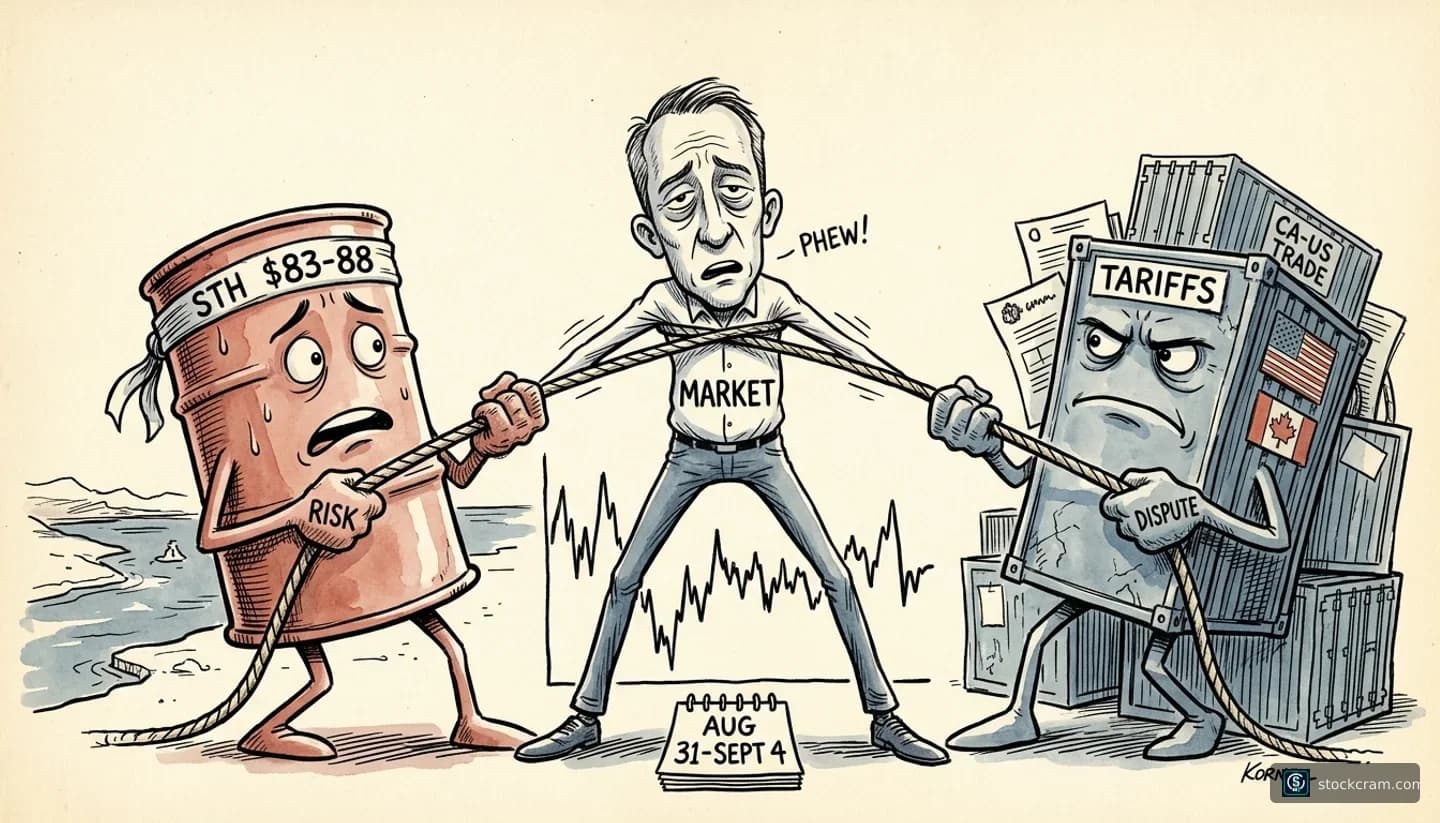
The Strait of Hormuz has been effectively closed by Tehran since the fighting began in late February, despite US President Donald Trump's repeated insistence that it is open and in Washington's control. Negotiators from Iran and Oman are working on a governance deal for the waterway. Brent crude, the international benchmark for oil, dipped significantly to $88 a barrel on Wednesday following news of progress in the Iran-Oman deal.
Market Relevance
The Strait of Hormuz typically carries approximately 20% of the world's oil supply. Historically, disruptions to major oil chokepoints have led to elevated energy prices and heightened inflation concerns. The International Energy Agency warned Wednesday that the reopening of the vital waterway is becoming more pressing, as the world burns through its oil stockpiles at a rapid pace. US officials are also forecasting higher oil and gas prices as traffic through the strait remains low.
Yes—the situation remains fluid with ongoing negotiations and potential for further escalation or de-escalation
Announced August 22-25, 2026; effective September 8, 2026
On Tuesday, the Canadian government said it would impose tariffs on 27.6 billion Canadian dollars, or $19.9bn, worth of US goods, matching 'dollar for dollar' the new US duties that Trump imposed. The counter-tariffs will impact more than 700 products, the government said in a statement, and will target the steel and aluminium, dairy, appliances, agricultural equipment, pulp and paper, plastics and electronics sectors. The counter-tariffs take effect on U.S. goods from September 8 and will impose duties of 15%, 25% and 50% across 700 products imported from south of the border.
Market Relevance
Trade disputes between the U.S. and major partners have historically created uncertainty for multinational corporations and affected supply chains. Markets typically react to tariff announcements based on their potential impact on corporate earnings and economic growth. Markets will position during the week ending September 4.
Yes—the tariffs represent an escalation in the U.S.-Canada trade dispute with potential for further retaliation
Friday, August 28, 2026
Fed Chair Kevin Warsh's speech at Jackson Hole on Friday was hawkish. He declined to offer forward guidance, saying he's 'committed to a discipline, not a decision.' He said this summer's better-than-expected inflation prints don't yet show that underlying trends have meaningfully improved, and that he'd be 'hard pressed to describe broad financial conditions as 'restrictive.'
Market Relevance
Fed Chair speeches at Jackson Hole have historically been closely watched for policy signals. The 10-year US Treasury yield climbed to 4.73% after Fed Chair Kevin Warsh warned that inflation has not meaningfully slowed, signaling that policymakers may have 'work to do' to bring price pressures back to the Fed's 2% target. In his first major speech since taking the chair in May, Warsh reiterated that 2% inflation is a firm and fixed objective and said financial conditions are not currently restrictive.
Yes—the speech has shifted market expectations toward a potential September rate hike
The ISM Manufacturing PMI provides insight into the health of the manufacturing sector, which accounts for about 18% of U.S. GDP. A reading above 50 indicates expansion, while below 50 signals contraction. The report includes sub-indices for new orders, production, employment, and prices paid.
U.S. ISM manufacturing and services data will test whether economic growth remains strong enough to support further Federal Reserve tightening. Manufacturing data has historically been watched closely as an indicator of broader economic momentum, particularly in the context of trade tensions and supply chain dynamics.
The Job Openings and Labor Turnover Survey tracks the number of job openings, hires, and separations. It provides context for the labor market beyond the monthly payroll numbers and is watched closely by the Federal Reserve for signs of labor market tightness.
JOLTS data has gained prominence as a key indicator of labor demand. The sequencing matters for the Fed outlook: ISM manufacturing, JOLTS, ADP, and Challenger all print before the jobs report, a run that has tended to pre-position the market so that payrolls confirm or correct rather than surprise from a flat base.
On Wednesday, September 2, 2026, the Bank of Canada will announce its decision on the target for the overnight rate. The central bank has held rates at 2.25% for six consecutive meetings. The Bank of Canada rate decision on September 2 is the week's most important domestic event, particularly for banks, REITs, utilities and the Canadian dollar.
Central bank decisions in major economies are closely watched for their impact on currency markets and cross-border capital flows. The BoC and RBNZ announcements landing on the same session invites the usual cross-rate treatment: CAD and NZD typically trade off the relative tone of the two statements rather than either decision in isolation.
The RBNZ meets on 2 September 2026 for its Monetary Policy Statement — markets currently price roughly even odds of a hold, further hike or even a cut following the July hike to 2.50%. After hiking the OCR 25bp to 2.50% in July — with a committee split 3-3 and Governor Breman casting the deciding vote — the RBNZ itself signalled that future moves are firmly data-dependent.
The RBNZ's July decision was decided by the governor's tie-breaking vote, reflecting deep uncertainty about the appropriate policy stance. Markets watch for any shift in tone that could signal the direction of future moves.
The ADP National Employment Report estimates private-sector payroll changes and is released two days before the official Bureau of Labor Statistics employment report. While not always predictive of the official number, it provides an early read on labor market trends.
The ADP report is part of the pre-jobs report data flow that helps markets calibrate expectations. Given July's weak official payroll print of 23,000, this week's ADP number will be watched for signs of whether that weakness was an anomaly or the start of a trend.
The ISM Services PMI tracks activity in the services sector, which accounts for approximately 80% of U.S. GDP. The PMI assesses the state of the US services sector, accounting for about 80% of US GDP. Therefore, the publication of the services sector data significantly impacts the US dollar.
Services data has taken on increased importance as the sector represents the bulk of economic activity. A reading above 50 indicates expansion. The July reading was 54.1, continuing a string of expansionary readings.
The monthly employment report includes nonfarm payrolls, the unemployment rate, average hourly earnings, and labor force participation. The main focus will be Friday's US employment report for August. Following the disappointing July figures and downward revisions to the previous three months' data, the report will be particularly important for the US dollar and a wide range of markets, including stock indices, commodities, cryptocurrencies, and currency pairs.
July's nonfarm payrolls fell 23,000, dragging the three-month average down to 20,000. The weak July print and subsequent Fed Chair Warsh comments have elevated the importance of the August data for gauging whether the labor market is cooling or if July was an outlier.
Fedspeak continues this week, with Governor Barr (Tue) and Governor Waller (Thu) likely to weigh in on the issues discussed by Warsh. Fed Governor speeches provide additional context on how policymakers are thinking about economic conditions and the appropriate path for interest rates.
Fed officials' speeches in the weeks following Jackson Hole and before the next FOMC meeting are closely monitored for any shifts in tone or new information that could affect rate expectations.
Waller's Thursday slot is notable given his prior form on labour-market framing directly ahead of the employment report. Governor Waller has been an influential voice on the committee, and his comments on labor markets ahead of the Friday jobs report will be parsed for policy signals.
Waller has previously given important speeches that helped frame how markets interpret economic data. His timing this week—speaking the day before the employment report—adds significance to his remarks.
The tail end of Q2 2026 earnings season brings several major technology companies reporting results, with particular focus on AI-related revenue growth. Broadcom's fiscal Q3 results on Wednesday are the week's most anticipated report.
Palo Alto Networks, Broadcom, MongoDB, Credo, and Snowflake report earnings this week, following the strong reception given to Nvidia, Salesforce, and CrowdStrike last week. Palo Alto Networks is a cybersecurity leader, and its results are watched for insights into enterprise IT spending trends.
Dell is a major provider of enterprise hardware and infrastructure solutions. The company's results provide insight into corporate IT spending and demand for AI-related infrastructure.
MongoDB provides database software and is viewed as a bellwether for cloud infrastructure spending. The company has been investing heavily in AI-related database capabilities.
Broadcom reports fiscal third-quarter 2026 earnings on Sept. 2 with analysts projecting EPS of $3.24 on revenue of $29.36 billion. The company carries a $60 billion reason for investors to believe in its AI trajectory: a bookings and backlog pipeline that has swelled beyond $30 billion entering the fiscal third quarter, with management guiding AI semiconductor revenue to $16 billion for the period. Broadcom is a major semiconductor and infrastructure software provider with significant exposure to AI infrastructure.
Snowflake provides cloud-based data warehousing and analytics. The company's results are watched for signs of enterprise data consumption trends and competition in the cloud analytics space.
Regional manufacturing survey that can provide early signals for the national ISM report
Another regional manufacturing indicator watched for trends in the sector
Final reading of the manufacturing purchasing managers index
Tracks spending on residential and nonresidential construction projects
Key gauge of manufacturing sector health; readings above 50 indicate expansion
Measures labor demand through job openings, hires, and separations data
Private-sector payroll estimate that precedes the official employment report
Canadian central bank policy decision with implications for the Canadian dollar and cross-border trade
Anecdotal report on economic conditions across Federal Reserve districts
Weekly measure of new unemployment insurance claims
Measures the difference between exports and imports of goods and services
Critical gauge of the services sector, which represents about 80% of U.S. GDP
Tracks announced corporate layoffs; can signal labor market trends
The most closely watched employment indicator; July's negative print has elevated focus on August data
Headline measure of labor market slack
Wage growth indicator watched closely by the Fed for inflation pressures
Canadian labor market data released simultaneously with U.S. report
3.50% - 3.75%
September 15-16, 2026
Federal funds rate futures now imply 2.4 rate increases over the next 12 months, up from 1.8 a week earlier, with odds of a September hike rising to about 60% from 35%. The shift follows Fed Chair Warsh's hawkish Jackson Hole speech and reflects increased concern that inflation is not cooling as quickly as hoped.
Tuesday, September 1
Eurozone inflation data provides context for global inflation trends and European Central Bank policy, which can affect currency markets and cross-border capital flows
Tuesday, September 1
Germany is Europe's largest economy; its consumer spending trends can signal broader European economic health
Wednesday, September 2
Australian economic data is watched as a proxy for China-linked commodity demand and Asia-Pacific economic trends
Friday, September 4
Consumer spending data from the eurozone provides insight into economic momentum in a major trading bloc
Ongoing through the week
Market participants will continue to monitor developments in the Middle East. Any breakthrough or setback in negotiations could significantly impact oil prices and inflation expectations
7,712
7,600-7,650 area has been noted by technical analysts as a potential support zone
7,800-7,850 represents recent highs that chartists are watching
26,402
26,000-26,200 has provided support in recent trading
26,800-27,000 represents overhead resistance from earlier in August
Technical analysis is one of many approaches used by market participants. The index is trading near the middle of its recent range as investors digest Fed policy signals.
Disclaimer: This week ahead preview is for educational purposes only and does not constitute investment advice. Scheduled events may be subject to change. Market reactions to events are unpredictable and past patterns do not guarantee future results. Always consult with a qualified financial advisor before making investment decisions.