
Market Analysis
Markets This Week: Oil Spike, Tech Selloff
Read Article
Market Analysis
AI-powered insights into global financial markets
 StockCram Editorial8 min read
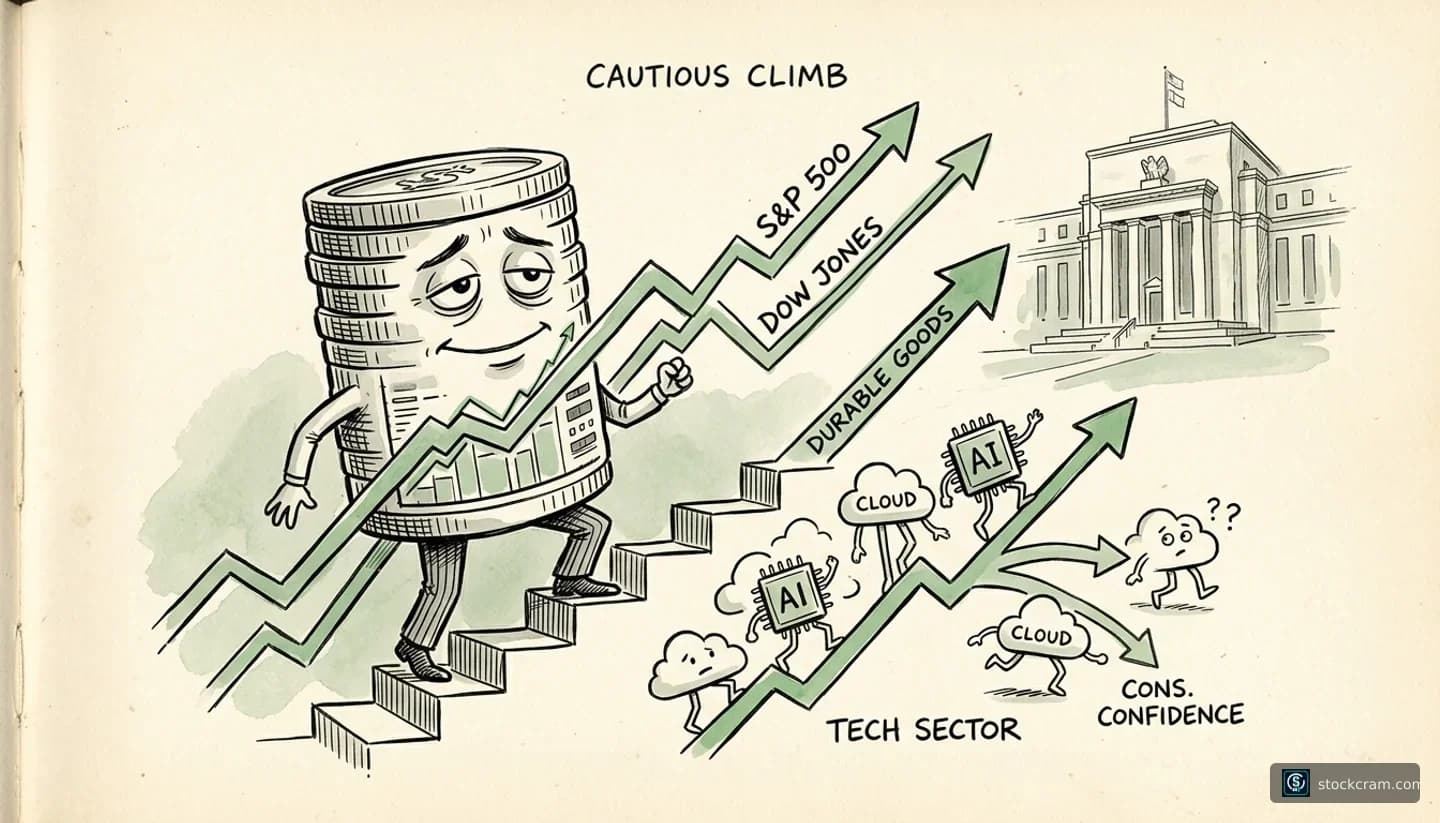
Markets climbed as Fed signals cautious optimism while tech earnings delivered mixed results amid shifting economic data.
Week of Monday, August 24, 2026 - Friday, August 28, 2026
+1.4%
5,648.25
+1.8%
17,925.50
+0.9%
41,235.75
+2.1%
2,185.40
14.8
-4.5%
4.28%%
+0.06%
$$81.25
+4.2%
$$2,485
+1.1%
101.5
-0.6%
Federal Reserve officials speaking throughout the week emphasized their commitment to monitoring incoming economic data before making further policy adjustments. Multiple Fed governors noted that while inflation has moderated from peak levels, they remain vigilant about ensuring price stability while supporting maximum employment. The commentary suggested policymakers are comfortable with the current stance but haven't committed to a specific path forward.
Markets interpreted the Fed's cautious tone as supportive, with bond yields stabilizing and equities advancing on expectations that the central bank won't aggressively tighten policy in the near term.
Earnings reports from major technology companies revealed a widening gap between enterprise-focused businesses and consumer-facing platforms. Cloud infrastructure and AI-related companies reported strong demand and expanding margins, while social media and consumer internet companies faced advertiser budget constraints and competitive pressures. This divergence highlighted how different segments of the tech sector are experiencing distinct business cycles.
Investors showed selectivity within technology, rotating toward companies with enterprise exposure and away from consumer-dependent platforms, contributing to increased dispersion in stock performance within the sector.
The week's economic data releases presented conflicting signals about the economy's trajectory. While manufacturing data showed resilience with durable goods orders beating forecasts, consumer confidence metrics declined more than expected. Housing data also showed signs of stabilization but remained below year-ago levels. Economists noted that this mixed data complicates the outlook for both growth and monetary policy.
The conflicting data contributed to range-bound trading in certain sectors as market participants debated whether the economy is experiencing a soft landing, continued expansion, or early signs of deceleration.
The Commerce Department reported that durable goods orders rose 3.2% in July, significantly exceeding the consensus forecast of 1.5%. The increase was broad-based, with strength in both transportation equipment and core capital goods, suggesting continued business investment appetite. Excluding volatile aircraft orders, core orders still advanced 1.8%.
Industrial stocks rallied on the news, with the sector posting its best day of the week. Treasury yields ticked higher as the data supported the narrative of economic resilience.
Optimistic analysts viewed the strong orders data as evidence that businesses remain confident in the economic outlook and are willing to invest in productive capacity, which could support earnings growth across manufacturing and industrial sectors.
Cautious observers noted that order backlogs have been declining and questioned whether the July surge represents sustainable momentum or a temporary bounce, particularly given ongoing concerns about commercial construction and potential inventory adjustments.
The Conference Board's Consumer Confidence Index dropped to 98.5 in August from 103.2 in July, marking the largest monthly decline since early 2026. The expectations component showed particular weakness, with consumers expressing increased concern about future business conditions and labor market prospects. Present situation assessments also softened but remained relatively elevated.
Consumer discretionary stocks declined on the report, with retailers and restaurant chains experiencing selling pressure. However, the broader market shrugged off the data as investors focused on other factors.
Some market participants noted that consumer confidence surveys can be influenced by political and media sentiment and don't always correlate directly with spending behavior, pointing to still-healthy employment levels and wage growth as supporting actual consumption.
Skeptical analysts emphasized that weakening confidence often precedes changes in spending patterns, particularly for big-ticket items, and suggested the decline could signal emerging cracks in the consumer sector that has been a pillar of economic strength.
A leading cloud infrastructure company reported quarterly results that exceeded analyst expectations on both revenue and earnings, with cloud services revenue growing 28% year-over-year. The company raised full-year guidance, citing accelerating enterprise adoption of AI-powered services and continued migration of workloads to the cloud. Management highlighted that AI-related revenue is becoming a meaningful contributor to growth.
Shares of the company surged 8% following the announcement, lifting other cloud and enterprise software stocks. The report reinforced investor enthusiasm for AI infrastructure investments.
Optimistic analysts pointed to the strong results as validation of the substantial capital investments being made in AI infrastructure, noting that enterprise customers are moving beyond experimentation to production deployments, which could drive multi-year growth.
Cautious observers questioned the sustainability of current growth rates and noted that competition is intensifying, which could pressure margins over time. Some also expressed concern about the high valuations being assigned to companies in the space relative to historical norms.
Energy stocks posted their strongest weekly performance in two months as crude oil prices advanced on reports of potential supply disruptions and declining U.S. inventory levels. OPEC+ members signaled their commitment to current production quotas, while unexpected maintenance issues at several Gulf Coast refineries tightened product markets. The Energy Information Administration reported a larger-than-expected draw in crude inventories.
The energy sector outperformed the broader market, with exploration and production companies leading gains. Oil services firms also advanced on expectations of sustained activity levels.
Proponents of energy investments noted that global demand remains resilient while supply discipline from major producers could support prices, potentially leading to improved cash flow generation and shareholder returns for energy companies.
Skeptics cautioned that economic uncertainty could dampen demand growth, while increased U.S. production capacity and potential resolution of geopolitical tensions could weigh on prices, limiting upside for energy equities.
Rising crude oil prices on supply concerns and inventory draws lifted exploration, production, and services companies across the sector.
Strong earnings from cloud infrastructure providers and enterprise software companies drove gains, though performance was uneven within the sector.
Banks and asset managers advanced as <a href="/learn/terms/federal-reserve">interest rate</a> expectations stabilized and loan demand showed signs of improvement in regional bank commentary.
Declining consumer confidence and weak results from several retail chains weighed on the sector, with particular pressure on non-essential goods retailers.
Commercial real estate concerns and mixed signals on residential markets kept the sector under pressure despite relatively stable bond yields.
The defensive sector posted minimal gains as investors favored growth-oriented areas of the market, though dividend-focused investors provided some support.
The energy sector ETF rallied alongside crude oil prices as supply concerns and inventory draws supported energy stocks across the exploration, production, and services segments.
Semiconductor stocks rebounded on optimism about AI chip demand and improving supply chain dynamics, with several component makers reporting better-than-expected order trends.
Small-cap stocks outperformed as investors rotated into domestically-focused companies, benefiting from dollar weakness and expectations of stabilizing regional economic conditions.
Retail stocks declined following the weak consumer confidence report and disappointing results from several chains that cited traffic softness and promotional pressure.
Utility stocks lagged as investors favored growth-oriented sectors over defensive areas, though the decline was modest compared to broader market gains.
Real estate investment trusts faced headwinds from persistent concerns about commercial property fundamentals and mixed signals from residential markets.
Expected: +1.5% expected
The stronger-than-expected reading suggested continued business investment appetite and manufacturing resilience, supporting the case for economic expansion and benefiting industrial sector stocks.
Expected: 101.0 expected
The decline raised questions about consumer spending momentum heading into the fall, though analysts noted that actual spending data has been more resilient than sentiment surveys.
Expected: 705,000 expected
The modest beat indicated stabilization in housing demand despite elevated mortgage rates, providing some support for homebuilders and related sectors.
Expected: 235,000 expected
Claims remained near historically low levels, reinforcing the narrative of a tight labor market and reducing concerns about imminent labor market deterioration.
The current market environment shares similarities with late summer periods in previous expansion cycles, characterized by modest gains, relatively low volatility, and investor focus on parsing mixed economic signals. The divergence between strong manufacturing data and softer consumer sentiment echoes patterns seen in 2018 and 2019, when markets navigated uncertainty about economic momentum.
Historical analysis suggests that periods of mixed economic data often lead to increased market sensitivity to upcoming releases, particularly employment reports and Fed communications. Past cycles have shown that markets can maintain upward trends during such periods if corporate earnings remain resilient and recession fears stay contained, though volatility tends to increase as investors debate the sustainability of growth. Understanding risk management principles becomes particularly relevant during these transitional periods.
Disclaimer: This weekly recap is for educational purposes only and does not constitute investment advice. Past performance is not indicative of future results. Always consult with a qualified financial advisor before making investment decisions.