
Market Analysis
Markets This Week: Oil Spike, Tech Selloff
Read Article
Market Analysis
AI-powered insights into global financial markets
 StockCram Editorial4 min read
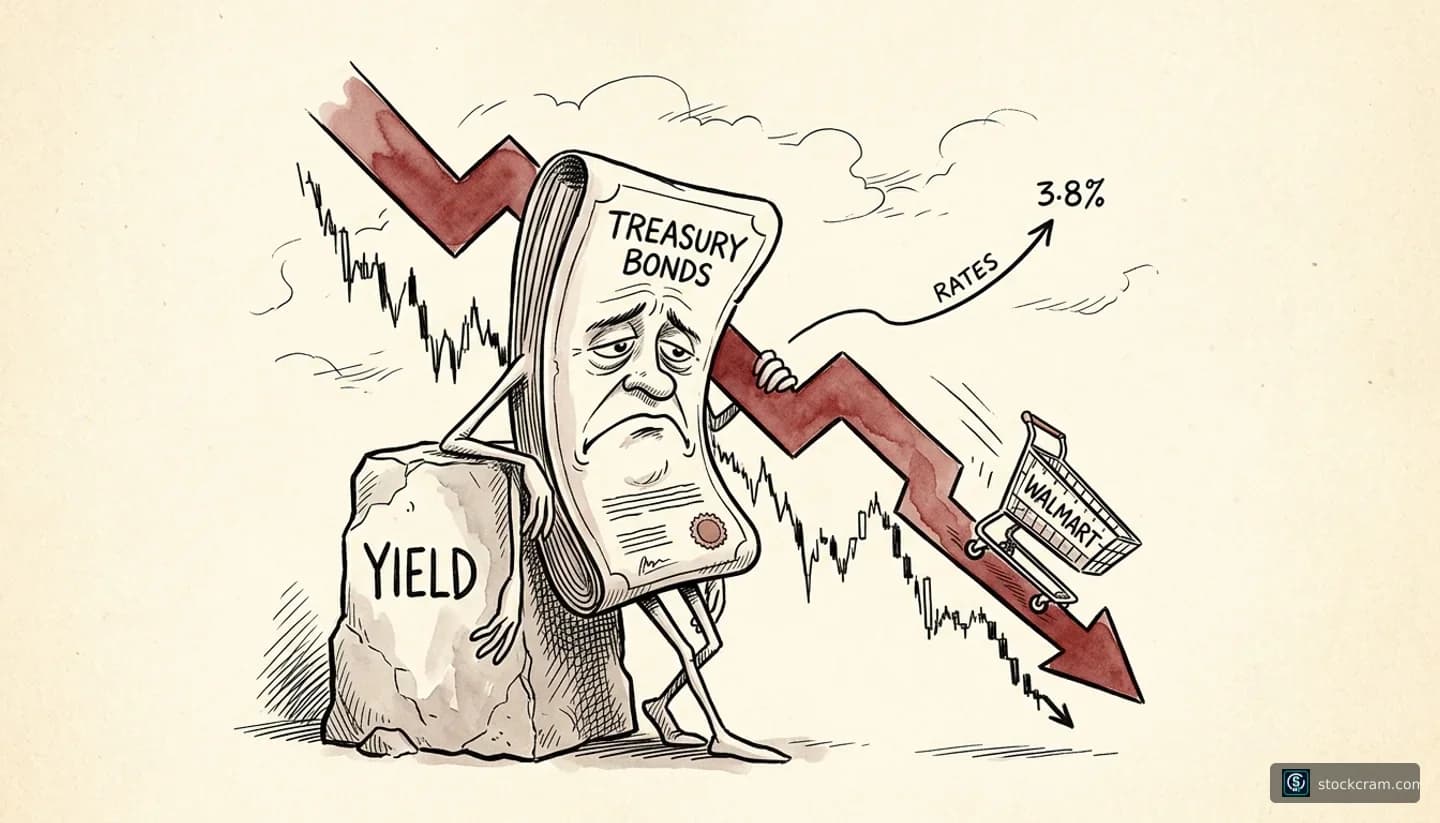
Markets tumble as Treasury's $4B bond buyback fails to calm yields. Walmart posts slowest sales in 6 years while Iran tensions push oil near $88.
Educational purposes only. This content does not constitute investment advice. Read our disclaimer
StockCram is not a broker-dealer, investment adviser, or financial institution. All content is for educational and informational purposes only and should not be construed as personalized investment advice. Consult a qualified financial professional before making investment decisions. Past performance does not guarantee future results.The Treasury Department announced Wednesday it would double its buyback of long-term government debt from $2 billion to at least $4 billion per operation, targeting the 10- to 30-year segment. Bond yields initially dropped sharply on the news, but by Thursday the rally had completely reversed. The 30-year Treasury yield climbed back to 5.25% and the 10-year to 4.70%, erasing Wednesday's gains as investors questioned whether the buyback addresses the root problem of surging government debt, which recently topped $40 trillion. Understanding why stocks react to rising interest rates is crucial in this environment.
The failed rally signals that markets view Treasury's intervention as a temporary band-aid rather than a cure for fiscal concerns. Rising long-term yields threaten to choke off the bull market by making borrowing more expensive for consumers and businesses, while also pressuring stock valuations as the risk-free rate climbs. When bond yields surge like this, the discount rate used to value future corporate earnings rises, mechanically pulling stock prices down.
Equities
S&P 500 down 0.9%, Dow fell 700 points
Rates
10-year yield climbed back to 4.70%, 30-year hit 5.25%
FX
Dollar weakened initially but volatility remains high
Commodities
Flight to safety limited as fiscal concerns dominate
Walmart reported second-quarter earnings Thursday morning that beat on the bottom line with 81 cents per share versus 74 cents expected, but U.S. same-store sales rose just 2.6%, missing the 3.5% Wall Street forecast and marking the slowest quarterly growth in more than six years. The company cited an 80 basis point headwind from its pharmacy business. Despite raising full-year guidance and announcing a $2.9 billion tariff refund it plans to pass through to customers via lower prices, shares plunged about 9-10%.
Walmart is a bellwether for the U.S. consumer and the broader economy. The sales miss raises red flags about spending power as inflation and higher borrowing costs bite. When even the low-price leader struggles to grow sales, it suggests consumers are tightening their belts, which could ripple through the economy and corporate earnings expectations. This kind of weakness can trigger panic selling behavior as investors reassess growth assumptions.
Equities
Consumer discretionary sector under pressure, retail stocks fell
Rates
Reinforces soft economic growth narrative
FX
Limited direct impact
Commodities
Signals weaker consumer demand
Oil prices climbed Thursday after Treasury Secretary Scott Bessent told CNBC the U.S. will impose the toughest sanctions in history against Iran and maintain the naval blockade. Brent crude futures rose to around $88 per barrel while WTI topped $87. The hawkish comments came after a 60-day U.S.-Iran negotiating period expired with no deal, and President Trump said no new talks with Tehran are planned. The ongoing conflict has kept the Strait of Hormuz under pressure and U.S. Strategic Petroleum Reserve levels at their lowest since 1983.
Higher oil prices feed directly into inflation, threatening to keep consumer prices elevated and limiting the Federal Reserve's ability to cut interest rates. Energy costs also act as a tax on consumers and businesses, reducing spending power elsewhere in the economy. With inflation expectations already rising to 4.3% from 4.2%, persistent oil strength could derail the bull market. The geopolitical risk premium embedded in oil prices can evaporate quickly if tensions ease, but for now it's adding upward pressure.
Equities
Energy sector outperforms, but higher oil weighs on broader market
Rates
Adds to inflation concerns, complicates Fed policy
FX
Pressure on currencies of oil-importing nations
Commodities
Brent crude near $88, WTI above $87
The Federal Reserve kept the federal funds rate at 3.5% to 3.75% at its July meeting, with Chair Kevin Warsh maintaining a cautious stance. Policymakers noted solid economic activity but somewhat elevated inflation, with the implications of the Iran conflict remaining uncertain. The Fed still expects one rate cut this year and another in 2027, but the timing is unclear. Market pricing now points to a potential December hike rather than a cut, reflecting concerns about persistent inflation. For context on Warsh's approach, see our analysis of Kevin Warsh's first Fed meeting.
The Fed's on-hold status means borrowing costs will stay elevated for longer, pressuring both consumers and corporations. With inflation running at 2.7% on the PCE measure and oil prices climbing, the central bank has little room to ease policy even as economic growth shows signs of cooling. This creates a challenging environment for stocks, which have been priced for eventual rate relief. The disconnect between what markets hoped for and what the Fed delivered is forcing a repricing across asset classes.
Equities
Removes near-term rate cut hopes, pressures valuations
Rates
Fed funds rate unchanged, but market pricing in December hike
FX
Dollar supported by steady policy stance
Commodities
Stable policy keeps commodities range-bound
Similar to the 2018 'taper tantrum' when Treasury yields spiked on concerns about Fed balance sheet reduction and fiscal deficits, today's yield surge reflects worries about the government's ability to manage $40+ trillion in debt.
In 2018, the S&P 500 fell nearly 20% from peak to trough as yields climbed and growth slowed. Markets only stabilized once the Fed pivoted to a more dovish stance in early 2019, signaling a pause in rate hikes.
The biggest wildcard is whether Treasury yields stabilize or continue climbing, which depends on investor confidence in U.S. fiscal policy. Iran conflict resolution timing remains highly unpredictable and could swing oil prices sharply in either direction. Consumer spending strength is also unclear—Walmart's miss could be company-specific or signal broader weakness.