
Market Analysis
Markets This Week: Oil Spike, Tech Selloff
Read Article
Market Analysis
AI-powered insights into global financial markets
 StockCram Editorial4 min read
Markets brace for Fed minutes as bond yields hit 19-year highs and chip stocks crater. Here's what investors need to know about today's key events.
Educational purposes only. This content does not constitute investment advice. Read our disclaimer
StockCram is not a broker-dealer, investment adviser, or financial institution. All content is for educational and informational purposes only and should not be construed as personalized investment advice. Consult a qualified financial professional before making investment decisions. Past performance does not guarantee future results.The Federal Reserve releases minutes from its July 28-29 meeting at 2:00 PM ET today. The meeting produced a rare 9-3 vote to hold rates at 3.5%-3.75%, with three regional Fed presidents pushing for a quarter-point hike—the first three-way dissent since September 2016. Markets are scrutinizing the minutes for clues on whether the Federal Reserve will raise rates at its September meeting or hold steady into 2027.
The minutes could shift market expectations dramatically. If the dissenting view gains traction, traders may price in higher odds of a September hike, pushing bond yields even higher and pressuring stocks. With inflation still above the Fed's 2% target and oil prices elevated due to Middle East tensions, the central bank faces a tough balancing act between controlling prices and supporting growth.
Equities
Downward pressure if Fed signals more tightening ahead
Rates
Yields could spike further if minutes reveal broad support for hikes
FX
Dollar strength if hawkish tone prevails; weakness if dovish
Commodities
Gold weakens on hawkish Fed; oil steady amid Iran tensions
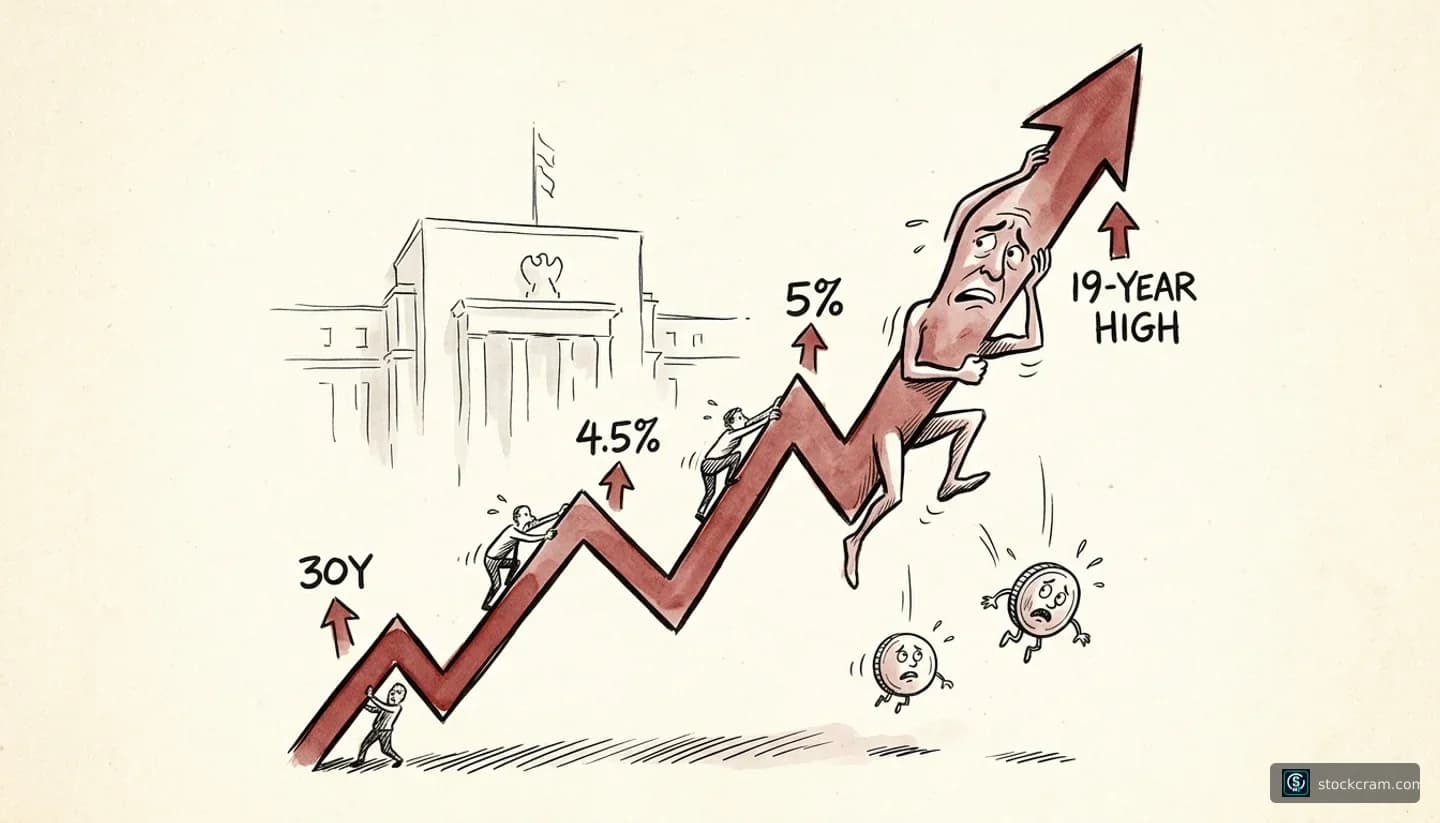
The U.S. 30-year Treasury yield climbed to a fresh 19-year high on Tuesday, surpassing 5.33% before pulling back slightly. The surge reflects mounting worries about the U.S. fiscal deficit—which hit its highest monthly total since March 2021 in July—and persistent inflation driven by elevated oil prices from the ongoing Strait of Hormuz crisis. Global government bond yields also spiked, with Japan's 10-year reaching a three-decade high and Germany's 30-year hitting levels not seen since 2011.
Rising long-term rates increase borrowing costs for businesses and consumers, potentially slowing economic growth. For equity investors, higher yields make bonds more attractive relative to stocks, compressing valuations especially for growth companies. The move also signals bond market skepticism about the government's ability to manage its debt load while inflation remains sticky.
Equities
Negative for stocks as borrowing costs rise and valuations compress
Rates
Long-end yields surging; 30-year topped 5.33% on Tuesday
FX
Dollar mixed as higher yields attract foreign capital but growth concerns linger
Commodities
Pressure on non-yielding assets like gold; minimal impact on oil
Semiconductor stocks extended their brutal selloff overnight, with South Korean shares dropping 5.5% and chip giants Samsung and SK Hynix both falling over 7%. Memory chip makers were hit hardest—Western Digital, Sandisk, and Seagate each lost 7-9% on Tuesday. The Nasdaq Composite fell 1.3%, posting its third straight losing session, while the S&P 500 declined 0.7% to 7,691.76. Asian markets opened sharply lower Wednesday, with Kioxia plunging 9% in Tokyo.
The chip selloff reflects growing investor anxiety about whether massive AI infrastructure spending can deliver near-term returns. With elevated bond yields raising the cost of capital and geopolitical uncertainty from the Iran conflict adding pressure, traders are rotating out of 2026's best-performing sector. This matters because semiconductors have been a key pillar supporting the broader market rally—their weakness could signal a broader correction ahead. Investors wondering whether we're in an AI bubble are watching these moves closely.
Equities
Tech-heavy Nasdaq down 1.3%; Asian chips fell 5-9% overnight
Rates
Flight to safety could support Treasuries despite recent selloff
FX
Yen and won weaken as Asian tech exporters suffer
Commodities
Minimal direct impact; reflects broader risk-off sentiment
Oil prices rebounded from early August lows as hopes for reopening the Strait of Hormuz faded. West Texas Intermediate crude hovered near $84 per barrel while Brent traded around $91 on Tuesday. President Trump said he doesn't see the U.S.-Iran war ending soon and threatened military action against Oman if it interferes with the strait. Iran's foreign minister stated the waterway won't reopen until the U.S. lifts its blockade, creating a deadlock that has kept shipping traffic at a fraction of pre-conflict levels.
The Strait of Hormuz handles about one-fifth of global oil supplies, and its effective closure since late February has been the largest energy disruption in recorded history. Higher oil prices feed directly into inflation, complicating the Fed's job and keeping pressure on consumers already squeezed by elevated interest rates. If the conflict escalates further or drags on, energy analysts warn Brent could spike toward $100 or higher. Understanding how geopolitical risk affects oil and stocks is crucial for navigating this environment.
Equities
Negative for consumer discretionary; positive for energy sector
Rates
Higher oil feeds inflation expectations, supporting hawkish Fed stance
FX
Oil-linked currencies like Canadian dollar under pressure
Commodities
WTI near $84/barrel, Brent around $91; up from early August lows
The last time three FOMC members dissented in the same direction was September 2016, when three regional Fed presidents wanted to hold rates steady while the majority voted to keep them unchanged. That period preceded a December 2016 rate hike.
Markets initially sold off on the hawkish dissent signal, but eventually stabilized as investors gained clarity on the Fed's path. The key difference today is that inflation is running well above target (versus near-target in 2016) and geopolitical risks are elevated, making the Fed's balancing act far more precarious.
The FOMC minutes could surprise markets in either direction depending on how much support the dissenting hawks had. Additionally, geopolitical developments in the Middle East remain highly unpredictable and could shift oil prices—and inflation expectations—rapidly. Finally, it's unclear whether the semiconductor selloff represents a healthy correction or the start of a broader tech unwind.