
Market Analysis
Markets This Week: Oil Spike, Tech Selloff
Read Article
Market Analysis
AI-powered insights into global financial markets
 StockCram Editorial4 min read
Bond yields hit 19-year highs while markets brace for Nvidia earnings and Fed Chair Kevin Warsh's first major Jackson Hole speech.
Educational purposes only. This content does not constitute investment advice. Read our disclaimer
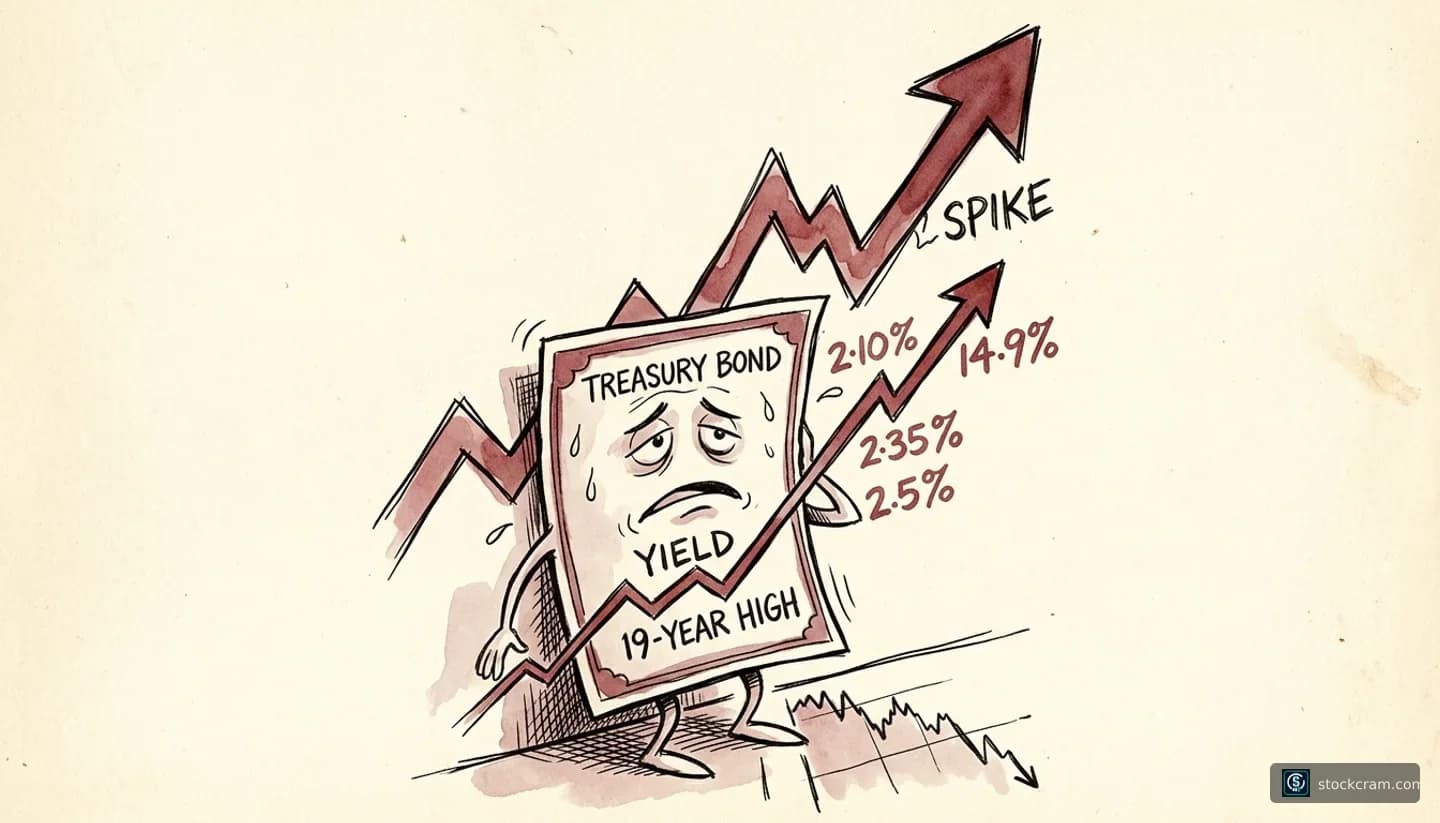
StockCram is not a broker-dealer, investment adviser, or financial institution. All content is for educational and informational purposes only and should not be construed as personalized investment advice. Consult a qualified financial professional before making investment decisions. Past performance does not guarantee future results.Long-dated Treasury bonds are selling off hard, with the 30-year yield breaking above 5.3% for the first time in nearly two decades. The selloff comes despite Treasury Secretary Scott Bessent's surprise announcement to double bond buybacks starting in September. Inflation concerns tied to the Middle East conflict and massive government borrowing are driving yields higher, putting pressure on stocks.
When long-term borrowing costs spike this fast, everything gets repriced. Mortgage rates are climbing, corporate borrowing becomes more expensive, and stocks lose their appeal versus bonds. This is the bond market telling the Fed and the White House that inflation isn't under control—and that matters more than any policy announcement. Understanding why stocks can still rise when rates are high becomes critical in this environment.
Equities
S&P 500 down 1.4% for the week, Nasdaq fell 2%
Rates
30-year Treasury yield topped 5.3%, highest since 2007
FX
Dollar steady as higher yields offset risk-off sentiment
Commodities
Oil under pressure from demand concerns, gold rises as hedge
Treasury Secretary Scott Bessent announced the U.S. will unveil what he calls 'the single greatest financial offensive ever' against Iran on Monday afternoon. The sanctions package aims to choke off Tehran's revenue streams as a six-month Middle East conflict drags on without resolution. Iran has threatened to seize ships in the Strait of Hormuz in response, raising fears about oil supply disruptions.
About 20% of the world's oil passes through the Strait of Hormuz. If Iran follows through on threats to disrupt shipping, oil prices could spike sharply, feeding directly into inflation and forcing the Fed's hand. Markets hate geopolitical uncertainty, and this adds another layer of risk heading into a week already packed with Nvidia earnings and Jackson Hole. Investors wondering whether to sell stocks during war should understand the historical context.
Equities
Energy sector gains, broader market cautious on geopolitical risk
Rates
Oil price volatility could feed into inflation expectations
FX
Potential dollar strength if sanctions disrupt global trade flows
Commodities
Oil prices elevated on Strait of Hormuz concerns
Nvidia reports Q2 fiscal 2027 results after the close on Wednesday, August 26. Wall Street expects revenue around $28.7 billion, up over 50% year-over-year, driven by insatiable demand for AI chips. The stock is up 17.7% year-to-date but has underperformed the broader market recently. Any hint that AI spending is slowing could trigger a sharp selloff across the semiconductor sector.
Nvidia isn't just another tech stock—it's the bellwether for the entire AI investment theme. With tech stocks accounting for over a third of the S&P 500's weight, a miss here could ripple across the entire market. Investors are asking whether trillion-dollar AI infrastructure spending is sustainable or a bubble waiting to pop.
Equities
Nasdaq heavily exposed; Nvidia results could move S&P 500 by 1%+
Rates
Tech selloff could accelerate if guidance disappoints
FX
Risk sentiment hinges on AI spending validation
Commodities
Little direct impact unless broader risk-off triggers flight to safety
Fed Chair Kevin Warsh will deliver his first keynote address at Jackson Hole on Friday, August 28, just 19 days before the September FOMC meeting. Warsh, who took over in May, has deliberately pulled back on forward guidance, leaving markets guessing. With inflation still above the Fed's 2% target and bond yields surging, investors are desperate for clarity on whether the Fed will hike rates again or pause.
New Fed chairs often use Jackson Hole to set the tone for their tenure. Warsh has a reputation as an inflation hawk from his previous time at the Fed, but his recent silence has markets on edge. At his first meeting in June, Warsh held rates but signaled a hawkish shift. If he signals concern about inflation, September rate hike odds will jump and stocks could tumble further. If he downplays risks, it could provide relief—but only if the bond market believes him.
Equities
Clarity on inflation fight would reduce uncertainty premium
Rates
Speech could shift September rate hike odds, currently one-in-three
FX
Hawkish tone could strengthen dollar; dovish pivot would weaken it
Commodities
Gold sensitive to real yield signals from Fed guidance
Samsung Electronics announced Friday it will return up to 110 trillion won ($80 billion) to shareholders in 2026, the largest shareholder return program in South Korean history. The move follows rival SK Hynix's $28.9 billion buyback earlier in the week. Despite the massive payout, Samsung shares fell as much as 6% on Monday as investors questioned the details and worried about slowing AI chip demand.
Samsung and SK Hynix supply the memory chips that power Nvidia's AI accelerators. Their willingness to return massive amounts of cash suggests they're confident in sustained AI demand—or that they see a peak coming and want to reward shareholders while cash flow is strong. The market's negative reaction hints at skepticism about whether the AI boom can last.
Equities
Korean tech stocks volatile; memory chip sector under pressure
Rates
Minimal direct impact on U.S. rates
FX
Korean won strengthened 1% on announcement
Commodities
Reflects broader AI infrastructure demand dynamics
In August 2007, the 30-year Treasury yield also spiked above 5% as subprime mortgage concerns began spreading. That bond selloff preceded the broader financial crisis by several months.
Markets initially shrugged off the yield spike, but within weeks credit markets froze and stocks entered a brutal bear market. Today's bond volatility may be an early warning sign that something deeper is wrong with fiscal or inflation dynamics.
We don't know if Nvidia will validate or deflate the AI spending narrative, whether Iran will escalate beyond threats, or if Warsh will finally give markets the clarity they're craving. Bond yields are screaming that something is broken, but it's unclear if it's inflation, fiscal policy, or just positioning ahead of a volatile week.