
Market Analysis
Markets This Week: Oil Spike, Tech Selloff
Read Article
Market Analysis
AI-powered insights into global financial markets
 StockCram Editorial4 min read
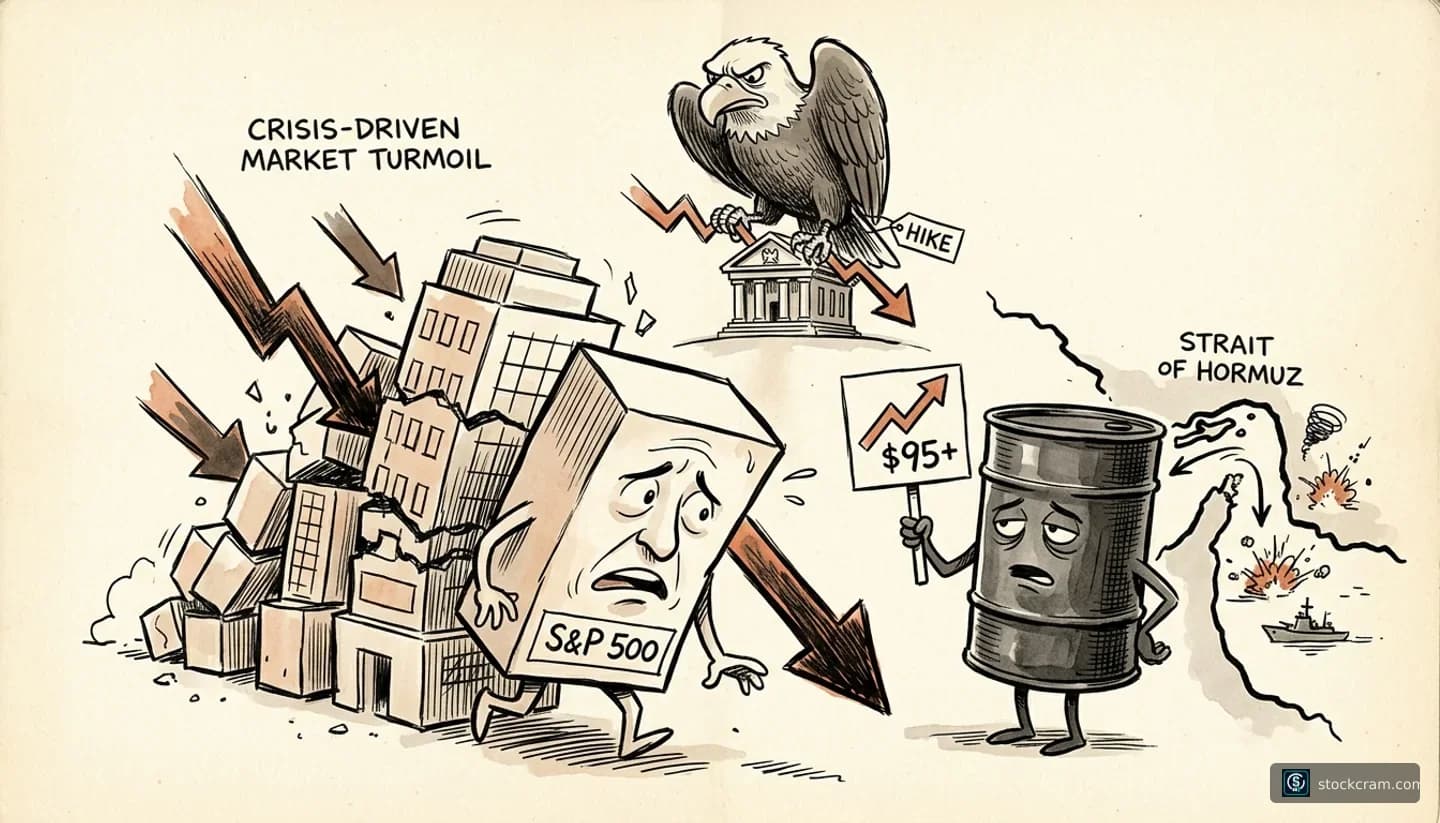
Markets tumble as US strikes Iran near Hormuz, oil spikes above $90, and Fed Chair Warsh's hawkish tone keeps rate-hike fears alive. Here's what investors need to know.
Educational purposes only. This content does not constitute investment advice. Read our disclaimer
StockCram is not a broker-dealer, investment adviser, or financial institution. All content is for educational and informational purposes only and should not be construed as personalized investment advice. Consult a qualified financial professional before making investment decisions. Past performance does not guarantee future results.The US military struck Iranian rocket launchers near the Strait of Hormuz on Sunday, ending weeks of relative calm in the region. Islamic Revolutionary Guard Corps forces were preparing to launch rockets with sea mines into the strait, according to US Central Command. Iranian media reported explosions near Larak Island, while the IRGC said several fighters and civilians had been killed or wounded. Iran's statement said the attack would "result in punishment of the aggressor".
The Strait of Hormuz is a critical chokepoint for global energy supplies—roughly 20% of the world's oil normally flows through it. Any escalation threatens supply chains and pushes oil prices higher, which feeds inflation fears and complicates the Fed's job. Markets hate uncertainty, and a renewed conflict here could derail the fragile economic recovery. Understanding how to respond to war headlines is crucial for investors navigating this volatility.
Equities
Asian markets down 0.5–1.1%, US futures down 0.3–0.4%
Rates
Bond yields edge higher on geopolitical risk
FX
Dollar gains on safe-haven demand
Commodities
Brent crude jumps 4.7% to $90+, WTI up 2%
Federal Reserve Chair Kevin Warsh said he was "impressed" with the economy's overall strength but is concerned by signs that "underlying trends" in inflation have not improved. "While this summer's [inflation] readings were better than expected, they do not tell me that underlying trends have meaningfully improved," Warsh said at the Jackson Hole symposium on Friday. Warsh avoided committing to forward guidance or a reaction function for monetary policy, leaving markets to interpret his remarks as hawkish.
Warsh's comments signal the Fed may not be done raising rates, even though many investors hoped for a pause or cuts later this year. Higher rates make borrowing more expensive for companies and consumers, slow economic growth, and pressure stock valuations—especially for high-growth tech firms. The lack of clear guidance also adds volatility, as traders are left guessing the Fed's next move. This hawkish stance directly impacts how stocks perform in a high-rate environment.
Equities
S&P 500 down 0.3% Friday, tech stocks lead losses
Rates
10-year Treasury yield rises, 30-year hits 19-year high
FX
Dollar posts biggest gain in a month
Commodities
Higher rates pressure gold and non-energy commodities
Brent crude rose to $90.69 per barrel on August 31, 2026, up 2.93% from the previous day. Global benchmark crude gained 2% at the open after the US military on Sunday struck Iranian rocket launchers that were preparing to send mines into the Strait of Hormuz. The spike comes after weeks of relative calm and follows the US completing mine-clearing operations in the strait's main shipping lanes last week. Around 6 to 8 million barrels of crude are still flowing through Hormuz each day despite the absence of a peace agreement.
Higher oil prices act like a tax on consumers and businesses—they push up costs for everything from gas at the pump to airline tickets and plastics. That makes inflation stickier and gives the Fed less room to cut rates. For investors, energy stocks benefit, but most other sectors suffer as profit margins shrink and consumer spending weakens. This oil shock could reverse recent geopolitical risk premium declines.
Equities
Energy stocks rally, broader indices under pressure
Rates
Inflation expectations tick up
FX
Petro-currencies strengthen, dollar gains
Commodities
Brent crude up 4.7% to $90.14, WTI up 2% to $85
Indian equity benchmark indices, the Sensex and Nifty, opened lower on Monday as renewed US-Iran military escalation revives concerns over global energy supplies, triggering a rebound in crude oil prices and prompting a broader risk-off tone across Asian markets. Japan's Nikkei 225 was down 735.56 points or 1.11 per cent to 65,670, while Hong Kong's Hang Seng dropped 173.79 points or 0.66 per cent. Stock futures fell early Monday after the US struck Iranian rocket launchers, with Dow Jones Industrial Average futures trading 155 points lower, or 0.29%, S&P 500 futures slipping 0.36%, and Nasdaq-100 futures losing 0.4%.
Asian markets often set the tone for US trading, and a broad selloff signals that global investors are nervous. The combination of geopolitical risk and hawkish Fed rhetoric creates a tough environment for stocks—especially in export-heavy economies like Japan and tech-focused markets like Taiwan. If this weakness persists, it could spill over into US markets and pressure already-jittery investors. This risk-off sentiment reflects broader market uncertainty.
Equities
Nikkei down 1.1%, Hang Seng down 0.7%, India's Sensex down 0.2%
Rates
Regional bond yields rise
FX
Asian currencies weaken vs. dollar
Commodities
Safe-haven gold gains modestly
In 2019–2020, tensions between the US and Iran spiked after the assassination of Qasem Soleimani, leading to attacks on oil tankers and brief spikes in crude prices above $70.
Markets initially sold off on fear, but oil prices retreated within weeks as supply disruptions proved limited. The S&P 500 recovered quickly, though energy stocks outperformed for months. The key lesson: geopolitical shocks often create short-term volatility but rarely derail long-term trends unless supply is genuinely cut off. Historical data shows that markets typically recover from war-related selloffs faster than investors expect.
Iran's next move is unpredictable—retaliation could escalate quickly or fizzle out. We also don't know if Warsh's hawkish tone translates into an actual September rate hike, or if softer economic data forces a pause. Oil flows through Hormuz remain fragile, and any disruption could send prices spiking again.